△ TruthInStone

Claims › Egypt: Sphinx & Giza dating › The Dendera 'light bulb' reliefs show ancient electric lamps

The Dendera 'light bulb' reliefs show ancient electric lamps

Status: Leading Edge Verdict: Measured: the captions carved beside the reliefs name each object as a gold or metal cult statue of the snake god Harsomtus, 3 palms to 1 cubit (about 22–52 cm) tall; no physical trace of electrical equipment has been reported
30-SECOND TAKEAWAY

In Plain English — The 30-Second Takeaway

What It Is:

Do wall carvings in the underground crypts at Dendera Temple in Egypt show ancient electric light bulbs?

What Everyone Agrees On (Measured Facts):

Carved around 50 BCE, the panels sit right beside hieroglyphic texts that name the material and height (22 to 52 cm) of each object.

🏛️ Mainstream Archaeology View:

Egypt scholars read the carved texts beside the art, which describe small gold statues of a snake god rising from a lotus flower.

🧭 Leading Edge View:

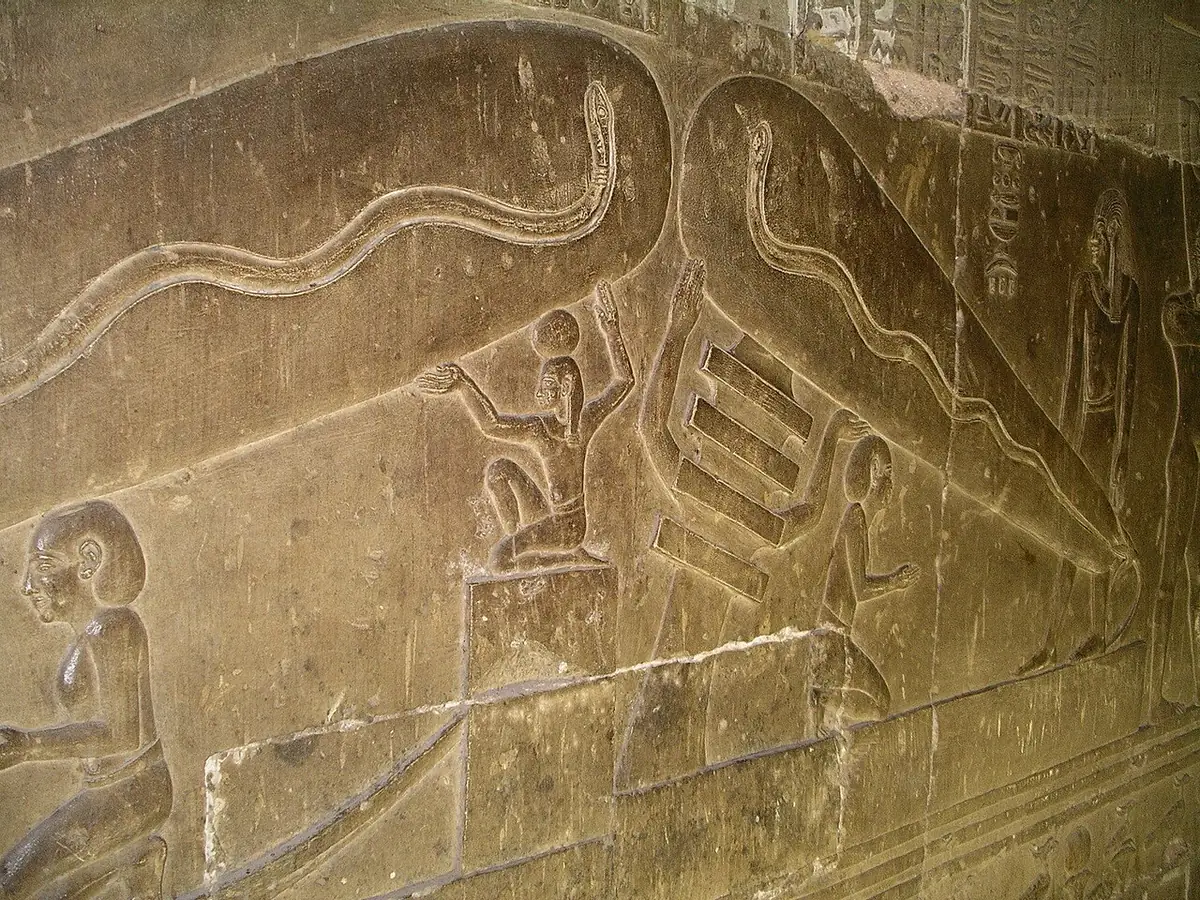
Other writers compare the oval carving, lotus stem, and pillar to a modern glass bulb, wire, and insulator.

Overview & Context

The Hathor temple at Dendera is late: the crypts carry the titles of Ptolemy XII, who reigned in the first century BCE, so the reliefs are roughly 2,100 years old. The 'light bulb' motif appears six times, three times in south crypt 1-C and three times in room G of the main temple.

▸ Read Technical Background, Full Claim Wording & Academic Literature History

Formal claim tested: Reliefs in the crypts of the Hathor temple at Dendera show electric lamps. In this reading the lotus flower is a socket, the snake is a filament, the bulb-shaped envelope is a glass tube and the djed pillar is an insulator, so the Egyptians had electric light.

Where the evidence stands: The reliefs are real and the resemblance to a lamp is striking. But each relief has a hieroglyphic caption, published in full, that names what is shown and gives its material and height. The captions describe statues of Harsomtus, a snake-shaped child god, rising from a lotus inside an oval container, made of gold, metal or precious stones. The crypt texts as a whole say these rooms stored cult images. The electrical reading rests on visual likeness and has no supporting text or object.

Peter Krassa and Reinhard Habeck popularised the electrical reading in 1982. The Egyptological reading comes from Wolfgang Waitkus, who edited the texts of the lower crypts in 1997 and studied these six objects in 2002. The temple's zodiac ceiling, now in the Louvre, is discussed under the Sphinx and Leo claim.

Relief in the Dendera crypt showing a large lotus-and-snake motif supported by a djed pillar
The relief in a crypt at the Temple of Hathor, Dendera. Image: Twthmoses (English Wikipedia), CC BY 2.5, via Wikimedia Commons. Resized.
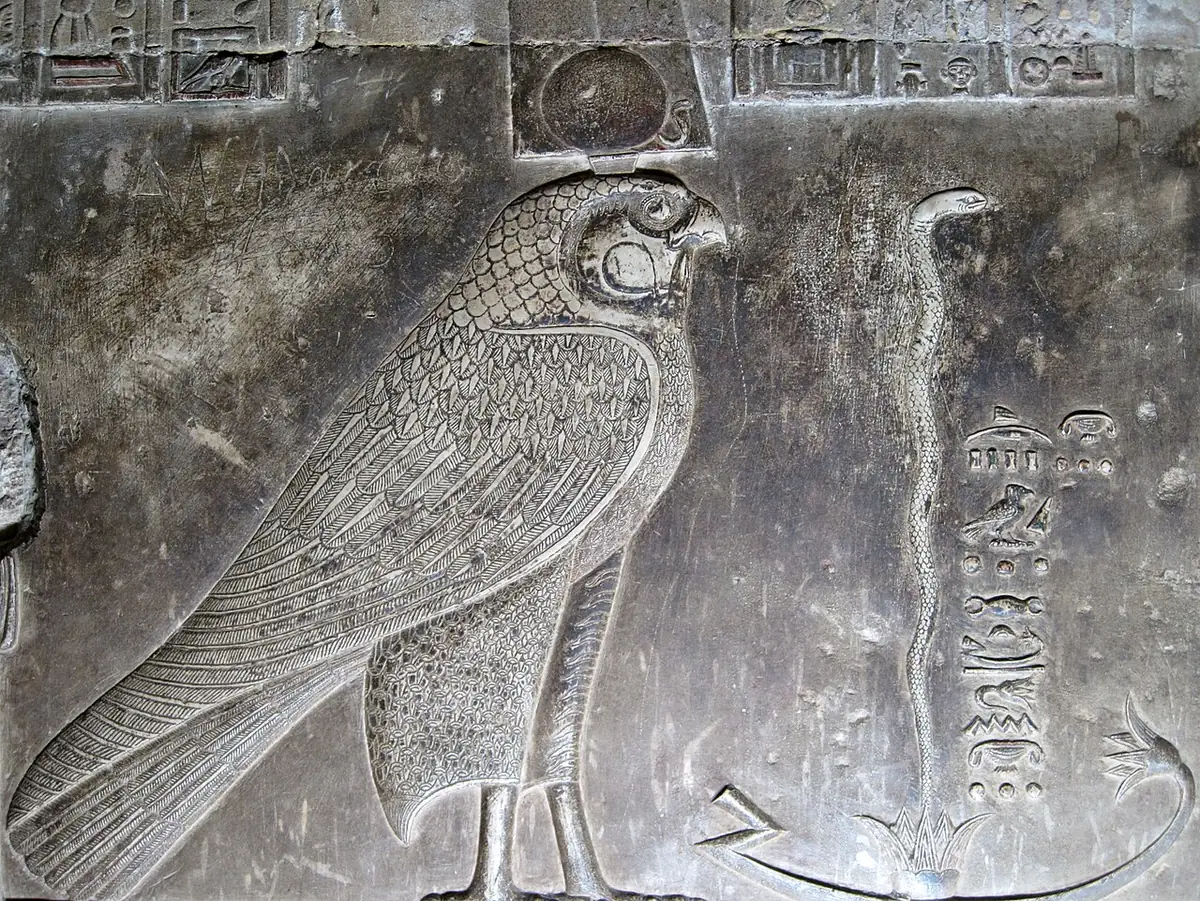
Relief of a falcon in one of the crypts at Dendera
Another relief in the same crypts. The crypts are narrow, dark corridors inside the temple walls. Image: Olaf Tausch, CC BY 3.0, via Wikimedia Commons. Resized.

✓ What Has Been Physically Measured

Dates, physical measurements, and excavated findings kept separate from interpretation.

🧭 Proponents' Case & Cited Evidence

  • The shape is: close to a large lamp or a Crookes tube: a bulb-shaped envelope, a wavy line inside it running from one end, a 'socket' at the narrow end and a supporting pillar. Krassa and Habeck built their case on this likeness. [5]
  • Key finding: In 1894 the astronomer Norman Lockyer wrote that freshly opened tombs show 'no traces whatever of any kind of combustion', and that the Egyptologist Urbain Bouriant 'laughingly suggested' the Egyptians knew electric light. This remark is often cited by supporters. [6]

🏛️ Mainstream Archaeological View & Evidence

  • Carved lotus-snake temple text: The captions identify the 'filament' as Harsomtus, the 'bulb' as the hn container (read by Waitkus as most probably the body of the sky goddess Nut) and the 'socket' as a lotus flower. This is a known creation image: the young sun god rising from a lotus. [2]
  • Key finding: Lockyer himself explained the lack of soot by reflected sunlight, not lamps, and treated Bouriant's remark as a joke. [6]
  • Key finding: The published studies of the crypts report no glass envelopes, wires, conductors or other electrical remains. None are known from Egyptian digs. [1]

🔬 What Future Tests Would Settle It

Lockyer's 'no soot' finding is anecdotal. A systematic survey of soot and lamp residues in decorated tombs and crypts would test how they were lit. Publishing a full English translation of all six caption texts alongside photographs would help readers compare them directly.

📚 Further Reading: Both Sides of the Argument

Top books from both sides of the debate on this topic. Browse all 34 books on Books & Further Reading or visit our Search for the Truth Bookshop.org storefront.

Mainstream Baseline 2017 ★ 4.7/5

Giza and the Pyramids: The Definitive History

Mark Lehner & Zahi Hawass

The Giza dig leaders share 30 years of finds, from the workers' town and stone quarries to Old Kingdom carbon dates.

▸ Why this book matters to both sides

The Giza dig teams' own large-format overview of decades of fieldwork on the plateau. It records the Heit el-Ghurab workers' town, limestone quarries, ramp remnants, and Old Kingdom carbon dates.

Role in the debate: Provides the primary archaeological and soil-layer baseline at Giza against which older-Sphinx, legacy-foundation, and precision-machining proposals are tested. (ISBN 9780226425696)

Leading Edge 1979 ★ 4.6/5

Serpent in the Sky: The High Wisdom of Ancient Egypt

John Anthony West

First pointed out the deep water-worn grooves on the Great Sphinx ditch that brought geologist Robert Schoch to Giza.

▸ Why this book matters to both sides

Expounds R. A. Schwaller de Lubicz's symbolist reading of Egyptian temple geometry. It first spotlighted the deep vertical weathering profiles on the Great Sphinx enclosure that brought geologist Robert Schoch to Giza.

Role in the debate: The historical starting point of the modern Sphinx water-erosion and Osireion dating debates. (ISBN 9780835606912)

Leading Edge 2010 ★ 4.7/5

Lost Technologies of Ancient Egypt: Advanced Engineering in the Temples of the Pharaohs

Christopher Dunn

An engineer measures Egyptian granite boxes, statues, and drill cores with precision gauges to argue for advanced ancient tools.

▸ Why this book matters to both sides

Manufacturing engineer Christopher Dunn applies straightedges, radius gauges, and optical comparators to the Serapeum granite sarcophagi, Luxor Ramses statues, and Petrie's drill cores. It argues for high-speed mechanical tooling.

Role in the debate: Provides the primary Leading Edge metrology claims on Egyptian granite symmetry and flatness, contrasted on our precision pages with test copper-saw, tubular-drill, and pounder replications. (ISBN 9781591431022)

Leading Edge 1995 ★ 4.7/5

Fingerprints of the Gods: The Evidence of Earth's Lost Civilization

Graham Hancock

Graham Hancock's bestseller arguing that Giza, Pumapunku, and ancient maps preserve traces of a lost Ice Age culture.

▸ Why this book matters to both sides

Hancock's worldwide bestseller examining Tiwanaku, Pumapunku, Teotihuacan, Giza, the Piri Reis map, and Hapgood's crustal-shift model. It argues for an Ice Age culture lost in a global cataclysm.

Role in the debate: The book that brought the lost-Ice-Age-culture idea to millions of readers and framed the modern debate over Giza, Pumapunku, and ancient sky sightlines. (ISBN 9780517887295)

FTC affiliate disclosure: Book links go to Bookshop.org (ID 130218, Search for the Truth). Each sale helps local bookstores and pays us a 10% fee at no extra cost to you. All partner links use rel="sponsored nofollow noopener". Fees never change our verdicts. Affiliate disclosure.

Visiting & base stays: Dendera Temple Complex of Hathor (day trips from Luxor)

FTC affiliate disclosure: Tour links go to GetYourGuide and Viator. Hotel links use Stay22 (aid=solarevidence) for Booking.com and Expedia. If you book a trip, we may earn a small fee at no extra cost to you. All partner links use rel="sponsored nofollow noopener". Check travel alerts before you go. Partner fees never change our ratings. All 64 site field visits · Affiliate disclosure.

Primary Academic Sources

▸ View All Cited Primary Sources & DOIs (6 papers)
  1. Waitkus, W. (1997). Die Texte in den unteren Krypten des Hathortempels von Dendera: ihre Aussagen zur Funktion und Bedeutung dieser Räume. MÄS 47 (publisher record). https://www.ugarit-verlag.com/products/die-texte-in-den-unteren-krypt… data
  2. Waitkus, W. (2002). Die Geburt des Harsomtus aus der Blüte: zur Bedeutung und Funktion einiger Kultgegenstände des Tempels von Dendera. Studien zur Altägyptischen Kultur 30: 373–394 (bibliographic record with summary). https://aegyptiaca.uni-muenster.de/Record/35187 data
  3. Wikipedia: "Dendera light" (English translations of the six caption texts, after Waitkus 2002; secondary, used only for the translations). https://en.wikipedia.org/wiki/Dendera_light background
  4. Habachy, M. (2019). Le supposé deuxième protocole royal de Ptolémée XII Aulète à Kôm Ombo et à Dendara. BIFAO 118. doi:10.4000/bifao.913 data
  5. Krassa, P. & Habeck, R. (1982). Licht für den Pharao (catalogue record). https://openlibrary.org/works/OL537575W proponent
  6. Lockyer, J. N. (1894). The Dawn of Astronomy, pp. 180–181 (full text). https://archive.org/details/dawnofastronomys00lockuoft/ background

More in this section: Egypt: Sphinx & Giza dating.

Sources checked against Crossref and publisher pages on 2026-10-23. This entry presents a debated idea neutrally: the proponents' case first, then the mainstream position, in plain English. "Open question" is not a judgment that the idea is true or false. Labels describe the claim, not the people who hold it. Methodology.