Claims › Sky alignments & sacred landscapes › The Nazca lines were runways, a star calendar, or ritual paths
The Nazca lines were runways, a star calendar, or ritual paths
Status: Mainstream
Verdict: Measured: 2024 AI survey found 303 new figures; their placement along paths and line networks supports ritual use; landing-strip and star-map readings are not supported
30-SECOND TAKEAWAY
In Plain English — The 30-Second Takeaway
What It Is: Were Peru's giant Nazca desert lines ritual walkways, star calendars, or signals for visitors from the sky?
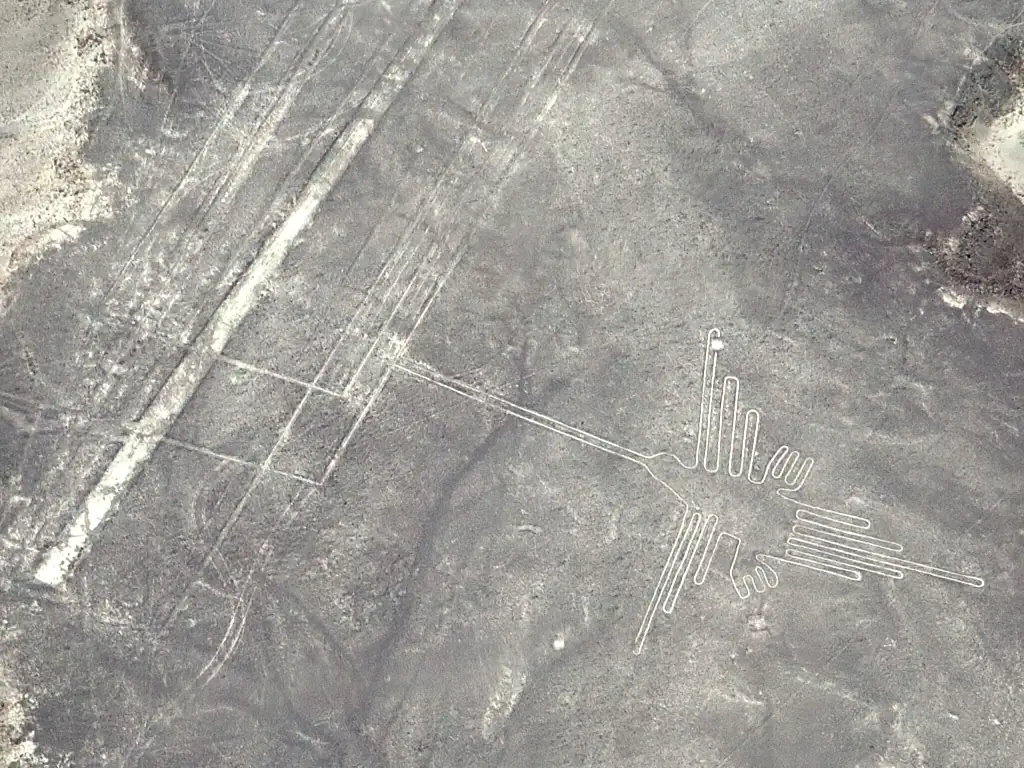
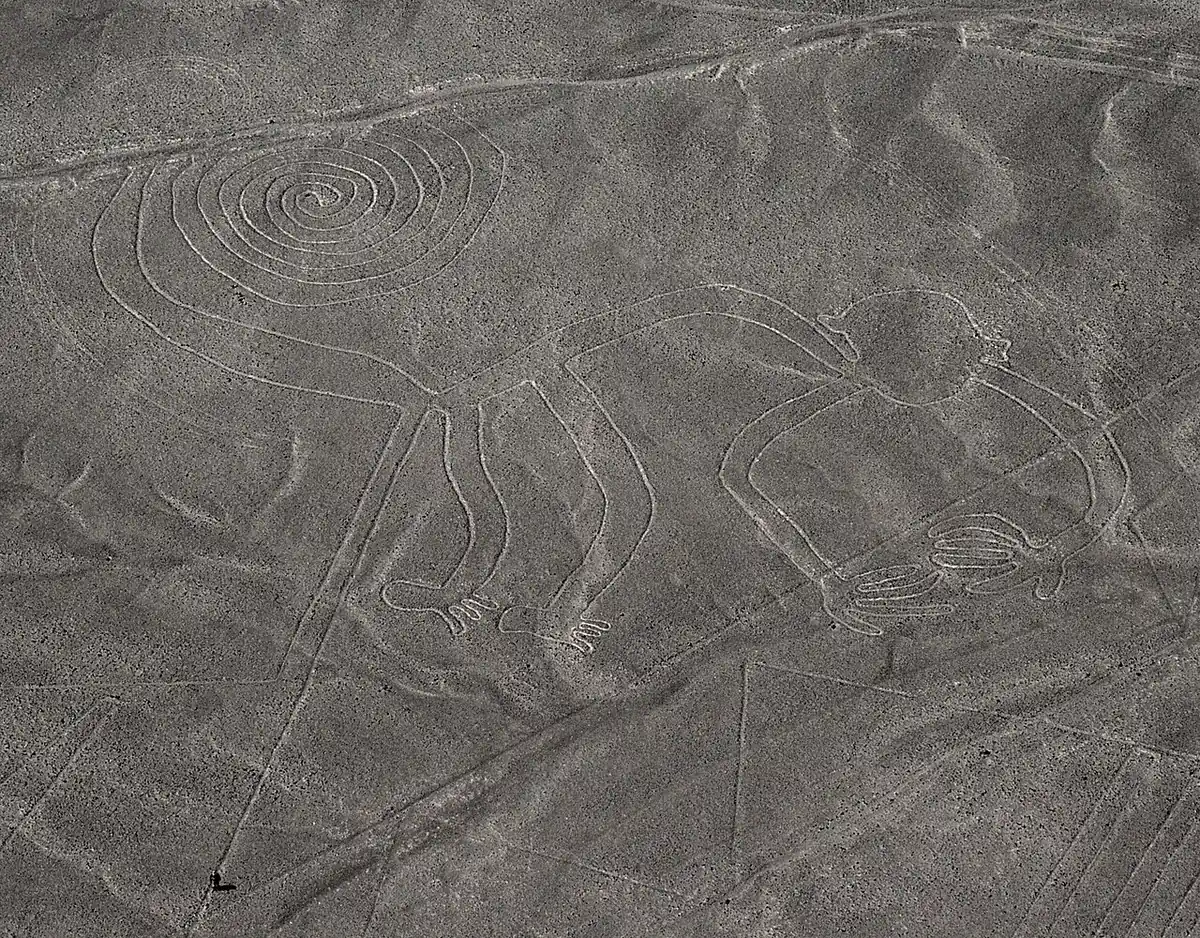
What Everyone Agrees On (Measured Facts): Over 1,000 straight lines and 700 animal figures (plus 303 found by AI in 2024) were made by clearing dark pebbles from 200 BCE to 650 CE.
🏛️ Mainstream Archaeology View: Dig teams find smashed water jars and worn paths showing people walked the lines in rituals to pray for mountain rain.
🧭 Leading Edge View: Earlier writers proposed star calendars or landing strips, though sky tests show most lines do not point to stars.
Overview & Context
The geoglyphs were made by removing dark surface stones to expose lighter ground. They date to the Paracas and Nasca periods, broadly from about 500 BCE to 500 CE. The 2024 PNAS study by Masato Sakai and colleagues, working with IBM Research, ran a deep-learning model over high-resolution aerial images of the whole Nazca Pampa and checked candidates on foot.
▸ Read Technical Background, Full Claim Wording & Academic Literature History
Formal claim tested: The Nazca lines and figures in southern Peru have three popular answers. They were landing strips or signals for visitors from the sky (von Däniken). They were an sky calendar (Maria Reiche and others). Or they were paths and images used in ritual.
Where the evidence stands: New data favour ritual paths and images. A 2024 survey combining AI with field checks nearly doubled the known figurative geoglyphs. It showed that the two main kinds of figure were placed in different settings. Small relief figures sit beside footpaths. There, walkers would see them. Large line figures sit on the network of lines and trapezoids used for group processions. Earlier tests of sky sightlines found no more matches than expected by chance. The ground is soft desert pavement unsuited to aircraft.
✓ What Has Been Physically Measured
Dates, physical measurements, and excavated findings kept separate from interpretation.
- 2024 finding: 303 new figurative geoglyphs were confirmed in six months of fieldwork, compared with 430 known before. Most new ones are small relief-type figures. [1]
- 2024 finding: Relief-type figures depict mostly human or human-modified subjects (81.6%) and lie on average 43 m from footpaths. Larger line-type figures mainly depict wild animals (64%) and lie on average 34 m from the network of lines and trapezoids. [1]
- 2023 finding: An earlier deep-learning pipeline found candidate figures about 21 times faster than visual inspection. Four new figures were confirmed on site. [2]
- Key finding: Aveni's team surveyed hundreds of lines and their meeting points ("ray centres"). Lines radiate from hills and connect to water sources and towns, and many show signs of being walked. [3]
🧭 Proponents' Case & Cited Evidence
- Key finding: Von Däniken proposed that the long straight lines and trapezoids look like runways and were made for, or by, visitors arriving from the sky. [4]
- Key finding: Maria Reiche and others proposed that some lines mark solstice and other horizon events, making the pampa an sky calendar. [3]
🏛️ Mainstream Archaeological View & Evidence
- Aveni's survey found: no strong overall sky pattern in the line directions, and linked the lines mainly to walking, water and the ray centres on hills. [3]
- Key finding: The figures cluster along footpaths and line networks in ways that fit being seen by people on the ground and used in group rituals. They do not fit a design meant to be read from the air. [1]
- Key finding: UNESCO describes the lines as made between about 500 BCE and 500 CE by removing surface stones, and as probably ritual, with possible sky associations. [5]
🔬 What Future Tests Would Settle It
Dating more lines directly (for example by luminescence of the cleared surfaces, or dated pottery along them) would show how the network grew. Many further AI candidates from the 2024 survey still await field checks.
📚 Further Reading: Both Sides of the Argument
Top books from both sides of the debate on this topic. Browse all 34 books on Books & Further Reading or visit our Search for the Truth Bookshop.org storefront.
Mainstream Baseline
2014
★ 4.6/5
The Incas (2nd ed.)
Terence N. D'Altroy
A clear guide to how the Inca built Cusco, Sacsayhuamán, and Ollantaytambo using stone hammers, quarries, and road crews.
▸ Why this book matters to both sides
Columbia University archaeologist Terence D'Altroy's leading survey of Inca origins, Cuzco royal estates, mit'a labor group, Rumiqolqa and Cachiccata quarries, and Andean stone building.
Role in the debate: Presents the mainstream ethnohistoric, carbon, and quarry evidence for fifteenth-century Inca building at Sacsayhuamán and Ollantaytambo alongside the open questions of polygonal fitting. (ISBN 9781444331158)
Mainstream Baseline
2005
★ 4.6/5
1491: New Revelations of the Americas Before Columbus (2nd ed.)
Charles C. Mann
Shows how new digs and laser maps proved the ancient Americas held big cities, roads, and farms long before Columbus.
▸ Why this book matters to both sides
Surveys the archaeological, botanical, and demographic discoveries showing that the pre-Columbian Americas—from Caral-Supe and the Amazon basin to Cahokia—were older, more populous, and more engineered than once taught.
Role in the debate: Documents how mainstream field evidence overturned the 20th-century 'pristine wilderness' model in the Amazon and pushed giant buildings in Peru back to the third millennium BCE. (ISBN 9781400032051)
Leading Edge
1995
★ 4.7/5
Fingerprints of the Gods: The Evidence of Earth's Lost Civilization
Graham Hancock
Graham Hancock's bestseller arguing that Giza, Pumapunku, and ancient maps preserve traces of a lost Ice Age culture.
▸ Why this book matters to both sides
Hancock's worldwide bestseller examining Tiwanaku, Pumapunku, Teotihuacan, Giza, the Piri Reis map, and Hapgood's crustal-shift model. It argues for an Ice Age culture lost in a global cataclysm.
Role in the debate: The book that brought the lost-Ice-Age-culture idea to millions of readers and framed the modern debate over Giza, Pumapunku, and ancient sky sightlines. (ISBN 9780517887295)
Bridge / Debate History
1969
★ 4.6/5
Hamlet's Mill: An Essay Investigating the Origins of Human Knowledge and Its Transmissions Through Myth
Giorgio de Santillana & Hertha von Dechend
Two science historians argue that ancient stories worldwide preserve real observations of the 26,000-year wobble of the stars.
▸ Why this book matters to both sides
Written by historians of science at MIT and Frankfurt University. The author argues ancient stories worldwide encode technical findings of the 26,000-year sky wobble of the equinoxes and shifting world ages.
Role in the debate: The scholarly bridge between academic history of astronomy and modern sky-sightline claims about sky-cycle coding at Giza, Angkor, and Göbekli Tepe. (ISBN 9780879232153)
FTC affiliate disclosure: Book links go to Bookshop.org (ID 130218, Search for the Truth). Each sale helps local bookstores and pays us a 10% fee at no extra cost to you. All partner links use rel="sponsored nofollow noopener". Fees never change our verdicts. Affiliate disclosure.
Visiting & base stays: The Nazca & Palpa Lines (overflights from Nazca, Ica or Lima, Peru)
FTC affiliate disclosure: Tour links go to GetYourGuide and Viator. Hotel links use Stay22 (aid=solarevidence) for Booking.com and Expedia. If you book a trip, we may earn a small fee at no extra cost to you. All partner links use rel="sponsored nofollow noopener". Check travel alerts before you go. Partner fees never change our ratings. All 64 site field visits · Affiliate disclosure.
Primary Academic Sources
▸ View All Cited Primary Sources & DOIs (5 papers)
- Sakai, M. et al. (2024). AI-accelerated Nazca survey nearly doubles the number of known figurative geoglyphs and sheds light on their purpose. PNAS 121(40). doi:10.1073/pnas.2407652121 data
- Sakai, M., Lai, Y. & Olano Canales, J. (2023). Accelerating the discovery of new Nasca geoglyphs using deep learning. Journal of Archaeological Science 155. doi:10.1016/j.jas.2023.105777 data
- Aveni, A. F. (1990). Order in the Nazca lines. In Aveni (ed.), The Lines of Nazca. American Philosophical Society Memoirs 183. doi:10.70249/9798893981193-005 critique
- von Däniken, E. (1968; English 1969). Chariots of the Gods? (catalogue record). https://openlibrary.org/search?q=chariots+of+the+gods+daniken proponent
- UNESCO World Heritage Centre: Lines and Geoglyphs of Nasca and Palpa (inscribed 1994). https://whc.unesco.org/en/list/700/ background
More in this section: Sky alignments & sacred landscapes.
Sources checked against Crossref and publisher pages on 2026-10-23. This entry presents a debated idea neutrally: the proponents' case first, then the mainstream position, in plain English. "Open question" is not a judgment that the idea is true or false. Labels describe the claim, not the people who hold it. Methodology.