Status: Leading EdgeVerdict: Measured: Seti I's name is carved on dovetails set inside the granite hall, under its roof blocks, and is stamped on the bricks; one 2015 luminescence date on its granite is 1980 ± 160 BCE, a few centuries older, but far from prehistoric
30-SECOND TAKEAWAY
In Plain English — The 30-Second Takeaway
What It Is:
Is the sunken granite hall of the Osireion at Abydos thousands of years older than Pharaoh Seti I (c. 1290 BCE)?
What Everyone Agrees On (Measured Facts):
Seti I's royal name is carved inside dovetail slots under the 60-ton roof beams. One 2015 light-dating test on granite gave 1980 ± 160 BCE.
🏛️ Mainstream Archaeology View:
Egypt scholars conclude Seti I built the hall in the 1200s BCE in an old-fashioned style to honour the god Osiris.
🧭 Leading Edge View:
Supporters point to the plain 60-ton granite pillars, deep water level, and the 1980 BCE date as signs Seti restored an older hall.
Overview & Context
Margaret Murray found the building in 1903. Édouard Naville cleared the Central Hall in 1912–14 and compared it with the Giza Valley Temple, and Henri Frankfort dug it for the Egypt Exploration Society, publishing in 1933. Graham Hancock revived the older-date case in 1995, quoting Naville and Murray.
▸ Read Technical Background, Full Claim Wording & Academic Literature History
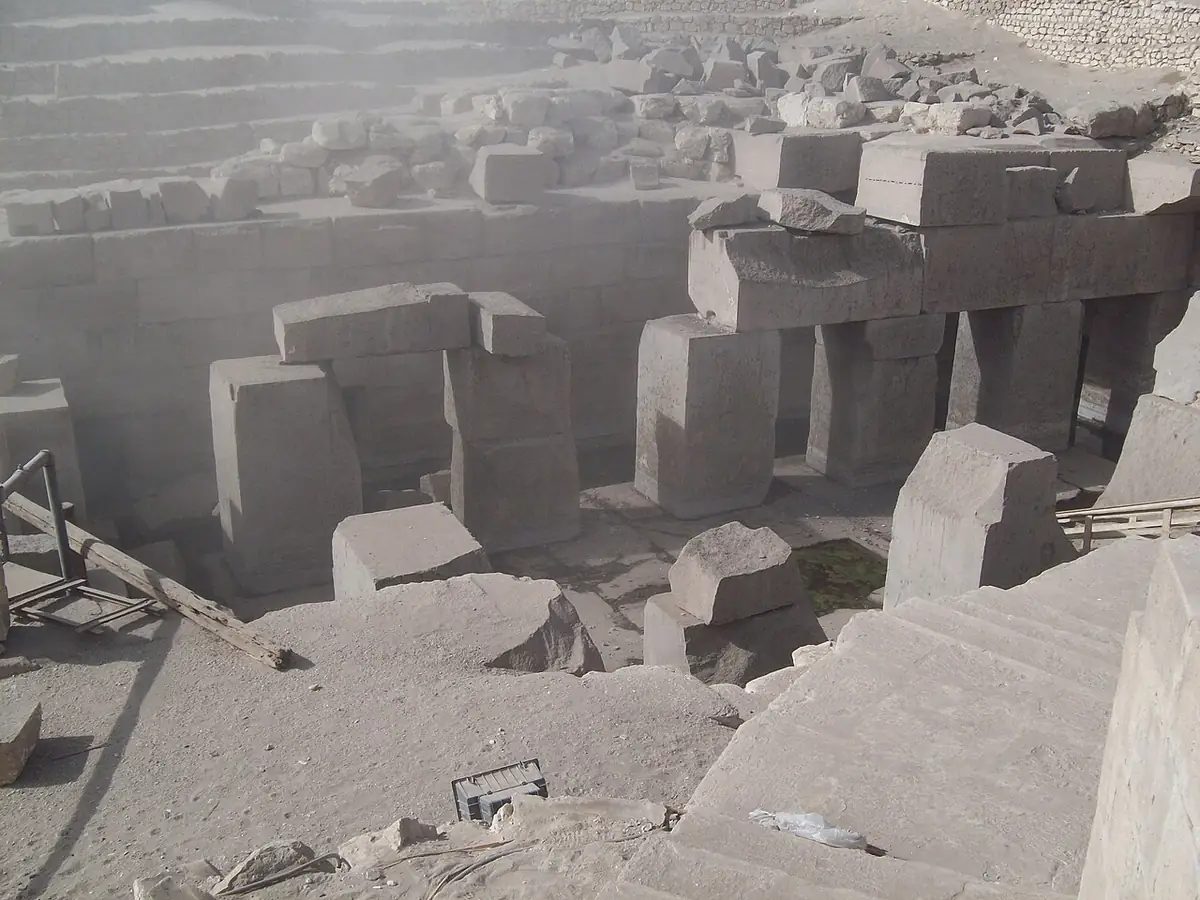
Formal claim tested: The Osireion, the sunken megalithic building behind the temple of Seti I at Abydos, is much older than Seti I (about 1290–1279 BCE). Its plain granite pillars resemble Khafre's Valley Temple at Giza, it lies far below the temple near the water table, and Seti only decorated or restored an ancient structure.
Where the evidence stands: Frankfort's excavation in the 1920s found Seti I's name on stamped bricks of the entrance, on inscribed dovetails still in position, one in a wall under the granite roof blocks, and on an ostracon naming the building during Seti's lifetime. That ties the granite work to Seti's building. The older-date case is building and has no dated find to support it. The newest data point, a 2015 surface-luminescence date on one granite sample of about 1980 BCE, suggests something somewhat older. It is a single sample, and it is still thousands of years too young for a prehistoric building.
Compare the Sphinx weathering debate. There, the older-date argument also rests on style and weathering rather than dated finds.
Computation & method notes: We read Frankfort's 1933 memoir in full for the dating evidence and the water readings, and took the luminescence ages from the 2015 paper's table. The 4-sigma figure is our own arithmetic: (1980 − 1290) / 160 ≈ 4.3. It ignores any error in the method's assumptions, such as whether the sampled granite face was fully exposed to light when the building was put up.
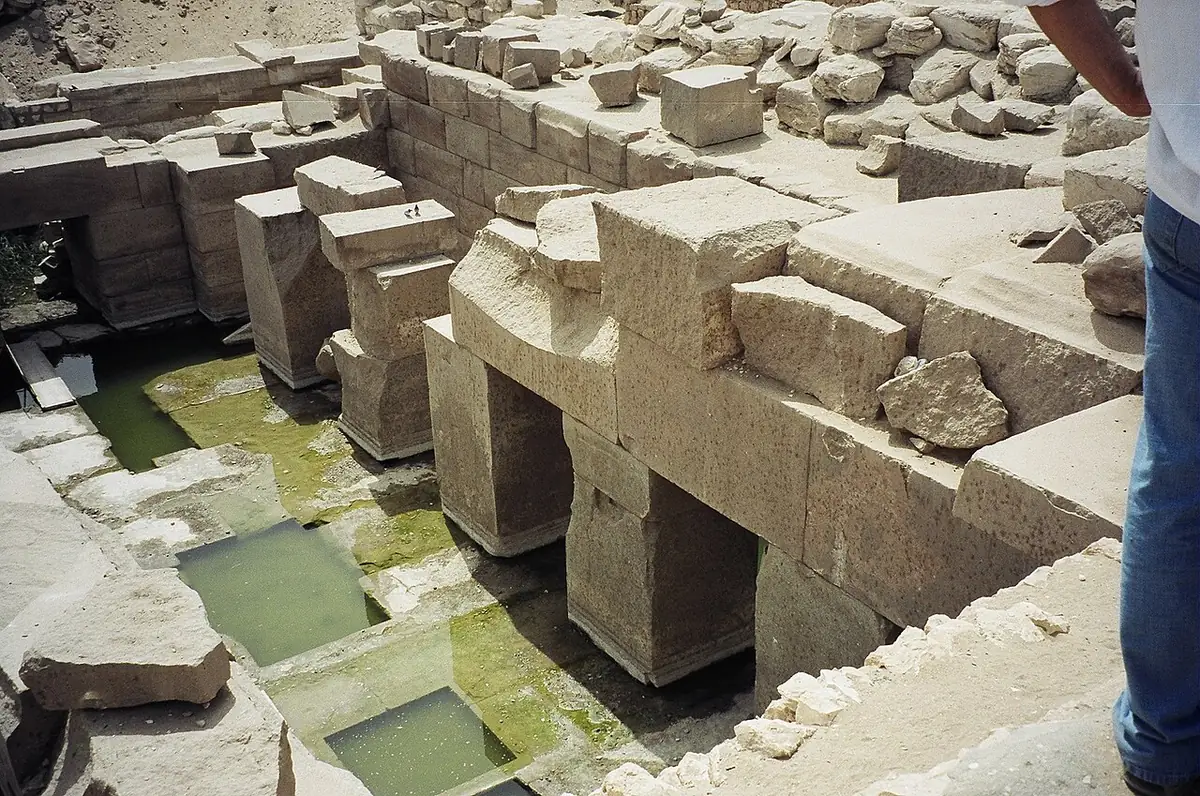
The Osireion behind the temple of Seti I at Abydos. Image: isawnyu, CC BY 2.0, via Wikimedia Commons. Resized.The Osireion's colonnade, often flooded by groundwater. Image: RsAzevedo (author as recorded on Commons), CC BY-SA 3.0, via Wikimedia Commons. Resized.
✓ What Has Been Physically Measured
Dates, physical measurements, and excavated findings kept separate from interpretation.
Seti I stamps and stone dates: Frankfort found a dovetail cut with Seti I's cartouche in position in the third course from the top at the north-east corner of the Central Hall, 'actually in the wall below the granite roofing-blocks which still rest upon it', with the granite architraves built into the same wall. A second inscribed dovetail sat on top of the hall's entrance. [1][2]
Seti I stamps and stone dates: The entrance shaft and vault are built of bricks stamped with Seti I's cartouche. The granite pillars stand on a red sandstone 'island' tied to the dovetailed walls by a sandstone thrust-beam. [1]
Seti I stamps and stone dates: A hieratic ostracon from the entrance passage records stone hauled and unloaded for 'Menmaatre (Seti I) is serviceable to Osiris', which Frankfort takes as the building's name, written while Seti was alive. Apart from robbers' debris and a prehistoric village that slid into the passage, 'not a stone or sherd of an earlier period was found'. [1]
Water: Frankfort's monthly readings showed the water in the channel rising and falling with the Nile, and pumping 1.5 m out took 90 minutes, after which it refilled in 30 minutes. He levelled reference irons in the Central Hall at 62.52–62.58 m above sea level, and one in the Seti temple forecourt at 68.45 m. In June 1992 the water stood just below 66 m. [1][7]
Surface luminescence (2015, repeated 2023): A sandstone sample gave 1300 ± 570 BCE, consistent with Seti I. A granite sample gave 1980 ± 160 BCE (given as ± 110 in 2023), which the authors read as an earlier phase, probably Middle Kingdom. [5][6]
🧭 Proponents' Case & Cited Evidence
Key finding: Naville judged the hall's huge plain blocks and square granite pillars to be of the same epoch as Khafre's Valley Temple at Giza, and Murray held to the end that Seti only added decoration to an Old Kingdom building. [3][4]
Seti I stamps and stone dates: Hancock argues that the evidence for Seti is circumstantial, that the ostracon reads like praise for a restorer, and that the decorated transverse chambers lie outside the thick enclosure wall and could be later additions. [4]
Key finding: Frankfort himself conceded that 'no similar building is known from the Nineteenth Dynasty'. [1]
Seti I stamps and stone dates: The 2015 granite date is some 700 years older than Seti I. That is about 4 standard errors on its own stated error, and it is the newest direct check of the stone. [5]
🏛️ Mainstream Archaeological View & Evidence
Key finding: An inscribed dovetail in a wall under roof blocks still resting on it cannot easily be a later addition, and Frankfort found the granite pillars and the sandstone walls structurally bound together. [1]
Key finding: Frankfort answered the Valley Temple comparison directly: the two buildings share only square granite pillars and architraves, the Osireion's pillars are heavier, and its plain look reflects an unfinished building meant to be carved. [1]
Key finding: Groundwater is not a fixed datum. Frankfort showed it tracks the Nile, and recent studies attribute it to Nile water reaching the site through a buried channel, or to a confined aquifer, so today's flooding does not show the hall was built when the water stood that high. [1][10][7]
Key finding: Even taken at face value, the luminescence date places the granite in the early second millennium BCE, not in prehistory. The same team dated Seti's own temple limestone to about 1550 ± 200 BCE, which is also earlier than its known date, so the method may run early here. [5]
🔬 What Future Tests Would Settle It
More luminescence samples from several granite blocks, taken with their position recorded, would show whether the 1980 BCE date is repeatable. Groundwater monitoring has been running since 2023 (Westerman and Sohag University). Its findings on where the water comes from are still preliminary. ARCE and the World Monuments Fund began conservation work in 2023.
The Giza dig leaders share 30 years of finds, from the workers' town and stone quarries to Old Kingdom carbon dates.
▸ Why this book matters to both sides
The Giza dig teams' own large-format overview of decades of fieldwork on the plateau. It records the Heit el-Ghurab workers' town, limestone quarries, ramp remnants, and Old Kingdom carbon dates.
Role in the debate: Provides the primary archaeological and soil-layer baseline at Giza against which older-Sphinx, legacy-foundation, and precision-machining proposals are tested. (ISBN 9780226425696)
Serpent in the Sky: The High Wisdom of Ancient Egypt
John Anthony West
First pointed out the deep water-worn grooves on the Great Sphinx ditch that brought geologist Robert Schoch to Giza.
▸ Why this book matters to both sides
Expounds R. A. Schwaller de Lubicz's symbolist reading of Egyptian temple geometry. It first spotlighted the deep vertical weathering profiles on the Great Sphinx enclosure that brought geologist Robert Schoch to Giza.
Role in the debate: The historical starting point of the modern Sphinx water-erosion and Osireion dating debates. (ISBN 9780835606912)
Fingerprints of the Gods: The Evidence of Earth's Lost Civilization
Graham Hancock
Graham Hancock's bestseller arguing that Giza, Pumapunku, and ancient maps preserve traces of a lost Ice Age culture.
▸ Why this book matters to both sides
Hancock's worldwide bestseller examining Tiwanaku, Pumapunku, Teotihuacan, Giza, the Piri Reis map, and Hapgood's crustal-shift model. It argues for an Ice Age culture lost in a global cataclysm.
Role in the debate: The book that brought the lost-Ice-Age-culture idea to millions of readers and framed the modern debate over Giza, Pumapunku, and ancient sky sightlines. (ISBN 9780517887295)
Forgotten Civilization: New Discoveries on the Solar-Induced Dark Age (Revised ed.)
Robert M. Schoch with Catherine Ulissey
Geologist Robert Schoch sets out his rain-erosion case for an older Sphinx and his theory of a giant solar blast in 9700 BCE.
▸ Why this book matters to both sides
Boston University geologist Robert Schoch details his geological and seismic-refraction case for an older Great Sphinx alongside his idea that extreme solar proton outbursts ended the last Ice Age around 9700 BCE.
Role in the debate: Presents the geological case for precipitation-induced weathering on the Sphinx enclosure walls and the solar-disaster alternative to the Younger Dryas comet idea. (ISBN 9781644112922)
FTC affiliate disclosure: Book links go to Bookshop.org (ID 130218, Search for the Truth). Each sale helps local bookstores and pays us a 10% fee at no extra cost to you. All partner links use rel="sponsored nofollow noopener". Fees never change our verdicts. Affiliate disclosure.
Visiting & base stays: Abydos — Temple of Seti I & the Osireion (day trips from Luxor)
FTC affiliate disclosure: Tour links go to GetYourGuide and Viator. Hotel links use Stay22 (aid=solarevidence) for Booking.com and Expedia. If you book a trip, we may earn a small fee at no extra cost to you. All partner links use rel="sponsored nofollow noopener". Check travel alerts before you go. Partner fees never change our ratings. All 64 site field visits · Affiliate disclosure.
Primary Academic Sources
▸ View All Cited Primary Sources & DOIs (10 papers)
Frankfort, H. (1926). Preliminary report on the excavations at Abydos, 1925–6. Journal of Egyptian Archaeology 12: 157–165. doi:10.1177/030751332601200130data
Naville, E. (1914). Excavations at Abydos: the Great Pool and the Tomb of Osiris. Journal of Egyptian Archaeology 1. doi:10.1177/030751331400100143data
Hancock, G. (1995). Fingerprints of the Gods, Part VII (Abydos and the Osireion). Excerpt on the author's site. https://grahamhancock.com/fingerprints/proponent
Liritzis, I. & Vafiadou, A. (2015). Surface luminescence dating of some Egyptian monuments. Journal of Cultural Heritage 16: 134–150. doi:10.1016/j.culher.2014.05.007data
Abudeif, A. M. et al. (2022). Detection of groundwater pathways to monitor their level rise in Osirion at Abydos using electrical resistivity tomography. Applied Sciences 12: 10417. doi:10.3390/app122010417data
Abudeif, A. M. et al. (2022). An integrated geophysics and isotope geochemistry to unveil the groundwater paleochannel in Abydos historical site. Minerals 13: 64 (published 30 December 2022). doi:10.3390/min13010064data
Sources checked against Crossref and publisher pages on 2026-10-23. This entry presents a debated idea neutrally: the proponents' case first, then the mainstream position, in plain English. "Open question" is not a judgment that the idea is true or false. Labels describe the claim, not the people who hold it. Methodology.