△ TruthInStone

Sites › Asia › Arkaim

Arkaim

Arkaim
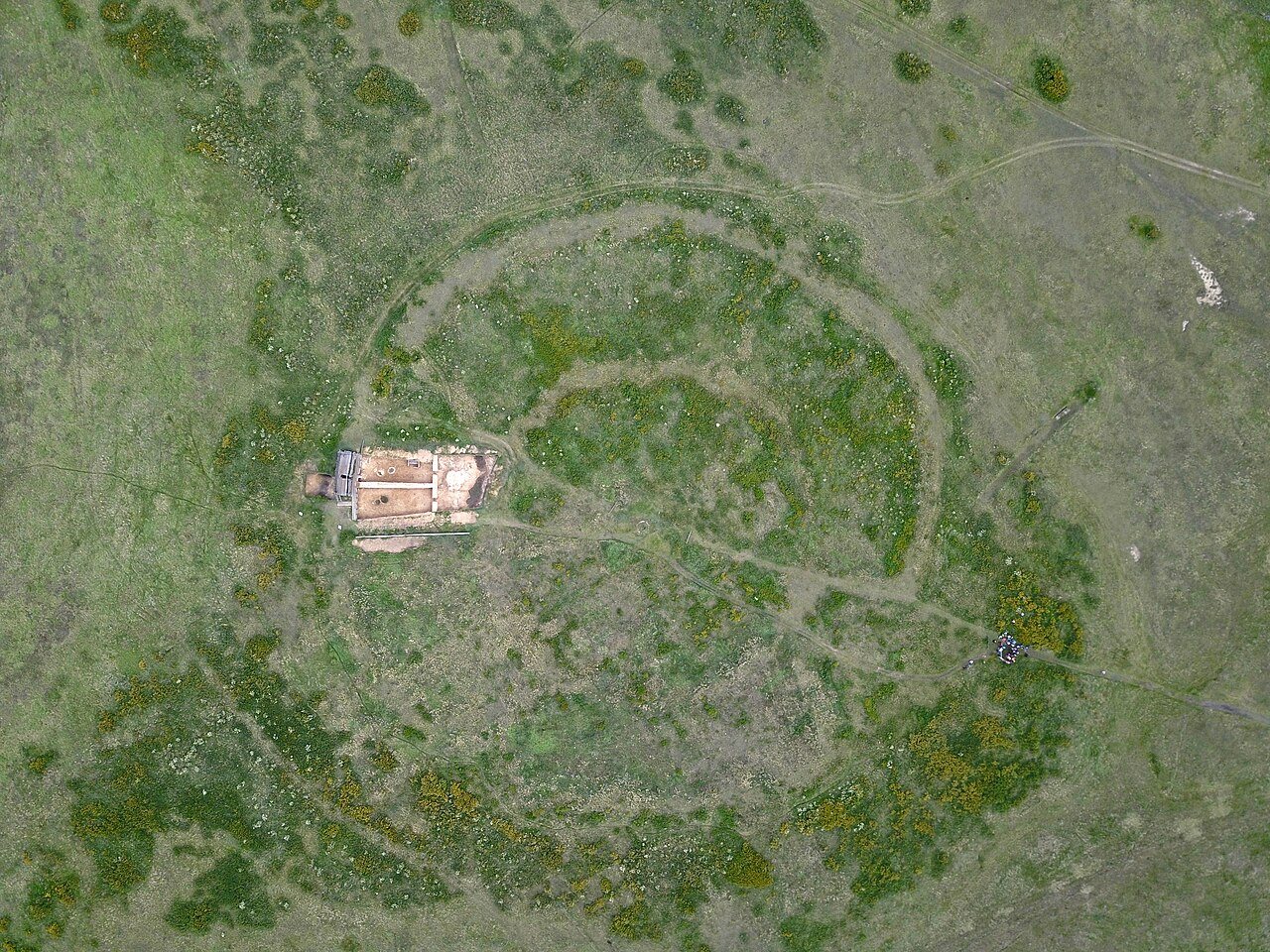
Image: ZolanPro, Wikimedia Commons, CC BY 4.0. Resized; not otherwise altered. All credits.
📍 Where It Is Chelyabinsk Oblast, southern Ural steppe, Russia 52.6492°, 59.5714°
🏛️ Mainstream Date c. 2100–1800 BCE (Middle Bronze Age Sintashta culture) Excavated baseline
🧭 Leading Edge / Open Angle Proposed solar/lunar horizon observatory with 18+ sightlines Debated or newly revised
🪨 Heaviest Stone & Quarry 150-m circular timber, turf & mudbrick double-ring fortress 0.0× the 40-ton test limit · Compare all 64 sites →
30-SECOND TAKEAWAY

In Plain English — The 30-Second Takeaway

What It Is:

Arkaim is a 4,000-year-old circular fortified town on the Russian steppe built as two concentric rings of 60 wedge-shaped houses.

What Everyone Agrees On (Measured Facts):

Excavated between 1987 and 1995, the 150-meter-wide town had copper smelting furnaces in every house, storm drains. Nearby spoke-wheeled chariot burials.

🏛️ Mainstream Archaeology View:

Russian scholars date the Sintashta culture to around 2000–1800 BCE. It also note the full excavation plans took over 20 years to publish.

🧭 Leading Edge View:

Physicist Konstantin Bystrushkin and local experts argued the double-ring plan served as a precision solar and lunar horizon observatory.

Site Story & Overview

Famous in Russia as the 'Land of Towns' site and a centre of esoteric tourism. The Sintashta culture is linked to early chariots and metallurgy. Many rebuilds of Arkaim were made before the full data were published, so claims about it should be checked against the excavation report.

✓ What Is Physically Measured on Site

Dated samples, laser scans, stone weights, and dug finds kept separate from opinion.

How carbon dates work, and their limits: How we date sites.

🏛️ Mainstream Archaeological View

  • Accepted timeline: Sintashta culture fortified town, early 2nd millennium BCE (Sintashta-phase carbon dates in the region cluster around 2100–1800 BCE).
  • Stone & hardness: Calcareous earth blocks, timber frames & river-stone furnace linings — Mohs hardness 2.0 (Earth/timber ramparts) (on the 1–10 Mohs scale where a steel knife is ~5.5 and diamond is 10).
  • Quarry distance & alignment: Stone source Adjacent Bolshaya Karaganka valley (<0.5 km). Orientation: Concentric circular rings with proposed solstice/lunar horizon sightlines.

🧭 Leading Edge Proposal & Open Questions

  • D. G. Zdanovich & A. K. Kirillov: The circular plan was used as a horizon observatory, with solar and lunar sightlines (sky-sightline reading) [2]

Visiting & base stays: Arkaim Fortified Settlement & Sintashta Steppe (Chelyabinsk base, southern Urals, Russia)

Travel advisory note: Official US and UK travel advisories currently advise against travel to Russia. Links are provided for informational reference.

FTC affiliate disclosure: Tour links go to GetYourGuide and Viator. Hotel links use Stay22 (aid=solarevidence) for Booking.com and Expedia. If you book a trip, we may earn a small fee at no extra cost to you. All partner links use rel="sponsored nofollow noopener". Check travel alerts before you go. Partner fees never change our ratings. All 64 site field visits · Affiliate disclosure.

📚 Further Reading: Both Sides of the Argument

Top books from both sides of the debate on this topic. Browse all 34 books on Books & Further Reading or visit our Search for the Truth Bookshop.org storefront.

Mainstream Baseline 2003 ★ 4.5/5

After the Ice: A Global Human History, 20,000–5000 BC

Steven Mithen

Follows human life across every continent from the peak of the Ice Age (20,000 BCE) to early farming towns (5000 BCE).

▸ Why this book matters to both sides

A continent-by-continent narrative of human life from the Last Glacial Maximum to 5000 BCE, built directly from excavation reports across the Near East (including Göbekli Tepe), Europe, Asia, and the Americas.

Role in the debate: Provides the archaeological baseline for what human populations were building, hunting, and cultivating before, during, and right after the Younger Dryas. (ISBN 9780674019997)

Mainstream Baseline 2021 ★ 4.5/5

The Dawn of Everything: A New History of Humanity

David Graeber & David Wengrow

Examines how hunter-gatherers built giant stone sites like Göbekli Tepe and Poverty Point without kings or farming.

▸ Why this book matters to both sides

An culture scholar and an archaeologist examine Göbekli Tepe, Karahan Tepe, Poverty Point, Watson Brake, and Teotihuacan. It challenges the textbook step-by-step ladder from small hunter-gatherer bands to states.

Role in the debate: Shows how mainstream archaeology accounts for giant buildings built by hunter-gatherers (Göbekli Tepe, Poverty Point) without invoking a single global parent culture. (ISBN 9781250858801)

Bridge / Debate History 1969 ★ 4.6/5

Hamlet's Mill: An Essay Investigating the Origins of Human Knowledge and Its Transmissions Through Myth

Giorgio de Santillana & Hertha von Dechend

Two science historians argue that ancient stories worldwide preserve real observations of the 26,000-year wobble of the stars.

▸ Why this book matters to both sides

Written by historians of science at MIT and Frankfurt University. The author argues ancient stories worldwide encode technical findings of the 26,000-year sky wobble of the equinoxes and shifting world ages.

Role in the debate: The scholarly bridge between academic history of astronomy and modern sky-sightline claims about sky-cycle coding at Giza, Angkor, and Göbekli Tepe. (ISBN 9780879232153)

Leading Edge 1995 ★ 4.7/5

Fingerprints of the Gods: The Evidence of Earth's Lost Civilization

Graham Hancock

Graham Hancock's bestseller arguing that Giza, Pumapunku, and ancient maps preserve traces of a lost Ice Age culture.

▸ Why this book matters to both sides

Hancock's worldwide bestseller examining Tiwanaku, Pumapunku, Teotihuacan, Giza, the Piri Reis map, and Hapgood's crustal-shift model. It argues for an Ice Age culture lost in a global cataclysm.

Role in the debate: The book that brought the lost-Ice-Age-culture idea to millions of readers and framed the modern debate over Giza, Pumapunku, and ancient sky sightlines. (ISBN 9780517887295)

FTC affiliate disclosure: Book links go to Bookshop.org (ID 130218, Search for the Truth). Each sale helps local bookstores and pays us a 10% fee at no extra cost to you. All partner links use rel="sponsored nofollow noopener". Fees never change our verdicts. Affiliate disclosure.

Primary Academic Sources

▸ View All Cited Primary Sources & DOIs (6 papers)
  1. Arkaim Reserve (in Russian). The Arkaim settlement in scientific and popular literature (official reserve page). https://arkaim-center.ru/science/nashi-publikacii/poselenie-arkaim-v-… background
  2. Zdanovich, D. G. & Kirillov, A. K. Arkaim: archaeoastronomical research and world view (in Russian, Arkaim Reserve). https://arkaim-center.ru/science/nashi-publikacii/arkaim-arheoastrono… proponent
  3. Epimakhov, A. V. et al. (2023). Migrations and cultural evolution in the light of radiocarbon dating of Bronze Age sites in the southern Urals. Radiocarbon. doi:10.1017/rdc.2023.62 data
  4. Hanks, B. K., Epimakhov, A. V. & Renfrew, A. C. (2007). Towards a refined chronology for the Bronze Age of the southern Urals, Russia. Antiquity 81. doi:10.1017/s0003598x00095235 data
  5. Petrov, F. N. Settlement Arkaim in scientific and popular literature. Rossiiskaya Arkheologiya (English abstract). http://www.ra.iaran.ru/?lang=en&page_id=1924 critique
  6. Grigoryev, S. A. (2024). Review of G. B. Zdanovich, T. S. Malyutina & D. G. Zdanovich, Arkaim: Archaeology of the Fortified Settlements. Rossiiskaya Arkheologiya. doi:10.31857/s0869606324010158 background

Dates and stone checks are summed up in plain English from the papers above. Measured facts stay separate from opinion. Methodology.