△ TruthInStone

Sites › North America › Cahokia and Monks Mound

Cahokia and Monks Mound

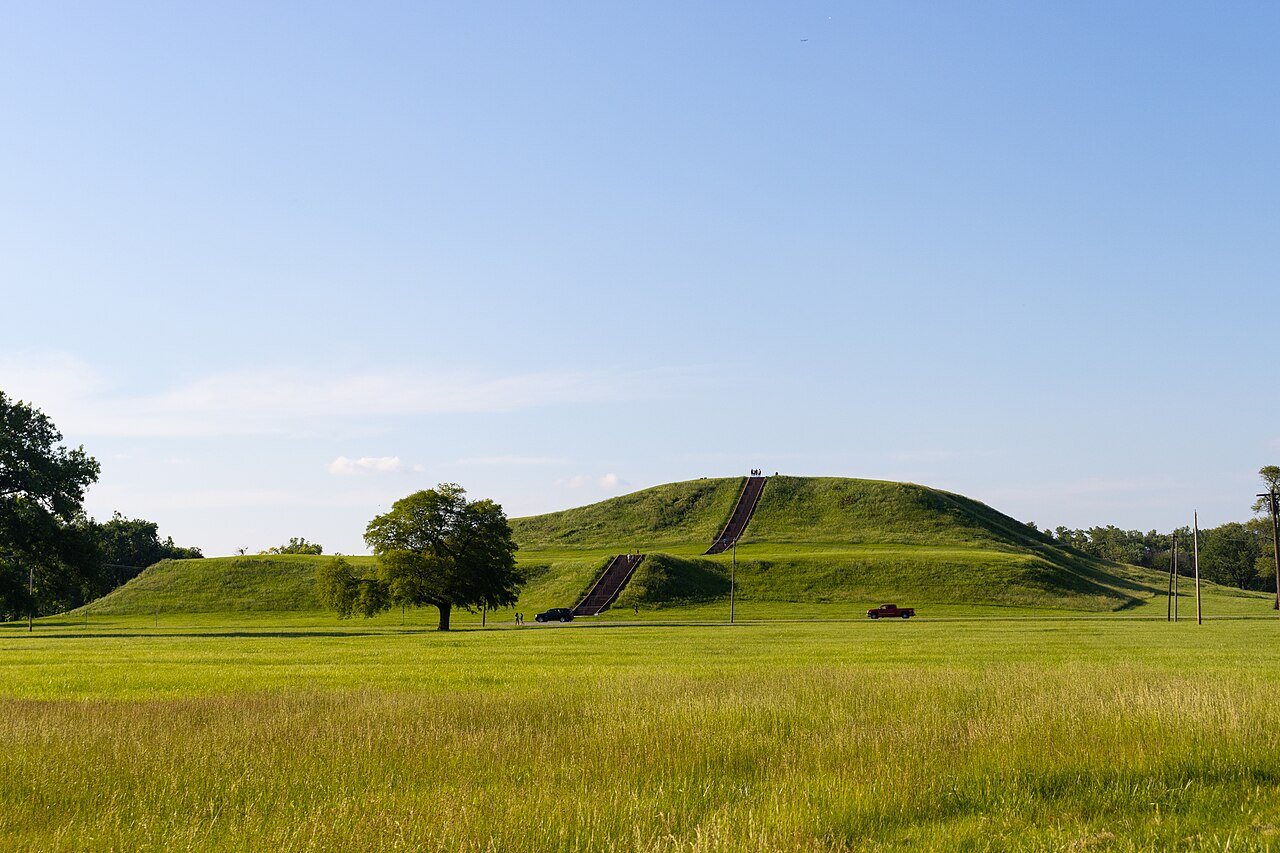
Cahokia and Monks Mound
Image: Skubasteve834, Wikimedia Commons, CC BY 4.0. Resized; not otherwise altered. All credits.
📍 Where It Is Collinsville, Illinois (across the Mississippi from St. Louis), USA 38.6551°, -90.0618°
🏛️ Mainstream Date c. 800–1400 CE (Mississippian urban peak c. 1050–1250 CE) Excavated baseline
🧭 Leading Edge / Open Angle Soil cores refuted the textbook 'deforestation collapse' story Debated or newly revised
🪨 Heaviest Stone & Quarry 620,000 m³ of engineered basket-carried clay & earth (Monks Mound) 0.0× the 40-ton test limit · Compare all 64 sites →
30-SECOND TAKEAWAY

In Plain English — The 30-Second Takeaway

What It Is:

Cahokia in Illinois was the largest ancient city north of Mexico, built around 120 earthen mounds. Also, a grand central plaza.

What Everyone Agrees On (Measured Facts):

Monks Mound stands 30 meters tall and covers 5.6 hectares built from 620,000 cubic meters of hand-carried clay and soil. Note: wider at its base than the Great Pyramid of Giza.

🏛️ Mainstream Archaeology View:

Scholars date Cahokia's boom between 1050 and 1350 CE alongside wooden solar circles. ('Woodhenges') that tracked solstice and equinox sunrises.

🧭 Leading Edge View:

New sediment cores overturned the old textbook claim that Cahokians destroyed their own environment by cutting down trees, pointing instead to droughts and river floods.

Site Story & Overview

Cahokia was the largest town north of Mexico before European contact. A popular answer for its decline was that its people over-cut the forest, which caused flooding.

▸ Read Full Archaeological & Engineering Context

When soil scientists checked the soil under the site directly, they found no evidence for that. The climate data point to river floods and drought instead. UNESCO World Heritage Site since 1982.

✓ What Is Physically Measured on Site

Dated samples, laser scans, stone weights, and dug finds kept separate from opinion.

How carbon dates work, and their limits: How we date sites.

🏛️ Mainstream Archaeological View

  • Accepted timeline: Mississippian city, about 800–1400 CE. Monks Mound is the largest single earthen mound in North America.
  • Stone & hardness: Engineered alternating clay and sand strata + red cedar Woodhenge posts — Mohs hardness 1.5 (Engineered earthen strata) (on the 1–10 Mohs scale where a steel knife is ~5.5 and diamond is 10).
  • Quarry distance & alignment: Stone source 0.5–1 km (American Bottom borrow pits). Orientation: Cardinal North–South plaza axis + Woodhenge equinox/solstice sunrise posts.

🧭 Leading Edge Proposal & Open Questions

  • Timeline consensus: New sediment cores overturned the old textbook claim that Cahokians destroyed their own environment by cutting down trees, pointing instead to droughts and river floods.
  • Engineering comparison: Heaviest unit is 620,000 m³ engineered earthen basket-fill (Monks Mound, 30 m high) (0.5–1 km (American Bottom borrow pits)). See how it compares in our 64-Site Scale-Gap Explorer.

Visiting & base stays: Cahokia Mounds State Historic Site & Monks Mound (Collinsville / St. Louis base, USA)

FTC affiliate disclosure: Tour links go to GetYourGuide and Viator. Hotel links use Stay22 (aid=solarevidence) for Booking.com and Expedia. If you book a trip, we may earn a small fee at no extra cost to you. All partner links use rel="sponsored nofollow noopener". Check travel alerts before you go. Partner fees never change our ratings. All 64 site field visits · Affiliate disclosure.

📚 Further Reading: Both Sides of the Argument

Top books from both sides of the debate on this topic. Browse all 34 books on Books & Further Reading or visit our Search for the Truth Bookshop.org storefront.

Mainstream Baseline 2005 ★ 4.6/5

1491: New Revelations of the Americas Before Columbus (2nd ed.)

Charles C. Mann

Shows how new digs and laser maps proved the ancient Americas held big cities, roads, and farms long before Columbus.

▸ Why this book matters to both sides

Surveys the archaeological, botanical, and demographic discoveries showing that the pre-Columbian Americas—from Caral-Supe and the Amazon basin to Cahokia—were older, more populous, and more engineered than once taught.

Role in the debate: Documents how mainstream field evidence overturned the 20th-century 'pristine wilderness' model in the Amazon and pushed giant buildings in Peru back to the third millennium BCE. (ISBN 9781400032051)

Mainstream Baseline 2021 ★ 4.5/5

The Dawn of Everything: A New History of Humanity

David Graeber & David Wengrow

Examines how hunter-gatherers built giant stone sites like Göbekli Tepe and Poverty Point without kings or farming.

▸ Why this book matters to both sides

An culture scholar and an archaeologist examine Göbekli Tepe, Karahan Tepe, Poverty Point, Watson Brake, and Teotihuacan. It challenges the textbook step-by-step ladder from small hunter-gatherer bands to states.

Role in the debate: Shows how mainstream archaeology accounts for giant buildings built by hunter-gatherers (Göbekli Tepe, Poverty Point) without invoking a single global parent culture. (ISBN 9781250858801)

Leading Edge 2019 ★ 4.7/5

America Before: The Key to Earth's Lost Civilization

Graham Hancock

Explores Amazon earthworks, Serpent Mound, ancient DNA, and early American sites to argue for an Ice Age culture in the Americas.

▸ Why this book matters to both sides

Tests pre-Clovis archaeological sites, Ancient North Eurasian DNA signals, Amazonian earthworks, Serpent Mound, and Poverty Point. It argues the Americas were central to an Ice Age cultural network.

Role in the debate: Contrasts directly with Charles Mann's *1491* and mainstream Americanist archaeology on early peopling, Amazon geoglyphs, and North American earthen mounds. (ISBN 9781250756954)

Leading Edge 2006 ★ 4.5/5

The Cycle of Cosmic Catastrophes: How a Stone-Age Comet Changed the Course of World Culture

Richard Firestone, Allen West & Simon Warwick-Smith

The founding book on the Younger Dryas comet impact idea, covering melted microbeads, black mats, and mammoth die-offs.

▸ Why this book matters to both sides

The first book-length presentation of the Younger Dryas impact idea by members of the team that published the 2007 PNAS paper. It details magnetic melted beads, black mats, and Clovis-era giant-animal die-offs.

Role in the debate: Gives the founding supporters' case for the ~12,800 BP Younger Dryas impact boundary, which can be read alongside subsequent separate replications and published critiques. (ISBN 9781591430612)

FTC affiliate disclosure: Book links go to Bookshop.org (ID 130218, Search for the Truth). Each sale helps local bookstores and pays us a 10% fee at no extra cost to you. All partner links use rel="sponsored nofollow noopener". Fees never change our verdicts. Affiliate disclosure.

Primary Academic Sources

▸ View All Cited Primary Sources & DOIs (6 papers)
  1. Schilling, T. (2012). Building Monks Mound, Cahokia, Illinois, A.D. 800–1400. Journal of Field Archaeology 37. doi:10.1179/0093469012z.00000000027 data
  2. Schilling, T. (2013). The chronology of Monks Mound. Southeastern Archaeology 32. doi:10.1179/sea.2013.32.1.002 data
  3. Crook, A. R. (1914). Cahokia or Monks Mound not of artificial origin. Science 40 (historical view, since overturned by coring and excavation). doi:10.1126/science.40.1026.312 background
  4. White, A. J. et al. (2019). Fecal stanols show simultaneous flooding and seasonal precipitation change correlate with Cahokia's population decline. PNAS 116. doi:10.1073/pnas.1809400116 data
  5. Rankin, C. G., Barrier, C. R. & Horsley, T. J. (2021). Evaluating narratives of ecocide with the stratigraphic record at Cahokia Mounds State Historic Site, Illinois, USA. Geoarchaeology 36. doi:10.1002/gea.21848 data
  6. UNESCO World Heritage Centre: Cahokia Mounds State Historic Site (inscribed 1982). https://whc.unesco.org/en/list/198/ background

Dates and stone checks are summed up in plain English from the papers above. Measured facts stay separate from opinion. Methodology.