Sites › North America › Chaco Canyon (New Mexico, USA)
Chaco Canyon (New Mexico, USA)
In Plain English — The 30-Second Takeaway
A canyon of great stone houses and roads built by ancestral Pueblo people.
Nine people in an elite room share the same mother-line DNA, over about 330 years.
Scholars see Chaco as the center of a large ancestral Pueblo society.
The DNA team reads a ruling line passed through mothers. That is their interpretation.
Site Story & Overview
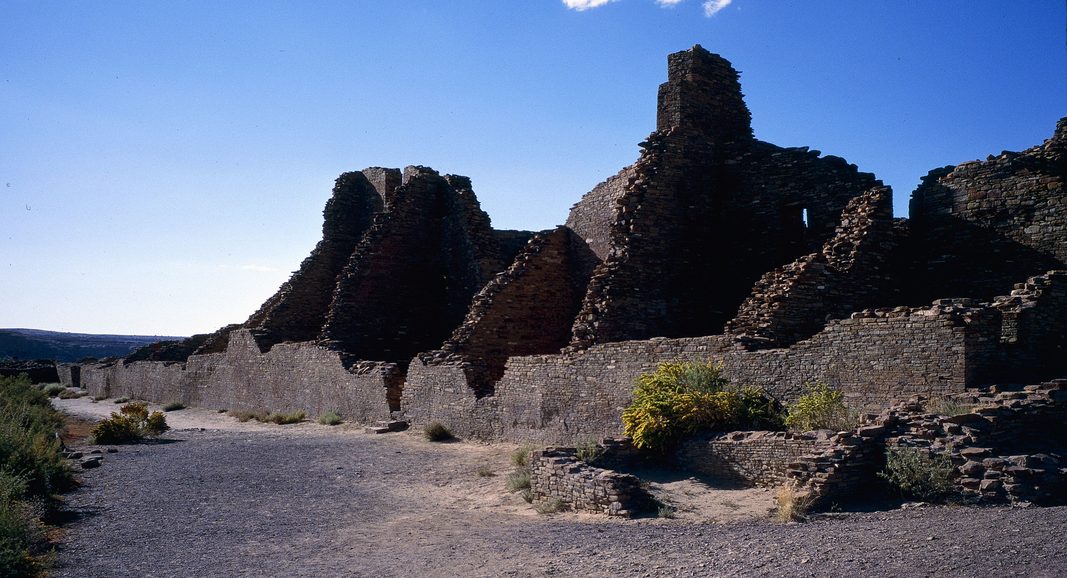
Chaco Canyon in New Mexico was the hub of a large ancestral Pueblo society. Its people built huge stone great houses and long, straight roads.
▸ Read Full Archaeological & Engineering Context
The biggest great house is Pueblo Bonito. A 2017 DNA study looked at people buried in one of its richest rooms.
✓ What Is Physically Measured on Site
Dated samples, laser scans, stone weights, and dug finds kept separate from opinion.
- Great houses and roads: UNESCO describes big public buildings and great houses several floors high. It also notes a network of well-built roads. Many of them can still be traced. [1]
- Nine people, one mother line: A 2017 study found that nine people buried in an elite burial room at Pueblo Bonito, the largest building in the canyon, share identical mitochondrial DNA. This kind of DNA passes from mother to child. [2]
- Mothers, daughters, grandsons: Six of them had better-kept DNA. It shows a mother and daughter, and a grandmother and grandson. [2]
- About 330 years: The burials span from about 800 to 1130 CE. [2]
🏛️ Mainstream Archaeological View
- Accepted timeline: The center of the Chacoan world of the ancestral Pueblo people. UNESCO places Chaco culture from the mid-800s to the early 1200s, at its height about 1020–1110.
- Stone & hardness: Not reported in the sources on this page. Mohs hardness: not reported in our sources.
- Quarry distance & alignment: Stone source not reported in the sources on this page. Orientation: Not reported in the sources on this page.
🧭 Leading Edge Proposal & Open Questions
- Leading Edge view (authors' interpretation): A matrilineal dynasty? Kennett and colleagues read the DNA as an elite family line, passed down through mothers, that lasted about 330 years. They call it a matrilineal dynasty. This is the authors' interpretation. Our sources do not yet include a published reply. [2]
Primary Academic Sources
▸ View All Cited Primary Sources & DOIs (2 papers)
- UNESCO World Heritage Centre. Chaco Culture (list no. 353), accessed 2 November 2026 https://whc.unesco.org/en/list/353 background
- Kennett, D. J., Plog, S., George, R. J., Culleton, B. J., Watson, A. S., Skoglund, P. & others (2017). Archaeogenomic evidence reveals prehistoric matrilineal dynasty. Nature Communications 8: 14115. doi:10.1038/ncomms14115 data
Dates and stone checks are summed up in plain English from the papers above. Measured facts stay separate from opinion. Methodology.