Sites › Asia › Derinkuyu Underground City (Cappadocia, Türkiye)
Derinkuyu Underground City (Cappadocia, Türkiye)
In Plain English — The 30-Second Takeaway
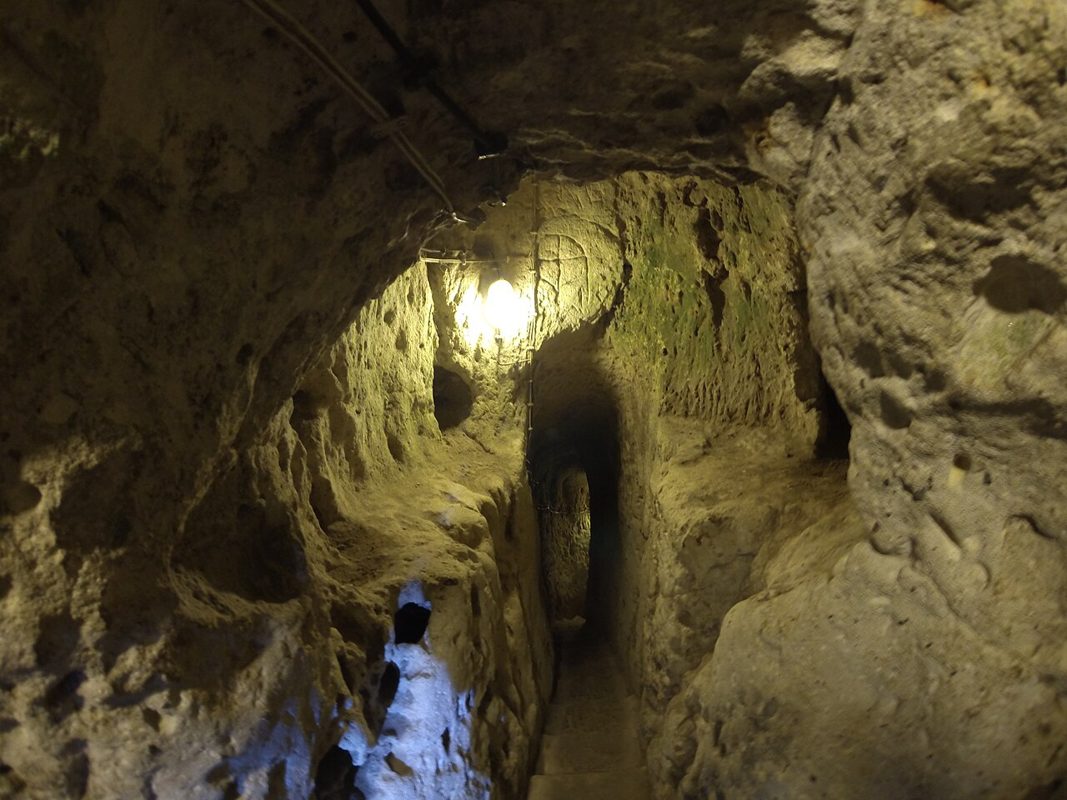
A many-level underground settlement cut into volcanic rock.
Engineers have tracked its rock and air since 1996. No study dates the site itself.
UNESCO links the underground towns to Byzantine refuge from raids.
Haldon says many sites in the region are older than Rome. That claim is for the group, not Derinkuyu.
Site Story & Overview
Derinkuyu is a huge underground settlement cut into soft volcanic rock in Cappadocia, Türkiye. It goes down many floors.
▸ Read Full Archaeological & Engineering Context
People hid there in times of danger. Who first dug it, and when, is still an open question.
✓ What Is Physically Measured on Site
Dated samples, laser scans, stone weights, and dug finds kept separate from opinion.
- Part of a World Heritage listing: UNESCO's listing for Göreme and the Rock Sites of Cappadocia names two underground cities: Kaymaklı and Derinkuyu. [1]
- Many levels deep: A 2024 review by Görkem Günay describes these underground cities as settlements on many levels. Winding passages could be closed with rolling stone doors. Some have wells and air shafts. [3]
- One of about 200: John Haldon's 2024 overview counts some two hundred underground settlements in Cappadocia. He calls the one at Malakopea, now Derinkuyu, the best known. [4]
- Rock tests: Engineers Ömer Aydan and Reşat Ulusay have studied the rock at Derinkuyu since 1996. They tracked heat, damp and air pressure. They also set up sensors on the fifth and seventh floors to watch how the rock behaves. [2]
- No site date: In the sources we opened, no study dates the site itself. The engineering study does not date it. The two 2024 reviews do not give a date for Derinkuyu alone. [2][3][4]
🏛️ Mainstream Archaeological View
- Accepted timeline: No study dates Derinkuyu itself. UNESCO links the underground towns to Byzantine times, when people used them as refuges. A 2024 overview says many of the region's underground sites go back long before the Romans.
- Stone & hardness: Not reported in the sources on this page. Mohs hardness: not reported in our sources.
- Quarry distance & alignment: Stone source not reported in the sources on this page. Orientation: Not reported in the sources on this page.
🧭 Leading Edge Proposal & Open Questions
- UNESCO's summary: Places of refuge: UNESCO says monks began living in rock cells in Cappadocia in the 4th century. Later, to resist Arab raids, people gathered in rock villages and underground towns such as Kaymaklı and Derinkuyu. UNESCO says these served as refuges. [1]
- Interpretation: Haldon (2024): Older than Rome? Haldon says many of the region's underground settlements date back many centuries before the Romans. He is speaking of the whole group, not of Derinkuyu alone. [4]
- Open question: Who dug it first? Günay calls the underground cities more puzzling than other rock-cut sites. In the sources we opened, no study dates the site itself. So when digging began, and who began it, is still open. [3]
Visiting: Derinkuyu Underground City (Cappadocia, Türkiye)
- Derinkuyu Underground City tours and tickets GetYourGuide
- Derinkuyu & Cappadocia underground city tours (search) Viator
FTC affiliate disclosure: Tour links go to GetYourGuide and Viator. Hotel links use Stay22 (aid=solarevidence) for Booking.com and Expedia. If you book a trip, we may earn a small fee at no extra cost to you. All partner links use rel="sponsored nofollow noopener". Check travel alerts before you go. Partner fees never change our ratings. All 87 site field visits · Affiliate disclosure.
Primary Academic Sources
▸ View All Cited Primary Sources & DOIs (4 papers)
- UNESCO World Heritage Centre. Göreme National Park and the Rock Sites of Cappadocia (list no. 357), accessed 3 November 2026 https://whc.unesco.org/en/list/357 background
- Aydan, Ö. & Ulusay, R. (2012). Geomechanical Evaluation of Derinkuyu Antique Underground City and its Implications in Geoengineering. Rock Mechanics and Rock Engineering 46(4): 731–754. doi:10.1007/s00603-012-0301-7 data
- Günay, G. (2024). Byzantine Rock-Cut Architecture in Cappadocia and Beyond: The State of Scholarship. Valonia: A Journal of Anatolian Studies 1(1): 35–63. doi:10.5505/valonia.2024.43531 background
- Haldon, J. (2024). Cappadocia: Old Questions, New Approaches – A Historian's Perspective. Valonia 1(1): 17–33 (an introductory survey). doi:10.5505/valonia.2024.21931 background
Dates and stone checks are summed up in plain English from the papers above. Measured facts stay separate from opinion. Methodology.