Sites › Europe › Dolmen of Menga (Antequera, Spain)
Dolmen of Menga (Antequera, Spain)
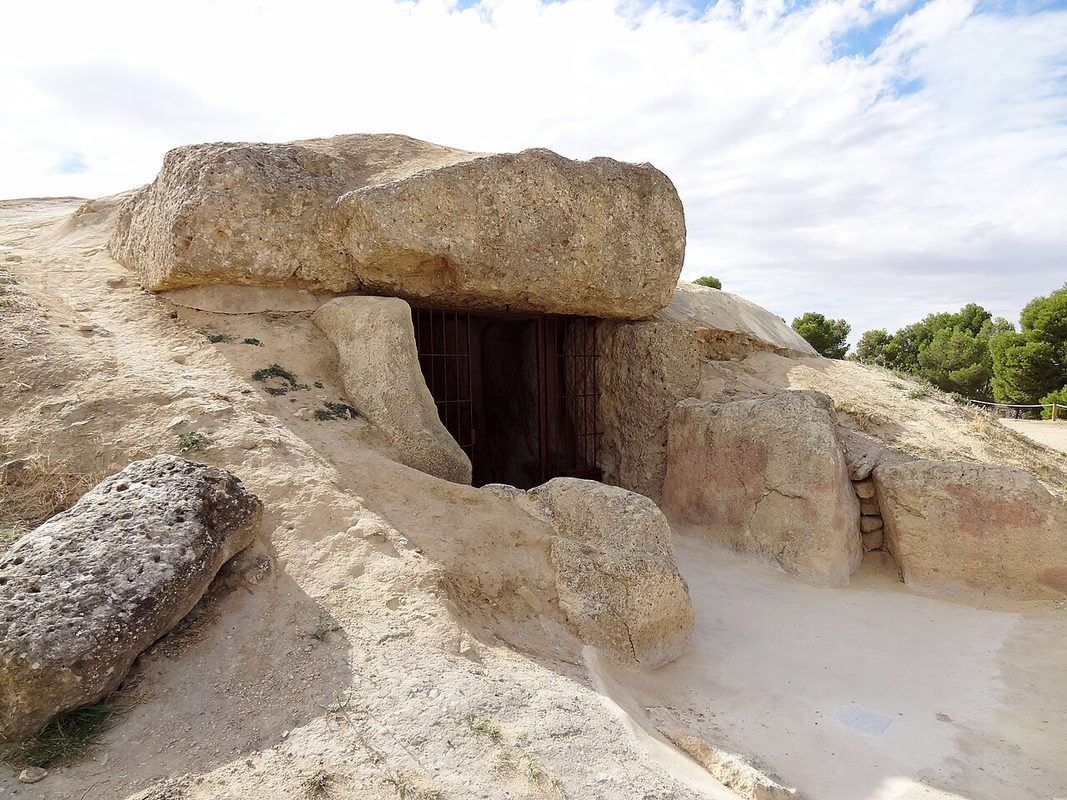
In Plain English — The 30-Second Takeaway
A huge Stone Age stone chamber (dolmen) in southern Spain.
It is 24.9 m long. Its 32 stones weigh about 1,140 t. The biggest is estimated at about 150 t.
It was built about 3800 to 3600 BCE from soft rock quarried about 1 km away.
The 2024 team proposes sledges on wooden tracks. This is proposed, not shown by excavation.
Site Story & Overview
Menga is a huge stone chamber, or dolmen, in Antequera in southern Spain. It was built from 32 giant slabs of soft rock.
▸ Read Full Archaeological & Engineering Context
Its biggest roof stone is estimated at about 150 t. The sources we opened agree on its age and size. How the stones were moved is still an open question.
✓ What Is Physically Measured on Site
Dated samples, laser scans, stone weights, and dug finds kept separate from opinion.
- Date: The 2024 team dates Menga to about 3800 to 3600 BCE. They write that "Menga is the oldest of the great dolmens in Iberia." [1][2]
- How it was dated: A 2022 study used 29 new dates from four methods, including radiocarbon. The authors say this set the date Menga was built. [3]
- Size: Menga is 24.9 m long and up to 5.7 m wide. [1]
- 32 stones: The 2024 team says the 32 stones weigh about 1,140 t in all. [1]
- The biggest roof stone: The largest roof slab is called C-5. Its weight is estimated at about 150 t. The 2024 authors call it the largest stone moved in Iberia as part of the megalith tradition. [1]
- Where the stone came from: The stones are mostly calcarenite, a soft rock. A 2023 study traced them to an outcrop about 1 km away. The 2024 paper names it the Cerro de la Cruz quarry. [2][1]
- Facing a mountain: Its long axis points toward the north cliff of La Peña de los Enamorados, a nearby mountain. UNESCO also notes that Menga faces this mountain. [1][5]
- A well: UNESCO mentions "the deep well inside Menga." [5]
- Later use: Two people were buried in the entrance area in the 8th to 11th centuries CE. The authors say Menga was used as a burial place "four millennia after it was built." [4]
Open questions: how were the stones moved?
The 2024 team gives a likely method. The sources we opened do not show it was tested.
- Open question Moving the slabs: How were slabs of up to about 150 t moved about 1 km from the quarry? The 2024 team proposes sledges on wooden tracks. This is proposed, not shown by excavation. [1][2]
- Open question Setting the roof: The 2024 team says the roof stones were set in order, from C-1 to C-5. Just how they were lifted into place is not shown in the sources we opened. [1]
🏛️ Mainstream Archaeological View
- Accepted timeline: About 3800–3600 BCE (Lozano Rodríguez and colleagues, 2024; same range in their 2023 paper).
- Stone & hardness: Mostly calcarenite, a soft rock (Lozano Rodríguez et al. 2023, 2024) — Mohs hardness not reported (on the 1–10 Mohs scale where a steel knife is ~5.5 and diamond is 10).
- Quarry distance & alignment: Stone source about 1 km (Cerro de la Cruz quarry). Orientation: Long axis toward the north cliff of La Peña de los Enamorados (2024; UNESCO).
🧭 Leading Edge Proposal & Open Questions
- Interpretation: Lozano Rodríguez and colleagues (2024): "Early science": The authors call Menga an example of "early science" among Neolithic societies. They say they know of no earlier building like it in Iberia. This is the authors' reading. [1]
- Interpretation: Lozano Rodríguez and colleagues (2024): Moved on sledges? The team proposes wooden tracks and huge sledges. They say rollers would not have worked well. They call sledges "the most likely method". This is proposed, not shown by excavation. [1]
- Debate status: Any pushback? No published challenge found in the sources we opened. [1][2]
Visiting: Dolmens of Antequera (Andalusia, Spain)
- Antequera tours, including the Dolmens of Menga and Viera GetYourGuide
- Antequera Dolmens tours (search) Viator
FTC affiliate disclosure: Tour links go to GetYourGuide and Viator. Hotel links use Stay22 (aid=solarevidence) for Booking.com and Expedia. If you book a trip, we may earn a small fee at no extra cost to you. All partner links use rel="sponsored nofollow noopener". Check travel alerts before you go. Partner fees never change our ratings. All 87 site field visits · Affiliate disclosure.
Primary Academic Sources
▸ View All Cited Primary Sources & DOIs (5 papers)
- Lozano Rodríguez, J. A., García Sanjuán, L., Jiménez-Espejo, F. J., Álvarez-Valero, A. M., Arrieta, J. M., Fraile-Nuez, E. & others (2024). Early science and colossal stone engineering in Menga, a Neolithic dolmen (Antequera, Spain). Science Advances 10(34): eadp1295 (full text read via Europe PMC). doi:10.1126/sciadv.adp1295 data
- Lozano Rodríguez, J. A., García Sanjuán, L., Álvarez-Valero, A. M., Jiménez-Espejo, F. J., Arrieta, J. M., Fraile-Nuez, E. & others (2023). The provenance of the stones in the Menga dolmen reveals one of the greatest engineering feats of the Neolithic. Scientific Reports 13: 21184. doi:10.1038/s41598-023-47423-y data
- García Sanjuán, L., Medialdea, A., Balsera Nieto, V., Athanassas, C. D., Pike, A. W. G., Standish, C. D. & others (2022). A multimethod approach to the genesis of Menga, a World Heritage megalith. Quaternary Research 111: 1–20 (abstract only). doi:10.1017/qua.2022.33 data
- Soares da Silva, M., García Sanjuán, L., Fichera, A., Oteo-García, G., Foody, M. G. B. & others (2026; online December 2025). Genetic and historical perspectives on the early medieval inhumations from the Menga dolmen, Antequera (Spain). Journal of Archaeological Science: Reports 69: 105559 (abstract read). doi:10.1016/j.jasrep.2025.105559 data
- UNESCO World Heritage Centre. Antequera Dolmens Site (list no. 1501), accessed 3 November 2026 https://whc.unesco.org/en/list/1501/ background
Dates and stone checks are summed up in plain English from the papers above. Measured facts stay separate from opinion. Methodology.