△ TruthInStone

Sites › Africa › Heliopolis (Matariya, Cairo, Egypt)

Heliopolis (Matariya, Cairo, Egypt)

Heliopolis (Matariya, Cairo, Egypt)
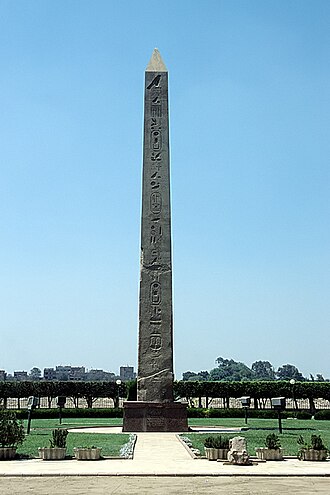
Image: Roland Unger, Wikimedia Commons, CC BY-SA 3.0. Resized; not otherwise altered. All credits.
📍 Where It Is Matariya, northeast Cairo, Egypt 30.1293°, 31.3075°
🏛️ Mainstream Date Fourth millennium BCE to Late Period (dug finds) Excavated baseline
🧭 Leading Edge / Open Angle Labelled claims: pyramid alignments and sun-cult questions Debated or newly revised
🪨 Heaviest Stone & Quarry Obelisk of Senusret I still standing (weight not in our sources) Compare all 64 sites →
30-SECOND TAKEAWAY

In Plain English — The 30-Second Takeaway

What It Is:

Heliopolis was the ancient City of the Sun. Today its temple ruins lie under the Matariya district of Cairo.

What Everyone Agrees On (Measured Facts):

Digs have found the stone footings of a Late Period temple and a buried deposit of broken sphinx heads. Older finds include a stone blade workshop from the fourth millennium BCE.

🏛️ Mainstream Archaeology View:

Scholars see Heliopolis as a major temple city used for thousands of years. Its remains now lie under metres of Nile mud and the modern city.

🧭 Leading Edge View:

Some researchers link the layout of the pyramid fields to Heliopolis. Others say much about its sun cult is still unproven.

Site Story & Overview

Heliopolis, the City of the Sun, lies under Matariya in northeast Cairo. Its great temple was a center of the sun cult.

▸ Read Full Archaeological & Engineering Context

In ancient times its monuments were torn down and rebuilt many times, and their stone was reused. Today the remains lie under m of Nile mud and the modern city. In 2022 the Egyptian-German mission dug two seasons near the Matariya museum, by the obelisk of Senusret I. Its finds include the footings of a Late Period temple and a buried deposit of broken sphinx heads. The team thinks the heads were ritually broken and burnt first, perhaps to make the statues powerless before their bodies were reused. That is an reading of the damage. Image: the obelisk of Senusret I at el-Matariya, 2001 (Roland Unger, CC BY-SA 3.0).

✓ What Is Physically Measured on Site

Dated samples, laser scans, stone weights, and dug finds kept separate from opinion.

🏛️ Mainstream Archaeological View

  • Accepted timeline: Ancient Heliopolis was a major temple city and a center of the sun cult. Digs have found stone-tool workshops from the fourth millennium BCE. They have also found statue pieces from the Middle and New Kingdoms and a Late Period temple. The obelisk of Senusret I still stands.
  • Stone & hardness: Not reported in the sources on this page. Mohs hardness: not reported in our sources.
  • Quarry distance & alignment: Stone source not reported in the sources on this page. Orientation: Not reported in the sources on this page.

🧭 Leading Edge Proposal & Open Questions

  • Archaeoastronomy claim: Giulio Magli (2010): Pyramids lined up on Heliopolis: Archaeoastronomer Giulio Magli argues that Old Kingdom pyramid fields were laid out with Heliopolis in mind. The south-east corners of the Giza pyramids line up toward its temple. At Abusir, three pyramids line up toward it too, though the temple could not be seen from there. The line-up is a known finding. That kings planned it on purpose is his reading. [3]
  • Open question: Nuzzolo & Krejčí (2017): How much do we know about the sun cult? Massimiliano Nuzzolo and Jaromír Krejčí re-checked the evidence for Heliopolis in the third millennium BC. They argue that some common assumptions about its role in the sun cult are far from proven. [4]

📚 Further Reading: Both Sides of the Argument

Top books from both sides of the debate on this topic. Browse all 34 books on Books & Further Reading or visit our Search for the Truth Bookshop.org storefront.

Bridge / Debate History 2013

Architecture, Astronomy and Sacred Landscape in Ancient Egypt

Giulio Magli

An archaeoastronomer's study of how Egyptian pyramids and temples were placed in the landscape and aligned to the sky, with the Old Kingdom pyramid fields and the sun cult of Heliopolis among its case studies.

▸ Why this book matters to both sides

An archaeoastronomer's study of how Egyptian pyramids and temples were placed in the landscape and aligned to the sky, with the Old Kingdom pyramid fields and the sun cult of Heliopolis among its case studies.

Role in the debate: Sets out measured sightlines next to the author's own reading of what the builders intended, so readers can weigh the geometry against the reading. (ISBN 9781107032088)

Mainstream Baseline 2017 ★ 4.7/5

Giza and the Pyramids: The Definitive History

Mark Lehner & Zahi Hawass

The Giza dig leaders share 30 years of finds, from the workers' town and stone quarries to Old Kingdom carbon dates.

▸ Why this book matters to both sides

The Giza dig teams' own large-format overview of decades of fieldwork on the plateau. It records the Heit el-Ghurab workers' town, limestone quarries, ramp remnants, and Old Kingdom carbon dates.

Role in the debate: Provides the primary archaeological and soil-layer baseline at Giza against which older-Sphinx, legacy-foundation, and precision-machining proposals are tested. (ISBN 9780226425696)

Leading Edge 1994 ★ 4.6/5

The Orion Mystery: Unlocking the Secrets of the Pyramids

Robert Bauval & Adrian Gilbert

The book that launched the Orion Correlation, matching the three Giza pyramids to the three stars of Orion's Belt.

▸ Why this book matters to both sides

The book that launched the Orion Correlation Theory, matching the ground plan of Khufu, Khafre, and Menkaure and the angles of the Great Pyramid's four internal shafts to Orion's Belt and Sirius.

Role in the debate: Allows readers to examine Bauval's original shaft-angle and layout geometry alongside mainstream Egyptological and sky-sightline critiques. (ISBN 9780517884546)

FTC affiliate disclosure: Book links go to Bookshop.org (ID 130218, Search for the Truth). Each sale helps local bookstores and pays us a 10% fee at no extra cost to you. All partner links use rel="sponsored nofollow noopener". Fees never change our verdicts. Affiliate disclosure.

Primary Academic Sources

▸ View All Cited Primary Sources & DOIs (4 papers)
  1. Connor, S., Ashmawy, A. & Raue, D. (2024). Beheaded, Burnt, and Buried: A Deposit of Royal Statue Fragments in the Temple of Heliopolis. Bulletin de l'Institut français d'archéologie orientale 124: 129–163. doi:10.4000/129n2 data
  2. Manclossi, F., Lombardi, L., Marsilio, A., Ugliano, F. & Lucarini, G. (2026). Crafting complexity: blade production and socio-economic transitions in Predynastic Heliopolis, Egypt (fourth millennium BCE). Journal of Anthropological Archaeology 84: 101819. doi:10.1016/j.jaa.2026.101819 data
  3. Magli, G. (2010). Topography, astronomy and dynastic history in the alignments of the pyramid fields of the Old Kingdom. Mediterranean Archaeology and Archaeometry 10(2): 59–74 (preprint arXiv:0903.1416). https://arxiv.org/abs/0903.1416 proponent
  4. Nuzzolo, M. & Krejčí, J. (2017). Heliopolis and the Solar Cult in the Third Millennium BC. Ägypten und Levante 27: 357–380. doi:10.1553/aeundl27s357 · PDF (backup, austriaca.at) background

Dates and stone checks are summed up in plain English from the papers above. Measured facts stay separate from opinion. Methodology.