△ TruthInStone

Sites › Asia › Liangzhu ancient city and dams

Liangzhu ancient city and dams

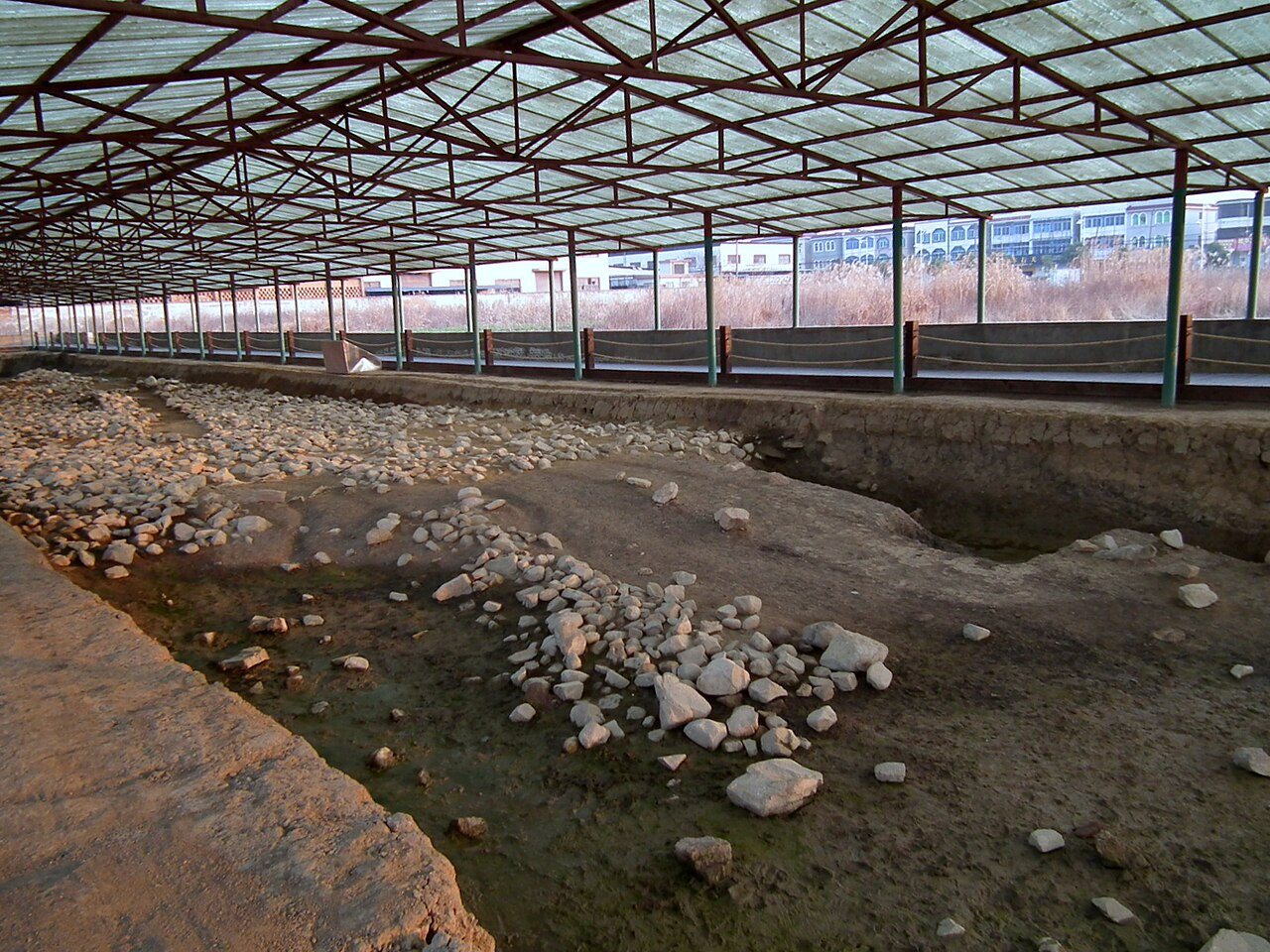
Liangzhu ancient city and dams
Image: LukeLOU, Wikimedia Commons, CC BY-SA 3.0. Resized; not otherwise altered. All credits.
📍 Where It Is Yuhang District, Hangzhou, Zhejiang Province, China 30.3956°, 119.9917°
🏛️ Mainstream Date c. 3300–2300 BCE (Late Neolithic Liangzhu culture) Excavated baseline
🧭 Leading Edge / Open Angle Oldest large-scale dam and flood-control network in East Asia Debated or newly revised
🪨 Heaviest Stone & Quarry 2.88 million m³ of engineered clay & grass-bag dams (5-km levee) 0.1× the 40-ton test limit · Compare all 64 sites →
30-SECOND TAKEAWAY

In Plain English — The 30-Second Takeaway

What It Is:

Liangzhu is a 5,000-year-old walled river city in eastern China surrounded by eleven huge earthen dams. Also, a 5-kilometer flood levee.

What Everyone Agrees On (Measured Facts):

Carbon dates on woven grass bags inside the dams show builders moved nearly 3 million cubic meters of earth between 3200 and 2800 BCE.

🏛️ Mainstream Archaeology View:

Dig teams and cave stalagmite records show the city thrived on rice farming. It also carved jade. Then, extreme monsoon floods around 2340 BCE forced its abandonment.

🧭 Leading Edge View:

Liangzhu pushed the start of large-scale hydraulic building and urban planning in China back past 3000 BCE.

Site Story & Overview

One of the oldest large-scale water-management systems known anywhere, built before most of the walled city it protected. UNESCO World Heritage Site since 2019.

✓ What Is Physically Measured on Site

Dated samples, laser scans, stone weights, and dug finds kept separate from opinion.

How carbon dates work, and their limits: How we date sites.

🏛️ Mainstream Archaeological View

  • Accepted timeline: Liangzhu culture, about 3300–2300 BCE (5,300–4,300 years ago (cal BP)). City about 300 ha.
  • Stone & hardness: Grass-wrapped silt/clay bags ('caoguoni'), rammed earth, stone foundations & nephrite jade — Mohs hardness 2.0 (Earth/stone dams; carved nephrite jade Mohs 6.0–6.5) (on the 1–10 Mohs scale where a steel knife is ~5.5 and diamond is 10).
  • Quarry distance & alignment: Stone source 1–6 km (Dazhe Mountain footstone & local wetlands). Orientation: North–south urban wall and palace grid.

🧭 Leading Edge Proposal & Open Questions

  • Timeline consensus: Liangzhu pushed the start of large-scale hydraulic building and urban planning in China back past 3000 BCE.
  • Engineering comparison: Heaviest unit is 2.88 million m³ in hydraulic dams + 30 ha Mojiaoshan palace platform (stone plinths ~2–5 t) (1–6 km (Dazhe Mountain footstone & local wetlands)). See how it compares in our 64-Site Scale-Gap Explorer.

Visiting & base stays: Liangzhu Ancient City, Mojiaoshan Palace & Hydraulic Dams (Hangzhou, China)

FTC affiliate disclosure: Tour links go to GetYourGuide and Viator. Hotel links use Stay22 (aid=solarevidence) for Booking.com and Expedia. If you book a trip, we may earn a small fee at no extra cost to you. All partner links use rel="sponsored nofollow noopener". Check travel alerts before you go. Partner fees never change our ratings. All 64 site field visits · Affiliate disclosure.

📚 Further Reading: Both Sides of the Argument

Top books from both sides of the debate on this topic. Browse all 34 books on Books & Further Reading or visit our Search for the Truth Bookshop.org storefront.

Mainstream Baseline 2003 ★ 4.5/5

After the Ice: A Global Human History, 20,000–5000 BC

Steven Mithen

Follows human life across every continent from the peak of the Ice Age (20,000 BCE) to early farming towns (5000 BCE).

▸ Why this book matters to both sides

A continent-by-continent narrative of human life from the Last Glacial Maximum to 5000 BCE, built directly from excavation reports across the Near East (including Göbekli Tepe), Europe, Asia, and the Americas.

Role in the debate: Provides the archaeological baseline for what human populations were building, hunting, and cultivating before, during, and right after the Younger Dryas. (ISBN 9780674019997)

Mainstream Baseline 2021 ★ 4.5/5

The Dawn of Everything: A New History of Humanity

David Graeber & David Wengrow

Examines how hunter-gatherers built giant stone sites like Göbekli Tepe and Poverty Point without kings or farming.

▸ Why this book matters to both sides

An culture scholar and an archaeologist examine Göbekli Tepe, Karahan Tepe, Poverty Point, Watson Brake, and Teotihuacan. It challenges the textbook step-by-step ladder from small hunter-gatherer bands to states.

Role in the debate: Shows how mainstream archaeology accounts for giant buildings built by hunter-gatherers (Göbekli Tepe, Poverty Point) without invoking a single global parent culture. (ISBN 9781250858801)

Mainstream Baseline 1998 ★ 4.4/5

Noah's Flood: The New Scientific Discoveries About the Event That Changed History

William Ryan & Walter Pitman

Two ocean geologists share seabed cores showing the Black Sea flooded rapidly around 5600 BCE.

▸ Why this book matters to both sides

Two Columbia University marine geologists present seabed cores, drowned shorelines, and sonar profiles for a rapid flooding of the freshwater Black Sea basin around 5600 BCE.

Role in the debate: Demonstrates how marine geologists test whether ancient Near Eastern deluge traditions preserve a real Holocene coastal inundation. (ISBN 9780684859200)

Leading Edge 2002 ★ 4.6/5

Underworld: The Mysterious Origins of Civilization

Graham Hancock

Combines Ice Age sea-level flood maps with scuba dives at submerged ruins off India, Japan, Malta, and Bimini.

▸ Why this book matters to both sides

Combines Glenn Milne's post-glacial sea-level inundation maps with scuba studies at India's Gulf of Khambhat and Dwarka, Japan's Yonaguni terraces, Malta, and Bimini.

Role in the debate: Frames the submerged-shelf debate over whether features at Yonaguni, Dwarka, and Bimini are human-modified monuments drowned by Meltwater pulses or natural coastal geology. (ISBN 9781400049516)

FTC affiliate disclosure: Book links go to Bookshop.org (ID 130218, Search for the Truth). Each sale helps local bookstores and pays us a 10% fee at no extra cost to you. All partner links use rel="sponsored nofollow noopener". Fees never change our verdicts. Affiliate disclosure.

Primary Academic Sources

▸ View All Cited Primary Sources & DOIs (3 papers)
  1. Liu, B. et al. (2017). Earliest hydraulic enterprise in China, 5,100 years ago. PNAS 114 (a correction was later issued). doi:10.1073/pnas.1710516114 data
  2. Zhang, H. et al. (2021). Collapse of the Liangzhu and other Neolithic cultures in the lower Yangtze region in response to climate change. Science Advances 7. doi:10.1126/sciadv.abi9275 data
  3. UNESCO World Heritage Centre: Archaeological Ruins of Liangzhu City (inscribed 2019). https://whc.unesco.org/en/list/1592/ background

Dates and stone checks are summed up in plain English from the papers above. Measured facts stay separate from opinion. Methodology.