Sites › Europe › Megalithic Temples of Malta and the Ħal Saflieni Hypogeum
Megalithic Temples of Malta and the Ħal Saflieni Hypogeum
In Plain English — The 30-Second Takeaway
Stone temples and an underground burial place on the islands of Malta.
Six temple sites. The Hypogeum held about 7,000 people. Three genomes show a tiny, inbred population.
Scholars see the temples as the work of Malta's Neolithic farmers.
The DNA team thinks the sea kept the islanders apart from others.
Site Story & Overview
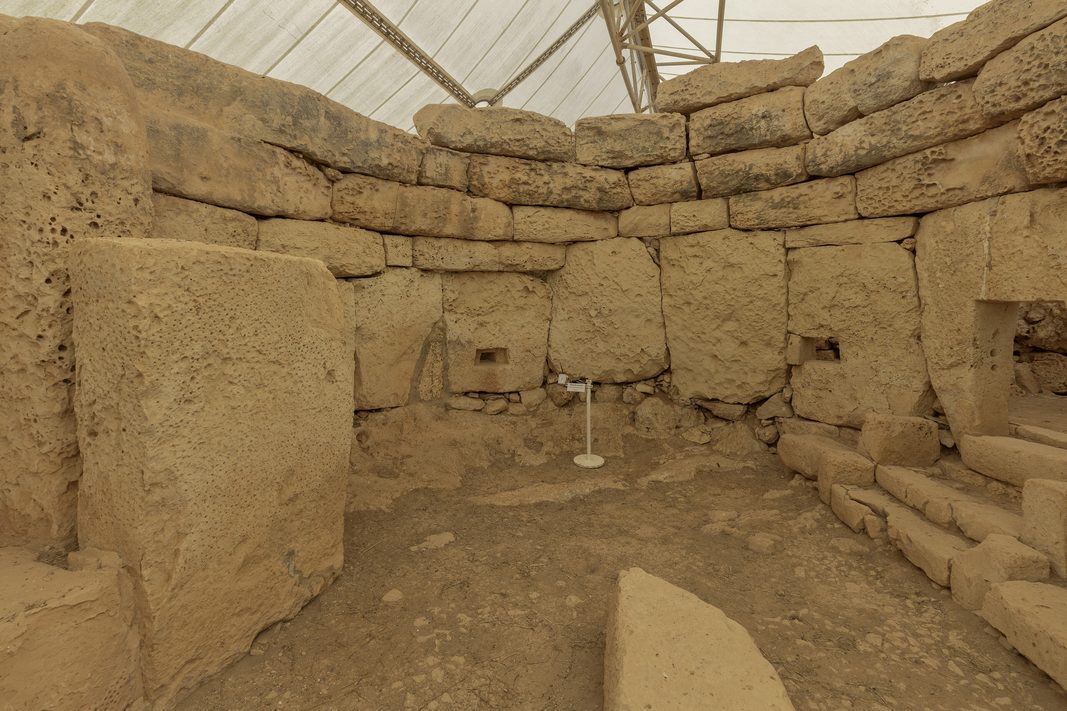
Malta's stone temples are among the oldest known free-standing stone buildings. They were built by farming people on these small islands thousands of years ago.
▸ Read Full Archaeological & Engineering Context
Nearby, the Ħal Saflieni Hypogeum is a burial place cut deep into the rock. A 2022 DNA study looked at how cut off these island farmers were.
✓ What Is Physically Measured on Site
Dated samples, laser scans, stone weights, and dug finds kept separate from opinion.
- Six temple sites: UNESCO's listing covers Ġgantija, Ħaġar Qim, Mnajdra, Skorba, Ta' Ħaġrat and Tarxien. It says they are among the earliest free-standing stone buildings in the world. [1]
- Upright slabs and corbelled roofs: The walls are made of upright stone slabs topped by flat blocks. UNESCO says the surviving courses show the roofs were corbelled, with each layer of stone set a little farther in. [1]
- An underground burial place: The Hypogeum was found in 1902. It has three levels cut into soft limestone with chert, flint and obsidian tools and antlers. It once held the remains of about 7,000 people. The lowest level is 10.6 m below today's ground. [2]
- DNA from three people: A 2022 study read three Late Neolithic genomes from Malta. They came from the Xagħra Circle on Gozo, a burial site, not a temple. One burial in the same layer as a sampled person dates to 2900–2650 BC. The genomes show long stretches of matching DNA, a sign of inbreeding, and a population of only a few hundred. [3]
- No new mixing: On the mainland, Late Neolithic farmers gained new hunter-gatherer ancestry. The Maltese genomes do not show this. [3]
🏛️ Mainstream Archaeological View
- Accepted timeline: Stone temples built in the 4th and 3rd millennia BC, per UNESCO. The Ħal Saflieni Hypogeum, an underground burial place, was used from about 4000 to 2500 BC.
- Stone & hardness: Not reported in the sources on this page. Mohs hardness: not reported in our sources.
- Quarry distance & alignment: Stone source not reported in the sources on this page. Orientation: Not reported in the sources on this page.
🧭 Leading Edge Proposal & Open Questions
- Interpretation: Ariano and colleagues (2022): Cut off by the sea? The authors read the genomes as a sign that the sea kept Malta's farmers apart from others. They say that for this group, the sea worked more like a barrier than a highway. [3]
Primary Academic Sources
▸ View All Cited Primary Sources & DOIs (3 papers)
- UNESCO World Heritage Centre. Megalithic Temples of Malta (list no. 132), accessed 2 November 2026 https://whc.unesco.org/en/list/132 background
- UNESCO World Heritage Centre. Ħal Saflieni Hypogeum (list no. 130), accessed 2 November 2026 https://whc.unesco.org/en/list/130 background
- Ariano, B., Mattiangeli, V., Breslin, E. M., Parkinson, E. W., McLaughlin, T. R., Thompson, J. E. & others (2022). Ancient Maltese genomes and the genetic geography of Neolithic Europe. Current Biology 32(12): 2668–2680. doi:10.1016/j.cub.2022.04.069 data
Dates and stone checks are summed up in plain English from the papers above. Measured facts stay separate from opinion. Methodology.