△ TruthInStone

Sites › Asia › Mohenjo-daro

Mohenjo-daro

Mohenjo-daro
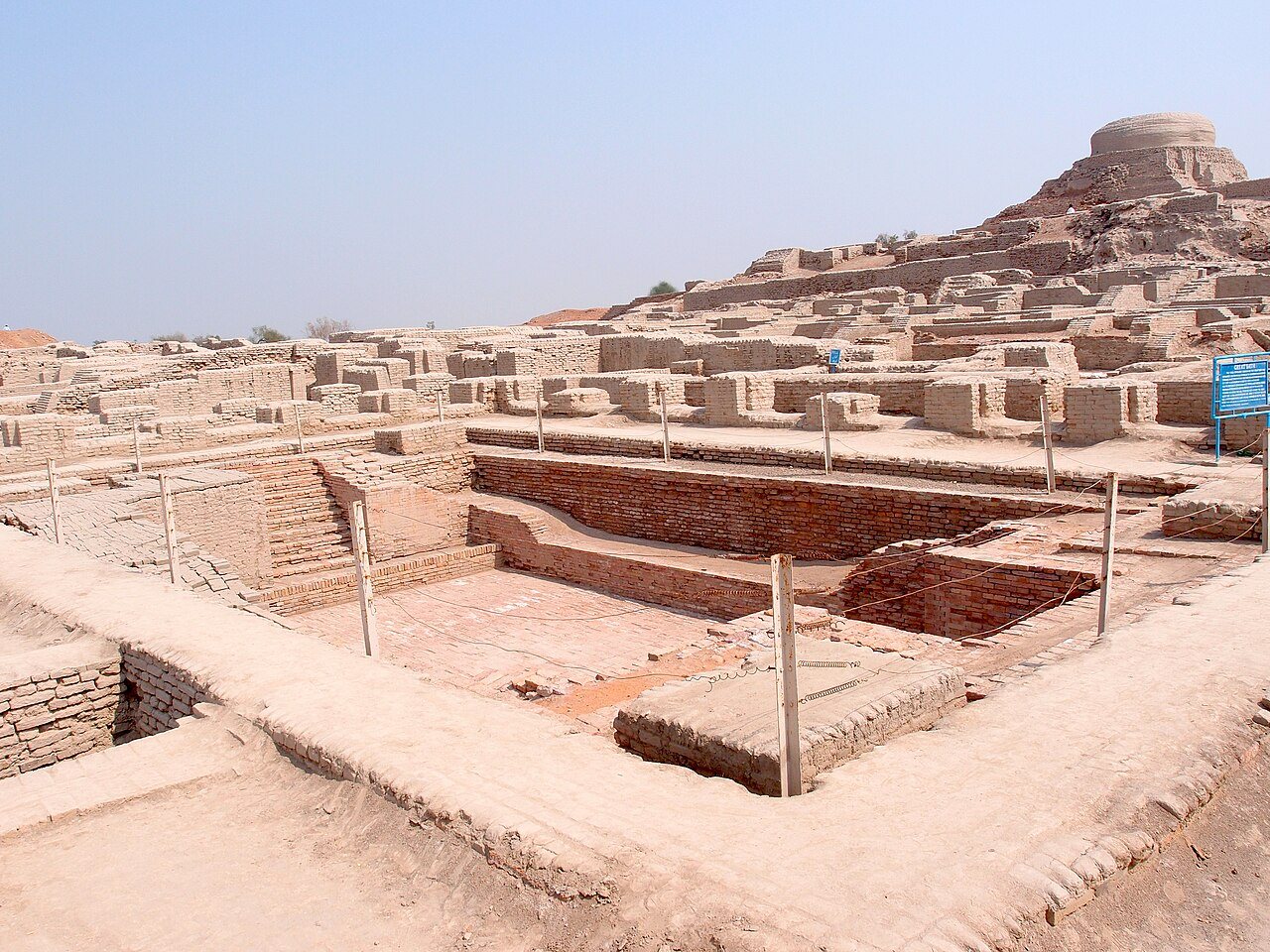
Image: Saqib Qayyum, Wikimedia Commons, CC BY-SA 3.0. Resized; not otherwise altered. All credits.
📍 Where It Is Larkana District, Sindh Province, Pakistan 27.3242°, 68.1375°
🏛️ Mainstream Date c. 2600–1900 BCE (Mature Harappan / Indus Civilization) Excavated baseline
🧭 Leading Edge / Open Angle Deepest foundation layers sit unexplored below the groundwater table Debated or newly revised
🪨 Heaviest Stone & Quarry Millions of standardized baked bricks + 1–2-ton limestone statues 0.0× the 40-ton test limit · Compare all 64 sites →
30-SECOND TAKEAWAY

In Plain English — The 30-Second Takeaway

What It Is:

Mohenjo-daro in Pakistan was the largest city of the Bronze Age Indus Civilization, built with straight grid streets, two-story brick homes. Indoor plumbing.

What Everyone Agrees On (Measured Facts):

The waterproofing of the Great Bath used natural bitumen tar. Five new 2026 carbon tests on the mudbrick city wall returned dates around 2700–2600 BCE.

🏛️ Mainstream Archaeology View:

Scholars attribute the city's decline after 1900 BCE to shifting Indus river channels and weaker monsoon rains.

🧭 Leading Edge View:

Because high groundwater blocks digging at the bottom of the mound, the city's earliest founding layers remain undug.

Site Story & Overview

One of the largest and best-planned Bronze Age cities, with the Great Bath, brick drains and grid streets. The headline dates are often quoted as settled, but the primary record shows how little of the site itself has been dated.

▸ Read Full Archaeological & Engineering Context

The 2025–26 work is the first new dating in decades. UNESCO World Heritage Site since 1980.

✓ What Is Physically Measured on Site

Dated samples, laser scans, stone weights, and dug finds kept separate from opinion.

How carbon dates work, and their limits: How we date sites.

🏛️ Mainstream Archaeological View

  • Accepted timeline: Indus (Harappan) city, about 2600–1900 BCE, with earlier roots possibly to about 3500 BCE.
  • Stone & hardness: Kiln-fired brick, sun-dried mudbrick, gypsum/bitumen mortar & limestone sculpture — Mohs hardness 4.0 (Kiln-fired brick) (on the 1–10 Mohs scale where a steel knife is ~5.5 and diamond is 10).
  • Quarry distance & alignment: Stone source Indus River alluvial clays (<2 km; Rohri Hills chert ~100 km). Orientation: Strict cardinal North–South and East–West street grid.

🧭 Leading Edge Proposal & Open Questions

  • Timeline consensus: Because high groundwater blocks digging at the bottom of the mound, the city's earliest founding layers remain undug.
  • Engineering comparison: Heaviest unit is Massive baked-brick & mud-brick Citadel platforms (millions of standardised 1:2:4 bricks) (Indus River alluvial clays (<2 km; Rohri Hills chert ~100 km)). See how it compares in our 64-Site Scale-Gap Explorer.

Visiting & base stays: Mohenjo-daro Citadel, Great Bath & National Museum (Karachi / Larkana base, Pakistan)

Travel advisory note: Check official government travel advisories for Sindh Province before arranging overland travel between Karachi and Larkana.

FTC affiliate disclosure: Tour links go to GetYourGuide and Viator. Hotel links use Stay22 (aid=solarevidence) for Booking.com and Expedia. If you book a trip, we may earn a small fee at no extra cost to you. All partner links use rel="sponsored nofollow noopener". Check travel alerts before you go. Partner fees never change our ratings. All 64 site field visits · Affiliate disclosure.

📚 Further Reading: Both Sides of the Argument

Top books from both sides of the debate on this topic. Browse all 34 books on Books & Further Reading or visit our Search for the Truth Bookshop.org storefront.

Mainstream Baseline 2021 ★ 4.6/5

1177 B.C.: The Year Civilization Collapsed (Revised & Updated)

Eric H. Cline

Explains how Bronze Age kingdoms around the Mediterranean collapsed within decades from drought, quakes, and broken trade.

▸ Why this book matters to both sides

Tests how the globalized Bronze Age kingdoms of Egypt, Hatti, Mycenae, and Ugarit collapsed within a few decades through interlocking megadrought, earthquake storms, famine, and cut trade networks.

Role in the debate: Provides a benchmark case study of how archaeologists use pollen cores, ancient climate proxies, seismic horizons, and royal letters to reconstruct a rapid multi-civilizational collapse. (ISBN 9780691208015)

Mainstream Baseline 2003 ★ 4.5/5

After the Ice: A Global Human History, 20,000–5000 BC

Steven Mithen

Follows human life across every continent from the peak of the Ice Age (20,000 BCE) to early farming towns (5000 BCE).

▸ Why this book matters to both sides

A continent-by-continent narrative of human life from the Last Glacial Maximum to 5000 BCE, built directly from excavation reports across the Near East (including Göbekli Tepe), Europe, Asia, and the Americas.

Role in the debate: Provides the archaeological baseline for what human populations were building, hunting, and cultivating before, during, and right after the Younger Dryas. (ISBN 9780674019997)

Leading Edge 2002 ★ 4.6/5

Underworld: The Mysterious Origins of Civilization

Graham Hancock

Combines Ice Age sea-level flood maps with scuba dives at submerged ruins off India, Japan, Malta, and Bimini.

▸ Why this book matters to both sides

Combines Glenn Milne's post-glacial sea-level inundation maps with scuba studies at India's Gulf of Khambhat and Dwarka, Japan's Yonaguni terraces, Malta, and Bimini.

Role in the debate: Frames the submerged-shelf debate over whether features at Yonaguni, Dwarka, and Bimini are human-modified monuments drowned by Meltwater pulses or natural coastal geology. (ISBN 9781400049516)

Leading Edge 1955 ★ 4.7/5

Earth in Upheaval

Immanuel Velikovsky

A 1955 classic that pointed to flipped magnetic lava rocks, frozen Alaskan mammoths, and sudden climate shifts before modern geology accepted them.

▸ Why this book matters to both sides

Deliberately omitting folklore, Velikovsky's 1955 geological volume compiled reversed-polarity basalt lavas (Ch. IX, 'Poles Displaced'), Alaskan 'muck' giant-animal bone beds, polar coal seams, and raised beaches. It challenges strict 1950s gradualism.

Role in the debate: Spotlights where Velikovsky was ahead of 1955 consensus—insisting reversed lavas recorded real geomagnetic reversals 8 years before Cox, Doell & Dalrymple (1963) and pointing to 1st-millennium BCE archaeomagnetic anomalies before the ~1050–700 BCE Levantine Iron Age spike was found—while K–Ar dating, plate tectonics, and AMS C-14 separated those formations across millions of years rather than a 1500 BCE axial flip. (ISBN 9781906833121)

FTC affiliate disclosure: Book links go to Bookshop.org (ID 130218, Search for the Truth). Each sale helps local bookstores and pays us a 10% fee at no extra cost to you. All partner links use rel="sponsored nofollow noopener". Fees never change our verdicts. Affiliate disclosure.

Primary Academic Sources

▸ View All Cited Primary Sources & DOIs (6 papers)
  1. Harappa.com: What has been the basis for determining the age of the Indus Valley civilization? (Kenoyer, quoted). https://www.harappa.com/answers/what-has-been-basis-determining-age-i… background
  2. Kenoyer, J. M. (2008). Indus urbanism: new perspectives on its origin and character. In The Ancient City (NAS Sackler Colloquium); author's manuscript, harappa.com (PDF). https://www.harappa.com/sites/default/files/pdf/Kenoyer2008%20Indus%2… background
  3. Arab News Pakistan (22 March 2026). New excavations show Mohenjo-daro is older than thought (reporting the Sindh DGAA statement on the 2025–26 excavations). https://www.arabnews.pk/pakistan/new-excavations-show-mohenjo-daro-an… background
  4. Possehl, G. L. (1997). The transformation of the Indus Civilization. Journal of World Prehistory 11. doi:10.1007/BF02220556 data
  5. Giosan, L. et al. (2012). Fluvial landscapes of the Harappan civilization. PNAS 109. doi:10.1073/pnas.1112743109 data
  6. UNESCO World Heritage Centre: Archaeological Ruins at Moenjodaro (inscribed 1980). https://whc.unesco.org/en/list/138/ background

Dates and stone checks are summed up in plain English from the papers above. Measured facts stay separate from opinion. Methodology.