Sites › Europe › Nebra Sky Disc (Mittelberg, Germany)
Nebra Sky Disc (Mittelberg, Germany)
In Plain English — The 30-Second Takeaway
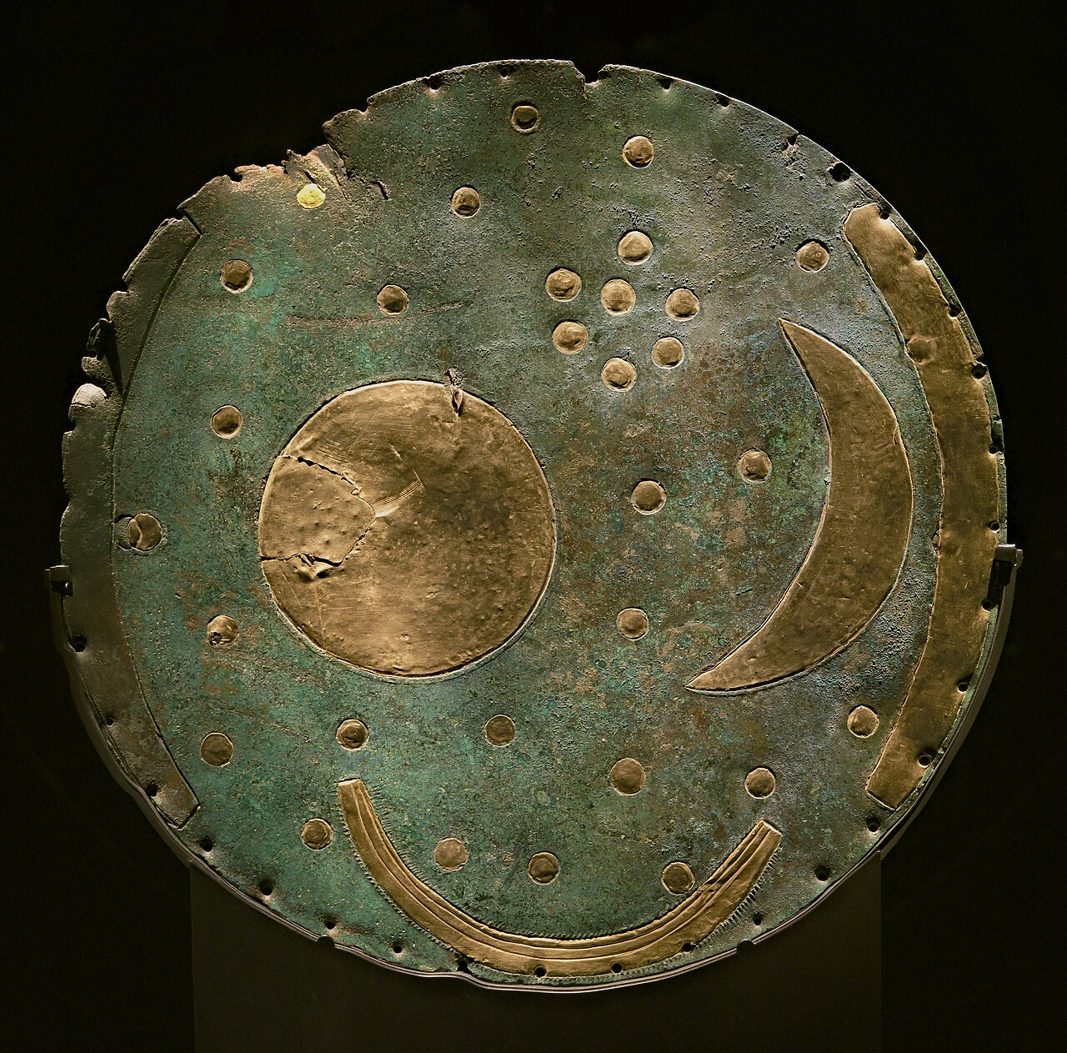
A bronze disc with shapes of the sky. It is an artifact with a dating dispute.
Bark in swords from the hoard dates to the 16th–15th centuries BC.
Most work dates the disc with its hoard to about 1600 BC.
Two critics say the disc may not belong with the hoard and may be younger.
Site Story & Overview
The Nebra Sky Disc is a bronze disc with shapes of the sky, found on a hill in eastern Germany. The disc is an artifact with a dating dispute.
▸ Read Full Archaeological & Engineering Context
Most work dates it to the Early Bronze Age. Two critics say it is younger and may not belong with the hoard.
✓ What Is Physically Measured on Site
Dated samples, laser scans, stone weights, and dug finds kept separate from opinion.
- An illegal dig: The disc was reportedly dug up in 1999 by looters, as part of a hoard. Gebhard and Krause (2020) give this account. [2]
- Found with it: The Halle museum says the hoard held swords, axes, a chisel and arm spirals. It says the axes are a type typical of about 1600 BC. [3]
- Bark in the swords: The museum says birch bark in the sword handles was radiocarbon dated to the 16th to 15th centuries BC. [3]
- Not modern metal: The museum says the disc's bronze has no measurable radioactive lead. Newly made metal would still show it for about 100 years. [3]
- How it was made: A 2024 metal study says the disc was cast flat, then hammered while hot. It was heated and hammered about 10 times. [4]
- No direct date: Pernicka and colleagues (2020) say no method can yet date copper alloys exactly. So the date rests on the find spot and the objects found with it. [1]
🏛️ Mainstream Archaeological View
- Accepted timeline: Its keepers date the disc by the objects said to be found with it, to about 1600 BC. Two scholars argue it belongs to the first millennium BC.
- Stone & hardness: Not reported in the sources on this page. Mohs hardness: not reported in our sources.
- Quarry distance & alignment: Stone source not reported in the sources on this page. Orientation: Not reported in the sources on this page.
🧭 Leading Edge Proposal & Open Questions
- Contested: Gebhard and Krause (2020): Not a closed hoard? The authors say the dig results do not show the objects were buried together at that spot. Taken on its own, they say, the disc fits the first millennium BC best. [2]
- Contested: Pernicka and colleagues (2020): A reply: The authors say their critics leave out many later studies. They say soil traces, metal tests, police work and the looters' confession all link the disc to the hoard and the hill. [1]
- Open question: Which age? The disc is an artifact with a dating dispute. The disc cannot be dated on its own. The answer depends on whether it was truly found with the hoard. [1][2]
Primary Academic Sources
▸ View All Cited Primary Sources & DOIs (4 papers)
- Pernicka, E., Adam, J., Borg, G., Brügmann, G. & others (2020). Why the Nebra Sky Disc Dates to the Early Bronze Age. An Overview of the Interdisciplinary Results. Archaeologia Austriaca 104: 89–122. doi:10.1553/archaeologia104s89 data
- Gebhard, R. & Krause, R. (2020). Critical comments on the find complex of the so-called Nebra Sky Disk. Archäologische Informationen 43 (critical comment article; peer review not confirmed). doi:10.11588/ai.2020.1.81419 critique
- State Museum of Prehistory Halle (Saale). Nebra Sky Disc – Dating, accessed 3 November 2026 https://www.landesmuseum-vorgeschichte.de/en/nebra-sky-disc/dating background
- Dieck, S., Michael, O., Wilke, M., Halle, T. & others (2024). Archaeometallurgical investigation of the Nebra Sky Disc. Scientific Reports 14: 28868. doi:10.1038/s41598-024-80545-5 data
Dates and stone checks are summed up in plain English from the papers above. Measured facts stay separate from opinion. Methodology.