Sites › Europe › Newgrange (Brú na Bóinne, Ireland)
Newgrange (Brú na Bóinne, Ireland)
In Plain English — The 30-Second Takeaway
A huge Neolithic tomb mound in Ireland's Boyne valley.
A man buried deep inside was the child of very close relatives. His kin were buried 150 km away.
Scholars see Brú na Bóinne as a major Neolithic burial landscape.
The DNA team argues for a ruling family line, a 'dynastic elite'. That is their interpretation.
Site Story & Overview
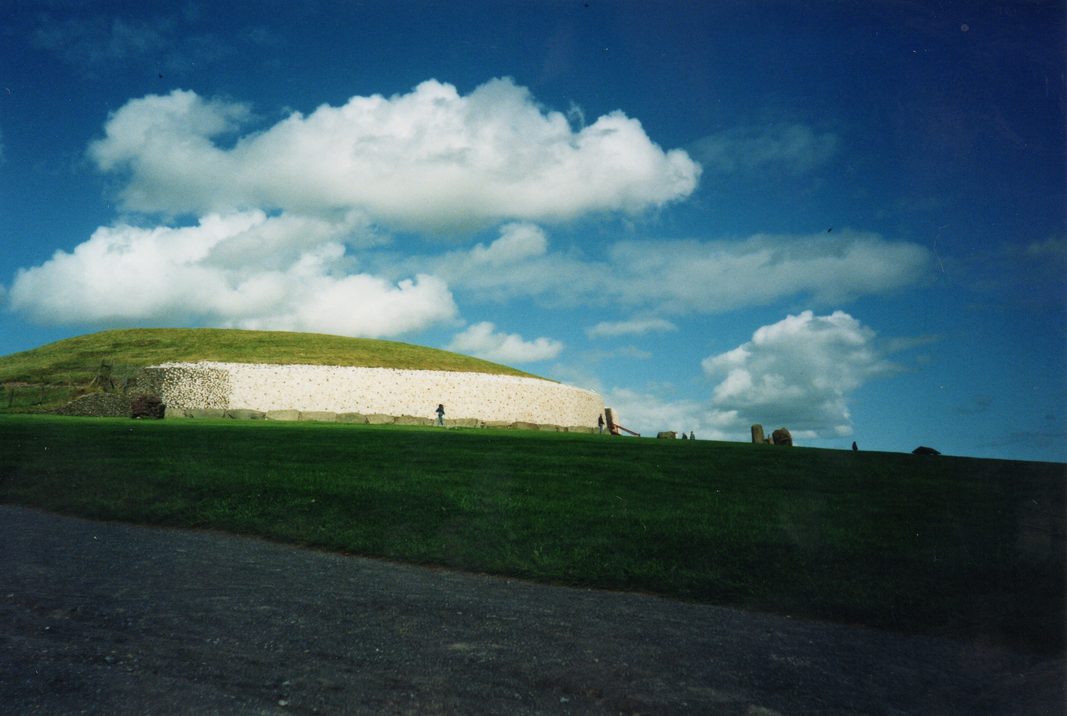
Newgrange is a huge stone-lined tomb mound in the bend of the River Boyne in Ireland. It belongs to a group of Neolithic passage tombs called Brú na Bóinne.
▸ Read Full Archaeological & Engineering Context
In 2020 a DNA study looked at people buried in passage tombs across Ireland. One man buried deep inside Newgrange turned out to be the child of very close relatives.
✓ What Is Physically Measured on Site
Dated samples, laser scans, stone weights, and dug finds kept separate from opinion.
- Three great mounds: UNESCO says three great burial mounds lead the site: Knowth, Newgrange and Dowth. About forty smaller passage graves lie around them. [1]
- Building date: It was built about 3300–3000 cal BC, as summarised by Guiry et al. 2025. [2]
- 44 ancient genomes: A 2020 study read 44 whole genomes from Neolithic Ireland. [3]
- A man from the inner tomb: Remains from the most elaborate recess of Newgrange came from an adult man. His parents were first-degree relatives, such as brother and sister or parent and child. [3]
- Relatives far away: The team found relatives of this man in two other big groups of passage tombs. They lie about 150 km to the west. The team also found that passage-tomb people differed from the rest in diet and in fine genetic patterns. [3]
🏛️ Mainstream Archaeological View
- Accepted timeline: A great Neolithic passage tomb in the Brú na Bóinne complex, with Knowth and Dowth. It was built about 3300–3000 cal BC, as summarised by Guiry et al. 2025.
- Stone & hardness: Not reported in the sources on this page. Mohs hardness: not reported in our sources.
- Quarry distance & alignment: Stone source not reported in the sources on this page. Orientation: Not reported in the sources on this page.
🧭 Leading Edge Proposal & Open Questions
- Interpretation: Cassidy and colleagues (2020): A 'dynastic elite'? The authors argue these results point to a dynastic elite: a ruling group that passed power down family lines. They note that such close-kin matings are known almost only in royal families led by god-kings. This is the authors' interpretation of the DNA, not a written record of rulers. [3]
Primary Academic Sources
▸ View All Cited Primary Sources & DOIs (3 papers)
- UNESCO World Heritage Centre. Brú na Bóinne: Archaeological Ensemble of the Bend of the Boyne (list no. 659), accessed 2 November 2026 https://whc.unesco.org/en/list/659 background
- Guiry, E., Beglane, F., Carlin, N., Orton, D., Teeter, M., Szpak, P. & others (2025). Pigs, pannage, and the solstice: isotopic insights from prehistoric feasting at Newgrange. Proceedings of the Prehistoric Society 91: 195–215. doi:10.1017/ppr.2025.10063 data
- Cassidy, L. M., Ó Maoldúin, R., Kador, T., Lynch, A., Jones, C., Woodman, P. C. & others (2020). A dynastic elite in monumental Neolithic society. Nature 582: 384–388. doi:10.1038/s41586-020-2378-6 data
Dates and stone checks are summed up in plain English from the papers above. Measured facts stay separate from opinion. Methodology.