Sites › North America › Norse in the Americas (L'Anse aux Meadows, Canada)
Norse in the Americas (L'Anse aux Meadows, Canada)
In Plain English — The 30-Second Takeaway
A Norse camp in Newfoundland, plus a check on other claimed Norse finds.
Wood from the site dates to AD 1021. UNESCO lists eight Norse-style turf buildings.
Scholars accept L'Anse aux Meadows as a Norse site about 1,000 years old.
Some argue for Norse visits farther south, such as Minnesota or Rhode Island. Those claims are disputed.
Site Story & Overview
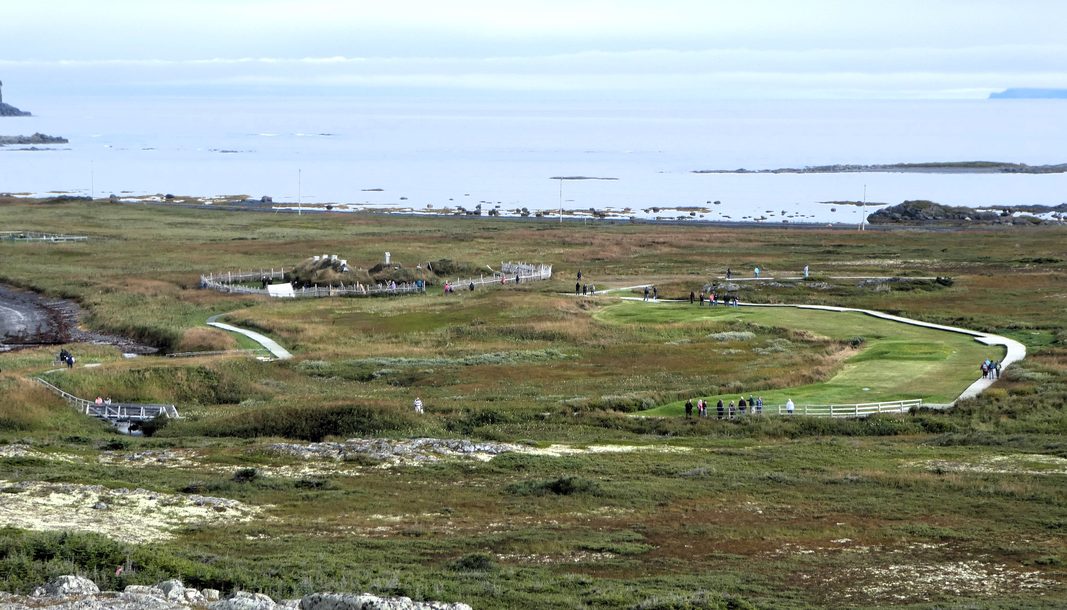
L'Anse aux Meadows is a Norse camp at the northern tip of Newfoundland. It is the only known Norse site in North America, and it matches stories told in the Vinland Sagas.
▸ Read Full Archaeological & Engineering Context
In 2021 a team dated wood from the site to AD 1021. This page also tracks other claimed Norse finds in North America. Each claim is labelled and each side is named.
✓ What Is Physically Measured on Site
Dated samples, laser scans, stone weights, and dug finds kept separate from opinion.
- An exact year, AD 1021: A 2021 study dated wood from the site to the year AD 1021. It used a sudden jump in carbon-14 in tree rings, caused by cosmic rays in AD 993, to fix the year. [1]
- Eight buildings: UNESCO lists eight buildings made of wood frames and turf. They match the style of Norse Greenland and Iceland. There are three homes, a forge and four workshops. [2]
- Iron and wood work: UNESCO says finds show iron making and woodworking, likely to repair ships. Some finds hint that people from the camp went farther south. [2]
Contested: The Kensington Runestone (Minnesota)
A farmer found this carved stone in Minnesota in 1898. Its runes give the year 1362. Whether it is a real medieval carving is disputed. Each view below is named.
- Mainstream — Measured The find: Olof Ohman, a Swedish immigrant, turned up the slab while clearing land on his farm near Kensington in the fall of 1898. The marks were later found to be Scandinavian runes. [4]
- Contested Minnesota Historical Society: Its online encyclopedia says most experts lean toward the view that the carving is not authentic. It adds that who made it, and how and when, has not been settled. [4]
- Contested Geologist Scott F. Wolter: His 2003 study concluded the carvings were more than 200 years old, as the same encyclopedia reports. It says this remains highly contested. We found no peer-reviewed version of his study. [4]
- Contested Anthropologist Alice Beck Kehoe: Her 2005 book looks at the stone using history, archaeology, geology, language and biology. Her publisher says most historians have called it a forgery. It says her book asks for a fuller look. It is a book, not a journal paper. [5]
Contested: The Newport Tower (Rhode Island)
A round stone tower in Newport, Rhode Island. Who built it, and when, has long been argued. All three items below come from Newport History, the journal of the Newport Historical Society. We could not confirm that it is peer reviewed.
- Contested A mortar date of about AD 1665: A 1997 appendix in Newport History reports carbon-14 tests on the tower's lime mortar. It gives a mean calendar age of AD 1665. [6]
- Contested A 1998 challenge: In the same journal, André J. de Bethune argued that dating mortar this way has built-in problems. He wrote that a pre-Columbian origin for the tower cannot be ruled out. [7]
- Contested The reply: Jan Heinemeier and Hogne Jungner answered in the same journal in 2000. They held that a pre-Columbian origin can still almost certainly be ruled out. They say the two sides weigh the possible sources of error in different ways. [8]
🏛️ Mainstream Archaeological View
- Accepted timeline: A Norse (Viking) camp in Newfoundland. It is the only known Norse site in the Americas. A 2021 study dates Norse activity there to AD 1021.
- Stone & hardness: Not reported in the sources on this page. Mohs hardness: not reported in our sources.
- Quarry distance & alignment: Stone source not reported in the sources on this page. Orientation: Not reported in the sources on this page.
🧭 Leading Edge Proposal & Open Questions
- Claim check: Point Rosee, Newfoundland: A second Norse site? A team led by Sarah Parcak and Greg Mumford dug at Point Rosee in 2015 and 2016, looking for Norse traces. Their report to the province found no sign of human activity there, as reported by CBC; the team's report was not reviewed. [3]
Primary Academic Sources
▸ View All Cited Primary Sources & DOIs (8 papers)
- Kuitems, M., Wallace, B. L., Lindsay, C., Scifo, A., Doeve, P., Jenkins, K. & others (2021). Evidence for European presence in the Americas in AD 1021. Nature 601: 388–391. doi:10.1038/s41586-021-03972-8 data
- UNESCO World Heritage Centre. L'Anse aux Meadows National Historic Site (list no. 4), accessed 2 November 2026 https://whc.unesco.org/en/list/4 background
- Bird, L. (2018). Archeological quest for Codroy Valley Vikings comes up short. CBC News, 30 May 2018 (news report; the team's report itself was not reviewed by us) https://www.cbc.ca/news/canada/newfoundland-labrador/codroy-valley-vi… background
- Nelson, P. Kensington Runestone. MNopedia, Minnesota Historical Society, accessed 2 November 2026 https://www.mnhs.org/mnopedia/search/index/thing/kensington-runestone background
- Kehoe, A. B. (2005). The Kensington Runestone: Approaching a Research Question Holistically. Waveland Press (book; publisher description) https://books.google.com/books?id=TdIYAAAAQBAJ proponent
- Appendix: Carbon-14 dating of the Newport Tower (1997). Newport History: Journal of the Newport Historical Society 68(235), article 3 (society journal; peer review not confirmed) https://digitalcommons.salve.edu/newporthistory/vol68/iss235/3/ data
- de Bethune, A. J. (1998). On the Carbon-14 Analyses of Mortar from the Newport Tower: Theoretical Considerations. Newport History 69(238), article 3 (society journal) https://digitalcommons.salve.edu/newporthistory/vol69/iss238/3 proponent
- Heinemeier, J. & Jungner, H. A Pre-Columbian Origin for the Newport Tower Can (Still) Almost Certainly be Excluded: A Reply to Professor Andre J. de Bethune. Newport History 70(243), 2000, article 3 (society journal) https://digitalcommons.salve.edu/newporthistory/vol70/iss243/3/ critique
Dates and stone checks are summed up in plain English from the papers above. Measured facts stay separate from opinion. Methodology.