△ TruthInStone

Sites › North America › Palenque (Lakamha') and the Temple of the Inscriptions

Palenque (Lakamha') and the Temple of the Inscriptions

Palenque (Lakamha') and the Temple of the Inscriptions
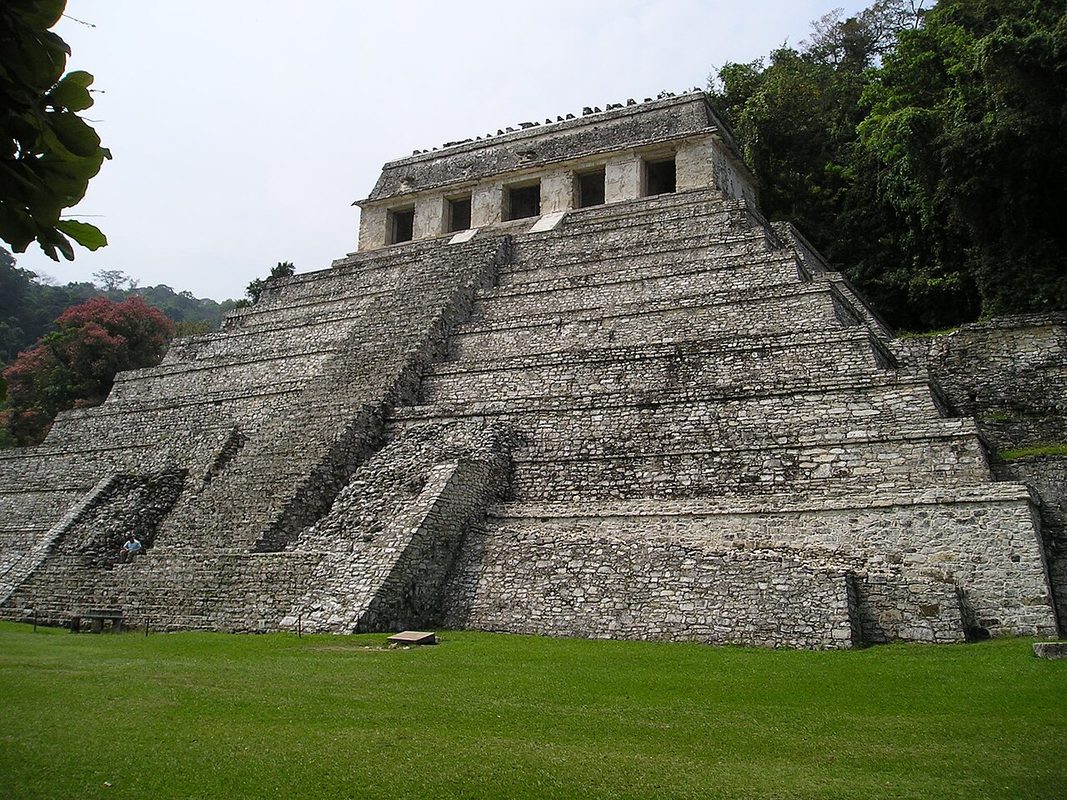
Image: Strobilomyces, Wikimedia Commons, CC BY-SA 3.0. Resized; not otherwise altered. All credits.
📍 Where It Is Chiapas foothills, southern Mexico 17.4838°, -92.0460°
🏛️ Mainstream Date c. 226 BCE to 800 CE (Pakal's tomb completed c. 683–690 CE) Excavated baseline
🧭 Leading Edge / Open Angle Pakal's carved tomb lid sparked 1968 'ancient astronaut' debate Debated or newly revised
🪨 Heaviest Stone & Quarry 15–20 tons (limestone sarcophagus box) + 5–7-ton carved lid 0.5× the 40-ton test limit · Compare all 64 sites →
30-SECOND TAKEAWAY

In Plain English — The 30-Second Takeaway

What It Is:

Palenque is a Classic Maya city in the Chiapas rainforest famous for its carved royal carved texts, underground stone water tunnels. The Temple of the Inscriptions.

What Everyone Agrees On (Measured Facts):

Beneath the pyramid stairway sits a 20-ton limestone coffin sealed with a 3.8-by-2.2-meter carved stone lid weighing 5 to 7 tons, alongside nine underground stone aqueducts.

🏛️ Mainstream Archaeology View:

The 617 carved Maya hieroglyphs inside the temple name King K'inich Janaab' Pakal. (died 683 CE) and show him descending into the Maya underworld beneath the World Tree.

🧭 Leading Edge View:

Erich von Däniken famously compared the carved lid to a pilot in a spacecraft in 1968. This makes Palenque a classic test case between Maya writing and visual lookalikes.

Site Story & Overview

Set on a series of natural terraces where the Chiapas highlands meet the Gulf coastal plain, Palenque is celebrated both for its long hieroglyphic dynastic texts and for its building solutions to extreme tropical rainfall. Because the city's core sits at the confluence of nine mountain streams, Maya builders encased the Otulum and Piedras Bolas streams inside corbelled limestone tunnels to create broad level plazas and pressurized water conduits.

▸ Read Full Archaeological & Engineering Context

The Temple of the Carved texts remains the most famous royal tomb pyramid in the Americas: the 15–20 t sarcophagus box and 5–7 t carved lid were positioned first. The nine-stepped pyramid was built around and over the corbelled stairway.

✓ What Is Physically Measured on Site

Dated samples, laser scans, stone weights, and dug finds kept separate from opinion.

🏛️ Mainstream Archaeological View

  • Accepted timeline: Classic Maya capital (Lakamha'), occupied c. 226 BCE to c. 800 CE. The Temple of the Carved texts was completed around 683–690 CE for K'inich Janaab' Pakal I (603–683 CE).
  • Stone & hardness: Paleocene-Eocene crystalline dolomitic limestone — Mohs hardness 3.8 (Crystalline limestone) (on the 1–10 Mohs scale where a steel knife is ~5.5 and diamond is 10).
  • Quarry distance & alignment: Stone source 0.5–2 km (Chiapas Sierra limestone escarpment). Orientation: Winter solstice sunset & Venus/solar hierarchy across the Temple of the Inscriptions and Cross Group.

🧭 Leading Edge Proposal & Open Questions

  • Erich von Däniken (Chariots of the Gods?, 1968): Interpreted the carved relief on Pakal's sarcophagus lid as a reclining pilot operating controls inside a rocket-propelled craft (a Leading Edge iconographic reading) [4]

Tested Claims About Palenque (Lakamha') and the Temple of the Inscriptions

ClaimStatusVerdict
Pyramids around the world point to a common lost source
Did pyramids in Egypt, Peru, Mexico, Sudan. Also, China come from one shared ancient parent culture?
Leading EdgeOpen question
LiDAR shows Maya lowlands were far more densely settled than thought
Airplane laser scans have revealed tens of thousands of hidden Maya buildings, roads, and farms under the jungle.
MainstreamMeasured: far denser settlement than mapped before

Visiting & base stays: Palenque Archaeological Zone & Temple of the Inscriptions (Chiapas, Mexico)

FTC affiliate disclosure: Tour links go to GetYourGuide and Viator. Hotel links use Stay22 (aid=solarevidence) for Booking.com and Expedia. If you book a trip, we may earn a small fee at no extra cost to you. All partner links use rel="sponsored nofollow noopener". Check travel alerts before you go. Partner fees never change our ratings. All 64 site field visits · Affiliate disclosure.

📚 Further Reading: Both Sides of the Argument

Top books from both sides of the debate on this topic. Browse all 34 books on Books & Further Reading or visit our Search for the Truth Bookshop.org storefront.

Mainstream Baseline 2022 ★ 4.7/5

The Maya (10th ed.)

Michael D. Coe & Stephen Houston

The classic guide to the Maya world, updated with new jungle laser maps, the 1000 BCE Aguada Fénix platform, and calendar science.

▸ Why this book matters to both sides

The tenth edition of the standard academic overview of Maya culture, updated with airborne LiDAR surveys across the Petén and Campeche, the 1000 BCE Aguada Fénix plateau, and Long Count astronomy.

Role in the debate: Pairs the latest LiDAR town densities and epigraphic readings with Mesoamerican calendrical and sky debates. (ISBN 9780500295144)

Mainstream Baseline 2005 ★ 4.6/5

1491: New Revelations of the Americas Before Columbus (2nd ed.)

Charles C. Mann

Shows how new digs and laser maps proved the ancient Americas held big cities, roads, and farms long before Columbus.

▸ Why this book matters to both sides

Surveys the archaeological, botanical, and demographic discoveries showing that the pre-Columbian Americas—from Caral-Supe and the Amazon basin to Cahokia—were older, more populous, and more engineered than once taught.

Role in the debate: Documents how mainstream field evidence overturned the 20th-century 'pristine wilderness' model in the Amazon and pushed giant buildings in Peru back to the third millennium BCE. (ISBN 9781400032051)

Bridge / Debate History 1969 ★ 4.6/5

Hamlet's Mill: An Essay Investigating the Origins of Human Knowledge and Its Transmissions Through Myth

Giorgio de Santillana & Hertha von Dechend

Two science historians argue that ancient stories worldwide preserve real observations of the 26,000-year wobble of the stars.

▸ Why this book matters to both sides

Written by historians of science at MIT and Frankfurt University. The author argues ancient stories worldwide encode technical findings of the 26,000-year sky wobble of the equinoxes and shifting world ages.

Role in the debate: The scholarly bridge between academic history of astronomy and modern sky-sightline claims about sky-cycle coding at Giza, Angkor, and Göbekli Tepe. (ISBN 9780879232153)

Leading Edge 1995 ★ 4.7/5

Fingerprints of the Gods: The Evidence of Earth's Lost Civilization

Graham Hancock

Graham Hancock's bestseller arguing that Giza, Pumapunku, and ancient maps preserve traces of a lost Ice Age culture.

▸ Why this book matters to both sides

Hancock's worldwide bestseller examining Tiwanaku, Pumapunku, Teotihuacan, Giza, the Piri Reis map, and Hapgood's crustal-shift model. It argues for an Ice Age culture lost in a global cataclysm.

Role in the debate: The book that brought the lost-Ice-Age-culture idea to millions of readers and framed the modern debate over Giza, Pumapunku, and ancient sky sightlines. (ISBN 9780517887295)

FTC affiliate disclosure: Book links go to Bookshop.org (ID 130218, Search for the Truth). Each sale helps local bookstores and pays us a 10% fee at no extra cost to you. All partner links use rel="sponsored nofollow noopener". Fees never change our verdicts. Affiliate disclosure.

Primary Academic Sources

▸ View All Cited Primary Sources & DOIs (5 papers)
  1. Ruz Lhuillier, A. (1973). El Templo de las Inscripciones, Palenque. Mexico City: INAH (Colección Científica 7). https://openlibrary.org/works/OL4916420W data
  2. Stuart, D. & Stuart, G. (2008). Palenque: Eternal City of the Maya. London: Thames & Hudson. https://openlibrary.org/works/OL8266586W data
  3. French, K. D., Duffy, C. J. & Bhatt, G. (2012). The hydroarchaeology of Palenque: urban water management in the Classic Maya lowlands. Journal of Archaeological Science 39(1). doi:10.1016/j.jas.2011.08.019 data
  4. von Däniken, E. (1968). Chariots of the Gods? (Erinnerungen an die Zukunft). Econ-Verlag / Putnam (astronaut reading of Pakal's sarcophagus lid). https://openlibrary.org/works/OL1118193W proponent
  5. UNESCO World Heritage Centre: Pre-Hispanic City and National Park of Palenque (inscribed 1987). https://whc.unesco.org/en/list/411/ background

Dates and stone checks are summed up in plain English from the papers above. Measured facts stay separate from opinion. Methodology.