△ TruthInStone

Sites › Asia › Sanxingdui

Sanxingdui

Sanxingdui
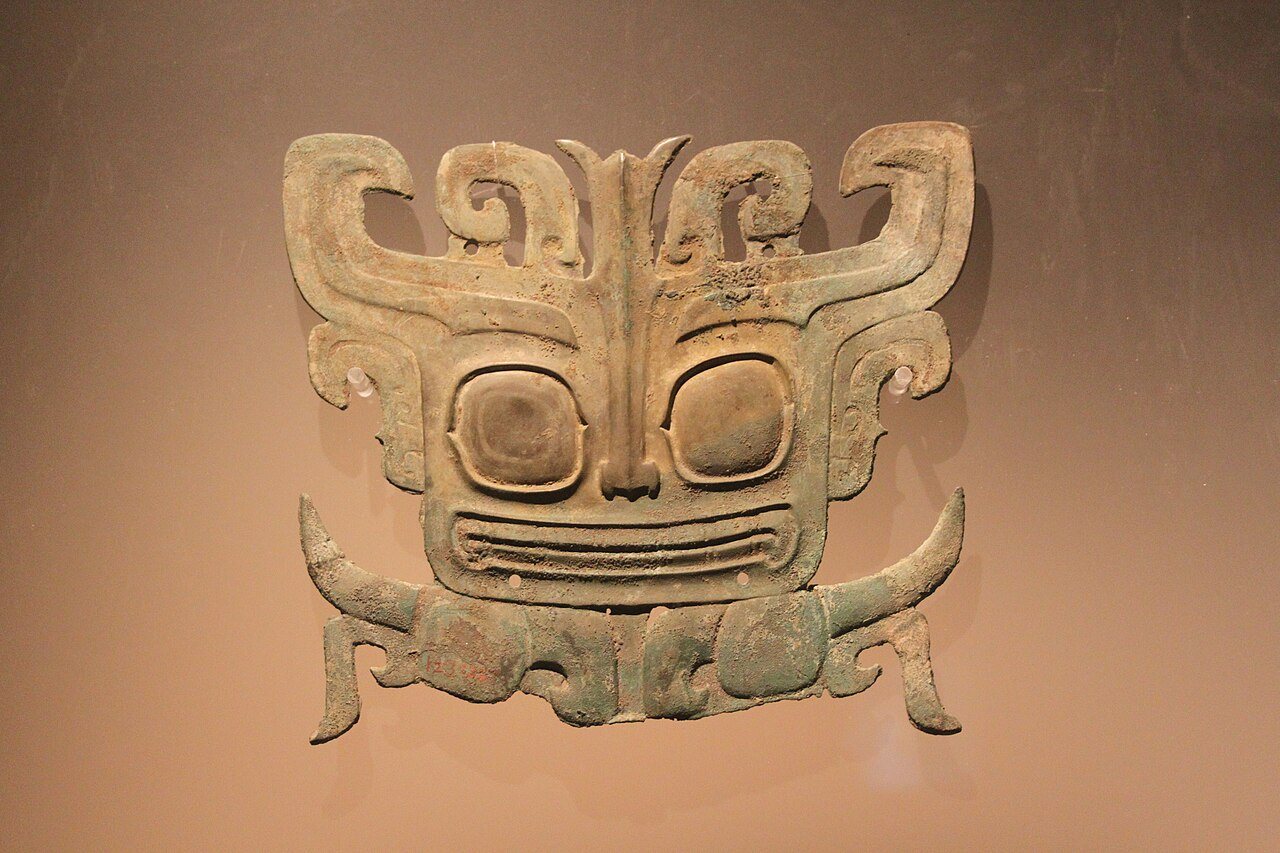
Image: Gary Todd, Wikimedia Commons, CC0. Resized; not otherwise altered. All credits.
📍 Where It Is Guanghan, near Chengdu, Sichuan Province, China 30.9922°, 104.1994°
🏛️ Mainstream Date c. 1200–1000 BCE (Ancient Shu Kingdom, contemporary with late Shang) Excavated baseline
🧭 Leading Edge / Open Angle Masks sparked outside-origin claims. Casting cores suggest masks and trees were likely cast locally Debated or newly revised
🪨 Heaviest Stone & Quarry 360-hectare rammed-earth city walls; giant cast bronze trees & masks 0.0× the 40-ton test limit · Compare all 64 sites →
30-SECOND TAKEAWAY

In Plain English — The 30-Second Takeaway

What It Is:

Sanxingdui is a walled Bronze Age city in southwestern China where dig teams found eight ritual pits packed with giant bronze masks, gold masks. Elephant tusks.

What Everyone Agrees On (Measured Facts):

Six carbon dates published in 2021 place Pit 4 at about 1199–1017 BCE. The finds in most of the pits point to about 1200–1000 BCE.

🏛️ Mainstream Archaeology View:

Scholars see Sanxingdui as a key early centre in southwest China (Lian et al. 2025). CT scans show its bronzes were cast in many parts and joined (Tian et al. 2022).

🧭 Leading Edge View:

The bug-eyed masks inspired popular ideas of a foreign origin. A 2025 study of the clay cores left inside the bronzes finds the masks, heads and trees were probably cast near Sanxingdui. The bronze vessels link to the middle and lower Yangtze (Lian et al. 2025). Many Shang bronzes hold a rare type of lead. Where it came from is still debated (Liu et al. 2018).

Site Story & Overview

The giant bronze masks, heads and trees look unlike anything else in Bronze Age China, which has fuelled debate. The new pits (dug 2020–22) were studied with many scientific methods.

▸ Read Full Archaeological & Engineering Context

Their dates fit the late Shang. A casting study suggests the masks and trees were made here. The bronze vessels have links to the middle and lower Yangtze (Lian et al. 2025).

✓ What Is Physically Measured on Site

Dated samples, laser scans, stone weights, and dug finds kept separate from opinion.

How carbon dates work, and their limits: How we date sites.

🏛️ Mainstream Archaeological View

  • Accepted timeline: Bronze Age centre of the ancient Shu, occupied about 4,500–3,000 years ago. The sacrificial pits date to the late Shang, about 1200–1000 BCE.
  • Stone & hardness: Rammed earth walls; cast tin-lead bronze, gold foil, jade & elephant ivory — Mohs hardness 3.5 (Bronze / Jade Mohs 6.5) (on the 1–10 Mohs scale where a steel knife is ~5.5 and diamond is 10).
  • Quarry distance & alignment: Stone source Local Chengdu Plain earth; copper/tin/jade ores from Longmenshan (~40–100 km). Orientation: Northwest–southeast orientation matching Chengdu Plain rivers and mountains.

🧭 Leading Edge Proposal & Open Questions

  • Popular authors and online commentators: An unknown or outside (non-Chinese) origin for the bronze culture. We found no published dating or rock source study that supports this

Visiting & base stays: Sanxingdui Museum & Archaeological Site (Guanghan / Chengdu base, Sichuan, China)

FTC affiliate disclosure: Tour links go to GetYourGuide and Viator. Hotel links use Stay22 (aid=solarevidence) for Booking.com and Expedia. If you book a trip, we may earn a small fee at no extra cost to you. All partner links use rel="sponsored nofollow noopener". Check travel alerts before you go. Partner fees never change our ratings. All 64 site field visits · Affiliate disclosure.

📚 Further Reading: Both Sides of the Argument

Top books from both sides of the debate on this topic. Browse all 34 books on Books & Further Reading or visit our Search for the Truth Bookshop.org storefront.

Mainstream Baseline 2003 ★ 4.5/5

After the Ice: A Global Human History, 20,000–5000 BC

Steven Mithen

Follows human life across every continent from the peak of the Ice Age (20,000 BCE) to early farming towns (5000 BCE).

▸ Why this book matters to both sides

A continent-by-continent narrative of human life from the Last Glacial Maximum to 5000 BCE, built directly from excavation reports across the Near East (including Göbekli Tepe), Europe, Asia, and the Americas.

Role in the debate: Provides the archaeological baseline for what human populations were building, hunting, and cultivating before, during, and right after the Younger Dryas. (ISBN 9780674019997)

Mainstream Baseline 2021 ★ 4.5/5

The Dawn of Everything: A New History of Humanity

David Graeber & David Wengrow

Examines how hunter-gatherers built giant stone sites like Göbekli Tepe and Poverty Point without kings or farming.

▸ Why this book matters to both sides

An culture scholar and an archaeologist examine Göbekli Tepe, Karahan Tepe, Poverty Point, Watson Brake, and Teotihuacan. It challenges the textbook step-by-step ladder from small hunter-gatherer bands to states.

Role in the debate: Shows how mainstream archaeology accounts for giant buildings built by hunter-gatherers (Göbekli Tepe, Poverty Point) without invoking a single global parent culture. (ISBN 9781250858801)

Bridge / Debate History 1969 ★ 4.6/5

Hamlet's Mill: An Essay Investigating the Origins of Human Knowledge and Its Transmissions Through Myth

Giorgio de Santillana & Hertha von Dechend

Two science historians argue that ancient stories worldwide preserve real observations of the 26,000-year wobble of the stars.

▸ Why this book matters to both sides

Written by historians of science at MIT and Frankfurt University. The author argues ancient stories worldwide encode technical findings of the 26,000-year sky wobble of the equinoxes and shifting world ages.

Role in the debate: The scholarly bridge between academic history of astronomy and modern sky-sightline claims about sky-cycle coding at Giza, Angkor, and Göbekli Tepe. (ISBN 9780879232153)

Leading Edge 2002 ★ 4.6/5

Underworld: The Mysterious Origins of Civilization

Graham Hancock

Combines Ice Age sea-level flood maps with scuba dives at submerged ruins off India, Japan, Malta, and Bimini.

▸ Why this book matters to both sides

Combines Glenn Milne's post-glacial sea-level inundation maps with scuba studies at India's Gulf of Khambhat and Dwarka, Japan's Yonaguni terraces, Malta, and Bimini.

Role in the debate: Frames the submerged-shelf debate over whether features at Yonaguni, Dwarka, and Bimini are human-modified monuments drowned by Meltwater pulses or natural coastal geology. (ISBN 9781400049516)

FTC affiliate disclosure: Book links go to Bookshop.org (ID 130218, Search for the Truth). Each sale helps local bookstores and pays us a 10% fee at no extra cost to you. All partner links use rel="sponsored nofollow noopener". Fees never change our verdicts. Affiliate disclosure.

Primary Academic Sources

▸ View All Cited Primary Sources & DOIs (5 papers)
  1. Li, Y., Qiu, T., Guo, J. & Li, Y. (2022). New discoveries at the Sanxingdui Bronze Age site in south-west China. Antiquity 97(391): e4. doi:10.15184/aqy.2022.150 data
  2. Wu, X., Ran, H. & Lei, Y. (2021). 四川广汉三星堆遗址四号祭祀坑的碳十四年代研究 [Radiocarbon dating of sacrificial Pit 4 at the Sanxingdui site, Guanghan, Sichuan]. Sichuan Wenwu (Sichuan Cultural Relics) 2021(2): 117–120. In Chinese; no DOI. data
  3. Lian, H., Zeng, X., Liang, P., Liu, S., Ran, H., Guo, J., Zhang, J., Mei, J. & Chen, K. (2025). Deciphering the origins of Sanxingdui bronzes through petrographic and elemental analysis of casting cores. Journal of Archaeological Science 178: 106212. doi:10.1016/j.jas.2025.106212 data
  4. Tian, H., Zeng, X., Guo, J., Qu, L. & Chen, K. (2022). X-ray computed tomography reveals special casting techniques used with unusual bronze objects unearthed from the Sanxingdui site. Advances in Archaeomaterials 3(1): 28–33. An erratum (2024) adds a missing competing-interests statement only. doi:10.1016/j.aia.2022.03.001 data
  5. Liu, R., Rawson, J. & Pollard, A. M. (2018). Beyond ritual bronzes: identifying multiple sources of highly radiogenic lead across Chinese history. Scientific Reports 8: 11770. doi:10.1038/s41598-018-30275-2 data

Dates and stone checks are summed up in plain English from the papers above. Measured facts stay separate from opinion. Methodology.