Sites › Europe › Skara Brae (Orkney, Scotland)
Skara Brae (Orkney, Scotland)
In Plain English — The 30-Second Takeaway
A Stone Age village of linked stone houses on Orkney.
Founded around 2900 cal BC, then lived in again in the twenty-eighth century cal BC.
Scholars agree on its rough age and its place among Orkney's great monuments.
Why the first village was left is not known. Bayliss and colleagues offer a tentative idea for Orkney as a whole.
Site Story & Overview
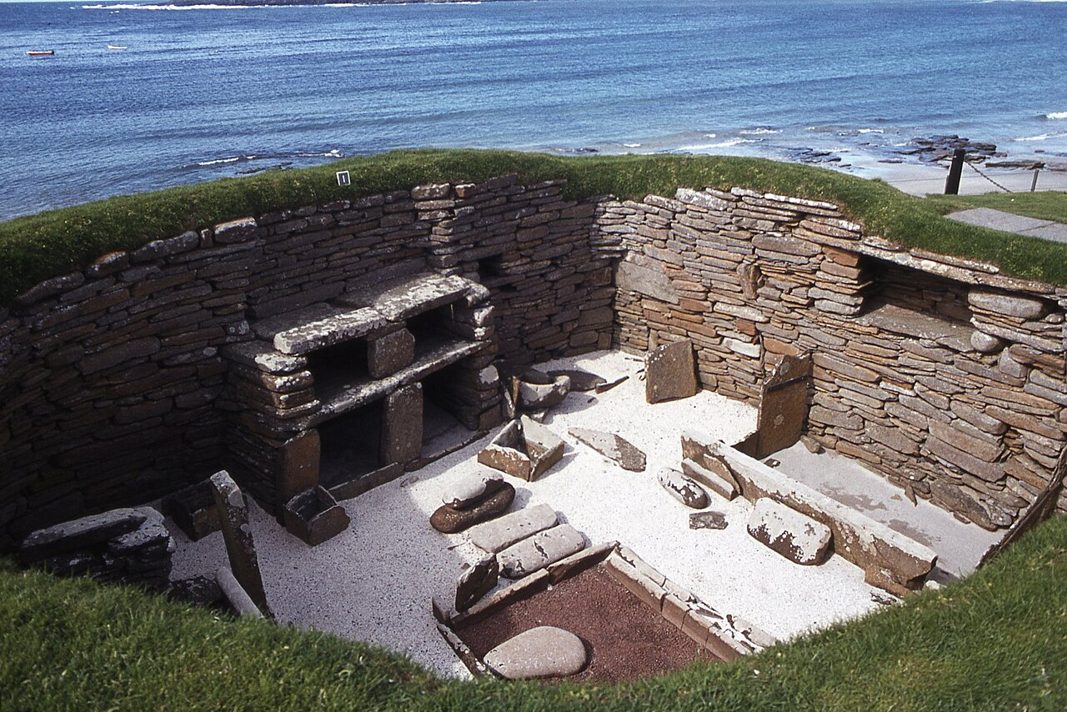
Skara Brae is a Stone Age village on Orkney, off the north coast of Scotland. Its stone houses still stand, linked by roofed passages.
▸ Read Full Archaeological & Engineering Context
Scholars agree on its rough age. Why its first village was left so soon is still open.
✓ What Is Physically Measured on Site
Dated samples, laser scans, stone weights, and dug finds kept separate from opinion.
- Part of a World Heritage group: UNESCO lists Skara Brae with the Ring of Brodgar, the Stones of Stenness and the tomb of Maeshowe. Together they make up the Heart of Neolithic Orkney. Orkney lies about 15 km north of Scotland. [1]
- Stone houses: UNESCO says Skara Brae has houses built of stone. Narrow passages with roofs link them. [1]
- Site-specific dates: Bayliss and colleagues say the first village was founded in the centuries around 2900 cal BC. It may have been left after a fairly short time, then lived in again in the twenty-eighth century cal BC. [2]
- An early test case: The same paper says 14 radiocarbon dates from Skara Brae were among the first used in a new kind of statistical dating model (Bayesian). It mixes lab dates with what diggers know about the layers. [2]
- Sheep that ate seaweed: A 2019 study tested chemical traces in animal bones from Skara Brae. It found sheep ate a fair amount of seaweed from the time they first reached Orkney. [3]
🏛️ Mainstream Archaeological View
- Accepted timeline: Bayliss and colleagues say the first village was founded in the centuries around 2900 cal BC. It may have been left after a fairly short time, then lived in again in the twenty-eighth century cal BC.
- Stone & hardness: Not reported in the sources on this page. Mohs hardness: not reported in our sources.
- Quarry distance & alignment: Stone source not reported in the sources on this page. Orientation: Not reported in the sources on this page.
🧭 Leading Edge Proposal & Open Questions
- Open question: Why was it left? Bayliss and colleagues say the first village may have been left after a short time, before people came back. The cause is not known. [2]
- Interpretation: Bayliss and colleagues (2017), a tentative idea: Too much strain? The authors suggest that local tensions may have made close-packed villages hard to keep going across Orkney. They offer this as a provisional idea for the islands, not a finding about Skara Brae. [2]
- Note on dates: Not the same date: The 2019 sheep study gives about 3500 cal BC. That is when farming animals reached Orkney, not when Skara Brae was built. [3]
Visiting: Skara Brae & the Heart of Neolithic Orkney (Scotland)
- Skara Brae and Neolithic Orkney tours GetYourGuide
- Skara Brae & Orkney heritage tours (search) Viator
FTC affiliate disclosure: Tour links go to GetYourGuide and Viator. Hotel links use Stay22 (aid=solarevidence) for Booking.com and Expedia. If you book a trip, we may earn a small fee at no extra cost to you. All partner links use rel="sponsored nofollow noopener". Check travel alerts before you go. Partner fees never change our ratings. All 87 site field visits · Affiliate disclosure.
Primary Academic Sources
▸ View All Cited Primary Sources & DOIs (3 papers)
- UNESCO World Heritage Centre. Heart of Neolithic Orkney (list no. 514), accessed 3 November 2026 https://whc.unesco.org/en/list/514 background
- Bayliss, A., Marshall, P., Richards, C. & Whittle, A. (2017). Islands of history: the Late Neolithic timescape of Orkney. Antiquity 91(359): 1171–1188 (full text read; Skara Brae dates p. 1184). doi:10.15184/aqy.2017.140 data
- Balasse, M., Tresset, A., Obein, G., Fiorillo, D. & Gandois, H. (2019). Seaweed-eating sheep and the adaptation of husbandry in Neolithic Orkney: new insights from Skara Brae. Antiquity 93(370): 919–932. doi:10.15184/aqy.2019.95 data
Dates and stone checks are summed up in plain English from the papers above. Measured facts stay separate from opinion. Methodology.