△ TruthInStone

Sites › North America › Watson Brake

Watson Brake

Watson Brake
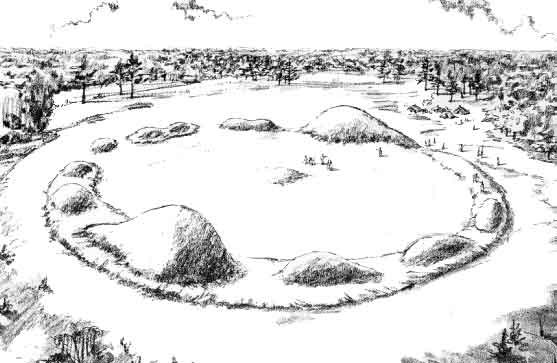
Image: Martin Pate, NPS South Eastern Archaeological Center, Wikimedia Commons, Public domain. Resized; not otherwise altered. All credits.
📍 Where It Is Ouachita Parish, northern Louisiana, USA 32.3630°, -92.1480°
🏛️ Mainstream Date c. 3500–2800 BCE (Middle Archaic hunter-foragers) Excavated baseline
🧭 Leading Edge / Open Angle Nearly 1,000 years older than Egypt's Great Pyramid Debated or newly revised
🪨 Heaviest Stone & Quarry 11 earthen mounds (up to 7.5 m tall) around a 280-m oval plaza 0.0× the 40-ton test limit · Compare all 64 sites →
30-SECOND TAKEAWAY

In Plain English — The 30-Second Takeaway

What It Is:

Watson Brake in northern Louisiana is an oval ring of eleven earthen mounds connected by a ridge, built 5,500 years ago.

What Everyone Agrees On (Measured Facts):

Carbon dates on burned plant seeds and charcoal beneath the mounds prove building began around 3500 BCE. Nearly 1,000 years before Giza.

🏛️ Mainstream Archaeology View:

Scholars recognize Watson Brake as the oldest dated mound complex in North America, built by mobile fishers and foragers.

🧭 Leading Edge View:

The site shows that North American earthwork architecture is older than both Stonehenge. Also, the Egyptian pyramids.

Site Story & Overview

Built more than 1,500 years before Poverty Point and older than the Great Pyramid, by foragers living on nuts, fish and deer. The authors suggest that some building bursts coincided with more erratic El Niño rainfall.

▸ Read Full Archaeological & Engineering Context

That idea is their inference, not a check. The image is a National Park Service artist's rebuild.

✓ What Is Physically Measured on Site

Dated samples, laser scans, stone weights, and dug finds kept separate from opinion.

How carbon dates work, and their limits: How we date sites.

🏛️ Mainstream Archaeological View

  • Accepted timeline: Middle Archaic, earthworks begun about 3500 BCE. The oldest dated mound complex in North America.
  • Stone & hardness: Alluvial sand, silt, clay & fire-cracked chert gravel — Mohs hardness 1.5 (Earthen mound complex) (on the 1–10 Mohs scale where a steel knife is ~5.5 and diamond is 10).
  • Quarry distance & alignment: Stone source Adjacent Ouachita River terrace (<0.3 km). Orientation: Northwest–southeast oval axis along the Pleistocene river terrace.

🧭 Leading Edge Proposal & Open Questions

  • Timeline consensus: The site shows that North American earthwork architecture is older than both Stonehenge. Also, the Egyptian pyramids.
  • Engineering comparison: Heaviest unit is 11 Middle Archaic mounds (up to 7.5 m tall) joined by a 280 m oval ridge (Adjacent Ouachita River terrace (<0.3 km)). See how it compares in our 64-Site Scale-Gap Explorer.

Visiting & base stays: Watson Brake & Ouachita River Earthworks (Monroe, Louisiana base, USA)

FTC affiliate disclosure: Tour links go to GetYourGuide and Viator. Hotel links use Stay22 (aid=solarevidence) for Booking.com and Expedia. If you book a trip, we may earn a small fee at no extra cost to you. All partner links use rel="sponsored nofollow noopener". Check travel alerts before you go. Partner fees never change our ratings. All 64 site field visits · Affiliate disclosure.

📚 Further Reading: Both Sides of the Argument

Top books from both sides of the debate on this topic. Browse all 34 books on Books & Further Reading or visit our Search for the Truth Bookshop.org storefront.

Mainstream Baseline 2021 ★ 4.5/5

The Dawn of Everything: A New History of Humanity

David Graeber & David Wengrow

Examines how hunter-gatherers built giant stone sites like Göbekli Tepe and Poverty Point without kings or farming.

▸ Why this book matters to both sides

An culture scholar and an archaeologist examine Göbekli Tepe, Karahan Tepe, Poverty Point, Watson Brake, and Teotihuacan. It challenges the textbook step-by-step ladder from small hunter-gatherer bands to states.

Role in the debate: Shows how mainstream archaeology accounts for giant buildings built by hunter-gatherers (Göbekli Tepe, Poverty Point) without invoking a single global parent culture. (ISBN 9781250858801)

Mainstream Baseline 2005 ★ 4.6/5

1491: New Revelations of the Americas Before Columbus (2nd ed.)

Charles C. Mann

Shows how new digs and laser maps proved the ancient Americas held big cities, roads, and farms long before Columbus.

▸ Why this book matters to both sides

Surveys the archaeological, botanical, and demographic discoveries showing that the pre-Columbian Americas—from Caral-Supe and the Amazon basin to Cahokia—were older, more populous, and more engineered than once taught.

Role in the debate: Documents how mainstream field evidence overturned the 20th-century 'pristine wilderness' model in the Amazon and pushed giant buildings in Peru back to the third millennium BCE. (ISBN 9781400032051)

Leading Edge 2019 ★ 4.7/5

America Before: The Key to Earth's Lost Civilization

Graham Hancock

Explores Amazon earthworks, Serpent Mound, ancient DNA, and early American sites to argue for an Ice Age culture in the Americas.

▸ Why this book matters to both sides

Tests pre-Clovis archaeological sites, Ancient North Eurasian DNA signals, Amazonian earthworks, Serpent Mound, and Poverty Point. It argues the Americas were central to an Ice Age cultural network.

Role in the debate: Contrasts directly with Charles Mann's *1491* and mainstream Americanist archaeology on early peopling, Amazon geoglyphs, and North American earthen mounds. (ISBN 9781250756954)

FTC affiliate disclosure: Book links go to Bookshop.org (ID 130218, Search for the Truth). Each sale helps local bookstores and pays us a 10% fee at no extra cost to you. All partner links use rel="sponsored nofollow noopener". Fees never change our verdicts. Affiliate disclosure.

Primary Academic Sources

▸ View All Cited Primary Sources & DOIs (2 papers)
  1. Saunders, J. W. et al. (1997). A mound complex in Louisiana at 5400–5000 years before the present. Science 277. doi:10.1126/science.277.5333.1796 data
  2. Saunders, J. W. et al. (2005). Watson Brake, a Middle Archaic mound complex in northeast Louisiana. American Antiquity 70 (a correction was issued in 2010). doi:10.2307/40035868 data

Dates and stone checks are summed up in plain English from the papers above. Measured facts stay separate from opinion. Methodology.