Sites › Africa › Zawyet el-Aryan: Layer Pyramid and the Great Pit (Egypt)
Zawyet el-Aryan: Layer Pyramid and the Great Pit (Egypt)

In Plain English — The 30-Second Takeaway
Two unfinished or ruined royal pyramid projects on the desert edge between Giza and Abusir. It is an unsolved site, and our sources report no modern excavation.
In 1905 Barsanti uncovered a sealed, polished granite vat in the Great Pit. The lid was plaster-sealed, yet the vat was empty except for a dark band about 10 cm high. No analysis of that band is recorded.
Most Egyptologists date the Layer Pyramid to the late Third Dynasty and the Great Pit to the early or middle Fourth.
The owner of the Great Pit is unread and the date and the vat's purpose are debated. Popular claims of advanced technology are not supported by the excavation record.
Site Story & Overview
Zawyet el-Aryan is a royal burial area on the desert edge between Giza and Abusir. It has two unfinished or ruined pyramid projects. The Great Pit holds a polished pink granite vat, sealed with plaster and found empty. Who built it is still unknown.
▸ Read Full Archaeological & Engineering Context
This is an unsolved site, not a new find. Almost everything we know comes from digs between 1900 and 1912. Published sources describe the area as a closed military zone (Verner 2001; Dodson 2000), and some later accounts date the closure to the 1960s. Our sources report no authorised excavation since 1912. The owner's cartouche is unread, the date is debated, and no analysis of the dark band inside the vat is recorded. This page keeps what the excavators reported apart from what scholars argue and from popular claims.
✓ What the Excavators Reported (Fact)
Statements taken from the 1900–1912 excavation reports and later reviews, each at the strength the source gives it. Our sources report no modern dating, scan or survey of this site.
- Two projects, one desert edge: Zawyet el-Aryan is a royal burial area on the desert edge between Giza and Abusir. It holds two separate pyramid projects. The Layer Pyramid is the southern one. The Great Pit, also called the Unfinished Northern Pyramid, lies about 1.5 km to the north (Barsanti's 1906 estimate). [2][5]
- Older graves nearby: Reisner and Fisher recorded graves around the Layer Pyramid from the First, Second, late Third and Eighteenth Dynasties, and from the Roman period. [5]
- Opening the Layer Pyramid: Barsanti began work on 13 March 1900. He followed a stair into a 36 m gallery, a vertical shaft and a burial chamber 3.63 m long, 2.65 m wide and nearly 3 m high. The chamber walls were bare. He reported no bones and no sarcophagus pieces. [1]
- Empty side rooms: The gallery system had 32 small side rooms. Barsanti described them as clean and empty, as if the workers had just left. He judged that the pyramid was never used. [1]
- How the Layer Pyramid is built: Reisner and Fisher cleared the north and east sides in 1910–1911. They described a rough stone core about 11 m square, a 2.60 m outer casing, and then fourteen more layers of the same weak local stone, all tilted at about 68°. [5]
- Khaba bowls: About 200 m north of the Layer Pyramid, Mastaba Z500 held eight marble bowls. Each carried the name-frame (serekh) of the Horus Khaba. Reisner and Fisher said that if the mastabas belong to people tied to the pyramid's builder, the king's name was probably Khaba. [5]
- First signs of the Great Pit: On 15 May 1900 Barsanti saw ground covered with granite chips and a heap of granite powder of the kind used to polish hard stone. Trial trenches the next day showed Old Kingdom work. Full excavation began in early March 1904. [2]
- Pit and corridor: Barsanti gives the open pit as 28 m on the south side and 14 m on the east and west sides. A corridor 8.50 m wide and 110 m long runs in from the north wall. He reports that the Egyptians had refilled the pit with jumbled limestone blocks up to about 15 m deep, about 1,200 cubic metres by his estimate. [2]
- Granite floor: In early February 1905 Barsanti reached a floor of huge granite blocks. He estimated that one weighed about 30 tonnes. [2]
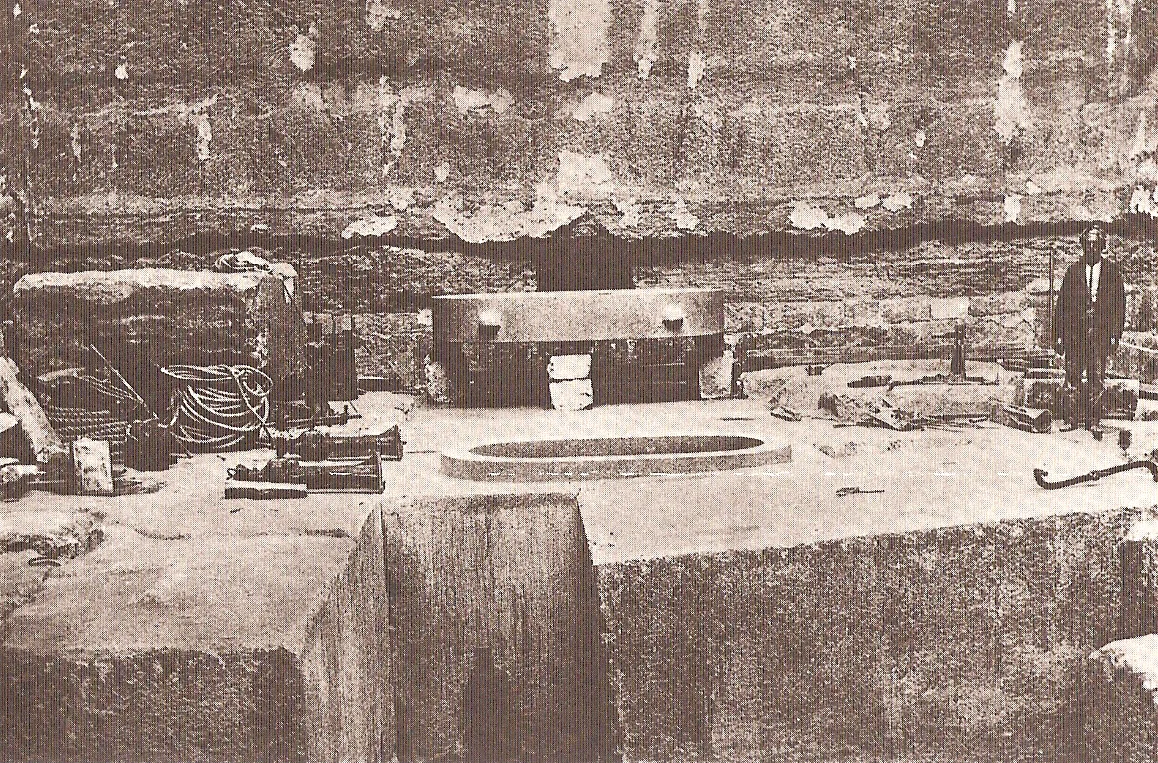
- The oval vat: On 12 March 1905, near the west side of the floor, Barsanti's team uncovered a large oval vat of pink granite, very highly polished, cut into one floor block. He gives its depth as 1.05 m in his 1906 text. The length (about 3.15 m) and width (about 2.22 m) are later readings: writers working from his plates and his 1907 plan usually give those figures. Some secondary books say 1.5 m deep; the excavation report's 1.05 m is the figure to prefer. [2][3]
- A sealed lid: The lid was still in place. It was sealed to the vat with plaster. Over it lay a layer of lime, a thick bed of clay and a neat stack of limestone blocks. [2]
- An empty vat: The vat was empty. The only trace inside was a blackish band, about 10 cm high, on the inner walls. No analysis of this band is recorded; Barsanti's 1906 report gives none. [2]
- Workers' huts: North of the pit, at the foot of the hill, Barsanti recorded rough stone huts that he took for the workers'. In one room his foreman collected a small green schist plaque with the cartouche of King Djedefre, plus bronze chisels, flints and pottery. This came from a hut, not from the monument itself. Some later writers treat the plaque with care because it was never formally published as an object. [2]
- Ink on the blocks: From 15 December 1904, Barsanti recorded many red-ink marks and cartouches on limestone blocks from the fill. He published them as hand-drawn copies. [2]
- Search for a burial chamber: Barsanti recorded a well-built stair 32.5 m long in two flights. He dug tunnels around and under the granite masonry looking for a hidden burial chamber. He reported none, and work in 1906 was still negative. [3]
- The last season: From 27 November 1911 to the end of February 1912, Barsanti moved very large granite blocks (one of 43 tonnes; over 426 tonnes in all) to search under and west of the vat. Money ran out with 72 of 390 square metres still unexamined. The First World War and his death in 1917 ended the work. [4]
- Maspero's view: Gaston Maspero visited the dig. He compared the T-shaped cutting to the underground work of Djedefre's pyramid at Abu Rawash and of pyramids at Saqqara. He concluded that this was a pyramid begun and then suddenly stopped. He praised the size and richness of the materials, the fine cuts and joints, and the finish of the granite vat. [2]
- Access: In 2001 Verner wrote that the Great Pit lies in a closed military zone and cannot be reached. Dodson (2000) described the Layer Pyramid as sanded up and next to a military zone, so the old measurements could not be checked. [6][7]
Debated by Scholars
Experts disagree on these points. Each item names who holds which view.
- Contested Who owned the Great Pit? The name in the cartouche is not read. The second sign is a ka. The first sign cannot be read in Barsanti's drawings. Verner warns that the copies are free-hand sketches and not reliable for reading the signs. [2][6]
- Contested Suggested names: Scholars have proposed Neferka (Maspero), Nebka (Sethe, with Černý and Junker leaning that way), Bikka or Horka (Lauer), Wehemka (Baer), Sethka (Dodson, 1985) and Baka (von Beckerath, Reisner). Baka is often linked to a son of Djedefre and to Manetho's Bikheris. Helck and others doubt the Baka link. Until the marks can be checked again or a better copy appears, the king's name is not known. [6]
- Contested Early Fourth Dynasty? (majority view today): Most recent accounts treat the pit as the unfinished underground part of a pyramid from the early or middle Fourth Dynasty. Verner says the pit is clearly such a substructure and that little of the pyramid above ground was begun. Comparisons with Djedefre's Abu Rawash complex are used to place the owner after Djedefre, either right after him or after Khafre. [6]
- Contested Late Third Dynasty? (serious minority view): Sethe, Černý, Swelim and sometimes Helck are reported to have preferred a late Third Dynasty date. The reasons reported are shaft-tomb traditions, the north–south layout, and granite in royal tombs already under Khasekhemwy. We have not read these works ourselves, so we report this second-hand. The Fourth Dynasty date is the one most recent standard accounts follow.
- Contested How long did work last? Verner argues that even if the owner was Manetho's Bikheris or Baka, a reign of up to seven years is too long. On Fourth Dynasty building rates, the work looks as if it stopped after about one or two years. [6]
- Contested What was the vat? Barsanti called it a libation vat, with the lid serving as an offering table. He rejected the idea of an unused sarcophagus because, in his view, nobody would guard an empty vessel so carefully. Many later Egyptologists call it a sarcophagus. The function is still debated. [2][4][9]
- Contested The dark band: Barsanti took the band for a slight deposit from a liquid offering that dried up. That is his reading. No test of it is recorded. [2]
- Contested A 2024 lecture abstract: Andrzej Ćwiek listed the same range of name readings. He argued that the state of the monument rules out that the oval sarcophagus ever held the king's body. He asked where the king was really buried and floated, as a hypothesis, a link to the tomb of the next king. This is a lecture announcement, not a finished excavation result. [9]
- Contested Layer Pyramid owner: Most Egyptologists accept a late Third Dynasty date and a probable link to Khaba. They point to the likeness of its underground plan to Sekhemkhet's Buried Pyramid at Saqqara and to the Z500 bowls. [7][5]
- Contested Was the Layer Pyramid finished? Stadelmann thought so. Verner and others point to the apparent lack of an outer casing. [6][7]
- Contested Two reports, two plans: Barsanti and Reisner–Fisher disagree on the Layer Pyramid's underground plan. Reisner and Fisher have the entrance running down from the west for 10 m, then turning south. Barsanti starts from a north-east stair. Dodson reviewed the clash in 2000. Because the site is sanded up and in the military zone, it cannot be checked on the ground. [5][1][7]
Open Questions: Still Unsolved
Nothing in our sources settles these points. Nothing here comes from new fieldwork.
- Open question What was in the dark band? A blackish band about 10 cm high lined the inside of the sealed vat. No analysis of it is recorded, and nothing in our sources says it survives for testing. Any claim about what it was is a guess. [2]
- Open question What was the vat for? A libation vat, an unused sarcophagus, or a burial installation whose body was never placed: the evidence does not choose between these. [2][4][9]
- Open question Whose pit is it? The cartouche is unread. Baka is the usual textbook guess, not a proof. [6]
- Open question Which dynasty? The building style points to the early Fourth Dynasty and to Djedefre's Abu Rawash. [6] A serious minority is reported to argue for the late Third (second-hand; not in our sources).
- Open question Is there a burial chamber? Barsanti searched for years under and around the granite floor and reported none. After the 1905 flood, water dropped by about a metre; he explained this as a hidden gallery. That is his inference, not a mapped space. [3][4]
- Open question Was the Layer Pyramid ever used? The chamber and side rooms were empty, which suggests not. But the absence of finds after two early clearances is not full proof. [1][5]
- Open question Where was the owner buried? Ćwiek notes this is rarely discussed. It is unanswered. [9]
- Open question What is the site like today? Our sources include no published first-hand report on the present state of either underground part. Our sources report no authorised excavation at the Great Pit since Barsanti's last season ended in 1912, or at the Layer Pyramid since Reisner and Fisher in 1910–1911. We know of no record of any. [6][7][4]
- Open question Military zone: Verner (2001) and Dodson (2000) describe a closed military zone. Other standard accounts say the area has been a restricted base since the 1960s. Their start years differ (about 1960, 1964, or, for the Layer Pyramid, 1970), and our sources do not include the original order, so we give no firm date. Verner (2001) calls the site inaccessible. [6][7]
- Open question Remote sensing: Our sources mention no published LiDAR or ground-radar survey of this site. It is named in the 2022 satellite atlas of the pyramid fields. We could not read that chapter, so we do not report what it concludes. We marked no features, and any remote-sensing result would be unscored. [8]
Popular Online Claims, and What the Record Shows
These are theories, not findings. The excavation record does not support them.
- Popular claim — not supported Claim: the polish and tight joints are too advanced for the Old Kingdom. Maspero, in the 1906 report's introduction, praised "le fini incomparable de la cuve" (the incomparable finish of the vat). That is praise for the craft. It does not place the work outside the Old Kingdom. Barsanti also recorded granite powder of the kind used for polishing at the site. That points to polishing on the spot, not to an unknown method. [2]
- Popular claim — not supported Claim: an empty vat means something vanished. An empty vessel is only that. The one reported trace is the 10 cm dark band, and no analysis of it is recorded. Barsanti's libation idea and the later sarcophagus idea are both interpretations. Neither shows a hidden or advanced content. [2][9]
- Popular claim — not supported Claim: the site is far older than the dynasties. The excavation record gives no support for this. It shows ink marks on the blocks, workers' huts with a Djedefre plaque, and a place inside a known pyramid field. [2]
- Popular claim — not supported Claim: the military zone hides the truth. The closure fits a modern military base on the desert edge, and it blocks archaeology. That is a real loss for research. It is not evidence about what the vat was for. [6][7]
🏛️ Majority View of Egyptologists
- Majority dating: Layer Pyramid: late Third Dynasty, probably for King Khaba (widely held, not proven). Great Pit: the unfinished underground part of a pyramid from the early or middle Fourth Dynasty (majority view; Verner 2001). The Great Pit owner is unknown.
- Stone & hardness: Pink granite (vat and floor, Great Pit); weak local stone (Layer Pyramid). Mohs hardness: not reported in our sources.
- Quarry distance & alignment: Stone source not reported in the sources on this page. Orientation: Not reported in the sources on this page.
🧭 Leading Edge Proposal & Open Questions
- Minority dating: late Third Dynasty: Reported (second-hand): a serious minority of scholars places the Great Pit in the late Third Dynasty rather than the early Fourth. See the debate section below.
- Barsanti (1906, 1912): libation vat: Not a sarcophagus: The excavator read the sealed vat as a vessel for liquid offerings, with the lid as an offering table. [2][4]
- Ćwiek (2024 lecture abstract): burial elsewhere: Where was the king buried? This hypothesis says the oval vessel never held the owner's body and that the burial lies elsewhere. It is not a finished excavation result. [9]
See also
- Nearby on the same desert ridge: Giza pyramids and Djedkare's south Saqqara necropolis, both Old Kingdom pyramid sites on Truth in Stone.
Primary Academic Sources
▸ View All Cited Primary Sources & DOIs (9 papers)
- Barsanti, A. (1902). Ouverture de la pyramide de Zaouiét el-Aryan. Annales du Service des Antiquités de l'Égypte 2: 92–94. https://archive.org/details/annalesduservice02egypuoft data
- Barsanti, A. (1906), with an introduction by G. Maspero. Fouilles de Zaouiét el-Aryân. Annales du Service des Antiquités de l'Égypte 7: 257–286. https://archive.org/details/annalesduservice78egyp data
- Barsanti, A. (1907). Fouilles de Zaouiét el-Aryan (1904-1905-1906). Annales du Service des Antiquités de l'Égypte 8 (continues the 1906 report). https://archive.org/details/annalesduservice08egypuoft data
- Barsanti, A. (report dated 30 March 1912). Fouilles de Zaouiét el-Aryan (1911-1912). Annales du Service des Antiquités de l'Égypte 12. https://archive.org/details/annalesduservice12egypuoft data
- Reisner, G. A. & Fisher, C. S. (1911). The Work of the Harvard University–Museum of Fine Arts Egyptian Expedition. Bulletin of the Museum of Fine Arts 9(54): 54–59. https://gizapyramids.org/static/pdf%20library/bmfa_pdfs/bmfa09_1911_5… data
- Verner, M. (2001). Archaeological Remarks on the 4th and 5th Dynasty Chronology. Archiv Orientální 69(3): 363–418 (pp. 380–381 discuss the Great Pit). https://www.gizapyramids.org/pdf_library/verner_archiv_or_69.pdf critique
- Dodson, A. (2000). The Layer Pyramid of Zawiyet el-Aryan: Its Layout and Context. Journal of the American Research Center in Egypt 37: 81–90. doi:10.2307/40000524 critique
- Bárta, M. & Brůna, V. (eds.) (2022). The Pyramid Fields of Ancient Egypt: A Satellite Atlas. Czech Institute of Egyptology, Charles University (publisher notice; we did not read the Zawiyet chapter). https://books.ff.cuni.cz/en/2022/03/31/the-pyramid-fields-of-ancient-… background
- Ćwiek, A. (2024). The Burial of Baka(?) or Where Was the Owner of the Unfinished Pyramid at Zawiyet el-Aryan Entombed? Lecture announcement, Czech Institute of Egyptology, 5 December 2024 (an abstract, not a published excavation result). https://cegu.ff.cuni.cz/cs/prednaska-andrzeje-cwieka-the-burial-of-ba… background
Dates and stone checks are summed up in plain English from the papers above. Measured facts stay separate from opinion. Methodology.