Angkor's temples mirror the constellation Draco as it stood in 10,500 BCE
Status: Leading EdgeVerdict: Measured sky: in 10,500 BCE Draco's head crossed the north meridian at its lowest at equinox dawn, but the same moment in Angkor's building era shows the figure turned about 170°, so the match depends on how the plan is read
30-SECOND TAKEAWAY
In Plain English — The 30-Second Takeaway
What It Is:
Were the temples of Angkor in Cambodia laid out to mirror the dragon constellation Draco in 10,500 BCE?
What Everyone Agrees On (Measured Facts):
Inscriptions date Angkor to 800–1200 CE. Our sky check shows Draco sat north at the 10,500 BCE spring dawn, turned 170° from 1150 CE.
🏛️ Mainstream Archaeology View:
Historians and laser maps show the temples follow Khmer Hindu-Buddhist city grids, water tanks, and dated royal texts.
🧭 Leading Edge View:
Graham Hancock argues the Khmer built their temples over sacred spots chosen to match the sky of 10,500 BCE.
Overview & Context
Graham Hancock and Santha Faiia proposed in Heaven's Mirror (1998) that the layout of Angkor's principal temples copies Draco, with secondary accounts saying the sky is shown 'at dawn on the spring equinox in 10,500 BC'. Carved texts and buildings date Angkor Wat to the early 12th century and the Bayon to the late 12th to early 13th century.
▸ Read Technical Background, Full Claim Wording & Academic Literature History
Formal claim tested: The main temples of Angkor form a ground plan of the constellation Draco, the dragon, as it looked at dawn on the spring equinox in about 10,500 BCE. The Khmer built in the 9th to 13th centuries CE, but to a design that encodes this much earlier sky.
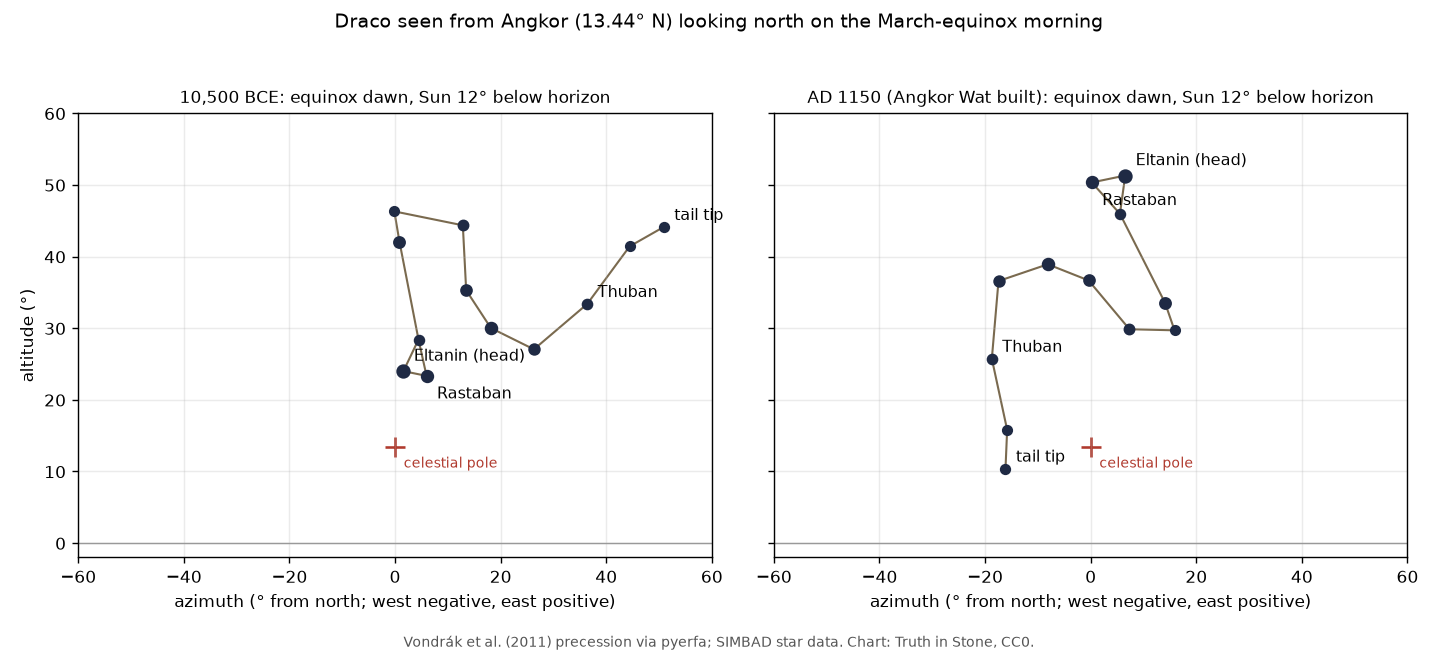
Where the evidence stands: The sky side can be computed and we did so. On the March-equinox morning of 10,500 BCE, Draco's head sat on the north meridian just above the celestial pole. Its head star Eltanin was within a few centuries of its closest approach to the pole. That is a real and specific feature of that epoch. At the same moment of the year in about AD 1150, when Angkor Wat was built, the dragon was in the same part of the sky but rotated by about 170°. Choosing 10,500 BCE over the builders' own sky therefore depends on how a star picture is laid onto a ground plan. No published star-by-temple key with positional errors is available for testing, so the ground side is untested.
We re-ran the sky with the same method used for our Sphinx–Leo and Göbekli Tepe Pillar 43 checks. Leading Edge: the date proposed is far outside the archaeological record of Cambodia, but the sky claim itself is testable. We could not consult the book's star-to-temple key directly (it is lending-only), so the wording of the claim comes from the author's site and secondary summaries.
Computation & method notes: How we computed this: precession uses the long-term model of Vondrák, Capitaine and Wallace (2011) in the IAU SOFA/ERFA library (pyerfa). Star positions, proper motions, parallaxes and radial velocities for 12 Draco stars and Vega come from SIMBAD (queried 23 October 2026). At the March equinox the Sun sits at the equinox point, so no calendar date is needed. Angkor is taken at latitude 13.441° N (the Bayon). We report altitudes and azimuths for the Sun at −18°, −12°, −6° and sunrise. We compare the shape of the figure between epochs with a best-fit shift, scale and rotation (no mirror image). These results are our own computation, not taken from a published paper. Download the Python script (CC0).
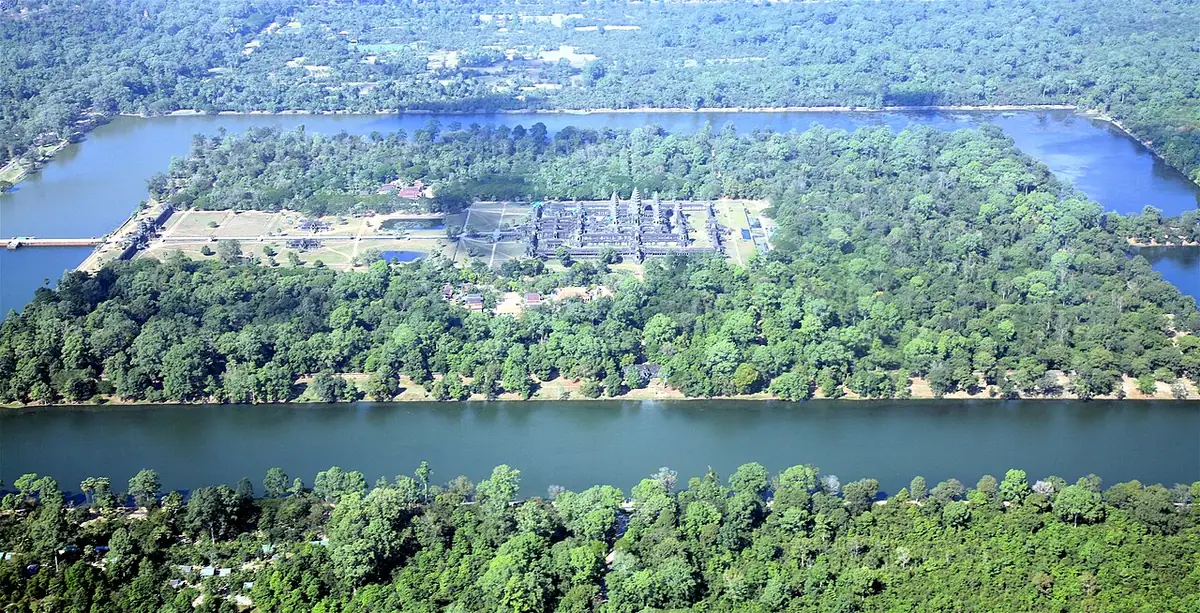
Angkor Wat from the air. Image: Steve Jurvetson from Menlo Park, USA, CC BY 2.0, via Wikimedia Commons. Resized.
✓ What Has Been Physically Measured
Dates, physical measurements, and excavated findings kept separate from interpretation.
Inscriptions and architectural style date: Angkor Wat to the reign of Suryavarman II (early 12th century) and the Bayon to Jayavarman VII (late 12th to early 13th century). [2][3]
Our sky calculation: On the March-equinox morning in 10,500 BCE (Sun 12° below the horizon), all 12 main Draco stars were above Angkor's horizon. The head (Eltanin, Rastaban) was on the north meridian at about 23–24° altitude, just above the celestial pole (13.4°), and the body arched up to about 46°. [7][8][9]
Our sky calculation: Eltanin reached its closest approach to the celestial pole (declination 79.4°) around 10,750 BCE. So 10,500 BCE is close to the epoch when Draco's head crossed the meridian at its lowest. [7][8]
Our sky calculation: At the same moment of the year in AD 1150, Draco was again on the north meridian, but with the head high (about 51°) and the tail low. A best fit shows the whole figure turned by about 172° compared with 10,500 BCE. [7]
Our sky calculation: At the equinox dawn the figure turns by about 13° per 1,000 years, so a plan that matches to within ±10° fixes the epoch only to within about ±800 years. [7]
Our sky calculation: Draco is never at lower culmination at the equinox dawn in any epoch from 14,000 BCE to AD 2000. Accounts that describe Draco at its 'lowest culmination' at that moment can only mean that the head was at its lowest upper transit. [7]
🧭 Proponents' Case & Cited Evidence
Key finding: Hancock argues that Angkor's main temples reproduce the pattern of Draco. He takes this as evidence that the plan preserves a sky from about 10,500 BCE, the same epoch he proposes for Giza. [1]
Angkor Wat itself is: astronomically designed. Stencel, Gifford and Morón found solar sightlines, including the equinox sunrise over the central tower seen from the western entrance, and checks that encode Hindu cosmological time periods. [3]
The 10,500 BCE sky does have: a distinctive feature: Draco's head at the meridian, near the pole, at the equinox dawn. This is a real match to the book's description, not a coincidence of wording. [7]
🏛️ Mainstream Archaeological View & Evidence
Key finding: A systematic GIS study of Khmer temples (Magli 2017) found a clear pattern of cardinal angle and solar sightlines linked to royal symbolism. It found no need for a stellar ground plan, and it argued against esoteric readings. [4]
The figure in AD 1150 is: the 10,500 BCE figure turned about 170°. Reading a plan with north or south at the top, or as seen from above or below, can flip or turn it, so the inferred epoch depends on a choice the claim does not fix in advance. [7]
Key finding: Angkor has hundreds of temples. Choosing a subset that resembles a constellation, without a rule fixed in advance for which temples count, makes a pattern easy to find (our assessment; the same selection issue applies to other sky-map claims). [7][4]
Lidar and excavation have: mapped Angkor's urban landscape and its 8th–9th-century predecessor on Phnom Kulen. They have found no building remotely near 10,500 BCE. [5][6]
🔬 What Future Tests Would Settle It
A published table matching named temples to named stars, with measured positions, would allow a proper fit test, including the probability that a random set of Angkor temples fits as well. Evidence that Khmer astronomers recognised a dragon figure in this part of the sky would also help.
Draco seen from Angkor (13.44° N), looking north at the March-equinox dawn with the Sun 12° below the horizon: 10,500 BCE (left) and AD 1150 (right). Computed with the Vondrák et al. (2011) precession model and SIMBAD star data. Chart: Truth in Stone (our own work), released under CC0.
Hamlet's Mill: An Essay Investigating the Origins of Human Knowledge and Its Transmissions Through Myth
Giorgio de Santillana & Hertha von Dechend
Two science historians argue that ancient stories worldwide preserve real observations of the 26,000-year wobble of the stars.
▸ Why this book matters to both sides
Written by historians of science at MIT and Frankfurt University. The author argues ancient stories worldwide encode technical findings of the 26,000-year sky wobble of the equinoxes and shifting world ages.
Role in the debate: The scholarly bridge between academic history of astronomy and modern sky-sightline claims about sky-cycle coding at Giza, Angkor, and Göbekli Tepe. (ISBN 9780879232153)
Archaeology from Space: How the Future Shapes Our Past
Sarah Parcak
Explains how satellites and airplane lasers spot buried cities, roads, and temples across Egypt and the Americas.
▸ Why this book matters to both sides
Remote-sensing archaeologist Sarah Parcak explains how multispectral satellite imagery and airborne LiDAR reveal buried towns, road networks, and giant foundations across Egypt, Europe, and the Americas.
Role in the debate: Explains the physics and ground-truthing requirements of remote sensing—essential context for comparing verified LiDAR cities against disputed subsurface radar claims. (ISBN 9781250231345)
Fingerprints of the Gods: The Evidence of Earth's Lost Civilization
Graham Hancock
Graham Hancock's bestseller arguing that Giza, Pumapunku, and ancient maps preserve traces of a lost Ice Age culture.
▸ Why this book matters to both sides
Hancock's worldwide bestseller examining Tiwanaku, Pumapunku, Teotihuacan, Giza, the Piri Reis map, and Hapgood's crustal-shift model. It argues for an Ice Age culture lost in a global cataclysm.
Role in the debate: The book that brought the lost-Ice-Age-culture idea to millions of readers and framed the modern debate over Giza, Pumapunku, and ancient sky sightlines. (ISBN 9780517887295)
The Orion Mystery: Unlocking the Secrets of the Pyramids
Robert Bauval & Adrian Gilbert
The book that launched the Orion Correlation, matching the three Giza pyramids to the three stars of Orion's Belt.
▸ Why this book matters to both sides
The book that launched the Orion Correlation Theory, matching the ground plan of Khufu, Khafre, and Menkaure and the angles of the Great Pyramid's four internal shafts to Orion's Belt and Sirius.
Role in the debate: Allows readers to examine Bauval's original shaft-angle and layout geometry alongside mainstream Egyptological and sky-sightline critiques. (ISBN 9780517884546)
FTC affiliate disclosure: Book links go to Bookshop.org (ID 130218, Search for the Truth). Each sale helps local bookstores and pays us a 10% fee at no extra cost to you. All partner links use rel="sponsored nofollow noopener". Fees never change our verdicts. Affiliate disclosure.
Visiting & base stays: Angkor Wat, Angkor Thom & Greater Angkor Hydraulic City (Siem Reap, Cambodia)
FTC affiliate disclosure: Tour links go to GetYourGuide and Viator. Hotel links use Stay22 (aid=solarevidence) for Booking.com and Expedia. If you book a trip, we may earn a small fee at no extra cost to you. All partner links use rel="sponsored nofollow noopener". Check travel alerts before you go. Partner fees never change our ratings. All 64 site field visits · Affiliate disclosure.
Primary Academic Sources
▸ View All Cited Primary Sources & DOIs (9 papers)
Hancock, G. & Faiia, S. (1998). Heaven's Mirror. Part III, Cambodia (chapter 7, 'Draco'). Publisher's summary and contents on the author's site. https://grahamhancock.com/heavens-mirror/proponent
Stencel, R., Gifford, F. & Morón, E. (1976). Astronomy and cosmology at Angkor Wat. Science 193: 281–287. doi:10.1126/science.193.4250.281data
Magli, G. (2017). Archaeoastronomy in the Khmer heartland. Studies in Digital Heritage 1(1). doi:10.14434/sdh.v1i1.22846critique
Evans, D. H. et al. (2013). Uncovering archaeological landscapes at Angkor using lidar. PNAS 110. doi:10.1073/pnas.1306539110data
Chevance, J.-B., Evans, D. et al. (2019). Mahendraparvata: an early Angkor-period capital defined through airborne laser scanning at Phnom Kulen. Antiquity 93 (corrigendum 2020). doi:10.15184/aqy.2019.133data
Vondrák, J., Capitaine, N. & Wallace, P. (2011). New precession expressions, valid for long time intervals. Astronomy & Astrophysics 534: A22. doi:10.1051/0004-6361/201117274data
SIMBAD astronomical database, CDS Strasbourg (star positions, proper motions, parallaxes and radial velocities; queried 22 October 2026). https://simbad.cds.unistra.fr/simbad/data
Sources checked against Crossref and publisher pages on 2026-10-23. This entry presents a debated idea neutrally: the proponents' case first, then the mainstream position, in plain English. "Open question" is not a judgment that the idea is true or false. Labels describe the claim, not the people who hold it. Methodology.