The Dogon people of Mali possessed pre-telescopic knowledge of the invisible white dwarf companion star Sirius B
Status: Leading EdgeVerdict: Measured: Sirius B is a magnitude-8.44 white dwarf with a 50.13-year orbit invisible to the naked eye (first resolved by Alvan Clark in 1862); whether Griaule's 1931–1950 Dogon accounts reflect ancient tradition, European visitor contact, or ethnographic questioning remains contested
30-SECOND TAKEAWAY
In Plain English — The 30-Second Takeaway
What It Is:
Did the Dogon people of Mali have pre-telescopic knowledge of the invisible white dwarf star Sirius B?
What Everyone Agrees On (Measured Facts):
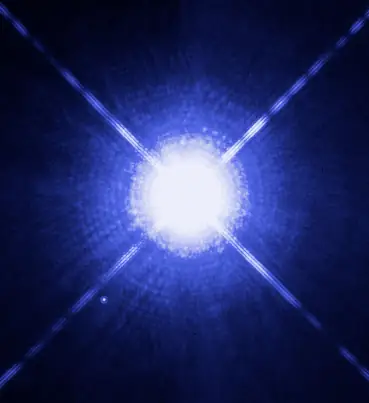
Sirius B is a tiny, super-heavy white dwarf star that orbits Sirius every 50 years. It cannot be seen with the naked eye and was first spotted by telescope in 1862.
🏛️ Mainstream Archaeology View:
Scholars Carl Sagan and Walter van Beek found that French visitors and an 1893 eclipse team likely shared 1920s star news with the four Dogon elders Griaule talked to.
🧭 Leading Edge View:
French writers reported in 1950 that Dogon elders drew a 50-year orbit for a tiny, heavy white star around Sirius. Robert Temple argued this lore came from ancient times.
Overview & Context
In 1946–1950, French culture scholar Marcel Griaule and his colleague Germaine Dieterlen recorded cosmological interviews with the blind Dogon elder Ogotemmêli and three other initiates in the Bandiagara cliffs of Mali. In their 1950 paper *Un système soudanais de Sirius*, they reported that the Dogon celebrated a 60-year *Sigui* ceremony tied to Sirius (*sigi tolo*) and spoke of a tiny, invisible, heavy white star (*po tolo*, named after the tiniest cereal grain, *Digitaria*) that orbits Sirius every 50 years.
▸ Read Technical Background, Full Claim Wording & Academic Literature History
Formal claim tested: Before modern contact, the Dogon people of the Bandiagara Escarpment in Mali held an oral and ritual tradition describing 'po tolo' (Sirius B)—an invisible, tiny, extraordinarily dense white companion star orbiting Sirius every 50 years.
Where the evidence stands: French ethnographers Marcel Griaule and Germaine Dieterlen published in 1950 ('Un système soudanais de Sirius') that Dogon initiates described a tiny, heavy companion star ('po tolo') orbiting Sirius with a 50-year period, and Robert Temple popularized the account in The Sirius Mystery (1976). Physically, Sirius B has an apparent magnitude of 8.44 separated by only 3 to 11 arcseconds from brilliant Sirius A (magnitude −1.46) and cannot be seen without a large telescope. However, astronomer Carl Sagan (1979) and restudy culture scholar Walter van Beek (1991, Current Anthropology) recorded that Sirius B's 50-year orbit and extreme white-dwarf density were famous news stories in the 1920s, that a French solar-eclipse expedition camped near the region in 1893, and that later Dogon informants outside Griaule's circle did not recognize Sirius B.
Because the real white dwarf Sirius B has a 50.1-year orbit and was only discovered telescopically in 1862 and weighed as an ultra-dense white dwarf in the 1910s–1920s, author Robert Temple (*The Sirius Mystery*, 1976) argued the Dogon preserved pre-telescopic knowledge from ancient Egypt or space contact. Anthropologist Walter van Beek (1991) and astronomer Carl Sagan (1979) tested the ethnography on the ground. See also solar and sky alignments.
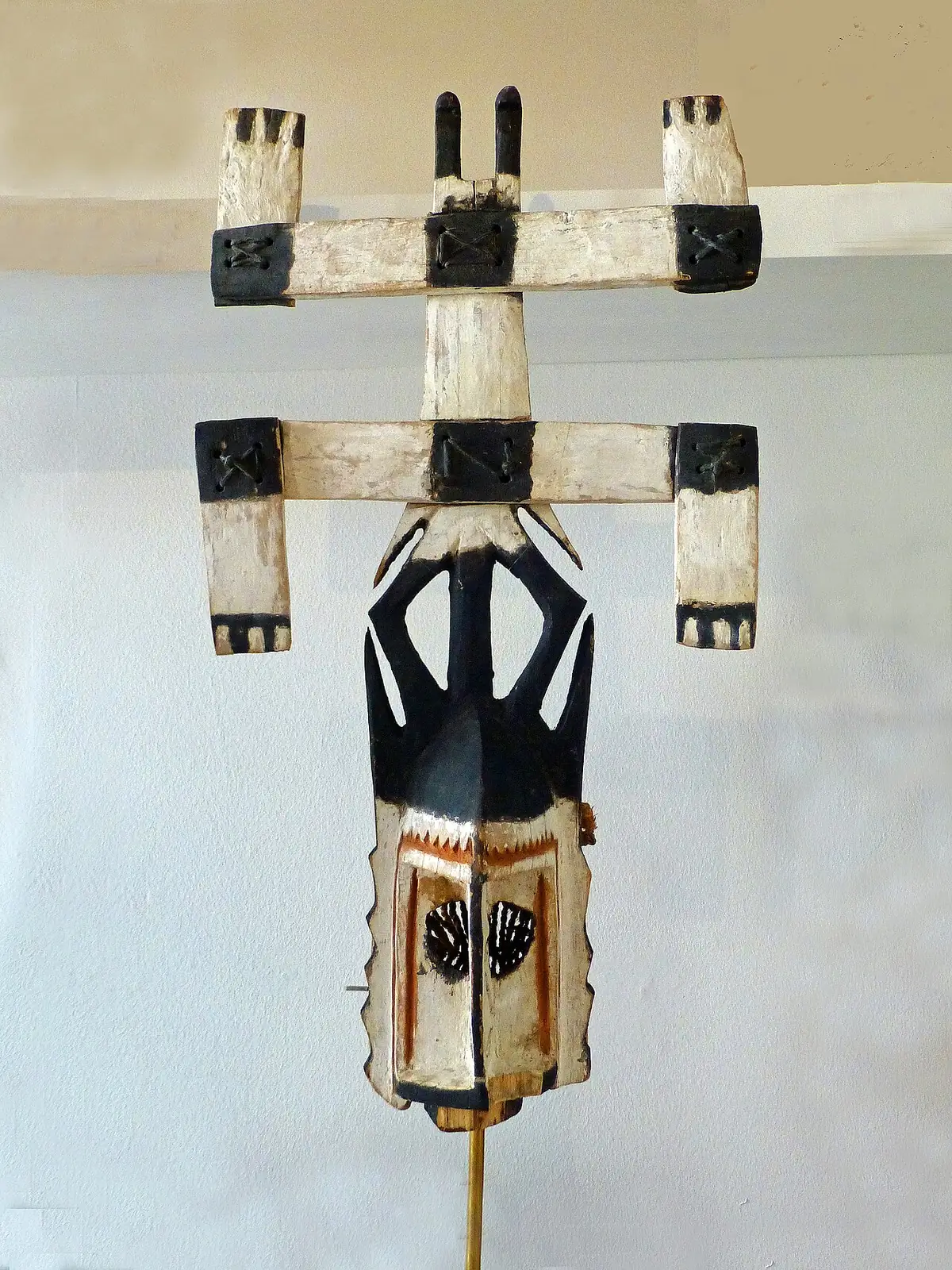
Hubble Space Telescope overexposed image of Sirius A with its tiny white dwarf companion Sirius B visible as a faint dot at lower left (NASA/ESA). Image: NASA, ESA, H. Bond (STScI), and M. Barstow (University of Leicester), Public domain, via Wikimedia Commons. Resized.A Dogon ceremonial Kanaga mask from the Bandiagara region of Mali. Image: Ji-Elle, CC BY-SA 4.0, via Wikimedia Commons. Resized.
✓ What Has Been Physically Measured
Dates, physical measurements, and excavated findings kept separate from interpretation.
Sirius B astrophysical parameters: Hubble Space Telescope data (Bond et al. 2017) show Sirius B orbits Sirius A every 50.13 years. It packs the mass of our Sun into a white dwarf the size of Earth and shines 10,000 times fainter than Sirius A. [5]
1844 prediction and 1862 telescopic discovery: Astronomer Friedrich Bessel predicted an unseen star from Sirius's wobble in 1844. Alvan Clark first saw Sirius B through an 18.5-inch telescope in 1862, and Walter Adams measured its huge density in 1915–1925. [5][4]
Griaule & Dieterlen's 1950 ethnographic report: In 1950, Griaule and Dieterlen reported that four Dogon elders described a star called po tolo. They called it the smallest and heaviest white star and said it orbits Sirius every 50 years. [1]
Van Beek's 1979–1989 field restudy: Scholar Walter van Beek studied the Dogon for 11 years and published his results in 1991. He found that Dogon elders outside Griaule's small group knew bright Sirius but had no lore of an invisible 50-year companion star. [3]
🧭 Proponents' Case & Cited Evidence
Match to 50-year orbit and high density: Griaule and Dieterlen (1950) and Temple (1976) emphasize that Dogon ritual diagrams drew an elliptical orbit around Sirius with a 50-year period and described po tolo as made of 'sagala', a metal heavier than all iron on Earth—matching the 50.1-year period and high density of the white dwarf Sirius B. [1][2]
Griaule's daughter's defense of fieldwork: In the 1991 Current Anthropology commentary, Marcel Griaule's daughter Geneviève Calame-Griaule defended her father's field methods. The author argues deep esoteric star lore was restricted to a tiny circle of highest-rank Hogan priests who would not share it with later outsiders. [3][1]
Proposed ancient Egyptian Sirius link: Temple (1976) argued that the Dogon migrated from northern Africa and inherited pre-dynastic or Egyptian temple traditions linking Isis/Sothis (Sirius) and Anubis with a dark companion star. [2]
🏛️ Mainstream Archaeological View & Evidence
1920s European contact and the 1893 eclipse team: Carl Sagan (1979) and astronomers Pesch & Pesch pointed out that Sirius B's 50-year orbit and 'one ton per cubic inch' white-dwarf density were widely publicized in French newspapers and popular science books in the 1920s—just before Griaule's 1931–1946 fieldwork—and that French astronomers camped in West Africa for 5 weeks during the April 1893 solar eclipse. Meanwhile, White Fathers missionaries and French schools operated across Bandiagara. [4][3]
Leading questions and informant courtesy: Van Beek's 1991 restudy concluded that Griaule, who had studied astronomy in Paris and carried star maps into the field, asked forceful leading questions that prompted courteous Dogon informants (some educated in French colonial schools) to weave European star facts into local grain metaphors. [3]
Reflects 1920s astronomy, including its gaps: Critics note that the Dogon account included 1920s ideas (such as a third star, 'Sirius C', which several European astronomers claimed to see in the 1920s, plus Saturn's rings and Jupiter's four Galilean moons) but knew nothing of white-dwarf nuclear physics discovered after 1930. [4][3]
🔬 What Future Tests Would Settle It
Only a pre-1862 written manuscript, dated rock-art carved text in the Bandiagara cliffs, or dated pre-1844 artifact explicitly recording a 50-year dense companion to Sirius—produced before Bessel's 1844 check and Clark's 1862 telescopic sighting—would prove that the Sirius B details predated 19th- and 20th-century European astronomy.
Examines how hunter-gatherers built giant stone sites like Göbekli Tepe and Poverty Point without kings or farming.
▸ Why this book matters to both sides
An culture scholar and an archaeologist examine Göbekli Tepe, Karahan Tepe, Poverty Point, Watson Brake, and Teotihuacan. It challenges the textbook step-by-step ladder from small hunter-gatherer bands to states.
Role in the debate: Shows how mainstream archaeology accounts for giant buildings built by hunter-gatherers (Göbekli Tepe, Poverty Point) without invoking a single global parent culture. (ISBN 9781250858801)
Stonehenge: A New Understanding — Solving the Mysteries of the Greatest Stone Age Monument
Mike Parker Pearson
The leader of the Stonehenge digs explains the latest carbon dates, solstice sightlines, and stone quarries.
▸ Why this book matters to both sides
The director of the Stonehenge Riverside Project details the digs at Stonehenge, Durrington Walls, and Bluestonehenge, including Bayesian carbon dates, solstice axes, and quarry sourcing.
Role in the debate: Establishes the dug timeline and solstice sightline baseline for British and European megaliths. (ISBN 9781615191932)
Hamlet's Mill: An Essay Investigating the Origins of Human Knowledge and Its Transmissions Through Myth
Giorgio de Santillana & Hertha von Dechend
Two science historians argue that ancient stories worldwide preserve real observations of the 26,000-year wobble of the stars.
▸ Why this book matters to both sides
Written by historians of science at MIT and Frankfurt University. The author argues ancient stories worldwide encode technical findings of the 26,000-year sky wobble of the equinoxes and shifting world ages.
Role in the debate: The scholarly bridge between academic history of astronomy and modern sky-sightline claims about sky-cycle coding at Giza, Angkor, and Göbekli Tepe. (ISBN 9780879232153)
The Orion Mystery: Unlocking the Secrets of the Pyramids
Robert Bauval & Adrian Gilbert
The book that launched the Orion Correlation, matching the three Giza pyramids to the three stars of Orion's Belt.
▸ Why this book matters to both sides
The book that launched the Orion Correlation Theory, matching the ground plan of Khufu, Khafre, and Menkaure and the angles of the Great Pyramid's four internal shafts to Orion's Belt and Sirius.
Role in the debate: Allows readers to examine Bauval's original shaft-angle and layout geometry alongside mainstream Egyptological and sky-sightline critiques. (ISBN 9780517884546)
FTC affiliate disclosure: Book links go to Bookshop.org (ID 130218, Search for the Truth). Each sale helps local bookstores and pays us a 10% fee at no extra cost to you. All partner links use rel="sponsored nofollow noopener". Fees never change our verdicts. Affiliate disclosure.
Primary Academic Sources
▸ View All Cited Primary Sources & DOIs (5 papers)
Griaule, M. & Dieterlen, G. (1950). Un système soudanais de Sirius. Journal de la Société des Africanistes 20(2): 273–294. doi:10.3406/jafr.1950.2611proponent
Temple, R. K. G. (1976; rev. 1998). The Sirius Mystery: New Scientific Evidence of Alien Contact 5,000 Years Ago. St. Martin's Press (Open Library record). https://openlibrary.org/works/OL2676177Wproponent
van Beek, W. E. A. (1991). Dogon Restudied: A Field Evaluation of the Work of Marcel Griaule (with CA comments and replies; title shortened). Current Anthropology 32(2): 139–167. doi:10.1086/203932critique
Sagan, C. (1979). Broca's Brain: Reflections on the Romance of Science (Ch. 6, "White Dwarfs and Little Green Men", on cultural contact and the 1893 solar eclipse expedition). Random House. https://openlibrary.org/works/OL14868536Wcritique
Bond, H. E., Schaefer, G. H., Gilliland, R. L. et al. (2017). The Sirius System and Its Astrophysical Puzzles: Hubble Space Telescope Astrometry. The Astrophysical Journal 840(2): 70. doi:10.3847/1538-4357/aa6af8data
Sources checked against Crossref and publisher pages on 2026-10-27. This entry presents a debated idea neutrally: the proponents' case first, then the mainstream position, in plain English. "Open question" is not a judgment that the idea is true or false. Labels describe the claim, not the people who hold it. Methodology.