Solar alignments & eclipse monuments: solstice, equinox and the August 2, 2027 total eclipse over Luxor & Karnak
Status: MainstreamVerdict: Measured: solar horizon alignments (solstice and equinox azimuths) at Chankillo, Stonehenge, Newgrange, Karnak and Serpent Mound are physically verified and independent of axial precession; on 2 August 2027, the longest land total solar eclipse of the century (6m 22s) will pass directly over Karnak, Luxor, Abydos and Dendera
30-SECOND TAKEAWAY
In Plain English — The 30-Second Takeaway
What It Is:
This review covers ancient sites proven to track the Sun's solstices and equinoxes, plus the 2027 total eclipse over Egypt.
What Everyone Agrees On (Measured Facts):
Solar sightlines at Chankillo, Stonehenge, Newgrange. Also, Karnak are verified on the ground and do not drift with star precession.
🏛️ Mainstream Archaeology View:
Scholars agree these temples and stone rings worked as giant horizon calendars to mark solstices and farming seasons.
🧭 Leading Edge View:
On August 2, 2027, a 6-minute-22-second total solar eclipse—the longest on land this century—will pass right over Luxor and Karnak.
Overview & Context
This cross-site directory connects the archaeological monuments on Truth in Stone with the solar physics and ephemeris checks on our sister site Solar Evidence. We compare verified solstice, equinox and solar-calendar sightlines worldwide, explain why solar sightlines change by less than a solar diameter over five millennia (driven by obliquity $\varepsilon$ rather than sky wobble), and highlight the upcoming **2 August 2027 total solar eclipse**—when 6 minutes 20 seconds of totality will stand 80° overhead directly above Karnak, Luxor, the Osireion at Abydos and Dendera. For full centerline tables, eye-safety standards and Luxor base stays, see Solar Evidence’s August 2, 2027 Total Solar Eclipse Guide.
▸ Read Technical Background, Full Claim Wording & Academic Literature History
Formal claim tested: Ancient builders across Peru, Egypt, Britain, Ireland and Mesoamerica engineered giant corridors, horizon towers and earthworks to track the solar solstices, equinoxes and calendar intervals—and on 2 August 2027 a 6-minute-22-second total solar eclipse will cross directly over Upper Egypt’s temple axis.
Where the evidence stands: Unlike stellar sightlines (which shift by 1° every ~71.6 years due to axial sky wobble and are often contested), solar horizon sightlines depend only on site latitude, local horizon altitude, and the slow change in Earth’s axial obliquity (~0.4° over 3,000 years). As a result, solstice and horizon-calendar monuments such as Chankillo’s Thirteen Towers in Peru, Newgrange in Ireland, Stonehenge in Britain. The Amun-Ra axis at Karnak are measured and accepted in mainstream archaeoastronomy.
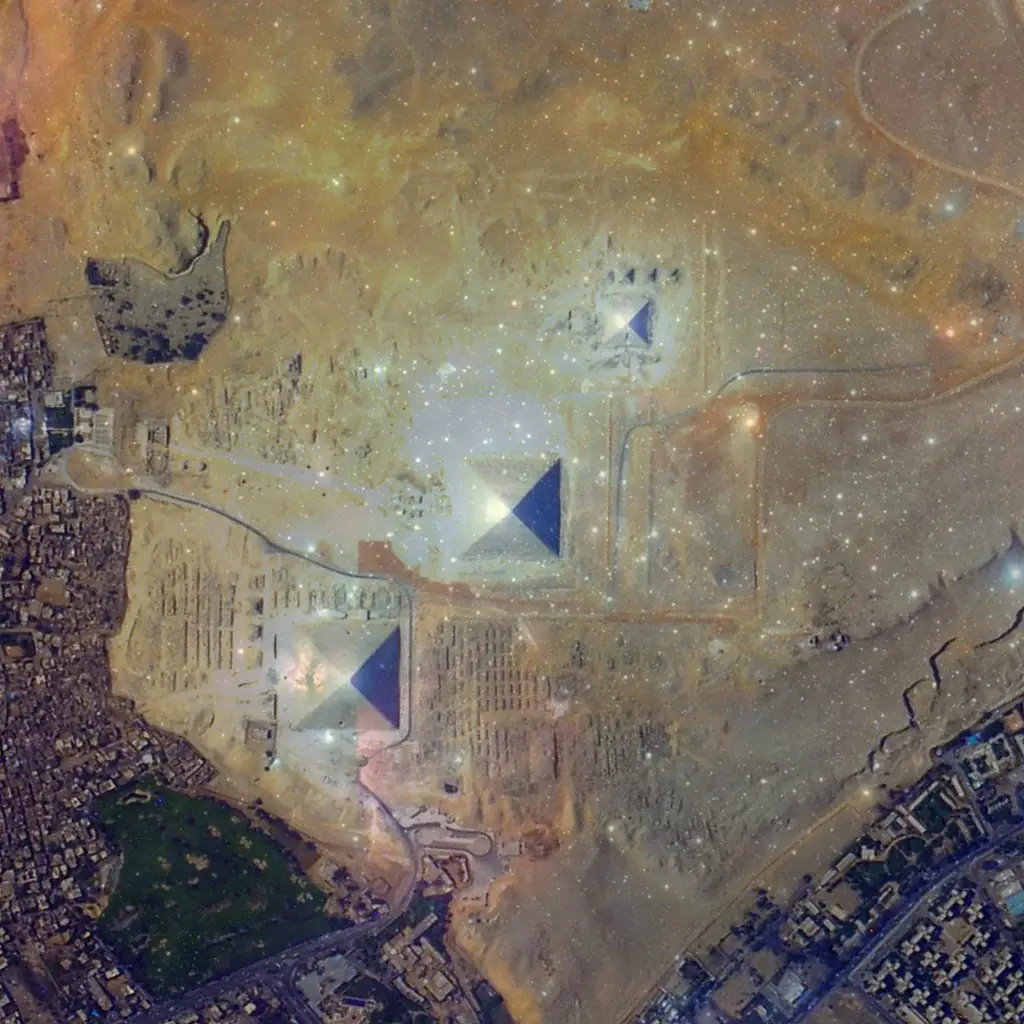
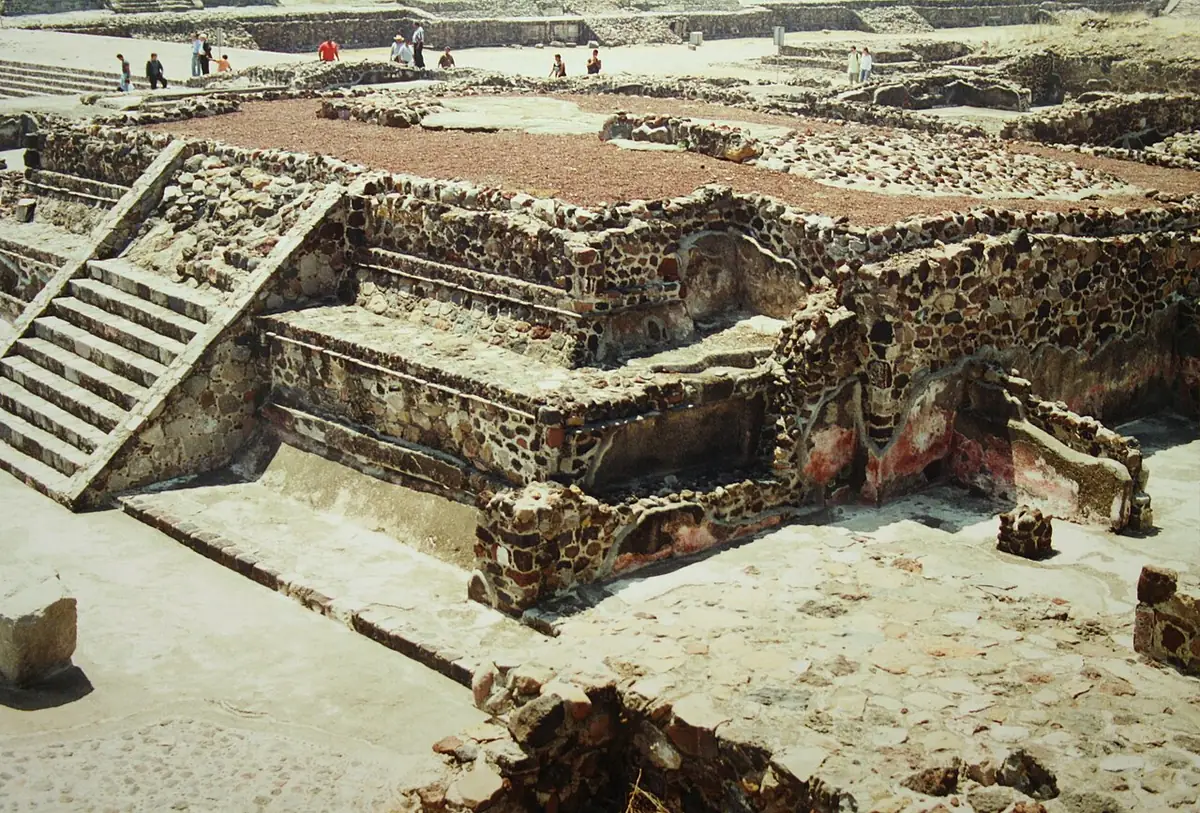
The comparison at the heart of the correlation idea: Orion's Belt beside the layout of the three main Giza pyramids. Image: NASA, Rogelio Bernal Andreo, cmglee, CC BY-SA 4.0, via Wikimedia Commons. Resized.The Avenue of the Dead, about 15.5° east of north. Image: Gary Todd from Xinzheng, China, CC0, via Wikimedia Commons. Resized.
✓ What Has Been Physically Measured
Dates, physical measurements, and excavated findings kept separate from interpretation.
Key finding: Chankillo Thirteen Towers (Casma Valley, coastal Peru, c. 300–200 BCE): Thirteen toothed stone towers running north–south along a low ridge span the entire annual sunrise and sunset arc from the June solstice to the December solstice as seen from two flanking finding points, allowing solar dates to be read to within 2–3 days (Ghezzi & Ruggles 2007; UNESCO World Heritage 2021). [1][4]
Key finding: Newgrange Passage Tomb (Brú na Bóinne, Ireland, c. 3200 BCE): Above the entrance, a purposefully built quartz-framed roof-box channels the first rays of the winter solstice sunrise (~133.7° azimuth) down the 19 m stone passage to illuminate the cruciform chamber floor for ~17 minutes. Accounting for the 3200 BCE obliquity (ε ≈ 24.03° vs. 23.44° today), the sunbeam originally entered the chamber directly at first gleam. [2][4]
Stonehenge (Wiltshire, UK, c. 2500 BCE): The Avenue and the principal axis of the sarsen horseshoe and circle align to ~49.6° NE (summer solstice sunrise behind the Heel Stone) and ~229.6° SW (winter solstice sunset framed between the uprights of the Great Trilithon). [5][4]
Key finding: Karnak & Upper Egyptian Temples (Luxor, Egypt): The main axis of the Great Temple of Amun-Ra at Karnak (~116.9° ESE / 296.9° WNW) is oriented to the winter solstice sunrise in the hills of the eastern desert (and perpendicular to the Nile). Meanwhile, neighbouring solar chapels at Karnak and Abu Simbel mark specific solar declinations (Belmonte et al. 2009). [3][6]
Giza Pyramids & Great Sphinx (Egypt): Khufu’s Great Pyramid is aligned to true cardinal north–south–east–west within 3.6 arcminutes (0.06°), and the Sphinx faces within ~0.2° of true east (90° azimuth), facing the equinox sunrise. [7][8]
Key finding: Teotihuacan & Mesoamerican "15.5° family" (Mexico): Teotihuacan’s Street of the Dead (~15.5° east of north) and perpendicular east–west axis (~105.5° / 285.5° azimuth) face sunset on ~12–13 August and ~29–30 April, dividing the 365-day solar year into intervals of 260 and 105 days matching the sacred mesoamerican 260-day calendar. [9][10]
Key finding: The 2 August 2027 Total Solar Eclipse over Upper Egypt: At 10:06 UTC (13:06 local time) on 2 August 2027, the centerline of Saros 136 crosses directly over Abydos (6m 15s totality), Dendera, and Luxor/Karnak (6m 20s totality, peaking at 6m 22.8s just 35 km east of Luxor with the Sun 80° above the horizon). Meanwhile, Giza and Cairo experience a 95% partial eclipse. [13][14]
🧭 Proponents' Case & Cited Evidence
800-ton Trilithon wall blocks: Because solar solstice and equinox azimuths shift by only ~0.5°–0.8° over 5,000 years (following the 41,000-year obliquity cycle between 22.1° and 24.5°), optical features like Newgrange’s roof-box, Chankillo’s toothed horizon towers, and Stonehenge’s Great Trilithon frame are physically testable in the field today. [2][1][4]
Key finding: Systematic statistical surveys of hundreds of Egyptian temples (Belmonte et al. 2009) and Mesoamerican civic centres (Šprajc 2000) show sharp, non-random clustering around solstice, equinox, and calendar-interval declinations. [3][9]
🏛️ Mainstream Archaeological View & Evidence
Key finding: Precisely because solar obliquity changes so slowly (~0.013° per century), a solstice or equinox sightline cannot by itself date a monument to a specific millennium (unlike Lockyer’s 1894 attempts to date Egyptian temples solely from tiny obliquity shifts, which are smaller than the angular width of the solar disc, 0.53°). [6][4]
Key finding: Secondary sightlines claimed across multiple subsidiary mounds or bends (such as some coil sightlines at Serpent Mound) can arise by chance unless the viewing backsight and foresight are separately marked in the buildings. [11][4]
🔬 What Future Tests Would Settle It
High-resolution 3D horizon-profile modelling across newly dug Anatolian (Taş Tepeler) and Amazonian/Maya LiDAR causeway complexes (such as Aguada Fénix’s 475 rectangular plateau platforms, which Inomata et al. 2021 link to solstice/calendar angles) will test how early systematic solar-calendar buildings began.
▸ Reference Data Table: Major solar-aligned monuments worldwide & 2 August 2027 eclipse intersection
Measured azimuths, target solar events, and astronomical sensitivity to obliquity vs. precession.
Stonehenge: A New Understanding — Solving the Mysteries of the Greatest Stone Age Monument
Mike Parker Pearson
The leader of the Stonehenge digs explains the latest carbon dates, solstice sightlines, and stone quarries.
▸ Why this book matters to both sides
The director of the Stonehenge Riverside Project details the digs at Stonehenge, Durrington Walls, and Bluestonehenge, including Bayesian carbon dates, solstice axes, and quarry sourcing.
Role in the debate: Establishes the dug timeline and solstice sightline baseline for British and European megaliths. (ISBN 9781615191932)
The Giza dig leaders share 30 years of finds, from the workers' town and stone quarries to Old Kingdom carbon dates.
▸ Why this book matters to both sides
The Giza dig teams' own large-format overview of decades of fieldwork on the plateau. It records the Heit el-Ghurab workers' town, limestone quarries, ramp remnants, and Old Kingdom carbon dates.
Role in the debate: Provides the primary archaeological and soil-layer baseline at Giza against which older-Sphinx, legacy-foundation, and precision-machining proposals are tested. (ISBN 9780226425696)
Hamlet's Mill: An Essay Investigating the Origins of Human Knowledge and Its Transmissions Through Myth
Giorgio de Santillana & Hertha von Dechend
Two science historians argue that ancient stories worldwide preserve real observations of the 26,000-year wobble of the stars.
▸ Why this book matters to both sides
Written by historians of science at MIT and Frankfurt University. The author argues ancient stories worldwide encode technical findings of the 26,000-year sky wobble of the equinoxes and shifting world ages.
Role in the debate: The scholarly bridge between academic history of astronomy and modern sky-sightline claims about sky-cycle coding at Giza, Angkor, and Göbekli Tepe. (ISBN 9780879232153)
The Orion Mystery: Unlocking the Secrets of the Pyramids
Robert Bauval & Adrian Gilbert
The book that launched the Orion Correlation, matching the three Giza pyramids to the three stars of Orion's Belt.
▸ Why this book matters to both sides
The book that launched the Orion Correlation Theory, matching the ground plan of Khufu, Khafre, and Menkaure and the angles of the Great Pyramid's four internal shafts to Orion's Belt and Sirius.
Role in the debate: Allows readers to examine Bauval's original shaft-angle and layout geometry alongside mainstream Egyptological and sky-sightline critiques. (ISBN 9780517884546)
FTC affiliate disclosure: Book links go to Bookshop.org (ID 130218, Search for the Truth). Each sale helps local bookstores and pays us a 10% fee at no extra cost to you. All partner links use rel="sponsored nofollow noopener". Fees never change our verdicts. Affiliate disclosure.
Visiting & base stays: Abydos — Temple of Seti I & the Osireion (day trips from Luxor)
FTC affiliate disclosure: Tour links go to GetYourGuide and Viator. Hotel links use Stay22 (aid=solarevidence) for Booking.com and Expedia. If you book a trip, we may earn a small fee at no extra cost to you. All partner links use rel="sponsored nofollow noopener". Check travel alerts before you go. Partner fees never change our ratings. All 64 site field visits · Affiliate disclosure.
Primary Academic Sources
▸ View All Cited Primary Sources & DOIs (14 papers)
Ghezzi, I. & Ruggles, C. (2007). Chankillo: a 2300-year-old solar observatory in coastal Peru. Science 315(5816): 1239–1243. doi:10.1126/science.1136415data
Patrick, J. (1974). Midwinter sunrise at Newgrange. Nature 249: 517–519. doi:10.1038/249517a0data
Belmonte, J. A., Shaltout, M. & Fekri, M. (2009). Astronomy, landscape and symbolism: a study of the orientation of ancient Egyptian temples. In In Search of Cosmic Order, Supreme Council of Antiquities Press. https://www.iac.es/endata
Ruggles, C. L. N. (ed.) (2015). Handbook of Archaeoastronomy and Ethnoastronomy. New York: Springer. doi:10.1007/978-1-4614-6141-8background
Dash, G. & Paulson, J. (2016). The 2015 survey of the base of the Great Pyramid. Journal of Egyptian Archaeology 102. doi:10.1177/030751331610200114data
Inomata, T. et al. (2021). Origins and spread of formal ceremonial complexes in the Olmec and Maya regions revealed by airborne lidar. Nature Human Behaviour 5. doi:10.1038/s41562-021-01218-1data
Sources checked against Crossref and publisher pages on 2026-10-24. This entry presents a debated idea neutrally: the proponents' case first, then the mainstream position, in plain English. "Open question" is not a judgment that the idea is true or false. Labels describe the claim, not the people who hold it. Methodology.