Claims › Megalithic construction › Göbekli Tepe & Karahan Tepe vs. Stonehenge: dates, stone tonnage, quarry transport and builder societies compared
Göbekli Tepe & Karahan Tepe vs. Stonehenge: dates, stone tonnage, quarry transport and builder societies compared
Status: Mainstream
Verdict: Measured: Göbekli Tepe Layer III (c. 9600–8800 BCE) is ~6,600 years older than Stonehenge’s sarsen circle (c. 2500 BCE); Göbekli Tepe carved local limestone 100–500 m from the enclosures, whereas Stonehenge hauled sarsens ~25 km, Welsh bluestones ~230 km, and the Scottish Altar Stone ≥750 km
30-SECOND TAKEAWAY
In Plain English — The 30-Second Takeaway
What It Is: This comparison sets Göbekli Tepe in Türkiye side by side with Stonehenge in Britain across dates, weight, and distance.
What Everyone Agrees On (Measured Facts): Göbekli Tepe (c. 9500 BCE) is 6,500+ years older than Stonehenge's stone ring (c. 2500 BCE). Stonehenge hauled stones up to 750+ km.
🏛️ Mainstream Archaeology View: Scholars see two distinct worlds: hunter-foragers carving local limestone in Türkiye versus farmers hauling hard stones across Britain.
🧭 Leading Edge View: Both cultures organized hundreds of workers and tracked the sky without metal tools or wheeled carts.
Overview & Context
Popular discussions frequently group Göbekli Tepe, Karahan Tepe and Stonehenge together as "prehistoric stone circles". In reality, the dating distance between Göbekli Tepe Layer III (c.
▸ Read Technical Background, Full Claim Wording & Academic Literature History
Formal claim tested: Comparing the Pre-Pottery Neolithic T-pillar enclosures of Upper Mesopotamia (Göbekli Tepe and Karahan Tepe) with Britain’s Neolithic stone circle at Stonehenge reveals two fundamentally different megalithic building traditions separated by 6,500 years.
Where the evidence stands: Both monument complexes are securely dated by carbon and mineral rock source, allowing a direct quantitative comparison. Göbekli Tepe and Karahan Tepe are roughly 6,500 years older than Stonehenge’s sarsen circle and were carved by pre-agricultural hunter-foragers out of immediate bedrock (100–500 m away) with high-relief animal sculpture. By contrast, Stonehenge was built by Neolithic farming groups who solved extreme long-distance stone transport (25 km for 30 t sarsens, ~230 km for Welsh bluestones, and ≥750 km for the 6 t Scottish Altar Stone) and mortise-and-tenon lintel joinery.
9600 BCE) and Stonehenge Stage 2 (c. 2500 BCE) is roughly 7,100 years—more than A.D. 2026 is from Stonehenge. Examining their measured carbon chronologies, block masses, quarry distances, joinery, and subsistence bases side by side clarifies what each society achieved and where open questions remain. See also Göbekli Tepe at 11,600 years, the Stonehenge Altar Stone rock source, and the worldwide megalith transport review.
✓ What Has Been Physically Measured
Dates, physical measurements, and excavated findings kept separate from interpretation.
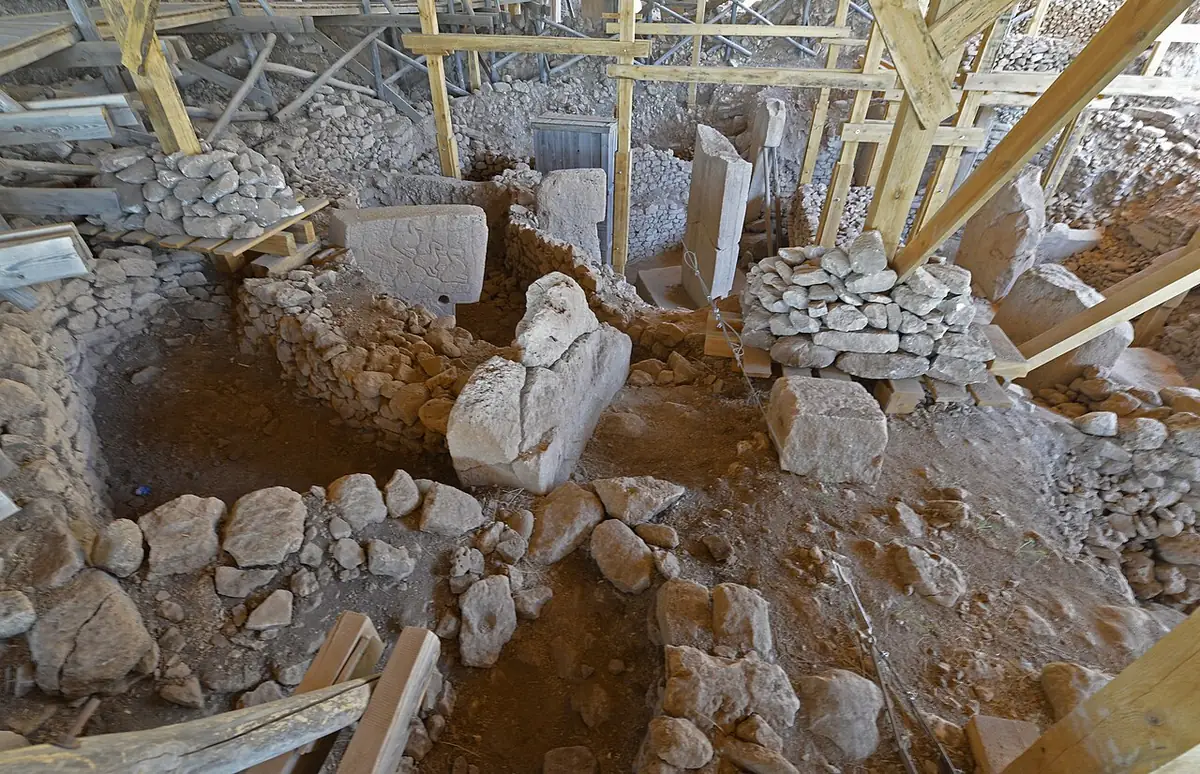
- Chronology gap: Göbekli Tepe’s giant circular enclosures (Layer III, PPNA) are carbon-dated on wall mortar charcoal and pedogenic carbonate coatings to c. 9600–8800 BCE (11,600–10,800 years ago). Stonehenge began with a circular earthwork bank and ditch (Stage 1) at c. 3000–2920 BCE. Its iconic sarsen trilithons and lintelled circle (Stage 2) were erected c. 2500 BCE—roughly 6,500 to 7,100 years after Göbekli Tepe Layer III. [1][5][6]
- Stone type & hardness: Göbekli Tepe and Karahan Tepe T-pillars are carved from local Eocene crystalline limestone (Mohs ~3.5) using flint picks and pounders. Stonehenge uses silcrete sarsen sandstone boulders (Mohs ~6.5–7.0), Preseli spotted dolerite/rhyolite bluestones (Mohs ~6.0), and an Old Red Sandstone micaceous Altar Stone (Mohs ~5.0–6.0). [2][3][8][7]
- 800-ton Trilithon wall blocks: Block mass & the 40-ton test baseline: Göbekli Tepe’s erected central T-pillars (such as P18 in Enclosure D, 5.5 m tall) weigh ~16–20 t, and an unfinished 6.9 m pillar still attached to the plateau quarry bedrock is estimated at ~43–50 t (~1.1–1.25× the 40 t modern test haul ceiling). Stonehenge’s largest sarsen (Stone 56, the standing upright of the Great Trilithon, 8.9 m long) weighs ~30–35 t, with typical circle sarsens ~20–25 t and bluestones ~2–4 t. [2][5][9]
- Quarry distance contrast: At Göbekli Tepe and Karahan Tepe, pillars were levered directly from horizontal limestone strata 100 to 500 m from the enclosures (and at Karahan Tepe’s Chamber AB, 10 of the 11 pillars were carved in situ out of the living bedrock). At Stonehenge, sarsens were hauled ~25 km from West Woods (Wiltshire), bluestones ~225–230 km from the Preseli Hills (Wales), and the 6 t Altar Stone at least 750 km from the Orcadian Basin of north-east Scotland. [2][3][7][8]
- Joinery & carving style: Göbekli Tepe pillars are single-stone T-shapes set into shallow bedrock sockets or dry-stone base loop walls and decorated with high-relief foxes, boars, vultures, scorpions, and human arms/loincloths. Stonehenge sarsens are dressed to tapered rectangular profiles and locked together overhead with wood-working-style mortise-and-tenon joints and tongue-and-groove curved lintels. [2][5][10]
- Subsistence & domestic settlement: Early Göbekli Tepe yields exclusively wild fauna (gazelle, aurochs, wild boar) and wild cereals. Still, 2020–2024 work found domestic-style buildings, cisterns and thousands of basalt grinding stones around the mound. Stonehenge was built by established Late Neolithic farming and pastoral groups centered on the nearby town of Durrington Walls. [2][4][1][5]
How carbon dates work, and their limits: How we date sites.
🧭 Proponents' Case & Cited Evidence
- Key finding: Both complexes show that giant stone buildings and coordinated multi-hundred-person labour existed without bronze tools, wheeled vehicles, or draft animals (at Göbekli Tepe) and without written scripts. [2][5]
- Key finding: Leading Edge authors (including Hancock and Collins) argue that the sophistication of Göbekli Tepe’s earliest enclosures (Layer III being larger than Layer II) and the precision of Stonehenge’s mortise-and-tenon solar axis suggest inherited building and sky traditions. [11][12]
🏛️ Mainstream Archaeological View & Evidence
- Key finding: The two traditions solve opposite building challenges: Upper Mesopotamian builders quarried soft-to-medium limestone right beside the enclosures and focused on sculptural relief. By contrast, British Neolithic builders shaped hard silcrete and transported multi-ton stones hundreds of km. [2][8][9]
- Key finding: More than 6,500 years and 3,200 km separate Göbekli Tepe Layer III from Stonehenge Stage 2, with distinct regional predecessors in each area (the Taş Tepeler PPN horizon in Anatolia versus British causewayed enclosures, timber circles and long barrows). [3][5][6]
🔬 What Future Tests Would Settle It
At Göbekli Tepe and Karahan Tepe, less than 10% of the geomagnetic anomalies have been dug. Dating the lowest bedrock floors across the remaining Taş Tepeler sites will clarify how the T-pillar tradition began. At Stonehenge, pinpointing the exact outcrop in north-east Scotland or Orkney that supplied the 6 t Altar Stone will test whether it travelled by coastal boat or overland.
▸ Reference Data Table: Head-to-head comparison: Göbekli Tepe & Karahan Tepe vs. Stonehenge
Compiled from primary excavation reports (DAI, Istanbul University, English Heritage, and Clarke et al. 2024).
| Dimension | Göbekli Tepe & Karahan Tepe (Türkiye) | Stonehenge (Wiltshire, UK) |
|---|
| Monumental phase date | c. 9600–8000 cal BCE (PPNA / Early PPNB) | c. 3000 BCE (Stage 1 earthwork); c. 2500 BCE (Stage 2 sarsen circle) |
| Heaviest moved stone | ~16–20 t erected T-pillars (~0.4–0.5× 40 t baseline); ~43–50 t unfinished in quarry | ~30–35 t Great Trilithon upright (~0.88× 40 t baseline); 6 t Scottish Altar Stone |
| Stone material & Mohs | Eocene limestone (Mohs ~3.5), flint tools | Silcrete sarsen (Mohs ~6.5–7), Preseli dolerite (~6), Orcadian sandstone (~5.5) |
| Quarry transport distance | 0.1 to 0.5 km (adjacent plateau bedrock) | ~25 km (sarsens), ~230 km (Wales bluestones), ≥750 km (Scotland Altar Stone) |
| Structural joinery | Monolithic T-pillars set in bedrock channels and rubble walls; high-relief sculpture | Overhead mortise-and-tenon and tongue-and-groove curved lintel ring |
| Economic base | Pre-Agricultural hunter-foragers harvesting wild cereals and gazelle | Late Neolithic agricultural and cattle/pig-herding society (Durrington Walls) |
| Astronomical orientation | Contested (proposals include Sirius, Deneb, or southern sky; enclosures were roofed or semi-subterranean) | Mainstream & measured: NE–SW axis aligned to summer solstice sunrise (~49.6° az.) and winter solstice sunset (~230° az.) |
Ancient Sites Involved
Göbekli Tepe · Karahan Tepe · Stonehenge
Related Tested Claims
📚 Further Reading: Both Sides of the Argument
Top books from both sides of the debate on this topic. Browse all 34 books on Books & Further Reading or visit our Search for the Truth Bookshop.org storefront.
Mainstream Baseline
2014
★ 4.4/5
Stonehenge: A New Understanding — Solving the Mysteries of the Greatest Stone Age Monument
Mike Parker Pearson
The leader of the Stonehenge digs explains the latest carbon dates, solstice sightlines, and stone quarries.
▸ Why this book matters to both sides
The director of the Stonehenge Riverside Project details the digs at Stonehenge, Durrington Walls, and Bluestonehenge, including Bayesian carbon dates, solstice axes, and quarry sourcing.
Role in the debate: Establishes the dug timeline and solstice sightline baseline for British and European megaliths. (ISBN 9781615191932)
Mainstream Baseline
2003
★ 4.5/5
After the Ice: A Global Human History, 20,000–5000 BC
Steven Mithen
Follows human life across every continent from the peak of the Ice Age (20,000 BCE) to early farming towns (5000 BCE).
▸ Why this book matters to both sides
A continent-by-continent narrative of human life from the Last Glacial Maximum to 5000 BCE, built directly from excavation reports across the Near East (including Göbekli Tepe), Europe, Asia, and the Americas.
Role in the debate: Provides the archaeological baseline for what human populations were building, hunting, and cultivating before, during, and right after the Younger Dryas. (ISBN 9780674019997)
Leading Edge
2014
★ 4.3/5
Göbekli Tepe: Genesis of the Gods — The Temple of the Watchers and the Discovery of Eden
Andrew Collins (Introduction by Graham Hancock)
Explores Göbekli Tepe's carved stone rings in Türkiye and argues they align with the northern sky and ancient flood lore.
▸ Why this book matters to both sides
Explores Göbekli Tepe's enclosures, T-shaped pillars, and stone carvings in southeastern Türkiye. It argues for sightlines to the star Deneb in Cygnus and connections to Near Eastern Watcher traditions.
Role in the debate: Sets out the Leading Edge sky-sightline and sudden reading of Göbekli Tepe to compare against the German Archaeological Institute (DAI) excavation reports. (ISBN 9781591431428)
Leading Edge
2015
★ 4.7/5
Magicians of the Gods: The Forgotten Wisdom of Earth's Lost Civilization
Graham Hancock
Links Göbekli Tepe, Baalbek, and the Younger Dryas comet debate to argue a cosmic impact erased an Ice Age world.
▸ Why this book matters to both sides
Integrates Göbekli Tepe, Baalbek, Gunung Padang. The Younger Dryas comet-impact idea. It argues Taurid meteor-stream impacts between 12,800 and 11,600 years ago erased an advanced culture.
Role in the debate: Sets out the strongest popular overview linking Göbekli Tepe's enclosures and Pillar 43 to the Younger Dryas impact debate. (ISBN 9781250118400)
FTC affiliate disclosure: Book links go to Bookshop.org (ID 130218, Search for the Truth). Each sale helps local bookstores and pays us a 10% fee at no extra cost to you. All partner links use rel="sponsored nofollow noopener". Fees never change our verdicts. Affiliate disclosure.
Visiting & base stays: Göbekli Tepe & Şanlıurfa Archaeology Museum (south-east Türkiye)
FTC affiliate disclosure: Tour links go to GetYourGuide and Viator. Hotel links use Stay22 (aid=solarevidence) for Booking.com and Expedia. If you book a trip, we may earn a small fee at no extra cost to you. All partner links use rel="sponsored nofollow noopener". Check travel alerts before you go. Partner fees never change our ratings. All 64 site field visits · Affiliate disclosure.
Primary Academic Sources
▸ View All Cited Primary Sources & DOIs (12 papers)
- Dietrich, O. et al. (2013). Establishing a radiocarbon sequence for Göbekli Tepe: state of research and new data. Neo-Lithics 1/13 (PDF). https://jensnotroff.com/wp-content/uploads/2015/10/ii-13_15_neolithic… data
- German Archaeological Institute (DAI) blog: How old is it? Dating Göbekli Tepe. https://www.dainst.org/en/blogs/how-old-is-it-dating-goebekli-tepe/625 data
- Karul, N. (2021). Buried buildings at Pre-Pottery Neolithic Karahantepe. Türk Arkeoloji ve Etnografya Dergisi 82. https://dergipark.org.tr/en/pub/arkeolojiveetnografya/article/909296 data
- Kinzel, M., Clare, L. & Sönmez, D. (2020). Built on rock – towards a reconstruction of the ›Neolithic‹ topography of Göbekli Tepe. Istanbuler Mitteilungen 70. doi:10.34780/n42qpb15 data
- English Heritage: A timeline of Stonehenge. https://www.english-heritage.org.uk/visit/places/stonehenge/history-a… background
- Parker Pearson, M. et al. (2015). Craig Rhos-y-felin: a Welsh bluestone megalith quarry for Stonehenge. Antiquity 89. doi:10.15184/aqy.2015.177 data
- Bevins, R. E., Ixer, R. A. & Pearce, N. J. G. (2014). Carn Goedog is the likely major source of Stonehenge doleritic bluestones. Journal of Archaeological Science 42. doi:10.1016/j.jas.2013.11.009 data
- Clarke, A. J. I. et al. (2024). A Scottish provenance for the Altar Stone of Stonehenge. Nature 632. doi:10.1038/s41586-024-07652-1 data
- Richards, J. & Whitby, M. (1997). The engineering of Stonehenge. In Cunliffe, B. & Renfrew, C. (eds), Science and Stonehenge. Proceedings of the British Academy 92: 231–256 (PDF). https://www.thebritishacademy.ac.uk/documents/3921/92p231.pdf data
- Ruggles, C. L. N. (ed.) (2015). Handbook of Archaeoastronomy and Ethnoastronomy. New York: Springer. doi:10.1007/978-1-4614-6141-8 background
- Hancock, G. (2015). Magicians of the Gods. Coronet / Thomas Dunne Books. https://openlibrary.org/search?q=magicians+of+the+gods+hancock proponent
- Sweatman, M. B. & Tsikritsis, D. (2017). Decoding Göbekli Tepe with archaeoastronomy: what does the fox say? Mediterranean Archaeology and Archaeometry 17(1). doi:10.5281/zenodo.400780 proponent
More in this section: Megalithic construction.
Sources checked against Crossref and publisher pages on 2026-10-24. This entry presents a debated idea neutrally: the proponents' case first, then the mainstream position, in plain English. "Open question" is not a judgment that the idea is true or false. Labels describe the claim, not the people who hold it. Methodology.