△ TruthInStone

Claims › Younger Dryas & the 12,000-year cycle › Younger Dryas Boundary (YDB) sites directory: chronology, black mats, impact proxies and archaeological transitions

Younger Dryas Boundary (YDB) sites directory: chronology, black mats, impact proxies and archaeological transitions

Status: Contested Verdict: Measured: the abrupt Younger Dryas stadial (c. 10,900–9,700 BCE) and organic-rich "black mats" at North American Clovis-horizon sites are well dated; whether the reported platinum, microspherule and nanodiamond peaks across ~50 sites represent a synchronous cosmic airburst/impact remains fiercely contested
30-SECOND TAKEAWAY

In Plain English — The 30-Second Takeaway

What It Is:

This directory maps the key ice cores, mammoth bone beds, and 'black mat' soil layers from the Younger Dryas freeze 12,800 years ago.

What Everyone Agrees On (Measured Facts):

Dark organic 'black mats' directly cover the last mammoth bones and Clovis spear points at dozens of sites dated to c. 10,850 BCE.

🏛️ Mainstream Archaeology View:

Geologists read the black mats as wet marsh soils from a cooling climate and question whether micro-beads prove a single comet.

🧭 Leading Edge View:

Impact experts point to platinum spikes and melted glass beads at 50+ sites worldwide as debris from a cosmic airburst.

Overview & Context

To help readers evaluate the Younger Dryas impact hypothesis, the abrupt cooling record, and the 12,000-year cycle debate without relying on broad generalizations, this directory catalogues the primary soil-layer, climate, and archaeological benchmark sites across the Younger Dryas Boundary (YDB, ~12,800 years ago (cal BP)) and its termination (~11,700 years ago (cal BP)). For each locality we separate the measured carbon/ice-core timeline and physical soil layers from the contested impact-proxy claims and critiques. On our sister site Solar Evidence, compare the dated cosmic-ray isotope record in the Solar micronova evidence review.

▸ Read Technical Background, Full Claim Wording & Academic Literature History

Formal claim tested: A soil-layer horizon dating to the onset of the Younger Dryas (~12,800 years ago (cal BP) / c. 10,850 BCE) across North America, South America, Europe and Western Asia preserves synchronous cosmic impact proxies, giant-animal die-offs, and abrupt cultural transitions.

Where the evidence stands: The climate event itself—a ~1,200-year return to near-glacial cold in the Northern Hemisphere between ~12,870 and ~11,700 years ago (cal BP)—is one of the best-measured transitions in Greenland ice cores, Atlantic marine sediments, and Earth pollen records. At dozens of archaeological and geological localities, researchers have also recorded dark organic-rich wetland layers ("black mats") right overlying terminal Pleistocene giant animals and Clovis artifacts. However, the reading of melted beads, platinum-group anomalies, tiny diamonds and meltglass at these sites as a single cosmic impact (Firestone et al. 2007; Wolbach et al. 2018; Moore et al. 2020) is contested by critics (Holliday et al. 2023, 2024), and three papers on related sites had retractions in 2025–2026.

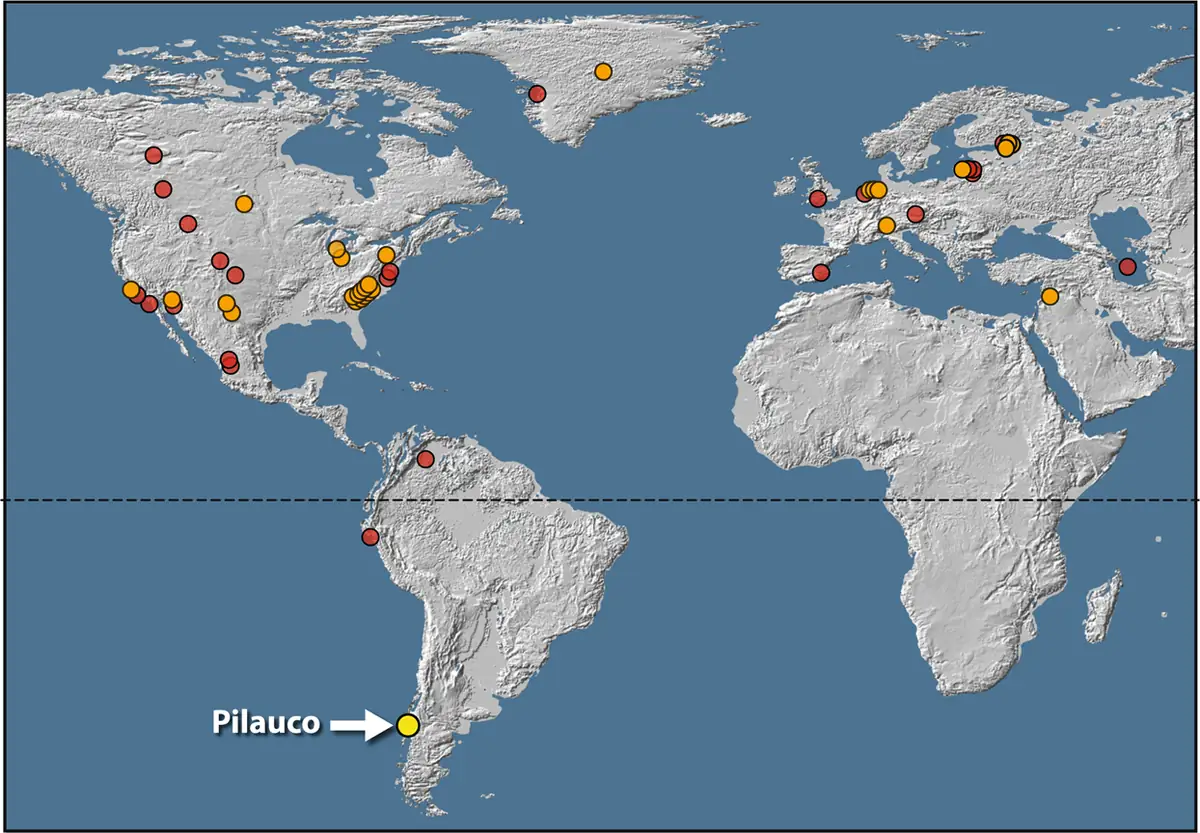
World map marking sites where Younger Dryas boundary markers have been reported
Sites where Younger Dryas boundary markers have been reported, from a proponents' paper (Pino et al. 2019). Image: Mario Pino et al., CC BY-SA 4.0, via Wikimedia Commons. Resized.
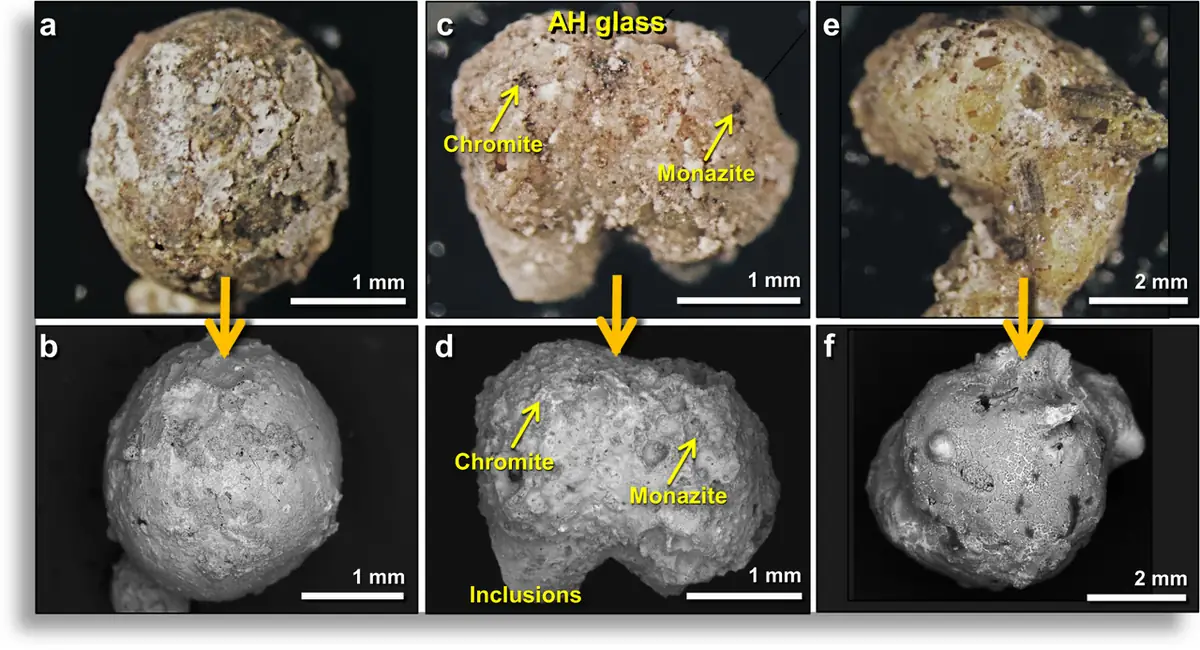
Microscope images of meltglass grains from Abu Hureyra
Meltglass from Abu Hureyra, Syria, from Moore et al. 2020. Image: Andrew M. T. Moore et al., CC BY-SA 4.0, via Wikimedia Commons. Resized.

✓ What Has Been Physically Measured

Dates, physical measurements, and excavated findings kept separate from interpretation.

How carbon dates work, and their limits: How we date sites.

🧭 Proponents' Case & Cited Evidence

  • Rapid Greenland ice-core freeze: Supporters (Firestone et al. 2007; Wolbach et al. 2018; Sweatman 2021; Moore et al. 2026) point to coeval peaks in platinum, high-temp iron/silica melted beads, meltglass and charcoal across more than 50 sites on four continents—including a Sept 2026 southern Sweden sequence separating the YDB platinum and microspherule peak by ~150 years from the underlying ~13,006 years ago (cal BP) Laacher See volcanic tephra—together with the GISP2 platinum spike and the abrupt disappearance of Clovis and ~35 North American giant-animal genera. [2][3][11][9][14]

🏛️ Mainstream Archaeological View & Evidence

  • Dark 'black mat' soil layer: Critics (Holliday et al. 2023, 2024) argue that carbon uncertainties of ±50 to ±150 years cannot prove a single afternoon event, that several separate labs failed to reproduce the nanodiamond and spherule peaks, that wetland "black mats" form diachronously wherever water tables rise, and that three YDB/airburst papers had retractions in 2025–2026. [12][13][7][6][8]

🔬 What Future Tests Would Settle It

Blind, inter-laboratory split-sample exchanges from Murray Springs, Abu Hureyra and Pilauco—combined with annual-layer volcanic tephra or 14C/10Be marker tie-points linking Earth black mats directly to the GISP2 platinum layer—remain the decisive test needed to settle whether the YDB proxy peaks are synchronous to the year.

▸ Reference Data Table: Directory of benchmark Younger Dryas Boundary (YDB) & transition sites

Chronology in calibrated years BP (before 1950) and approximate BCE; status of proxy claims and critiques from peer-reviewed literature.

Site / RecordRegionCalibrated ageMeasured stratigraphy & archaeologyYDB impact-proxy claim vs. critique
NGRIP, GISP2 & GRIP Ice CoresGreenland12,896 to 11,703 b2k (c. 10,900–9,700 BCE)Global stratotype for GS-1 onset and Holocene onset; δ18O drop, dust spike, and 20-year Pt anomaly in GISP2Pt spike cited for extraterrestrial/volcanic input; exact temporal alignment with terrestrial black mats debated within ±30–100 yr ice-core uncertainty
Murray Springs & Lehner RanchSan Pedro Valley, Arizona, USA~12,800 cal BP (c. 10,850 BCE)Classic Clovis hunting camps and mammoth kill sites directly capped by Stratum F2 wetland "black mat"Magnetic spherules, Pt and iridium reported at base of black mat (Firestone 2007); independent replication and synchroneity questioned by Holliday et al. (2023)
Blackwater Draw (Clovis Type Site)New Mexico, USA~12,900–12,750 cal BPStratified mammoth bones and Clovis fluted points beneath diatomaceous pond deposits and Folsom layersReported microspherule and nanodiamond peaks at the Clovis/Folsom transition; critics argue wetland authigenesis and reworking
Arlington Springs & Daisy CaveChannel Islands, California, USA~12,900–12,800 cal BPHuman femora (Arlington Springs Man), pygmy mammoth extinction horizon, and charcoal-rich dark sediment layersHexagonal lonsdaleite/nanodiamonds and spherules reported (Kennett et al. 2009); mineral identification disputed by Daulton et al.
Sheriden Cave & TopperOhio & South Carolina, USA~12,850 cal BPSheriden Cave yielded extinct giant short-faced bear, stag-moose and two Clovis bone points in a charcoal-rich layer; Topper has a distinct Clovis quarry floorPlatinum, microspherules and nanodiamonds reported directly on the Clovis floor; critics question single-year synchroneity across Bayesian radiocarbon widths
Abu HureyraEuphrates Valley, Syria~12,800 cal BP (c. 10,850 BCE)Late Epipalaeolithic pit-dwellings transitioning to early cereal cultivation during YD cooling and dryingMeltglass (>1,700°C) and Pt peak reported (Moore et al. 2020); 2023 shock-quartz follow-up paper retracted in 2025
PilaucoLos Lagos, Chile~12,800 cal BPPeat/wetland boundary with extinction of Notiomastodon, horses and megafaunal dung fungi (Sporormiella)Pt/Pd anomaly, Cr-rich spherules and biomass-burning peak reported in Southern Hemisphere (Pino et al. 2019)
Southern Sweden YDB sequenceSouthern Sweden~12,850 cal BP (~150 yr above ~13,006 cal BP Laacher See tephra)Late-glacial sediment sequence with dated Laacher See volcanic tephra marker ~150 years below the YDB onsetLeading Edge (Moore et al., Sept 30, 2026): Pt peak and Fe/Si-rich microspherules (mostly terrestrial impact-melt + minor extraterrestrial component) chronologically separated from the Laacher See eruption
Göbekli Tepe (Layer III) & Karahan TepeŞanlıurfa, Türkiye~11,600–10,800 cal BP (c. 9600–8800 BCE)Earliest monumental T-pillar enclosures built immediately at the Younger Dryas–Holocene warming boundarySweatman & Tsikritsis (2017) read Pillar 43 as a 10,950 BCE comet record; DAI excavators read the reliefs as local PPNA cosmology and note Layer III postdates YD onset by ~1,200 yr

Ancient Sites Involved

Göbekli Tepe · Karahan Tepe · Monte Verde

Related Tested Claims

📚 Further Reading: Both Sides of the Argument

Top books from both sides of the debate on this topic. Browse all 34 books on Books & Further Reading or visit our Search for the Truth Bookshop.org storefront.

Mainstream Baseline 2004 ★ 4.4/5

The Long Summer: How Climate Changed Civilization

Brian Fagan

Explains how sudden climate flips—like the 1,200-year Younger Dryas freeze—shaped early human farming and towns.

▸ Why this book matters to both sides

Archaeologist Brian Fagan examines how the Younger Dryas cold reversal, Lake Agassiz meltwater releases, the 8.2 ka event, and mid-Holocene droughts shaped agriculture and ancient states.

Role in the debate: Sets out the standard ocean-circulation (AMOC shutdown) and ancient climate model of the Younger Dryas and its effects on Near Eastern and European societies. (ISBN 9780465022823)

Case Study in Scientific Debate 2008 ★ 4.7/5

Bretz's Flood: The Remarkable Story of a Rebel Geologist and the World's Greatest Flood

John Soennichsen

The true story of geologist J Harlen Bretz, who spent 40 years proving a giant Ice Age flood carved the Northwest.

▸ Why this book matters to both sides

Chronicles J Harlen Bretz's forty-year campaign to convince the geological profession that the Channeled Scablands were carved in days by a sudden glacial flood rather than over millions of years.

Role in the debate: Essential reading for both sides on how scientific orthodoxy resists sudden answers and what quantitative field evidence eventually changes the consensus. (ISBN 9781570616310)

Leading Edge 2006 ★ 4.5/5

The Cycle of Cosmic Catastrophes: How a Stone-Age Comet Changed the Course of World Culture

Richard Firestone, Allen West & Simon Warwick-Smith

The founding book on the Younger Dryas comet impact idea, covering melted microbeads, black mats, and mammoth die-offs.

▸ Why this book matters to both sides

The first book-length presentation of the Younger Dryas impact idea by members of the team that published the 2007 PNAS paper. It details magnetic melted beads, black mats, and Clovis-era giant-animal die-offs.

Role in the debate: Gives the founding supporters' case for the ~12,800 BP Younger Dryas impact boundary, which can be read alongside subsequent separate replications and published critiques. (ISBN 9781591430612)

Leading Edge 2015 ★ 4.7/5

Magicians of the Gods: The Forgotten Wisdom of Earth's Lost Civilization

Graham Hancock

Links Göbekli Tepe, Baalbek, and the Younger Dryas comet debate to argue a cosmic impact erased an Ice Age world.

▸ Why this book matters to both sides

Integrates Göbekli Tepe, Baalbek, Gunung Padang. The Younger Dryas comet-impact idea. It argues Taurid meteor-stream impacts between 12,800 and 11,600 years ago erased an advanced culture.

Role in the debate: Sets out the strongest popular overview linking Göbekli Tepe's enclosures and Pillar 43 to the Younger Dryas impact debate. (ISBN 9781250118400)

FTC affiliate disclosure: Book links go to Bookshop.org (ID 130218, Search for the Truth). Each sale helps local bookstores and pays us a 10% fee at no extra cost to you. All partner links use rel="sponsored nofollow noopener". Fees never change our verdicts. Affiliate disclosure.

Visiting & base stays: Göbekli Tepe & Şanlıurfa Archaeology Museum (south-east Türkiye)

FTC affiliate disclosure: Tour links go to GetYourGuide and Viator. Hotel links use Stay22 (aid=solarevidence) for Booking.com and Expedia. If you book a trip, we may earn a small fee at no extra cost to you. All partner links use rel="sponsored nofollow noopener". Check travel alerts before you go. Partner fees never change our ratings. All 64 site field visits · Affiliate disclosure.

Primary Academic Sources

▸ View All Cited Primary Sources & DOIs (19 papers)
  1. Rasmussen, S. O. et al. (2014). A stratigraphic framework for abrupt climatic changes during the Last Glacial period based on three synchronized Greenland ice-core records. Quaternary Science Reviews 106. doi:10.1016/j.quascirev.2014.09.007 data
  2. Firestone, R. B. et al. (2007). Evidence for an extraterrestrial impact 12,900 years ago that contributed to the megafaunal extinctions and the Younger Dryas cooling. PNAS 104. doi:10.1073/pnas.0706977104 proponent
  3. Wolbach, W. S. et al. (2018). Extraordinary biomass-burning episode and impact winter triggered by the Younger Dryas cosmic impact ~12,800 years ago. 1. Ice cores and glaciers. Journal of Geology 126. doi:10.1086/695703 proponent
  4. Moore, A. M. T. et al. (2020). Evidence of cosmic impact at Abu Hureyra, Syria at the Younger Dryas onset (~12.8 ka). Scientific Reports 10 (later corrected). doi:10.1038/s41598-020-60867-w proponent
  5. Scientific Reports (19 Nov 2025). Correction to Moore et al. (2020), Abu Hureyra: inconsistencies between Supplementary Table S1 and the original data sources revised; a geochronology discussion added. doi:10.1038/s41598-025-28180-6 notice
  6. PLOS ONE editors (11 Feb 2026). Retraction: 'A 12,800-year-old layer with cometary dust, microspherules, and platinum anomaly ... Baffin Bay' (Moore et al. 2025): calibration and particle-identification concerns; several authors disagree. doi:10.1371/journal.pone.0342613 notice
  7. PLOS ONE editors (11 Feb 2026). Retraction: 'Shocked quartz at the Younger Dryas onset (12.8 ka) supports cosmic airbursts/impacts...' (Kennett et al. 2025): age-model and sampling concerns; eight authors disagree. doi:10.1371/journal.pone.0342620 notice
  8. Scientific Reports (24 Apr 2025). Retraction note: 'A Tunguska sized airburst destroyed Tall el-Hammam...' (Bunch et al. 2021); several authors disagree. doi:10.1038/s41598-025-99265-5 notice
  9. Pino, M. et al. (2019). Sedimentary record from Patagonia, southern Chile supports cosmic-impact triggering of biomass burning, climate change, and megafaunal extinctions at 12.8 ka. Scientific Reports 9. doi:10.1038/s41598-018-38089-y proponent
  10. Kennett, D. J. et al. (2009). Nanodiamonds in the Younger Dryas boundary sediment layer. Science 323. doi:10.1126/science.1162819 proponent
  11. Sweatman, M. B. (2021). The Younger Dryas impact hypothesis: review of the impact evidence. Earth-Science Reviews 218. doi:10.1016/j.earscirev.2021.103677 proponent
  12. Holliday, V. T. et al. (2023). Comprehensive refutation of the Younger Dryas Impact Hypothesis (YDIH). Earth-Science Reviews 247. doi:10.1016/j.earscirev.2023.104502 critique
  13. Holliday, V. T. et al. (2024). Rebuttal of Sweatman, Powell, and West's 'Rejection of Holliday et al.'s alleged refutation of the Younger Dryas impact hypothesis'. Earth-Science Reviews 258. doi:10.1016/j.earscirev.2024.104961 critique
  14. Moore, A. M. T., Kennett, J. P., LeCompte, M. A., et al. (2026, September 30). "Platinum and Microspherule Evidence at the Younger Dryas Boundary Above the Laacher See Tephra in Southern Sweden." ScienceOpen Research. doi:10.14293/S2199-1006.1.SOR.2026.0004.v1 · ScienceOpen proponent
  15. Dietrich, O. et al. (2013). Establishing a radiocarbon sequence for Göbekli Tepe: state of research and new data. Neo-Lithics 1/13 (PDF). https://jensnotroff.com/wp-content/uploads/2015/10/ii-13_15_neolithic… data
  16. German Archaeological Institute (DAI) blog: How old is it? Dating Göbekli Tepe. https://www.dainst.org/en/blogs/how-old-is-it-dating-goebekli-tepe/625 data
  17. Karul, N. (2021). Buried buildings at Pre-Pottery Neolithic Karahantepe. Türk Arkeoloji ve Etnografya Dergisi 82. https://dergipark.org.tr/en/pub/arkeolojiveetnografya/article/909296 data
  18. Sweatman, M. B. & Tsikritsis, D. (2017). Decoding Göbekli Tepe with archaeoastronomy: what does the fox say? Mediterranean Archaeology and Archaeometry 17(1). doi:10.5281/zenodo.400780 proponent
  19. Kennett, J. P. et al. (2015). Bayesian chronological analyses consistent with synchronous age of 12,835–12,735 cal B.P. for Younger Dryas boundary on four continents. PNAS 112. doi:10.1073/pnas.1507146112 proponent

More in this section: Younger Dryas & the 12,000-year cycle.

Sources checked against Crossref and publisher pages on 2026-10-26. This entry presents a debated idea neutrally: the proponents' case first, then the mainstream position, in plain English. "Open question" is not a judgment that the idea is true or false. Labels describe the claim, not the people who hold it. Methodology.