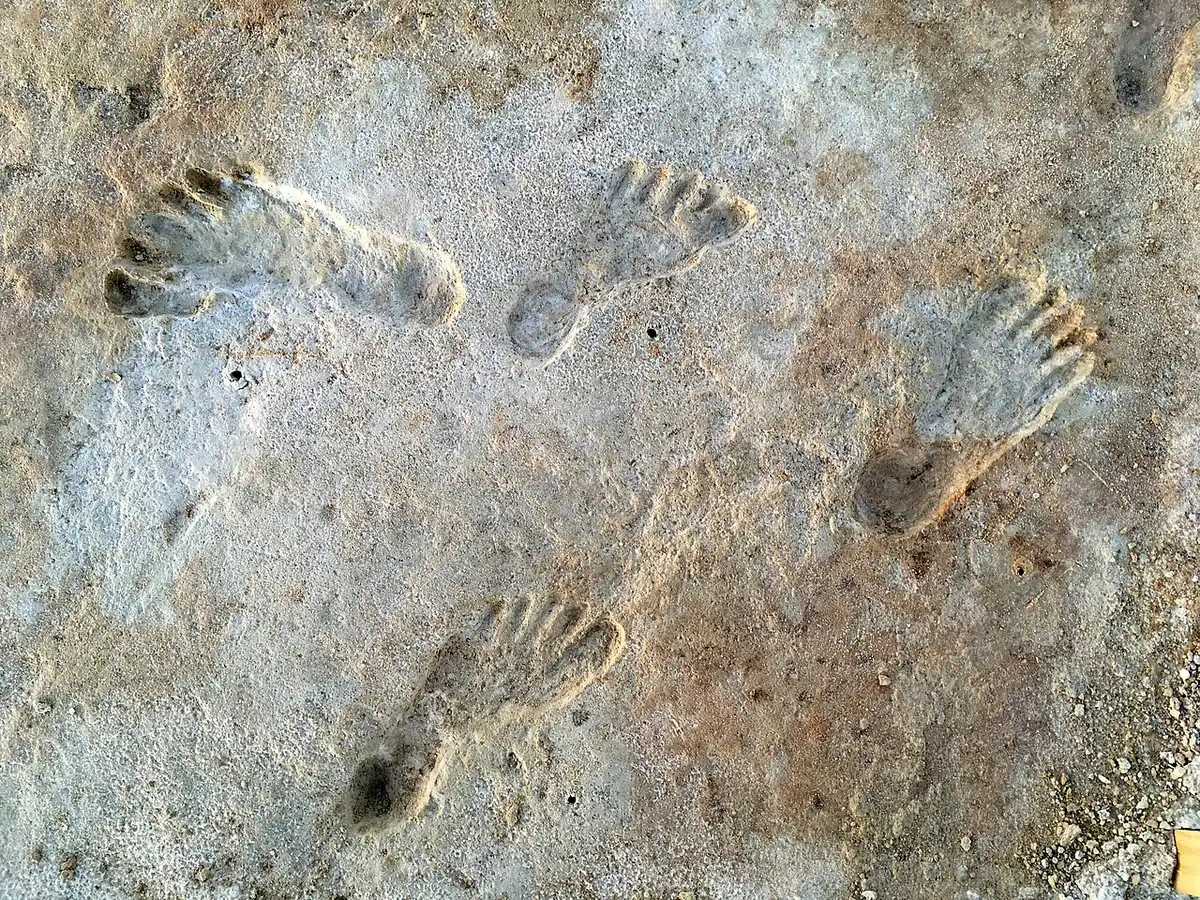
People were in North America 23,000 years ago (White Sands footprints)
Status: ContestedVerdict: Open question, leaning to the early date: three dating methods agree on about 23,000–21,000 years, but critics argue all three are maximum ages
30-SECOND TAKEAWAY
In Plain English — The 30-Second Takeaway
What It Is:
Fossil human footprints in White Sands, New Mexico, date to 23,000–21,000 years ago during the peak of the last Ice Age.
What Everyone Agrees On (Measured Facts):
Three separate tests—carbon on seeds, carbon on pine pollen, and optically stimulated luminescence dating—all gave ages of 23,000 to 21,000 years.
🏛️ Mainstream Archaeology View:
After the 2023 pollen and sand tests confirmed the seed dates, most scholars accept humans lived in North America 7,000 years before Clovis.
🧭 Leading Edge View:
The footprints vindicate experts who argued for decades that people reached the Americas long before the Ice Age ended.
Overview & Context
The White Sands tracks were published in Science in 2021. The dating of the seeds of the aquatic plant Ruppia was right challenged, because water plants can take up old carbon from groundwater.
▸ Read Technical Background, Full Claim Wording & Academic Literature History
Formal claim tested: Human footprints in ancient lake beds at White Sands National Park, New Mexico, are 23,000 to 21,000 years old. That would put people in North America at the height of the last Ice Age, thousands of years before the Clovis culture and before the ice-free corridor opened.
Where the evidence stands: The original team and the US Geological Survey have now dated the layers three ways: aquatic seeds, land-plant pollen and luminescence. All give the Last Glacial Maximum. Critics accept the footprints are human but argue that each method could give ages that are too old. These are working scientists publishing in the same journals, so this stays open. We lean slightly to the early date because the newest separate methods agree with it.
The 2023 study added dates on pollen from land plants and on quartz sand (OSL), and the team declared the controversy resolved. Critics replied in 2024 and 2025. This bears directly on Monte Verde, whose 14,500-year age is itself under fresh challenge, and on the broader idea of a lost Ice Age civilisation, which needs people present early.
Computation & method notes:About luminescence dates: Luminescence (OSL) dating measures when sand grains last saw sunlight. Single grains from one layer often give ages that spread out more than their error bars. A 2026 methods paper by Eren Şahiner finds that the size of that spread cannot, on its own, show what caused it. Several causes can give the same number. The paper also finds that most published data sets have too few grains to detect a small real spread. It is a general methods paper. It does not test White Sands or any other site. [8]
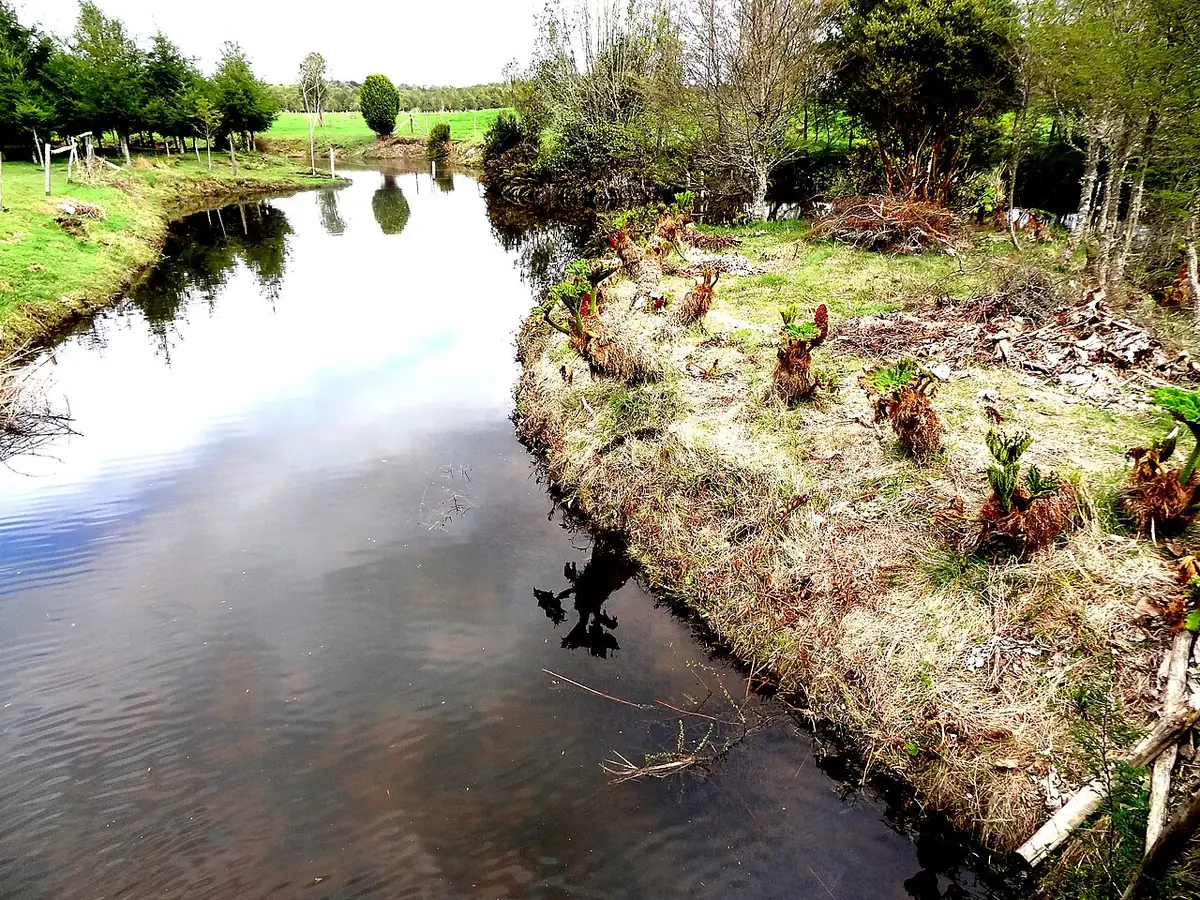
Human footprints at White Sands, New Mexico (US Geological Survey). Image: US Geological Survey, Public domain, via Wikimedia Commons. Resized.The Monte Verde site in Chile. Image: Rodolfo Ditzel Lacoa, CC BY-SA 3.0, via Wikimedia Commons. Resized.
✓ What Has Been Physically Measured
Dates, physical measurements, and excavated findings kept separate from interpretation.
2021 finding: Human footprints in situ, stratigraphically bracketed by seed layers with calibrated carbon ages of about 23,000–21,000 years. [1]
2023 finding: Carbon dates on Earth (conifer) pollen from the same layers, and optically stimulated luminescence (OSL) dates on the sediment, gave ages consistent with the seed dates. [4]
2026 finding: A USGS fact sheet summarises the dating and the Ice Age setting of the trackways, which include tracks of extinct animals as well as people. [7]
Key finding: Three separate dating methods, each with different possible errors, agree on a Last Glacial Maximum age. The authors argue this rules out a single systematic error. [4][3]
Key finding: The team answered the reservoir-effect comment by showing that the seed ages are in soil-layer order and consistent across the sequence. [3]
🏛️ Mainstream Archaeological View & Evidence
23,000-year-old human footprints: Madsen and colleagues argued that Ruppia takes up dissolved old carbon from groundwater, so its seeds could date thousands of years too old. [2]
Key finding: Rhode and colleagues (2024) argued that the OSL samples may contain partly bleached grains and lie below most tracks, and that the pollen may be redeposited. If so, all three are maximum ages and the tracks could be much younger. [5]
23,000-year-old human footprints: Rachal and Dello-Russo (2025) argued that the Ruppia seeds were washed in from deeper parts of the lake by storms rather than grown in place, which would make their dates older than the tracks. [6]
🔬 What Future Tests Would Settle It
Dates on material that must be the same age as the footprints, for example organic matter pressed into a track or seeds from a single plant layer cut by tracks, would settle it. Replication at another site with tracks or artefacts of the same age would also help.
1491: New Revelations of the Americas Before Columbus (2nd ed.)
Charles C. Mann
Shows how new digs and laser maps proved the ancient Americas held big cities, roads, and farms long before Columbus.
▸ Why this book matters to both sides
Surveys the archaeological, botanical, and demographic discoveries showing that the pre-Columbian Americas—from Caral-Supe and the Amazon basin to Cahokia—were older, more populous, and more engineered than once taught.
Role in the debate: Documents how mainstream field evidence overturned the 20th-century 'pristine wilderness' model in the Amazon and pushed giant buildings in Peru back to the third millennium BCE. (ISBN 9781400032051)
After the Ice: A Global Human History, 20,000–5000 BC
Steven Mithen
Follows human life across every continent from the peak of the Ice Age (20,000 BCE) to early farming towns (5000 BCE).
▸ Why this book matters to both sides
A continent-by-continent narrative of human life from the Last Glacial Maximum to 5000 BCE, built directly from excavation reports across the Near East (including Göbekli Tepe), Europe, Asia, and the Americas.
Role in the debate: Provides the archaeological baseline for what human populations were building, hunting, and cultivating before, during, and right after the Younger Dryas. (ISBN 9780674019997)
America Before: The Key to Earth's Lost Civilization
Graham Hancock
Explores Amazon earthworks, Serpent Mound, ancient DNA, and early American sites to argue for an Ice Age culture in the Americas.
▸ Why this book matters to both sides
Tests pre-Clovis archaeological sites, Ancient North Eurasian DNA signals, Amazonian earthworks, Serpent Mound, and Poverty Point. It argues the Americas were central to an Ice Age cultural network.
Role in the debate: Contrasts directly with Charles Mann's *1491* and mainstream Americanist archaeology on early peopling, Amazon geoglyphs, and North American earthen mounds. (ISBN 9781250756954)
The Cycle of Cosmic Catastrophes: How a Stone-Age Comet Changed the Course of World Culture
Richard Firestone, Allen West & Simon Warwick-Smith
The founding book on the Younger Dryas comet impact idea, covering melted microbeads, black mats, and mammoth die-offs.
▸ Why this book matters to both sides
The first book-length presentation of the Younger Dryas impact idea by members of the team that published the 2007 PNAS paper. It details magnetic melted beads, black mats, and Clovis-era giant-animal die-offs.
Role in the debate: Gives the founding supporters' case for the ~12,800 BP Younger Dryas impact boundary, which can be read alongside subsequent separate replications and published critiques. (ISBN 9781591430612)
FTC affiliate disclosure: Book links go to Bookshop.org (ID 130218, Search for the Truth). Each sale helps local bookstores and pays us a 10% fee at no extra cost to you. All partner links use rel="sponsored nofollow noopener". Fees never change our verdicts. Affiliate disclosure.
Primary Academic Sources
▸ View All Cited Primary Sources & DOIs (8 papers)
Bennett, M. R. et al. (2021). Evidence of humans in North America during the Last Glacial Maximum. Science 373: 1528–1531. doi:10.1126/science.abg7586data
Madsen, D. B. et al. (2022). Comment on “Evidence of humans in North America during the Last Glacial Maximum”. Science 375. doi:10.1126/science.abm4678critique
Pigati, J. S. et al. (2022). Response to comment on “Evidence of humans in North America during the Last Glacial Maximum”. Science 375. doi:10.1126/science.abm6987data
Pigati, J. S. et al. (2023). Independent age estimates resolve the controversy of ancient human footprints at White Sands. Science 382: 73–75. doi:10.1126/science.adh5007data
Rhode, D., Neudorf, C. & Rachal, D. (2024). Unresolved: persistent problems with the White Sands Locality 2 geochronology. PaleoAmerica 10. doi:10.1080/20555563.2024.2345979critique
Rachal, D. & Dello-Russo, R. (2025). Seeds of controversy: ecology, depositional context, and radiocarbon dating of Ruppia cirrhosa at the White Sands trackway. Journal of Archaeological Science 179. doi:10.1016/j.jas.2025.106232critique
Springer, K. B., Pigati, J. S., Bustos, D. et al. (2026). Fossil footprints and Ice Age ecosystems of White Sands National Park. USGS Fact Sheet 2025–3046. doi:10.3133/fs20253046background
Şahiner, E. (2026). Deconstructing overdispersion: a generative variance budget for luminescence dating from single grains to aliquots. Scientific Reports (online 27 Oct 2026). doi:10.1038/s41598-026-75487-zbackground
Sources checked against Crossref and publisher pages on 2026-10-23. This entry presents a debated idea neutrally: the proponents' case first, then the mainstream position, in plain English. "Open question" is not a judgment that the idea is true or false. Labels describe the claim, not the people who hold it. Methodology.