△ TruthInStone

Claims › Megalithic construction › Göbekli Tepe's monumental buildings were deliberately buried

Göbekli Tepe's monumental buildings were deliberately buried

Status: Contested Verdict: Open question: newer work at Göbekli Tepe favours collapse and slope slides; Karahan Tepe shows deliberate filling
30-SECOND TAKEAWAY

In Plain English — The 30-Second Takeaway

What It Is:

Did the builders of Göbekli Tepe bury their own stone rooms on purpose, or did the walls collapse naturally?

What Everyone Agrees On (Measured Facts):

The stone rings were filled with fist-sized limestone rubble, animal bones, and flint tools. Nearby Karahan Tepe shows purposeful burial.

🏛️ Mainstream Archaeology View:

Current Göbekli Tepe dig teams think roof collapse and hill slides buried the rooms. Earlier dig teams favoured purposeful burial.

🧭 Leading Edge View:

Many experts argue the builders buried the stone rings on purpose like time capsules to protect the carvings.

Overview & Context

The question matters for dating: if the buildings were filled all at once, the fill dates time their burial. If they filled slowly, the fill holds material from long periods.

▸ Read Technical Background, Full Claim Wording & Academic Literature History

Formal claim tested: When the great pillar buildings of Göbekli Tepe went out of use, people filled them in on purpose, perhaps during feasts, which is why they survived so well.

Where the evidence stands: This was the dig teams' original view and is still widely repeated. Since 2017 the excavation team has argued that the fill is better explained by building collapse and debris sliding down the slopes, and in 2020 they called deliberate ritual backfilling 'increasingly unlikely'. At nearby Karahan Tepe, however, the excavator reports that the special buildings were filled in on purpose. Both readings rest on published field data, so the claim is Contested.

The current dig teams describe the fill as fist-sized limestone rubble mixed with artefacts. They link it to slope slides and collapse, and later work has recorded damage that may come from earthquakes. Weighting the newest findings slightly, the evidence at Göbekli Tepe now leans toward gradual or accidental burial. At Karahan Tepe the evidence leans the other way, so practices may have differed from site to site. Related: the dating of Göbekli Tepe and the Pillar 43 claim.

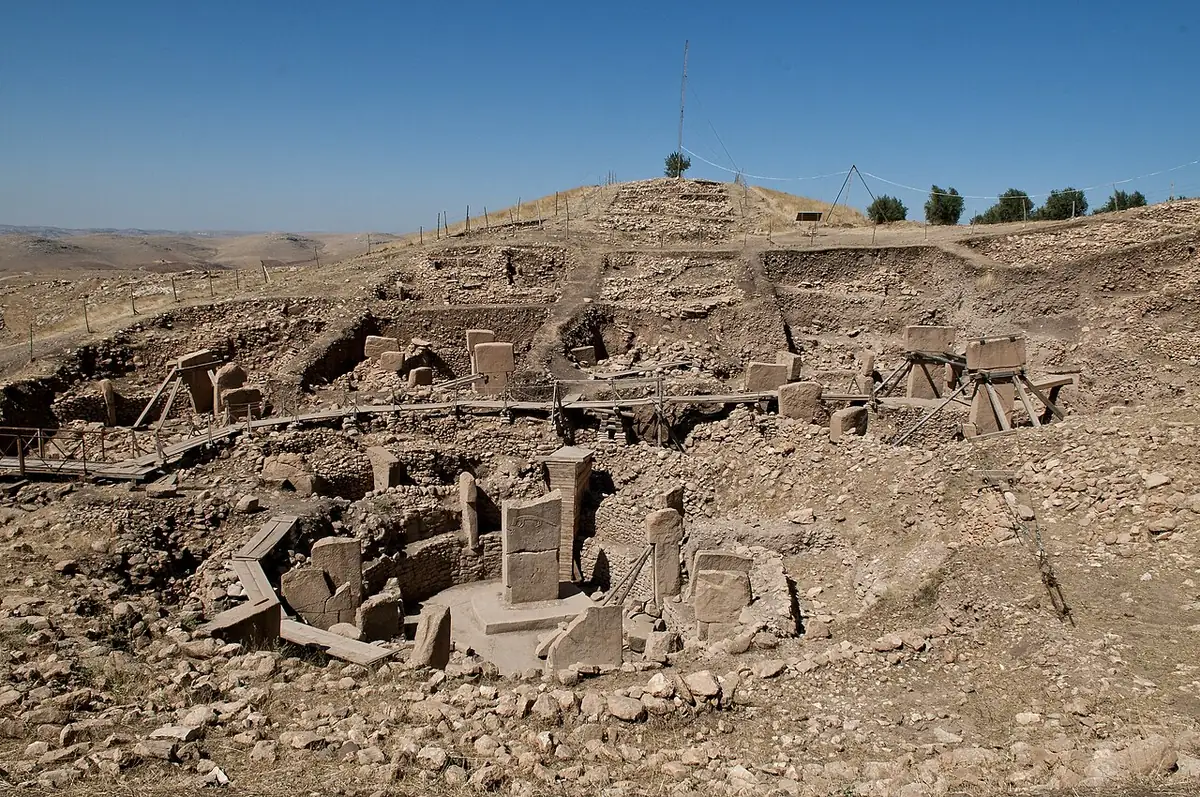
Excavation trenches and stone walls at Göbekli Tepe
Excavated enclosures at Göbekli Tepe. Whether the fill around the pillars was placed deliberately is the question. Image: Teomancimit, CC BY-SA 3.0, via Wikimedia Commons. Resized.

✓ What Has Been Physically Measured

Dates, physical measurements, and excavated findings kept separate from interpretation.

🧭 Proponents' Case & Cited Evidence

  • Key finding: Klaus Schmidt's team originally interpreted the fill as deliberate, which would explain the excellent preservation of the pillars. [5]
  • Deliberate filling is reported: at the related site of Karahan Tepe. [4]

🏛️ Mainstream Archaeological View & Evidence

  • How the rooms were buried: The current team argues the buildings were buried by collapse and eroded slope deposits, and considers deliberate ritual backfilling during feasts 'increasingly unlikely'. [1]
  • Key finding: A revised overview of the site's research (2015–19) moves away from the 'first temples' picture that the burial story was part of. [2]
  • Earthquake damage gives: another way for buildings to fail and fill. [3]

🔬 What Future Tests Would Settle It

Micromorphology of the fill (layering that shows slow build-up versus a single event), dates on short-lived plants from different levels of the same fill, and published carbon dates from Karahan Tepe's filled buildings.

Ancient Sites Involved

Göbekli Tepe · Karahan Tepe

Related Tested Claims

📚 Further Reading: Both Sides of the Argument

Top books from both sides of the debate on this topic. Browse all 34 books on Books & Further Reading or visit our Search for the Truth Bookshop.org storefront.

Mainstream Baseline 2003 ★ 4.5/5

After the Ice: A Global Human History, 20,000–5000 BC

Steven Mithen

Follows human life across every continent from the peak of the Ice Age (20,000 BCE) to early farming towns (5000 BCE).

▸ Why this book matters to both sides

A continent-by-continent narrative of human life from the Last Glacial Maximum to 5000 BCE, built directly from excavation reports across the Near East (including Göbekli Tepe), Europe, Asia, and the Americas.

Role in the debate: Provides the archaeological baseline for what human populations were building, hunting, and cultivating before, during, and right after the Younger Dryas. (ISBN 9780674019997)

Mainstream Baseline 2021 ★ 4.5/5

The Dawn of Everything: A New History of Humanity

David Graeber & David Wengrow

Examines how hunter-gatherers built giant stone sites like Göbekli Tepe and Poverty Point without kings or farming.

▸ Why this book matters to both sides

An culture scholar and an archaeologist examine Göbekli Tepe, Karahan Tepe, Poverty Point, Watson Brake, and Teotihuacan. It challenges the textbook step-by-step ladder from small hunter-gatherer bands to states.

Role in the debate: Shows how mainstream archaeology accounts for giant buildings built by hunter-gatherers (Göbekli Tepe, Poverty Point) without invoking a single global parent culture. (ISBN 9781250858801)

Leading Edge 2014 ★ 4.3/5

Göbekli Tepe: Genesis of the Gods — The Temple of the Watchers and the Discovery of Eden

Andrew Collins (Introduction by Graham Hancock)

Explores Göbekli Tepe's carved stone rings in Türkiye and argues they align with the northern sky and ancient flood lore.

▸ Why this book matters to both sides

Explores Göbekli Tepe's enclosures, T-shaped pillars, and stone carvings in southeastern Türkiye. It argues for sightlines to the star Deneb in Cygnus and connections to Near Eastern Watcher traditions.

Role in the debate: Sets out the Leading Edge sky-sightline and sudden reading of Göbekli Tepe to compare against the German Archaeological Institute (DAI) excavation reports. (ISBN 9781591431428)

Leading Edge 2012 ★ 4.7/5

Forgotten Civilization: New Discoveries on the Solar-Induced Dark Age (Revised ed.)

Robert M. Schoch with Catherine Ulissey

Geologist Robert Schoch sets out his rain-erosion case for an older Sphinx and his theory of a giant solar blast in 9700 BCE.

▸ Why this book matters to both sides

Boston University geologist Robert Schoch details his geological and seismic-refraction case for an older Great Sphinx alongside his idea that extreme solar proton outbursts ended the last Ice Age around 9700 BCE.

Role in the debate: Presents the geological case for precipitation-induced weathering on the Sphinx enclosure walls and the solar-disaster alternative to the Younger Dryas comet idea. (ISBN 9781644112922)

FTC affiliate disclosure: Book links go to Bookshop.org (ID 130218, Search for the Truth). Each sale helps local bookstores and pays us a 10% fee at no extra cost to you. All partner links use rel="sponsored nofollow noopener". Fees never change our verdicts. Affiliate disclosure.

Visiting & base stays: Göbekli Tepe & Şanlıurfa Archaeology Museum (south-east Türkiye)

FTC affiliate disclosure: Tour links go to GetYourGuide and Viator. Hotel links use Stay22 (aid=solarevidence) for Booking.com and Expedia. If you book a trip, we may earn a small fee at no extra cost to you. All partner links use rel="sponsored nofollow noopener". Check travel alerts before you go. Partner fees never change our ratings. All 64 site field visits · Affiliate disclosure.

Primary Academic Sources

▸ View All Cited Primary Sources & DOIs (6 papers)
  1. Kinzel, M., Clare, L. & Sönmez, D. (2020). Built on rock – towards a reconstruction of the ›Neolithic‹ topography of Göbekli Tepe. Istanbuler Mitteilungen 70. doi:10.34780/n42qpb15 data
  2. Clare, L. (2020). Göbekli Tepe, Turkey. A brief summary of research at a new World Heritage Site (2015–2019). e-Forschungsberichte des DAI 2020/2. doi:10.34780/efb.v0i2.1012 data
  3. Kinzel, M. (2024). Shaking up the Neolithic – tracing seismic impact at Neolithic Göbekli Tepe/Southeast-Türkiye. Archaeological Research in Asia 40. doi:10.1016/j.ara.2024.100560 data
  4. Karul, N. (2021). Buried buildings at Pre-Pottery Neolithic Karahantepe. Türk Arkeoloji ve Etnografya Dergisi 82. https://dergipark.org.tr/en/pub/arkeolojiveetnografya/article/909296 data
  5. German Archaeological Institute (DAI) blog: How old is it? Dating Göbekli Tepe. https://www.dainst.org/en/blogs/how-old-is-it-dating-goebekli-tepe/625 data
  6. Nykamp, M. et al. (2021). Sediment cascades and the entangled relationship between human impact and natural dynamics at the pre-pottery Neolithic site of Göbekli Tepe. Earth Surface Processes and Landforms 46. doi:10.1002/esp.5035 data

More in this section: Megalithic construction.

Sources checked against Crossref and publisher pages on 2026-10-23. This entry presents a debated idea neutrally: the proponents' case first, then the mainstream position, in plain English. "Open question" is not a judgment that the idea is true or false. Labels describe the claim, not the people who hold it. Methodology.