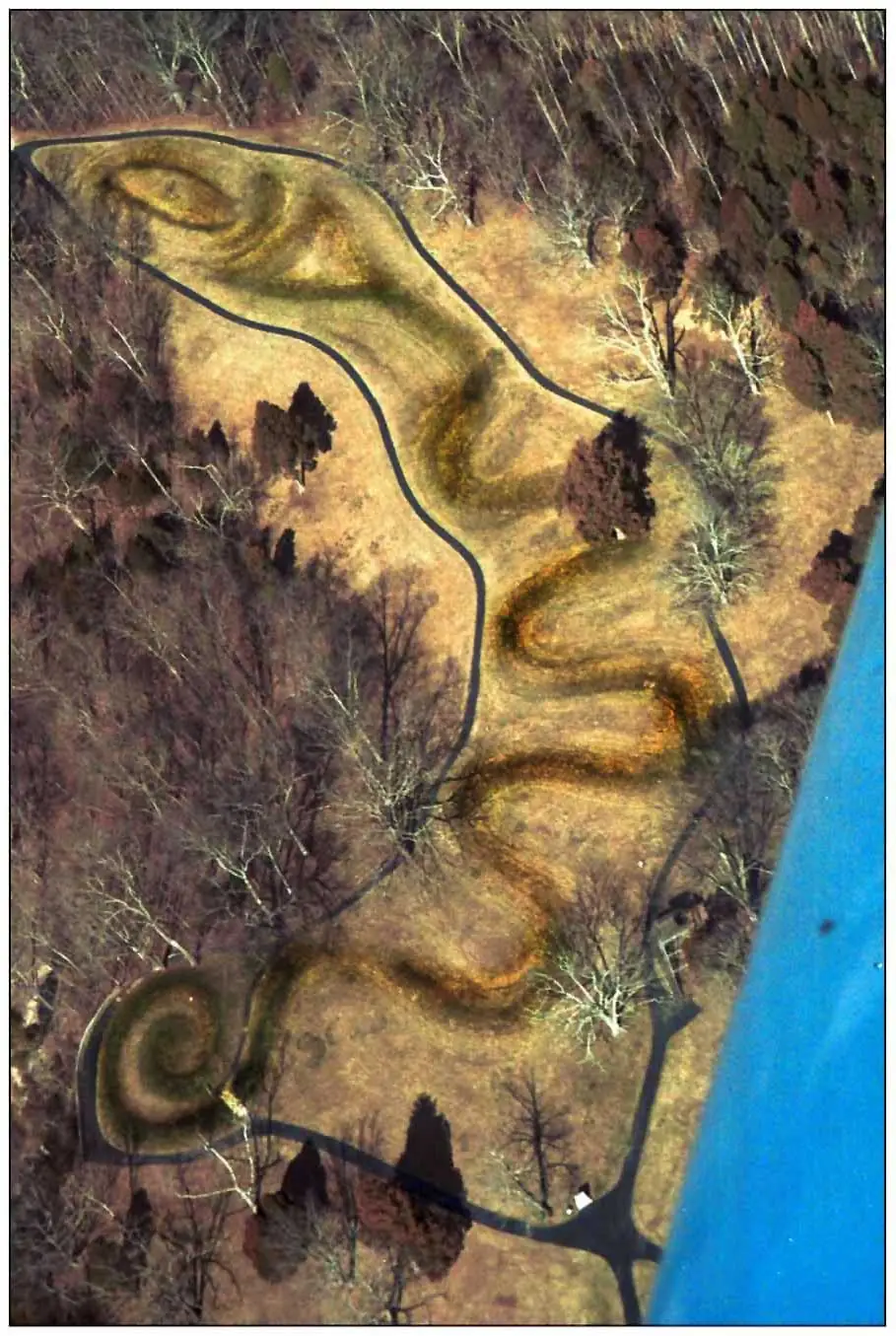
The solstice reading goes back at least to a 1988 survey by Fletcher and Cameron. The mound's age is separately disputed between a Fort Ancient date (about 1070 CE, charcoal) and an Adena date (about 300 BCE, soil dates).
▸ Read Technical Background, Full Claim Wording & Academic Literature History
Formal claim tested: The oval and head of the Great Serpent Mound point to the summer-solstice sunset. Because the Earth's axial tilt changes slowly, the exact azimuth shows when the mound was built. In America Before (2019), Graham Hancock argues for an sightline of 302°, which he says fits about 13,000 years ago better than the last 2,000 years.
Where the evidence stands: That the head points roughly to the solstice sunset is widely accepted. Using a date from it is not supported by the numbers. We computed the sunset azimuth at the site with a modern long-term model of the Earth's tilt. For a flat horizon, 302° matches about 300 BCE, the Adena date proposed by one group of archaeologists, rather than 13,000 years ago (302.5°). The surveyed 300°05′ fits the last 1,000 years if the local skyline is about 1° high. Across 13,000 years the sunset moved by only about 0.9°, which is smaller than the uncertainty from the skyline and from the earthwork's own outline.
See the site page. Some writers also link the serpent's shape to the constellation Draco. We found no peer-reviewed analysis of that idea to test, so it is noted, not assessed.
Computation & method notes: How we computed this: the obliquity of the ecliptic (the Earth's tilt) is the angle between the mean celestial pole and the ecliptic pole of date from the long-term precession model of Vondrák, Capitaine and Wallace (2011), via pyerfa. At the June solstice the Sun's declination equals the obliquity. Serpent Mound is taken at 39.025° N. We give azimuths for the Sun's upper limb on a flat horizon (altitude −0.833°) and for the Sun's centre at 0° and +1°, because the local skyline has not been surveyed here. These are our own computation, not taken from a published paper. Download the Python script (CC0).