Liquid mercury and buried mica at Teotihuacan point to a lost technology
Status: Leading EdgeVerdict: Measured: liquid mercury lay in the chambers at the end of the tunnel under the Feathered Serpent Temple, and two layers of Oaxacan mica sheets lay under a Viking Group floor. The excavators read them as ritual offerings and stored valuables; no evidence of a technical use has been published, so the technology reading is an open Leading Edge question
30-SECOND TAKEAWAY
In Plain English — The 30-Second Takeaway
What It Is:
Were liquid mercury pools and shiny mica rock sheets found at Teotihuacan in Mexico used for lost technology?
What Everyone Agrees On (Measured Facts):
Digs found liquid mercury in three deep tunnel rooms in 2015 and two thick layers of Oaxacan mica sheets under a floor in 1906.
🏛️ Mainstream Archaeology View:
Scholars read the mercury as a shiny ritual underworld river for royal tombs and the mica as stored luxury craft stone.
🧭 Leading Edge View:
Other writers note modern industry uses mercury and mica for electrical and heat shielding and ask if they had a technical role.
Overview & Context
In 2003 a sinkhole beside the Feathered Serpent Temple led Sergio Gómez Chávez of INAH to a tunnel sealed about 1,800 years ago. Over twelve years his Proyecto Tlalocan team cleared it to three chambers at its end, about 18 m down, and in 2015 announced liquid mercury there, which Gómez interpreted as the waters of the underworld.
▸ Read Technical Background, Full Claim Wording & Academic Literature History
Formal claim tested: The liquid mercury found deep under Teotihuacan's Feathered Serpent Temple. The layers of mica sheets hidden under a floor in the Viking Group, were put there for a technical purpose, such as electrical or thermal insulation, by builders with knowledge that has since been lost.
Where the evidence stands: Both finds are real and were recorded by the people who dug them. The technology reading is a Leading Edge idea: it rests on what mica and mercury are used for today, not on any apparatus, residue or text from Teotihuacan. Two details often repeated in its support do not match the primary data. The excavator measured the mica layers at 10.40 × 2.80 m, and chemical studies trace Teotihuacan's mica to Oaxaca, about 400 km away, not to Brazil. Even the amount of mercury is unclear, because published figures range from about 50 g to about 200 ml.
A separate find is much older: in 1942–43 Pedro Armillas uncovered two layers of mica sheets under a floor in the Viking Group, a compound on the Street of the Dead named after the fund that paid for the dig. Graham Hancock's Fingerprints of the Gods (1995) made the mica famous, describing it as an imported type with no decorative role and noting mica's modern uses as an insulator. We went back to the dig teams' own reports and the later chemical studies. For the city's angle, see the Teotihuacan layout claim and the Teotihuacan site page.
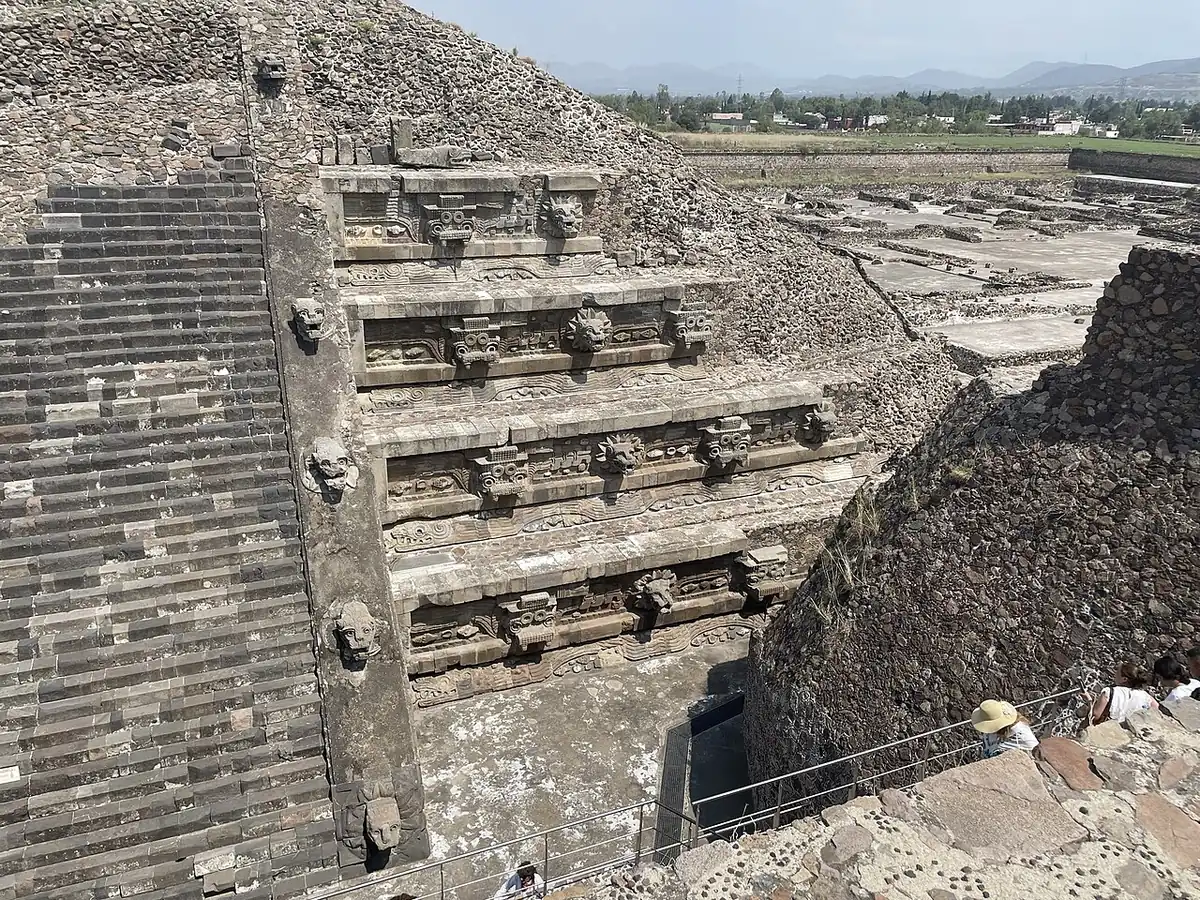
The Temple of the Feathered Serpent. The tunnel with liquid mercury runs beneath it. Image: Peachseltzer, CC BY-SA 4.0, via Wikimedia Commons. Resized.
✓ What Has Been Physically Measured
Dates, physical measurements, and excavated findings kept separate from interpretation.
The tunnel runs: about 103 m under the Ciudadela to three chambers about 18 m deep. More than 60,000 objects were recovered. Carbon dates on its offerings fall between about AD 125 and 240, and material on the surface of the end chamber dates to about AD 400–534. INAH dates the final closure to about AD 250. [1][4][2]
Underground mercury and mica: Liquid mercury was found in the end chambers in 2015. Gómez told reporters at the time it was 'a large quantity'. A 2022 review cites him (personal communication, 2016) for about 200 ml, which would weigh about 2.7 kg (our conversion). An INAH Querétaro archaeologist wrote in 2020 that it was about 400 g and had not yet been analysed. The project's 2022 paper reports 50 g of mercury. It was found as drops when soil from the south chamber floor was sieved and washed. The paper says there was probably more at first. [5][6][7][8]
The tunnel walls were: dusted with the reflective mineral pyrite. Cinnabar (mercury sulphide, a red pigment) was widely used at Teotihuacan in burials and mural painting. [3][8]
Underground mercury and mica: Liquid mercury is rare in Mesoamerican archaeology but not unique to Teotihuacan. A cache at Lamanai, Belize (about AD 900) held 131.9 g. Ten contexts at Copán, Honduras, held an estimated 4–6 kg in total. A burial at Kaminaljuyú, Guatemala, held about 25 cc. The Teotihuacan deposit is the oldest so far. [6][9]
Armillas's own account: In an inner patio of the Viking Group, under a mortar floor and a 20 cm gravel bed, lay two layers of mica sheets, each about 6 cm thick and separated by a thin layer of earth, covering the whole patio, 10.40 × 2.80 m. Test pits under the mica did not show what it was for, and he stopped work before exhausting the possibilities. [10]
Key finding: More than 90% of Teotihuacan's mica comes from two elite compounds, the Viking Group (about 25–35 kg, depending on the count) and the Xalla palace (about 37 kg). A neighbourhood centre, Teopancazco, yielded 71.41 g. [11][12]
Key finding: Mica does not occur in the Teotihuacan Valley. X-ray diffraction, electron microscopy and neutron activation match mica from Xalla and Teopancazco to the Central Valleys of Oaxaca, most likely the Ejutla area, about 400 km away (our distance). PIXE and XRF analyses match mica from the Viking Group, Xalla and the city's Oaxaca neighbourhood to mica stockpiled on Monte Albán's North Platform. [11][12]
Other large mica deposits are known: Mica plates on a floor in Xalla's Plaza 5 comparable to the Viking Group's, a possible mica pavement in Cave III near the Sun Pyramid, plates reported by Leopoldo Batres on the top of the Sun Pyramid, and about 154 kg in one area of Monte Albán's North Platform. [12][11]
Key finding: Hancock argues that mica laid out of sight under a floor. There, it had no decorative role, looks designed to do a particular job. He notes that modern industry uses mica in capacitors and as a thermal and electrical insulator. [13]
Key finding: Hancock wrote that trace elements showed the Viking Group mica to be a type found only in Brazil, about 2,000 miles away, so the builders must have wanted that particular kind. He also wrote that no other ancient structure has a feature like it. [13]
Underground mercury and mica: A 2019 guest article on Hancock's website suggests that an ancient technology, no longer understood, may explain both the mica at the Sun Pyramid and along the Street of the Dead and the liquid mercury under the Feathered Serpent pyramid. [14]
Underground mercury and mica: Liquid mercury is toxic and rarely preserved. The Teotihuacan deposit is the oldest known in Mesoamerica, so obtaining and placing it took deliberate effort. The mica Batres saw on the Sun Pyramid was removed, so that context can no longer be checked. [6][13][11]
🏛️ Mainstream Archaeological View & Evidence
Key finding: Hancock describes the sheets as 'ninety feet square'. Armillas, who dug them, gives 10.40 × 2.80 m (about 34 × 9 ft) for the whole patio. [10][13]
Key finding: Hancock's notes for the Brazil source cite a general encyclopaedia and a popular book, not a trace-element study. The published trace-element and diffraction studies point to Oaxaca instead, and we found no study supporting a Brazilian source. [13][11][12]
The Viking Group floor is not unique: Xalla's Plaza 5 and Cave III have comparable mica layers, and Monte Albán stockpiled mica in bulk. The mica is concentrated in elite compounds and arrived as raw plates up to 50 × 30 × 3 cm, which the authors read as controlled storage and redistribution of a prized import. [12][11]
Key finding: The dig teams think the mercury probably stood for water. It formed part of a model of the underworld, in a tunnel full of offerings. No wires, electrodes or other apparatus have been reported. Mercury at Maya sites likewise comes from ritual caches and burials. [5][4][8][6][9]
No special technology is: needed to obtain mercury: native droplets occur in cinnabar deposits and can be collected, and heating cinnabar on a fire releases it, a method recorded in pre-modern times elsewhere. Pre-Hispanic cinnabar mines are known in the Sierra Gorda of Querétaro. [9][6][7]
🔬 What Future Tests Would Settle It
A full published inventory of the mercury (amount, exact position and containers) from the Proyecto Tlalocan volume and the 2022 paper would settle the quantity. Isotope analysis of the mercury would show where it came from. Renewed excavation beneath the Viking Group mica, which Armillas stopped before finishing, and full publication of the trace-element results for the Viking mica itself would test both the storage and the technology readings. Any residue or fitting attached to the mica layers would be decisive either way.
1491: New Revelations of the Americas Before Columbus (2nd ed.)
Charles C. Mann
Shows how new digs and laser maps proved the ancient Americas held big cities, roads, and farms long before Columbus.
▸ Why this book matters to both sides
Surveys the archaeological, botanical, and demographic discoveries showing that the pre-Columbian Americas—from Caral-Supe and the Amazon basin to Cahokia—were older, more populous, and more engineered than once taught.
Role in the debate: Documents how mainstream field evidence overturned the 20th-century 'pristine wilderness' model in the Amazon and pushed giant buildings in Peru back to the third millennium BCE. (ISBN 9781400032051)
Examines how hunter-gatherers built giant stone sites like Göbekli Tepe and Poverty Point without kings or farming.
▸ Why this book matters to both sides
An culture scholar and an archaeologist examine Göbekli Tepe, Karahan Tepe, Poverty Point, Watson Brake, and Teotihuacan. It challenges the textbook step-by-step ladder from small hunter-gatherer bands to states.
Role in the debate: Shows how mainstream archaeology accounts for giant buildings built by hunter-gatherers (Göbekli Tepe, Poverty Point) without invoking a single global parent culture. (ISBN 9781250858801)
Fingerprints of the Gods: The Evidence of Earth's Lost Civilization
Graham Hancock
Graham Hancock's bestseller arguing that Giza, Pumapunku, and ancient maps preserve traces of a lost Ice Age culture.
▸ Why this book matters to both sides
Hancock's worldwide bestseller examining Tiwanaku, Pumapunku, Teotihuacan, Giza, the Piri Reis map, and Hapgood's crustal-shift model. It argues for an Ice Age culture lost in a global cataclysm.
Role in the debate: The book that brought the lost-Ice-Age-culture idea to millions of readers and framed the modern debate over Giza, Pumapunku, and ancient sky sightlines. (ISBN 9780517887295)
Lost Technologies of Ancient Egypt: Advanced Engineering in the Temples of the Pharaohs
Christopher Dunn
An engineer measures Egyptian granite boxes, statues, and drill cores with precision gauges to argue for advanced ancient tools.
▸ Why this book matters to both sides
Manufacturing engineer Christopher Dunn applies straightedges, radius gauges, and optical comparators to the Serapeum granite sarcophagi, Luxor Ramses statues, and Petrie's drill cores. It argues for high-speed mechanical tooling.
Role in the debate: Provides the primary Leading Edge metrology claims on Egyptian granite symmetry and flatness, contrasted on our precision pages with test copper-saw, tubular-drill, and pounder replications. (ISBN 9781591431022)
FTC affiliate disclosure: Book links go to Bookshop.org (ID 130218, Search for the Truth). Each sale helps local bookstores and pays us a 10% fee at no extra cost to you. All partner links use rel="sponsored nofollow noopener". Fees never change our verdicts. Affiliate disclosure.
Visiting & base stays: Teotihuacan: Pyramid of the Sun, Moon & Feathered Serpent (from Mexico City)
FTC affiliate disclosure: Tour links go to GetYourGuide and Viator. Hotel links use Stay22 (aid=solarevidence) for Booking.com and Expedia. If you book a trip, we may earn a small fee at no extra cost to you. All partner links use rel="sponsored nofollow noopener". Check travel alerts before you go. Partner fees never change our ratings. All 64 site field visits · Affiliate disclosure.
Primary Academic Sources
▸ View All Cited Primary Sources & DOIs (14 papers)
Gómez-Chávez, S., Solís, C., Gazzola, J., Chávez-Lomelí, E. et al. (2017; online 2016). AMS 14C dating of materials recovered from the tunnel under the Temple of the Feathered Serpent in Teotihuacan, Mexico. Radiocarbon 59(2): 545–557. doi:10.1017/rdc.2016.77data
Fine Arts Museums of San Francisco, LACMA & INAH (2017). Teotihuacan: City of Water, City of Fire, exhibition digital story (tunnel walls dusted with pyrite; more than 50,000 offerings; closure about AD 250). https://digitalstories.famsf.org/teo/background
Cook, D. E., Beach, T. P., Luzzadder-Beach, S., Dunning, N. P. & Turner, S. D. (2022). Environmental legacy of pre-Columbian Maya mercury. Frontiers in Environmental Science 10: 986119. doi:10.3389/fenvs.2022.986119data
Gazzola, J. (2022). Cinabrio y mercurio en Teotihuacán y, en particular, en el túnel bajo el templo de la Serpiente Emplumada, México. Journal de la Société des Américanistes 108(1): 83–115 (in Spanish). doi:10.4000/jsa.20694data
Armillas, P. Excavator's account of the 1942–43 Viking Group dig, including the mica layers (from his collected Teotihuacan writings; first reported in 'Exploraciones recientes en Teotihuacán', Cuadernos Americanos, 1944), quoted in full by Pueblos Originarios (in Spanish). https://pueblosoriginarios.com/meso/valle/teotihuacan/complejo_muertos.htmldata
Manzanilla, L. R., Bokhimi, X., Tenorio, D., Jiménez-Reyes, M., Rosales, E., Martínez, C. & Winter, M. (2017). Procedencia de la mica de Teotihuacan: control de los recursos suntuarios foráneos por las élites gobernantes. Anales de Antropología 51: 23–38 (in Spanish, English abstract; open access). doi:10.1016/j.antro.2016.09.001data
Rosales de la Rosa, E. A. (2021). La mica: usos y distribución de un recurso alóctono en Teotihuacan. Cuicuilco. Revista de Ciencias Antropológicas 28(82): 219–254 (in Spanish; open access). https://www.redalyc.org/journal/5295/529570277010/data
Hancock, G. (1995). Fingerprints of the Gods. Heinemann / Crown. Chapter 23, 'The Sun and the Moon and the Way of the Dead' (Teotihuacan mica). (catalogue record). https://openlibrary.org/works/OL15016014Wproponent
Truman, D. (16 July 2019). Teotihuacan: model of a very different cosmos. Guest article on Graham Hancock's official website. https://grahamhancock.com/trumand5/proponent
Sources checked against Crossref and publisher pages on 2026-10-23. This entry presents a debated idea neutrally: the proponents' case first, then the mainstream position, in plain English. "Open question" is not a judgment that the idea is true or false. Labels describe the claim, not the people who hold it. Methodology.