△ TruthInStone

Sites › North America › Monte Albán and Mitla (Lyobaa)

Monte Albán and Mitla (Lyobaa)

Monte Albán and Mitla (Lyobaa)
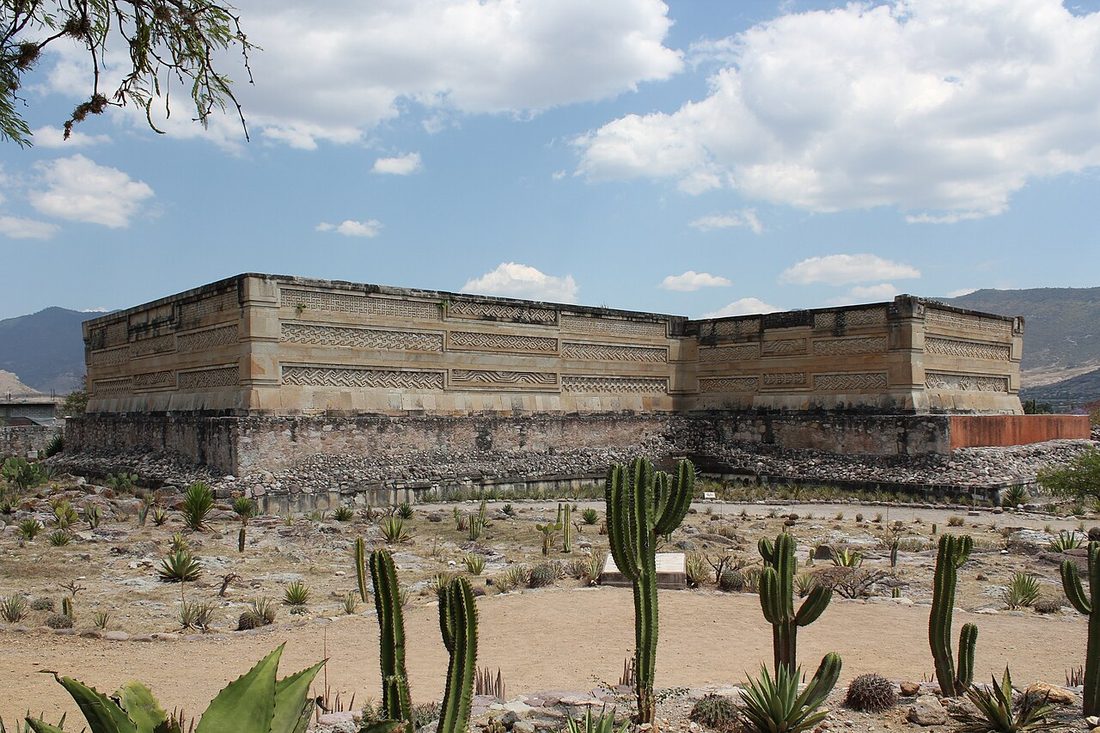
Image: Arian Zwegers from Brussels, Belgium, Wikimedia Commons, CC BY 2.0. Resized; not otherwise altered. All credits.
📍 Where It Is Oaxaca Valley, southern Mexico 17.0439°, -96.7678°
🏛️ Mainstream Date Monte Albán c. 500 BCE–800 CE · Mitla c. 900–1521 CE Excavated baseline
🧭 Leading Edge / Open Angle 2023 radar scans confirmed sealed underground voids beneath Mitla Debated or newly revised
🪨 Heaviest Stone & Quarry 18–30 tons (Mitla stone lintels & columns, hauled 2–6 km) 0.8× the 40-ton test limit · Compare all 64 sites →
30-SECOND TAKEAWAY

In Plain English — The 30-Second Takeaway

What It Is:

Monte Albán and Mitla are the two great Zapotec and Mixtec stone capitals of Oaxaca in southern Mexico.

What Everyone Agrees On (Measured Facts):

Mitla's palaces combine 18-to-30-ton single-stone stone lintels and columns with over 100,000 tiny cut-stone tiles fitted without mortar into geometric walls.

🏛️ Mainstream Archaeology View:

Scholars traced Mitla's 30-ton stones to cliff quarries 2 to 6 km away. There, unfinished lintels still sit in the rock.

🧭 Leading Edge View:

In 2023, the Project Lyobaa radar and seismic survey confirmed that 17th-century stories of a sealed underground labyrinth beneath Mitla match real buried chambers.

Site Story & Overview

Monte Albán and Mitla anchor two complementary halves of Oaxacan giant buildings. Monte Albán reshaped an entire mountain summit around 500 BCE and controlled the long-distance Oaxacan mica trade that supplied Teotihuacan.

▸ Read Full Archaeological & Engineering Context

As Monte Albán declined after 800 CE, ceremonial power shifted 40 km east to Mitla. There, builders combined two rare building feats in Mesoamerica: single-stone ignimbrite lintels and underground cruciform tomb slabs weighing up to 25–30 tons. It also covers delicate three-dimensional stone mosaic friezes. The 2023 Project Lyobaa geophysical survey confirmed that colonial accounts of sealed underground chambers beneath the Church Group correspond to measurable subsurface voids.

✓ What Is Physically Measured on Site

Dated samples, laser scans, stone weights, and dug finds kept separate from opinion.

🏛️ Mainstream Archaeological View

  • Accepted timeline: Monte Albán was founded as the Zapotec capital on a flattened mountain ridge c. 500 BCE and flourished until c. 800 CE. Mitla (Lyobaa) rose as the primary Postclassic Zapotec-Mixtec religious centre c. 900–1521 CE.
  • Stone & hardness: Miocene rhyolitic ignimbrite (trachyte tuff), limestone & Oaxacan mica caches — Mohs hardness 5.5 (Silicified ignimbrite / trachyte) (on the 1–10 Mohs scale where a steel knife is ~5.5 and diamond is 10).
  • Quarry distance & alignment: Stone source 2–6 km (Mitla cliff quarries at Dainzú-Macuilxóchitl & Los Compadres). Orientation: North–south Main Plaza with Building J arrow structure rotated ~45° to zenith/Capella.

🧭 Leading Edge Proposal & Open Questions

  • Leading Edge & colonial-chronicle researchers: Cite 17th-century friar Francisco de Burgoa's account of a vast underground labyrinth beneath Mitla ('Lyobaa', the Place of Rest) and highlight the mortarless precision of Mitla's 30-ton trachyte lintels and step-fret mosaics [3][2]

Tested Claims About Monte Albán and Mitla (Lyobaa)

ClaimStatusVerdict
Pyramids around the world point to a common lost source
Did pyramids in Egypt, Peru, Mexico, Sudan. Also, China come from one shared ancient parent culture?
Leading EdgeOpen question
Liquid mercury and buried mica at Teotihuacan point to a lost technology
Were liquid mercury pools and shiny mica rock sheets found at Teotihuacan in Mexico used for lost technology?
Leading EdgeMeasured: liquid mercury lay in the chambers at the end of the tunnel under the Feathered Serpent Temple, and two layers of Oaxacan mica sheets lay under a Viking Group floor. The excavators read them as ritual offerings and stored valuables; no evidence of a technical use has been published, so the technology reading is an open Leading Edge question
Precision and shaping in ancient stonework: what has been measured, what has been replicated
Did tight stone joints, flat granite boxes, drill cores, and stone vases require advanced machine tools?
Leading EdgeMeasured in part: tolerances of about 0.25–0.5 mm (Giza casing) and ±1–2 mm survey precision (Tiwanaku) are documented; copper-and-sand and hammerstone methods are replicated at small scale; how the sharpest interior angles, Petrie's spiral-grooved core and the finest vessels were finished is an open question
▸ View Engineering Callout Sources (6 lettered references)
  1. Robles García, N. M. (1994). Las canteras de Mitla, Oaxaca: tecnología para la arquitectura monumental. Vanderbilt University Publications in Anthropology No. 47. https://hdl.handle.net/1803/5789 data
  2. Argote, D. L., Tejero-Andrade, A., Cárdenas-Soto, M. et al. (2023). Joint geophysical survey (ERT, GPR and seismic noise) at the Church Group and Columns Group in Mitla, Oaxaca (Project Lyobaa). Journal of Archaeological Science: Reports 51. doi:10.1016/j.jasrep.2023.104156 data
  3. Miksic, J. N. (1990). Borobudur: Golden Tales of the Buddhas. Boston: Shambhala / Periplus. https://openlibrary.org/works/OL2152678W data
  4. UNESCO World Heritage Centre: Borobudur Temple Compounds (inscribed 1991). https://whc.unesco.org/en/list/592/ background
  5. Bisht, R. S. (2015). Excavations at Dholavira (1989–90 to 2004–2005). New Delhi: Archaeological Survey of India (916-page excavation report). https://asi.nic.in/ data
  6. UNESCO World Heritage Centre: Dholavira: a Harappan City (inscribed 2021). https://whc.unesco.org/en/list/1645/ background

Visiting & base stays: Monte Albán & Mitla Step-Fret Palaces (Oaxaca de Juárez base, Mexico)

FTC affiliate disclosure: Tour links go to GetYourGuide and Viator. Hotel links use Stay22 (aid=solarevidence) for Booking.com and Expedia. If you book a trip, we may earn a small fee at no extra cost to you. All partner links use rel="sponsored nofollow noopener". Check travel alerts before you go. Partner fees never change our ratings. All 64 site field visits · Affiliate disclosure.

📚 Further Reading: Both Sides of the Argument

Top books from both sides of the debate on this topic. Browse all 34 books on Books & Further Reading or visit our Search for the Truth Bookshop.org storefront.

Mainstream Baseline 2005 ★ 4.6/5

1491: New Revelations of the Americas Before Columbus (2nd ed.)

Charles C. Mann

Shows how new digs and laser maps proved the ancient Americas held big cities, roads, and farms long before Columbus.

▸ Why this book matters to both sides

Surveys the archaeological, botanical, and demographic discoveries showing that the pre-Columbian Americas—from Caral-Supe and the Amazon basin to Cahokia—were older, more populous, and more engineered than once taught.

Role in the debate: Documents how mainstream field evidence overturned the 20th-century 'pristine wilderness' model in the Amazon and pushed giant buildings in Peru back to the third millennium BCE. (ISBN 9781400032051)

Mainstream Baseline 2022 ★ 4.7/5

The Maya (10th ed.)

Michael D. Coe & Stephen Houston

The classic guide to the Maya world, updated with new jungle laser maps, the 1000 BCE Aguada Fénix platform, and calendar science.

▸ Why this book matters to both sides

The tenth edition of the standard academic overview of Maya culture, updated with airborne LiDAR surveys across the Petén and Campeche, the 1000 BCE Aguada Fénix plateau, and Long Count astronomy.

Role in the debate: Pairs the latest LiDAR town densities and epigraphic readings with Mesoamerican calendrical and sky debates. (ISBN 9780500295144)

Leading Edge 1995 ★ 4.7/5

Fingerprints of the Gods: The Evidence of Earth's Lost Civilization

Graham Hancock

Graham Hancock's bestseller arguing that Giza, Pumapunku, and ancient maps preserve traces of a lost Ice Age culture.

▸ Why this book matters to both sides

Hancock's worldwide bestseller examining Tiwanaku, Pumapunku, Teotihuacan, Giza, the Piri Reis map, and Hapgood's crustal-shift model. It argues for an Ice Age culture lost in a global cataclysm.

Role in the debate: The book that brought the lost-Ice-Age-culture idea to millions of readers and framed the modern debate over Giza, Pumapunku, and ancient sky sightlines. (ISBN 9780517887295)

Leading Edge 2010 ★ 4.7/5

Lost Technologies of Ancient Egypt: Advanced Engineering in the Temples of the Pharaohs

Christopher Dunn

An engineer measures Egyptian granite boxes, statues, and drill cores with precision gauges to argue for advanced ancient tools.

▸ Why this book matters to both sides

Manufacturing engineer Christopher Dunn applies straightedges, radius gauges, and optical comparators to the Serapeum granite sarcophagi, Luxor Ramses statues, and Petrie's drill cores. It argues for high-speed mechanical tooling.

Role in the debate: Provides the primary Leading Edge metrology claims on Egyptian granite symmetry and flatness, contrasted on our precision pages with test copper-saw, tubular-drill, and pounder replications. (ISBN 9781591431022)

FTC affiliate disclosure: Book links go to Bookshop.org (ID 130218, Search for the Truth). Each sale helps local bookstores and pays us a 10% fee at no extra cost to you. All partner links use rel="sponsored nofollow noopener". Fees never change our verdicts. Affiliate disclosure.

Primary Academic Sources

▸ View All Cited Primary Sources & DOIs (6 papers)
  1. Blanton, R. E. (1978). Monte Albán: Settlement Patterns at the Ancient Zapotec Capital. New York: Academic Press. https://openlibrary.org/works/OL4568598W data
  2. Robles García, N. M. (1994). Las canteras de Mitla, Oaxaca: tecnología para la arquitectura monumental. Vanderbilt University Publications in Anthropology No. 47. https://hdl.handle.net/1803/5789 data
  3. Argote, D. L., Tejero-Andrade, A., Cárdenas-Soto, M. et al. (2023). Joint geophysical survey (ERT, GPR and seismic noise) at the Church Group and Columns Group in Mitla, Oaxaca (Project Lyobaa). Journal of Archaeological Science: Reports 51. doi:10.1016/j.jasrep.2023.104156 data
  4. Manzanilla, L. R., Bokhimi, X., Tenorio, D., Jiménez-Reyes, M., Rosales, E., Martínez, C. & Winter, M. (2017). Procedencia de la mica de Teotihuacan: control de los recursos suntuarios foráneos por las élites gobernantes. Anales de Antropología 51: 23–38 (in Spanish, English abstract; open access). doi:10.1016/j.antro.2016.09.001 data
  5. Rosales de la Rosa, E. A. (2021). La mica: usos y distribución de un recurso alóctono en Teotihuacan. Cuicuilco. Revista de Ciencias Antropológicas 28(82): 219–254 (in Spanish; open access). https://www.redalyc.org/journal/5295/529570277010/ data
  6. UNESCO World Heritage Centre: Historic Centre of Oaxaca and Archaeological Site of Monte Albán (inscribed 1987). https://whc.unesco.org/en/list/415/ background

Dates and stone checks are summed up in plain English from the papers above. Measured facts stay separate from opinion. Methodology.