Status: ContestedVerdict: Measured: the 15.5° grid fits sunsets about 260 days apart if the skyline is about 1° high; the Pleiades setting was about 2° away; which (or both) the builders intended is open
30-SECOND TAKEAWAY
In Plain English — The 30-Second Takeaway
What It Is:
Why is the entire street grid of Teotihuacan in Mexico turned 15.5 degrees east of true north?
What Everyone Agrees On (Measured Facts):
The Sun Pyramid faces sunsets around April 29 and August 13. Those dates split the year into the 260-day Mesoamerican ritual calendar.
🏛️ Mainstream Archaeology View:
Sky experts conclude the 15.5-degree grid was built to track those 260-day calendar sunrises and sunsets.
🧭 Leading Edge View:
Other writers link the grid angle to the setting of the Pleiades star cluster or older sky eras.
Overview & Context
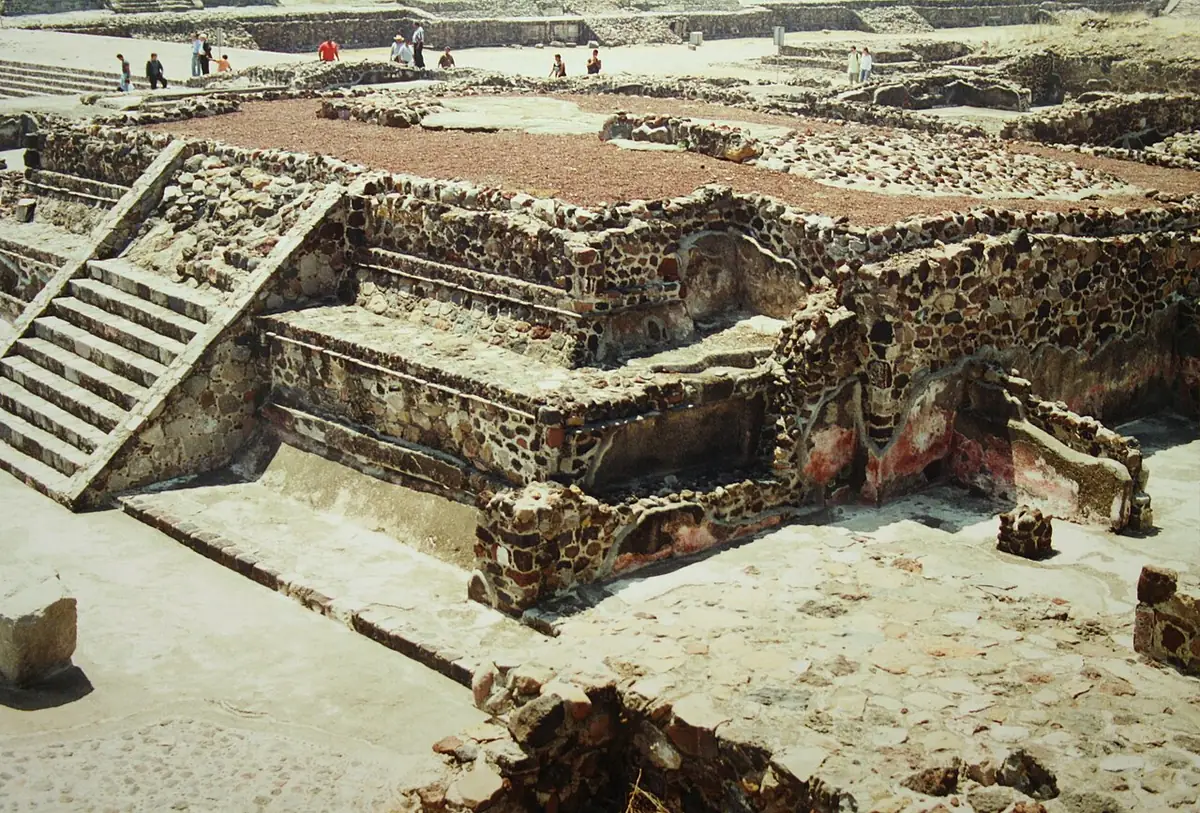
Teotihuacan, north-east of Mexico City, was one of the largest cities in the world around 100–550 CE. Its Street of the Dead and the Sun Pyramid share an angle about 15.5° east of north.
▸ Read Technical Background, Full Claim Wording & Academic Literature History
Formal claim tested: Teotihuacan's city grid, turned about 15.5° east of north, was set by the sky. One reading is that the Sun Pyramid faces sunsets on dates 260 days apart, the length of the Mesoamerican ritual calendar. Another is that the grid points to the setting of the Pleiades.
Where the evidence stands: Both readings are published by archaeoastronomers and both survive our re-check. Sunsets along the Sun Pyramid's axis fall about 29 April and 13 August in today's calendar (about 1 May and 15–16 August in AD 200). The interval from August to April is 258–261 days, depending on the skyline height we assume. The Pleiades set about 2° north of the axis in AD 150. Neither reading has separate written confirmation from Teotihuacan itself, so intent remains open.
A second group of buildings, including the Ciudadela, is turned about 16.5°. James Dow (1967) proposed a stellar reason, and Ivan Šprajc (2000) a solar calendar. Popular claims that the three main pyramids copy Orion's Belt, or that the layout is a scale model of the solar system, have no peer-reviewed analysis we could test. Reports of liquid mercury and mica at the site are assessed in the mercury and mica claim.
Computation & method notes: How we computed this: the Sun's declination comes from a standard low-precision solar theory (Meeus, Astronomical Algorithms, chapter 25) with the Vondrák et al. (2011) long-term obliquity from pyerfa. Teotihuacan is taken at 19.692° N. We find the dates when the setting Sun lies on azimuth 285.5° for skyline altitudes from flat to +1°. A check run for AD 2000 gives the commonly quoted 29 April and 13 August. Alcyone's position uses SIMBAD data and pyerfa precession. These are our own computation. Download the Python script (CC0).
The Avenue of the Dead, about 15.5° east of north. Image: Gary Todd from Xinzheng, China, CC0, via Wikimedia Commons. Resized.
✓ What Has Been Physically Measured
Dates, physical measurements, and excavated findings kept separate from interpretation.
The city grid has: two related angles, about 15.5° and 16.5° clockwise from the cardinal directions. [1]
Our sky calculation: For the Sun Pyramid's west axis (azimuth 285.5°), sunset falls on 29 April and 13 August in AD 2000, and about 1 May and 15–16 August in AD 200 (proleptic Gregorian). [4][5]
Our sky calculation: The interval from the August sunset to the April sunset is 256–261 days, depending on the skyline height (flat to +1°). It equals 260 days when the skyline is about 1° high. [4]
Our sky calculation: Alcyone, the brightest Pleiades star, set at azimuth about 287.4–288.0° in AD 150, about 2° north of the Sun Pyramid axis. It moves about 0.5° per century, so this match depends on the building date. [4][6]
Key finding: Ceramic and carbon dating places the main building of the Sun Pyramid in about 100–200 CE. [3]
Key finding: Šprajc argues that the Sun Pyramid and the Ciudadela recorded sunrises and sunsets on dates separated by multiples of 20 days and by 260 days, matching Mesoamerican calendar counts. The same dates appear in other central Mexican sites. [1]
Dow proposed a stellar explanation: The setting point of the Pleiades, a star group important in later Mesoamerican calendars. [2]
🏛️ Mainstream Archaeological View & Evidence
Key finding: The Pleiades and the Sun both pass close to the axis, and Šprajc also cites a mountain in line with the perpendicular axis. With several candidate targets within 2°, a match does not prove which one was intended. [4][1]
Key finding: The 260-day interval needs a skyline about 1° high. A flat horizon gives about 256–258 days, so the exact count rests on a skyline value we have not surveyed. [4]
🔬 What Future Tests Would Settle It
A published horizon survey from the Sun Pyramid, together with dated building stages, would show whether the sunset interval was exactly 260 days when it was built. Excavated evidence of finding points or markers would help decide between solar, stellar and topographic answers.
1491: New Revelations of the Americas Before Columbus (2nd ed.)
Charles C. Mann
Shows how new digs and laser maps proved the ancient Americas held big cities, roads, and farms long before Columbus.
▸ Why this book matters to both sides
Surveys the archaeological, botanical, and demographic discoveries showing that the pre-Columbian Americas—from Caral-Supe and the Amazon basin to Cahokia—were older, more populous, and more engineered than once taught.
Role in the debate: Documents how mainstream field evidence overturned the 20th-century 'pristine wilderness' model in the Amazon and pushed giant buildings in Peru back to the third millennium BCE. (ISBN 9781400032051)
The classic guide to the Maya world, updated with new jungle laser maps, the 1000 BCE Aguada Fénix platform, and calendar science.
▸ Why this book matters to both sides
The tenth edition of the standard academic overview of Maya culture, updated with airborne LiDAR surveys across the Petén and Campeche, the 1000 BCE Aguada Fénix plateau, and Long Count astronomy.
Role in the debate: Pairs the latest LiDAR town densities and epigraphic readings with Mesoamerican calendrical and sky debates. (ISBN 9780500295144)
Fingerprints of the Gods: The Evidence of Earth's Lost Civilization
Graham Hancock
Graham Hancock's bestseller arguing that Giza, Pumapunku, and ancient maps preserve traces of a lost Ice Age culture.
▸ Why this book matters to both sides
Hancock's worldwide bestseller examining Tiwanaku, Pumapunku, Teotihuacan, Giza, the Piri Reis map, and Hapgood's crustal-shift model. It argues for an Ice Age culture lost in a global cataclysm.
Role in the debate: The book that brought the lost-Ice-Age-culture idea to millions of readers and framed the modern debate over Giza, Pumapunku, and ancient sky sightlines. (ISBN 9780517887295)
Hamlet's Mill: An Essay Investigating the Origins of Human Knowledge and Its Transmissions Through Myth
Giorgio de Santillana & Hertha von Dechend
Two science historians argue that ancient stories worldwide preserve real observations of the 26,000-year wobble of the stars.
▸ Why this book matters to both sides
Written by historians of science at MIT and Frankfurt University. The author argues ancient stories worldwide encode technical findings of the 26,000-year sky wobble of the equinoxes and shifting world ages.
Role in the debate: The scholarly bridge between academic history of astronomy and modern sky-sightline claims about sky-cycle coding at Giza, Angkor, and Göbekli Tepe. (ISBN 9780879232153)
FTC affiliate disclosure: Book links go to Bookshop.org (ID 130218, Search for the Truth). Each sale helps local bookstores and pays us a 10% fee at no extra cost to you. All partner links use rel="sponsored nofollow noopener". Fees never change our verdicts. Affiliate disclosure.
Visiting & base stays: Teotihuacan: Pyramid of the Sun, Moon & Feathered Serpent (from Mexico City)
FTC affiliate disclosure: Tour links go to GetYourGuide and Viator. Hotel links use Stay22 (aid=solarevidence) for Booking.com and Expedia. If you book a trip, we may earn a small fee at no extra cost to you. All partner links use rel="sponsored nofollow noopener". Check travel alerts before you go. Partner fees never change our ratings. All 64 site field visits · Affiliate disclosure.
Primary Academic Sources
▸ View All Cited Primary Sources & DOIs (6 papers)
Šprajc, I. (2000). Astronomical alignments at Teotihuacan, Mexico. Latin American Antiquity 11(4). doi:10.2307/972004proponent
Dow, J. W. (1967). Astronomical orientations at Teotihuacán: a case study in astro-archaeology. American Antiquity 32(3). doi:10.2307/2694661proponent
Sugiyama, N. et al. (2018). Revisiting Sun Pyramid ceramic and radiocarbon dates from Teotihuacan. Latin American Antiquity. doi:10.1017/laq.2017.68data
Vondrák, J., Capitaine, N. & Wallace, P. (2011). New precession expressions, valid for long time intervals. Astronomy & Astrophysics 534: A22. doi:10.1051/0004-6361/201117274data
SIMBAD astronomical database, CDS Strasbourg (star positions, proper motions, parallaxes and radial velocities; queried 22 October 2026). https://simbad.cds.unistra.fr/simbad/data
Sources checked against Crossref and publisher pages on 2026-10-23. This entry presents a debated idea neutrally: the proponents' case first, then the mainstream position, in plain English. "Open question" is not a judgment that the idea is true or false. Labels describe the claim, not the people who hold it. Methodology.