△ TruthInStone

Sites › North America › Quiriguá (Stela E) and Copán

Quiriguá (Stela E) and Copán

Quiriguá (Stela E) and Copán
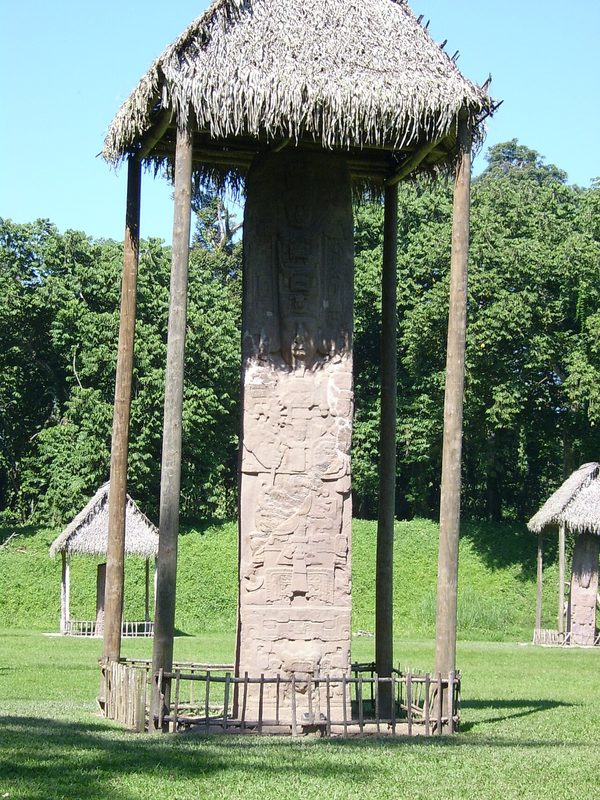
Image: Jan Pešula, Wikimedia Commons, CC BY 2.5. Resized; not otherwise altered. All credits.
📍 Where It Is Motagua Valley, Guatemala & Copán Valley, western Honduras 15.2722°, -89.0403°
🏛️ Mainstream Date c. 400–850 CE (Stela E dedicated January 22, 771 CE) Excavated baseline
🧭 Leading Edge / Open Angle 65-ton freestanding stone needle & Long Count dates reaching millions of years back Debated or newly revised
🪨 Heaviest Stone & Quarry 59–65 tons (Quiriguá Stela E, 10.6 m tall, hauled ~5 km) 1.6× the 40-ton test limit · Compare all 64 sites →
30-SECOND TAKEAWAY

In Plain English — The 30-Second Takeaway

What It Is:

Quiriguá in Guatemala and Copán in Honduras are Classic Maya cities famous for high-relief stone sculpture. Also, the tallest freestanding stone shaft in the Americas.

What Everyone Agrees On (Measured Facts):

Quiriguá's Stela E is a single 10.6-meter. (35-foot) sandstone needle weighing 59 to 65 tons, quarried 5 km away and raised unbroken in 771 CE.

🏛️ Mainstream Archaeology View:

Maya hieroglyphs on the stelae record exact historical dates under King K'ak' Tiliw Chan Yopaat alongside sacred calendar cycles reaching back to 3114 BCE.

🧭 Leading Edge View:

Raising a brittle 65-ton sandstone shaft without snapping it. Also, carving deep-time calendar counts spanning millions of years. Stands out in ancient American building.

Site Story & Overview

Situated just 50 km apart in the southeastern Maya lowlands, Copán and Quiriguá pair high-relief volcanic-tuff sculpture with the single heaviest freestanding monolith erected by the Maya. After Quiriguá's ruler K'ak' Tiliw Chan Yopaat captured Copán's thirteenth king in 738 CE and gained control of the Motagua jade and obsidian trade route, he commissioned a series of sandstone shafts that culminated in Stela E (10.6 m long, ~59–65 tons). Moving and raising a brittle 10.6 m sandstone needle without cracking it—and anchoring it 2.6 m deep into soggy alluvial clay with stone-and-clay packing—remains one of the standout structural achievements of Classic Mesoamerica.

✓ What Is Physically Measured on Site

Dated samples, laser scans, stone weights, and dug finds kept separate from opinion.

🏛️ Mainstream Archaeological View

  • Accepted timeline: Classic Maya kingdoms of the southeastern periphery, c. 400–850 CE. Quiriguá's giant stelae were dedicated between 746 and 810 CE under K'ak' Tiliw Chan Yopaat (Cauac Sky) after his 738 CE victory over Copán's ruler Waxaklajuun Ub'aah K'awiil.
  • Stone & hardness: Red feldspathic sandstone, rhyolite & Copán green volcanic tuff (ignimbrite) — Mohs hardness 5.0–5.5 (Quartzose sandstone / Rhyolite) (on the 1–10 Mohs scale where a steel knife is ~5.5 and diamond is 10).
  • Quarry distance & alignment: Stone source ~5 km from Sierra de las Minas foothills via Motagua floodplain. Orientation: North–south Great Plaza axis with solar zenith & Long Count stela sightlines.

🧭 Leading Edge Proposal & Open Questions

  • Epigraphic & archaeoastronomical studies: Quiriguá Stela C (775 CE) and Stela F record the Classic Maya 'Creation Date' 13.0.0.0.0 4 Ahau 8 Cumku (11 or 13 August 3114 BCE) alongside deep-time Long Count checks reaching millions of years into the past. Mainstream epigraphers read these as sacred and cosmological cycle anchors rather than historical memories [1][2]

Tested Claims About Quiriguá (Stela E) and Copán

ClaimStatusVerdict
LiDAR shows Maya lowlands were far more densely settled than thought
Airplane laser scans have revealed tens of thousands of hidden Maya buildings, roads, and farms under the jungle.
MainstreamMeasured: far denser settlement than mapped before
How the world's megaliths were moved: what is shown, what is inferred, and where the gaps are
Can wooden sledges, ropes, wet sand, and dirt ramps explain how ancient crews moved stones weighing 80 to 860 tons?
ContestedMeasured in part: sledges, wetted or timber tracks, ramps and boats are documented, and finished monuments show ancient moves of about 750–860 t; no test of ancient methods we found goes above about 40 t, and the 1,000 t-plus Baalbek blocks never left the quarry
Liquid mercury and buried mica at Teotihuacan point to a lost technology
Were liquid mercury pools and shiny mica rock sheets found at Teotihuacan in Mexico used for lost technology?
Leading EdgeMeasured: liquid mercury lay in the chambers at the end of the tunnel under the Feathered Serpent Temple, and two layers of Oaxacan mica sheets lay under a Viking Group floor. The excavators read them as ritual offerings and stored valuables; no evidence of a technical use has been published, so the technology reading is an open Leading Edge question
▸ View Engineering Callout Sources (7 lettered references)
  1. Richards, J. & Whitby, M. (1997). The engineering of Stonehenge. In Cunliffe, B. & Renfrew, C. (eds), Science and Stonehenge. Proceedings of the British Academy 92: 231–256 (PDF). https://www.thebritishacademy.ac.uk/documents/3921/92p231.pdf data
  2. NOVA (PBS airdate 12 Feb 1997). Secrets of Lost Empires: Obelisk, transcript: a forty-ton obelisk (US tons, about 36 t) dragged on a sledge at Aswan; it was not raised. https://www.pbs.org/wgbh/nova/transcripts/2405obelisk.html data
  3. NOVA (PBS airdate 8 Feb 2000). Secrets of Lost Empires: Pharaoh's Obelisk, transcript: a 25-ton block dragged on a timber roadbed and a 25-ton (perhaps 30-ton) obelisk raised from a sand pit. https://www.pbs.org/wgbh/nova/transcripts/27poobelisk.html data
  4. Li, J. & Chen, Z. (2016). Lubrication for transporting heavy objects in the history. Tribology Online 11(2): 242–249 (includes the Japanese shura sledge experiments). doi:10.2474/trol.11.242 background
  5. Harris, B. (2018). Moving megaliths: time to park the rollers. British Archaeology 163: 30–35 (author's accepted manuscript, UCL Discovery). https://discovery.ucl.ac.uk/id/eprint/10114174/ background
  6. Looper, M. G. (2003). Lightning Warrior: Maya Art and Kingship at Quirigua. Austin: University of Texas Press. doi:10.7560/705562 data
  7. UNESCO World Heritage Centre: Archaeological Park and Ruins of Quirigua (inscribed 1981). https://whc.unesco.org/en/list/149/ background

Visiting & base stays: Quiriguá Stela E & Copán Hieroglyphic Stairway (Copán Ruinas / Río Dulce base)

FTC affiliate disclosure: Tour links go to GetYourGuide and Viator. Hotel links use Stay22 (aid=solarevidence) for Booking.com and Expedia. If you book a trip, we may earn a small fee at no extra cost to you. All partner links use rel="sponsored nofollow noopener". Check travel alerts before you go. Partner fees never change our ratings. All 64 site field visits · Affiliate disclosure.

📚 Further Reading: Both Sides of the Argument

Top books from both sides of the debate on this topic. Browse all 34 books on Books & Further Reading or visit our Search for the Truth Bookshop.org storefront.

Mainstream Baseline 2022 ★ 4.7/5

The Maya (10th ed.)

Michael D. Coe & Stephen Houston

The classic guide to the Maya world, updated with new jungle laser maps, the 1000 BCE Aguada Fénix platform, and calendar science.

▸ Why this book matters to both sides

The tenth edition of the standard academic overview of Maya culture, updated with airborne LiDAR surveys across the Petén and Campeche, the 1000 BCE Aguada Fénix plateau, and Long Count astronomy.

Role in the debate: Pairs the latest LiDAR town densities and epigraphic readings with Mesoamerican calendrical and sky debates. (ISBN 9780500295144)

Mainstream Baseline 2005 ★ 4.6/5

1491: New Revelations of the Americas Before Columbus (2nd ed.)

Charles C. Mann

Shows how new digs and laser maps proved the ancient Americas held big cities, roads, and farms long before Columbus.

▸ Why this book matters to both sides

Surveys the archaeological, botanical, and demographic discoveries showing that the pre-Columbian Americas—from Caral-Supe and the Amazon basin to Cahokia—were older, more populous, and more engineered than once taught.

Role in the debate: Documents how mainstream field evidence overturned the 20th-century 'pristine wilderness' model in the Amazon and pushed giant buildings in Peru back to the third millennium BCE. (ISBN 9781400032051)

Bridge / Debate History 1969 ★ 4.6/5

Hamlet's Mill: An Essay Investigating the Origins of Human Knowledge and Its Transmissions Through Myth

Giorgio de Santillana & Hertha von Dechend

Two science historians argue that ancient stories worldwide preserve real observations of the 26,000-year wobble of the stars.

▸ Why this book matters to both sides

Written by historians of science at MIT and Frankfurt University. The author argues ancient stories worldwide encode technical findings of the 26,000-year sky wobble of the equinoxes and shifting world ages.

Role in the debate: The scholarly bridge between academic history of astronomy and modern sky-sightline claims about sky-cycle coding at Giza, Angkor, and Göbekli Tepe. (ISBN 9780879232153)

Leading Edge 1995 ★ 4.7/5

Fingerprints of the Gods: The Evidence of Earth's Lost Civilization

Graham Hancock

Graham Hancock's bestseller arguing that Giza, Pumapunku, and ancient maps preserve traces of a lost Ice Age culture.

▸ Why this book matters to both sides

Hancock's worldwide bestseller examining Tiwanaku, Pumapunku, Teotihuacan, Giza, the Piri Reis map, and Hapgood's crustal-shift model. It argues for an Ice Age culture lost in a global cataclysm.

Role in the debate: The book that brought the lost-Ice-Age-culture idea to millions of readers and framed the modern debate over Giza, Pumapunku, and ancient sky sightlines. (ISBN 9780517887295)

FTC affiliate disclosure: Book links go to Bookshop.org (ID 130218, Search for the Truth). Each sale helps local bookstores and pays us a 10% fee at no extra cost to you. All partner links use rel="sponsored nofollow noopener". Fees never change our verdicts. Affiliate disclosure.

Primary Academic Sources

▸ View All Cited Primary Sources & DOIs (5 papers)
  1. Looper, M. G. (2003). Lightning Warrior: Maya Art and Kingship at Quirigua. Austin: University of Texas Press. doi:10.7560/705562 data
  2. Fash, W. L. (2001). Scribes, Warriors and Kings: The City of Copán and the Ancient Maya (rev. ed.). London: Thames & Hudson. https://openlibrary.org/works/OL2697115W data
  3. Cook, D. E., Beach, T. P., Luzzadder-Beach, S., Dunning, N. P. & Turner, S. D. (2022). Environmental legacy of pre-Columbian Maya mercury. Frontiers in Environmental Science 10: 986119. doi:10.3389/fenvs.2022.986119 data
  4. UNESCO World Heritage Centre: Archaeological Park and Ruins of Quirigua (inscribed 1981). https://whc.unesco.org/en/list/149/ background
  5. UNESCO World Heritage Centre: Maya Site of Copan (inscribed 1980). https://whc.unesco.org/en/list/129/ background

Dates and stone checks are summed up in plain English from the papers above. Measured facts stay separate from opinion. Methodology.