Claims › Egypt: Sphinx & Giza dating › The 100-ton granite boxes in the Serapeum of Saqqara required advanced machining and underground rigging
The 100-ton granite boxes in the Serapeum of Saqqara required advanced machining and underground rigging
Status: ContestedVerdict: Measured: 24 monolithic granite/diorite boxes (up to ~65–70 t box + ~25–30 t lid = ~90–100 t) sit in 3 m-wide underground tunnels dated by 500+ Apis stelae to c. 612–30 BCE; full peer-reviewed 3D laser flatness maps of the interior walls have not yet been published
30-SECOND TAKEAWAY
In Plain English — The 30-Second Takeaway
What It Is:
How did ancient crews cut and move 100-ton granite boxes inside the narrow underground tunnels of Saqqara?
What Everyone Agrees On (Measured Facts):
Twenty-four single-block stone chests sit in narrow 10-foot-wide underground tunnels at Saqqara. The boxes weigh up to 70 tons with 30-ton lids, cut from hard Aswan granite 500 miles away.
🏛️ Mainstream Archaeology View:
Egyptologists date the burial galleries to 612–30 BCE using 500 dated wall stones. Craftsmen shaped the chests for sacred Apis bulls with pounders, copper saws, and sand.
🧭 Leading Edge View:
Engineer Christopher Dunn notes the inside granite walls are flat and square while outside hieroglyphs are roughly scratched. Rigging 100 tons in tight tunnels remains a major puzzle.
Overview & Context
Rediscovered by Auguste Mariette in 1851 beneath the desert northwest of Djoser's Step Pyramid, the Greater Vaults of the Serapeum of Saqqara house 24 colossal single-block stone chests carved from Aswan rose granite, black granodiorite, and basalt (Mohs hardness 6.0–7.0), quarried 500 miles (800 km) south. Egypt scholars identify them as the burial coffins of the sacred Apis bulls of Memphis from the 26th Dynasty through the Ptolemaic era.
▸ Read Technical Background, Full Claim Wording & Academic Literature History
Formal claim tested: The 24 giant granite, diorite, and basalt sarcophagi inside the narrow underground tunnels of the Serapeum at Saqqara display interior surface flatness, square corners, and 100-ton underground rigging that exceed hand-pounding tools and surpass the crude hieroglyphs scratched onto their sides.
Where the evidence stands: The physical scale and setting are undisputed: 24 single-block stone chests weighing up to 90–100 metric tons (with lid) sit in sunken crypts off a 3-meter-wide underground limestone gallery, more than double the 40-ton modern ancient-tool haul test limit. Three boxes carry 26th–31st Dynasty royal carved texts (Amasis II, Cambyses II, Khabbash), and hundreds of dated Apis stelae seal the gallery timeline to c. 612–30 BCE. However, engineer Christopher Dunn's straightedge and square checks of the polished interior faces are pass/fail findings over 6-inch spans rather than peer-reviewed 3D laser-tracker surface maps, leaving the exact micron flatness and rigging mechanics a live building debate.
Manufacturing engineer Christopher Dunn and Leading Edge authors highlight two striking puzzles: how ancient crews moved and lowered 90-to-100-ton stone assemblies inside dark 3-meter-wide (10-foot) rock tunnels where hundreds of haulers could not stand, and why the finely polished interior granite surfaces contrast so sharply with the rough hieroglyphs scratched onto Amasis II's and Khabbash's boxes. See also precision stonework tolerances and worldwide megalith transport.
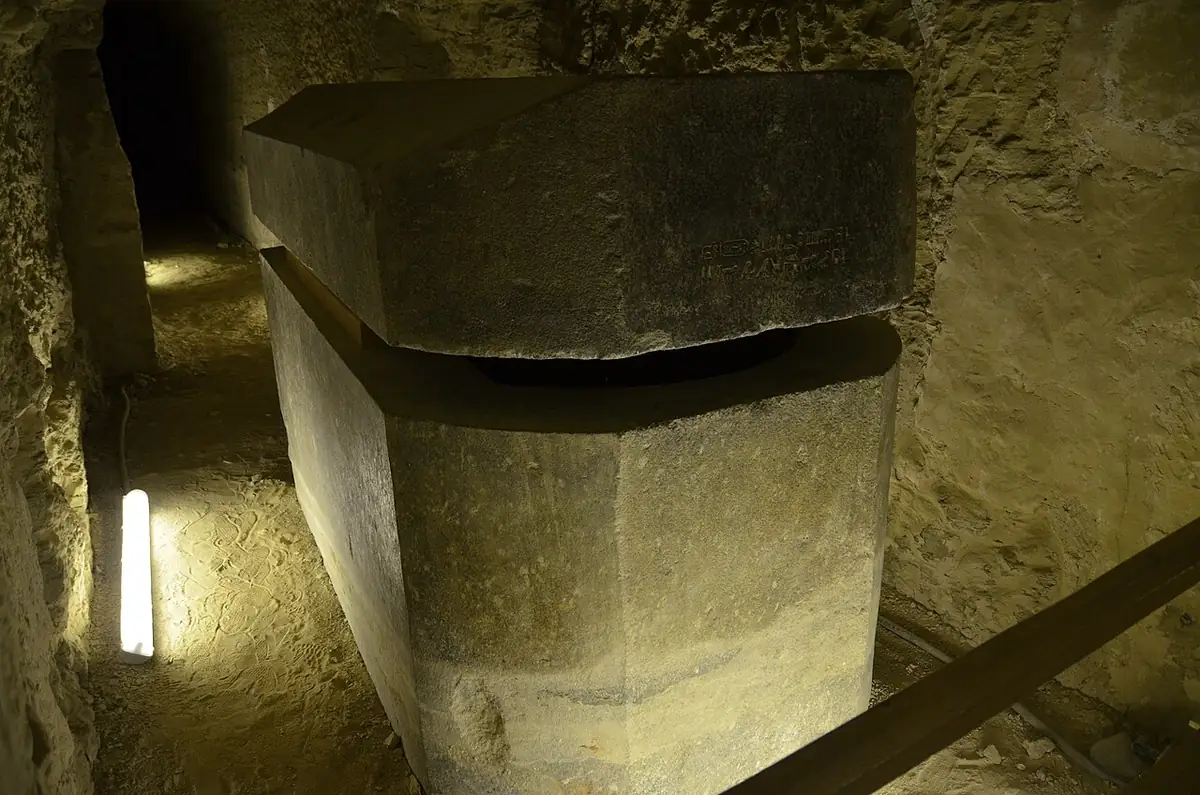
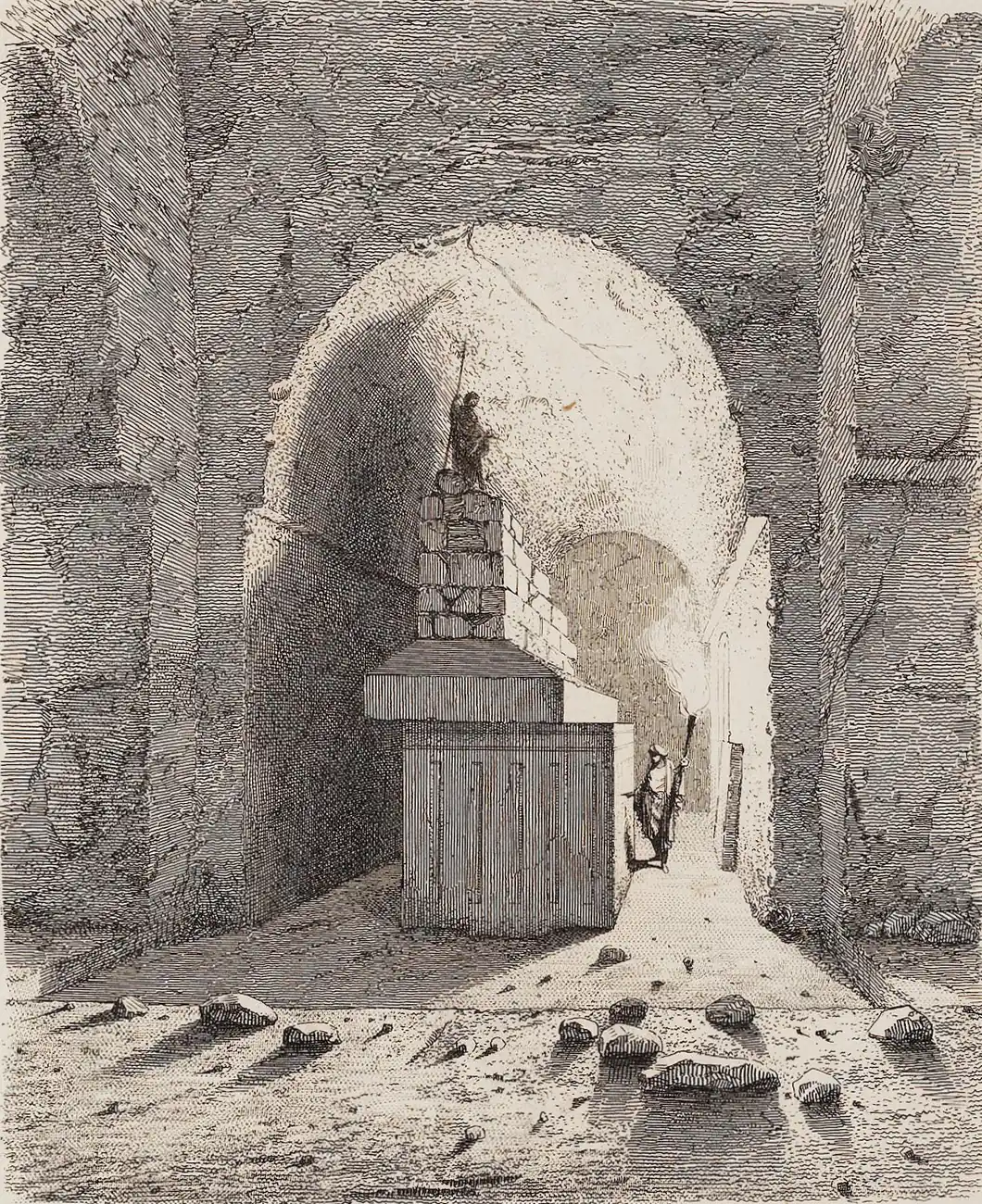
One of the giant single-block granite sarcophagi inside the underground vaults of the Serapeum at Saqqara. Image: Carole Raddato, CC BY-SA 2.0, via Wikimedia Commons. Resized.Nineteenth-century engraving from Auguste Mariette's Serapeum excavations showing a sunken vault and granite box. Image: Auguste Guillaumot (in Mariette, 1882), Public domain, via Wikimedia Commons. Resized.
✓ What Has Been Physically Measured
Dates, physical measurements, and excavated findings kept separate from interpretation.
24 monolithic hard-stone chests: Hollowed from single blocks of Aswan rose granite, black granodiorite, diorite, and basalt (Mohs hardness 6.0–7.0), the largest boxes measure ~3.85 × 2.3 × 2.4 m (~12.6 × 7.5 × 7.9 feet) with walls ~35–40 cm thick. [1][2][4]
65-to-100-ton masses in 3-m tunnels: Individual boxes weigh ~40 to 70 metric tons and their lids weigh ~20 to 30 metric tons, reaching ~90–100 metric tons combined (~2.25–2.5× the 40-ton modern ancient-tool haul limit). Every box was moved through a rock-cut main gallery ~3 m (10 feet) wide and lowered into a sunken floor pit. [1][2][4][9]
500+ dated Apis stelae and 3 inscribed boxes: Mariette dug over 500 dated limestone stelae embedded in the gallery walls recording Apis bull burials from Year 52 of Psamtik I (612 BCE) to Cleopatra VII. Meanwhile, three boxes bear hieroglyphs naming Pharaohs Amasis II (570–526 BCE), Cambyses II, and Khabbash (c. 338 BCE). [1][2][3]
Dunn's 6-inch straightedge and square checks: In 1995 and 2001, engineer Christopher Dunn placed a 6-inch precision straightedge (rated to 0.0002 in / 0.005 mm) and a calibrated toolmaker's square against the interior walls and under-lid ceiling of two granite boxes, reporting no visible light gap and ~4 mm (5/32-inch) inside corner radii. [5]
🧭 Proponents' Case & Cited Evidence
Flat interior granite vs. scratched hieroglyphs: Dunn and Leading Edge researchers point out that the boxes themselves are cut square and polished smooth in Mohs 6.5–7 granite. By contrast, the Late Period hieroglyphs on Amasis II's and Cambyses II's boxes are shallowly and unevenly scratched—suggesting later rulers may have inscribed older chests. [5][10]
Confined subterranean rigging problem: Unlike open-air temple yards where hundreds of haulers can pull ropes in long lines, the 3-meter-wide underground gallery with 90-degree turns into sunken side crypts severely restricts human pulling teams for a 70-ton box. [5][1]
High-precision squareness on interior faces: Dunn argues that finishing the unseen inside walls and under-lid surfaces of a bull coffin to toolmaker-square tolerances serves no funerary decorative purpose. [5]
🏛️ Mainstream Archaeological View & Evidence
Sequential gallery excavation dated by stelae: Egypt scholars Aidan Dodson and H. S. Smith show that the Greater Vaults were cut progressively northward niche by niche from 612 BCE to the Ptolemies, with dated stelae mortared into the bedrock walls outside each new crypt—and an unfinished rough granite box still sits blocked in the entrance passage. [2][3][1]
Sand-box lowering and capstan winches: Archaeological builders explain the underground placement by hauling the box on wooden rollers with capstans onto a crypt packed full of dry sand, then slowly letting the sand out from beneath the box to lower it into the pit. [2][8]
Short-span gauge checks vs. full-wall flatness: Critics note that a 6-inch (15 cm) straightedge only measures local smoothness over 15 cm, not flatness across a 3.8-meter wall, and that Denys Stocks replicated flat polished granite surfaces using copper saws, dolerite pounders, and quartz-sand/emery lapping plates. [7][8][5]
🔬 What Future Tests Would Settle It
Publishing a peer-reviewed 3D laser-tracker or structured-light metrological scan across the full 3.8-meter interior walls and lids of several Serapeum boxes—reporting numerical flatness deviations in microns/mm rather than 6-inch pass/fail checks—would settle the machining debate directly.
Richards, J. & Whitby, M. (1997). The engineering of Stonehenge. In Cunliffe, B. & Renfrew, C. (eds), Science and Stonehenge. Proceedings of the British Academy 92: 231–256 (PDF). https://www.thebritishacademy.ac.uk/documents/3921/92p231.pdfdata
NOVA (PBS airdate 8 Feb 2000). Secrets of Lost Empires: Pharaoh's Obelisk, transcript: a 25-ton block dragged on a timber roadbed and a 25-ton (perhaps 30-ton) obelisk raised from a sand pit. https://www.pbs.org/wgbh/nova/transcripts/27poobelisk.htmldata
Li, J. & Chen, Z. (2016). Lubrication for transporting heavy objects in the history. Tribology Online 11(2): 242–249 (includes the Japanese shura sledge experiments). doi:10.2474/trol.11.242background
Harris, B. (2018). Moving megaliths: time to park the rollers. British Archaeology 163: 30–35 (author's accepted manuscript, UCL Discovery). https://discovery.ucl.ac.uk/id/eprint/10114174/background
Dodson, A. (2005). Bull Cults (Apis burials and the Serapeum of Saqqara). In Ikram, S. (ed.), Divine Creatures: Animal Mummies in Ancient Egypt, American University in Cairo Press, pp. 72–105. doi:10.5743/cairo/9789774248580.003.0004data
Petrie, W. M. F. (1883). The Pyramids and Temples of Gizeh. London: Field & Tuer (casing-joint measurements, §26; tubular drilling and core No. 7, §§130–133; Internet Archive scan). https://archive.org/details/cu31924012038927data
Stocks, D. A. (2001). Testing ancient Egyptian granite-working methods in Aswan, Upper Egypt. Antiquity 75. doi:10.1017/s0003598x00052777data
Science Frontiers no. 137 (Sep–Oct 2001). Granite-working in ancient Egypt (summary of Stocks 2001: a 3 cm × 95 cm saw slot in 14 hours; the blade lost 7.5 mm). https://www.science-frontiers.com/sf137/sf137p01.htmbackground
Stocks, D. A. (2003). Experiments in Egyptian Archaeology: Stoneworking Technology in Ancient Egypt. London: Routledge. doi:10.4324/9780203430231data
The Giza dig leaders share 30 years of finds, from the workers' town and stone quarries to Old Kingdom carbon dates.
▸ Why this book matters to both sides
The Giza dig teams' own large-format overview of decades of fieldwork on the plateau. It records the Heit el-Ghurab workers' town, limestone quarries, ramp remnants, and Old Kingdom carbon dates.
Role in the debate: Provides the primary archaeological and soil-layer baseline at Giza against which older-Sphinx, legacy-foundation, and precision-machining proposals are tested. (ISBN 9780226425696)
The Red Sea Scrolls: How Ancient Papyri Reveal the Secrets of the Pyramids
Pierre Tallet & Mark Lehner
Tells how 4,500-year-old papyrus logs found at a Red Sea cave record crews hauling fine limestone to the Great Pyramid for King Khufu.
▸ Why this book matters to both sides
Tells how the oldest known inscribed papyri—discovered in Fourth Dynasty boat caves at Wadi al-Jarf—record Inspector Merer's team hauling Tura casing limestone to the Great Pyramid under Khufu.
Role in the debate: Presents the contemporary written logbook evidence for Fourth Dynasty casing transport at Khufu's horizon, directly addressing whether the Great Pyramid was built or restored in the Old Kingdom. (ISBN 9780500052112)
Lost Technologies of Ancient Egypt: Advanced Engineering in the Temples of the Pharaohs
Christopher Dunn
An engineer measures Egyptian granite boxes, statues, and drill cores with precision gauges to argue for advanced ancient tools.
▸ Why this book matters to both sides
Manufacturing engineer Christopher Dunn applies straightedges, radius gauges, and optical comparators to the Serapeum granite sarcophagi, Luxor Ramses statues, and Petrie's drill cores. It argues for high-speed mechanical tooling.
Role in the debate: Provides the primary Leading Edge metrology claims on Egyptian granite symmetry and flatness, contrasted on our precision pages with test copper-saw, tubular-drill, and pounder replications. (ISBN 9781591431022)
Fingerprints of the Gods: The Evidence of Earth's Lost Civilization
Graham Hancock
Graham Hancock's bestseller arguing that Giza, Pumapunku, and ancient maps preserve traces of a lost Ice Age culture.
▸ Why this book matters to both sides
Hancock's worldwide bestseller examining Tiwanaku, Pumapunku, Teotihuacan, Giza, the Piri Reis map, and Hapgood's crustal-shift model. It argues for an Ice Age culture lost in a global cataclysm.
Role in the debate: The book that brought the lost-Ice-Age-culture idea to millions of readers and framed the modern debate over Giza, Pumapunku, and ancient sky sightlines. (ISBN 9780517887295)
FTC affiliate disclosure: Book links go to Bookshop.org (ID 130218, Search for the Truth). Each sale helps local bookstores and pays us a 10% fee at no extra cost to you. All partner links use rel="sponsored nofollow noopener". Fees never change our verdicts. Affiliate disclosure.
Visiting & base stays: The Serapeum of Saqqara & Step Pyramid Complex (Memphis Necropolis, Cairo/Giza base)
FTC affiliate disclosure: Tour links go to GetYourGuide and Viator. Hotel links use Stay22 (aid=solarevidence) for Booking.com and Expedia. If you book a trip, we may earn a small fee at no extra cost to you. All partner links use rel="sponsored nofollow noopener". Check travel alerts before you go. Partner fees never change our ratings. All 64 site field visits · Affiliate disclosure.
Primary Academic Sources
▸ View All Cited Primary Sources & DOIs (10 papers)
Dodson, A. (2005). Bull Cults (Apis burials and the Serapeum of Saqqara). In Ikram, S. (ed.), Divine Creatures: Animal Mummies in Ancient Egypt, American University in Cairo Press, pp. 72–105. doi:10.5743/cairo/9789774248580.003.0004data
Smith, H. S. (1973). Excavations East of the Serapeum at Saqqara (and chronology of the Apis bull burials). Journal of Egyptian Archaeology 59. doi:10.2307/3856105data
Petrie, W. M. F. (1883). The Pyramids and Temples of Gizeh. London: Field & Tuer (casing-joint measurements, §26; tubular drilling and core No. 7, §§130–133; Internet Archive scan). https://archive.org/details/cu31924012038927data
Stocks, D. A. (2001). Testing ancient Egyptian granite-working methods in Aswan, Upper Egypt. Antiquity 75. doi:10.1017/s0003598x00052777data
Stocks, D. A. (2003). Experiments in Egyptian Archaeology: Stoneworking Technology in Ancient Egypt. London: Routledge. doi:10.4324/9780203430231data
Richards, J. & Whitby, M. (1997). The engineering of Stonehenge. In Cunliffe, B. & Renfrew, C. (eds), Science and Stonehenge. Proceedings of the British Academy 92: 231–256 (PDF). https://www.thebritishacademy.ac.uk/documents/3921/92p231.pdfdata
Sources checked against Crossref and publisher pages on 2026-10-27. This entry presents a debated idea neutrally: the proponents' case first, then the mainstream position, in plain English. "Open question" is not a judgment that the idea is true or false. Labels describe the claim, not the people who hold it. Methodology.