What lies under the Sphinx and the Giza pyramids (Hall of Records, tunnels, shafts)
Status: Leading EdgeVerdict: Measured: two voids inside the Great Pyramid, a dead-end passage in the Sphinx's rump and the Late Period Osiris Shaft; unconfirmed: a Hall of Records, seismic 'cavities' read as rooms, and SAR shafts under Khafre
30-SECOND TAKEAWAY
In Plain English — The 30-Second Takeaway
What It Is:
What hidden rooms have actually been found inside and under Giza versus legends of a 'Hall of Records'?
What Everyone Agrees On (Measured Facts):
Confirmed spaces include two voids in the Great Pyramid, the deep water-filled Osiris Shaft, and a short tunnel in the Sphinx's rump.
🏛️ Mainstream Archaeology View:
Egypt scholars note that drill holes and radar around the Sphinx's paws found natural rock cracks, but no library chamber.
🧭 Leading Edge View:
Supporters point to 1990s seismic echoes under the Sphinx's left paw and ask for camera inspections.
Overview & Context
This page gathers the underground claims in one place and keeps measured findings apart from unconfirmed ones. For detail see the muon voids and the Khafre radar claim.
▸ Read Technical Background, Full Claim Wording & Academic Literature History
Formal claim tested: Hidden chambers and tunnels lie beneath the Sphinx and the Giza pyramids. They include a 'Hall of Records' under the Sphinx's paws, cavities found by seismic surveys in the 1990s, and, according to a 2025 announcement, giant shafts and chambers hundreds of m below the Pyramid of Khafre.
Where the evidence stands: Several underground and internal spaces at Giza are real and measured: the two voids found by muon imaging in the Great Pyramid, a short dead-end passage in the Sphinx's rump, a drill hole and a head hole, and the three-level Osiris Shaft under Khafre's causeway. No survey has confirmed a chamber under the Sphinx. Geophysical surveys report anomalies that need reading, and the one anomaly that was drilled turned out to be natural. The 2025 Khafre structures were announced at a press conference, not in a peer-reviewed paper. The method's only peer-reviewed paper was retracted in August 2026.
The 'Hall of Records' idea comes from the psychic Edgar Cayce, who said in 1933 that records of Atlantis lay sealed between the Sphinx and the Nile and would be found when the time was right. The seismic survey by Thomas Dobecki and Robert Schoch (1991, published 1992) is best known for the weathering debate, but it also reported cavities around the Sphinx.
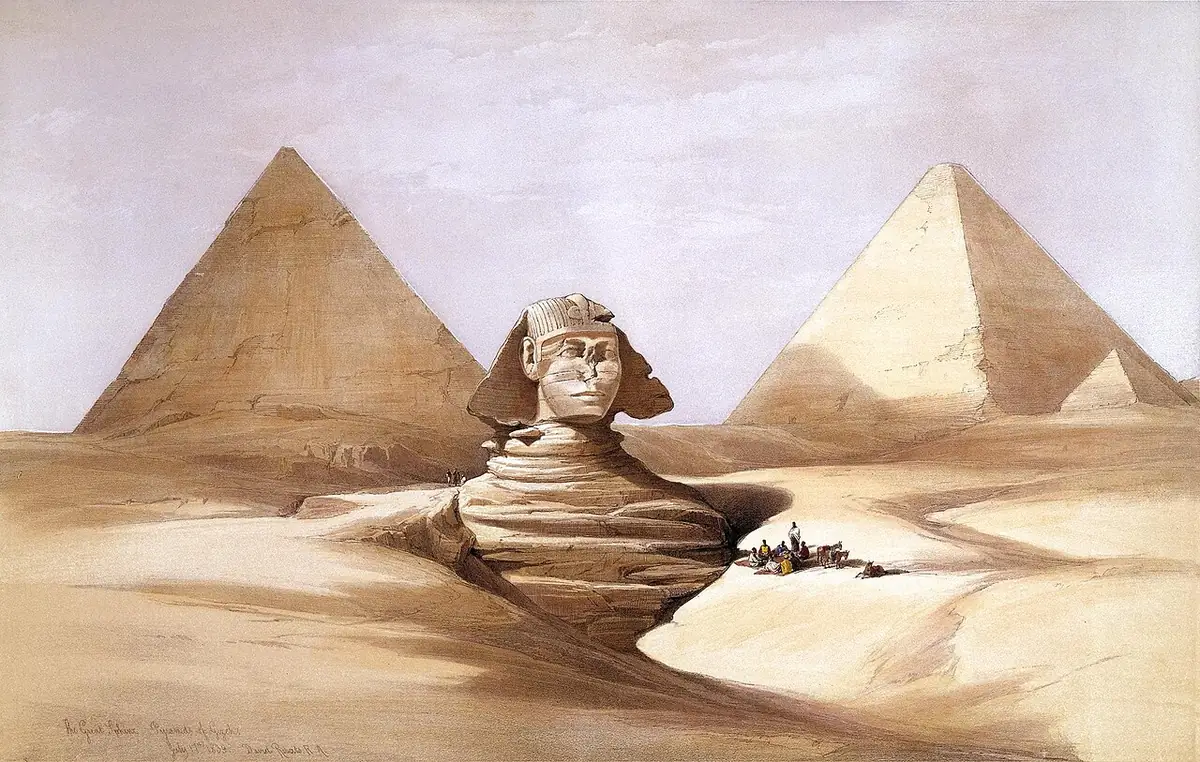
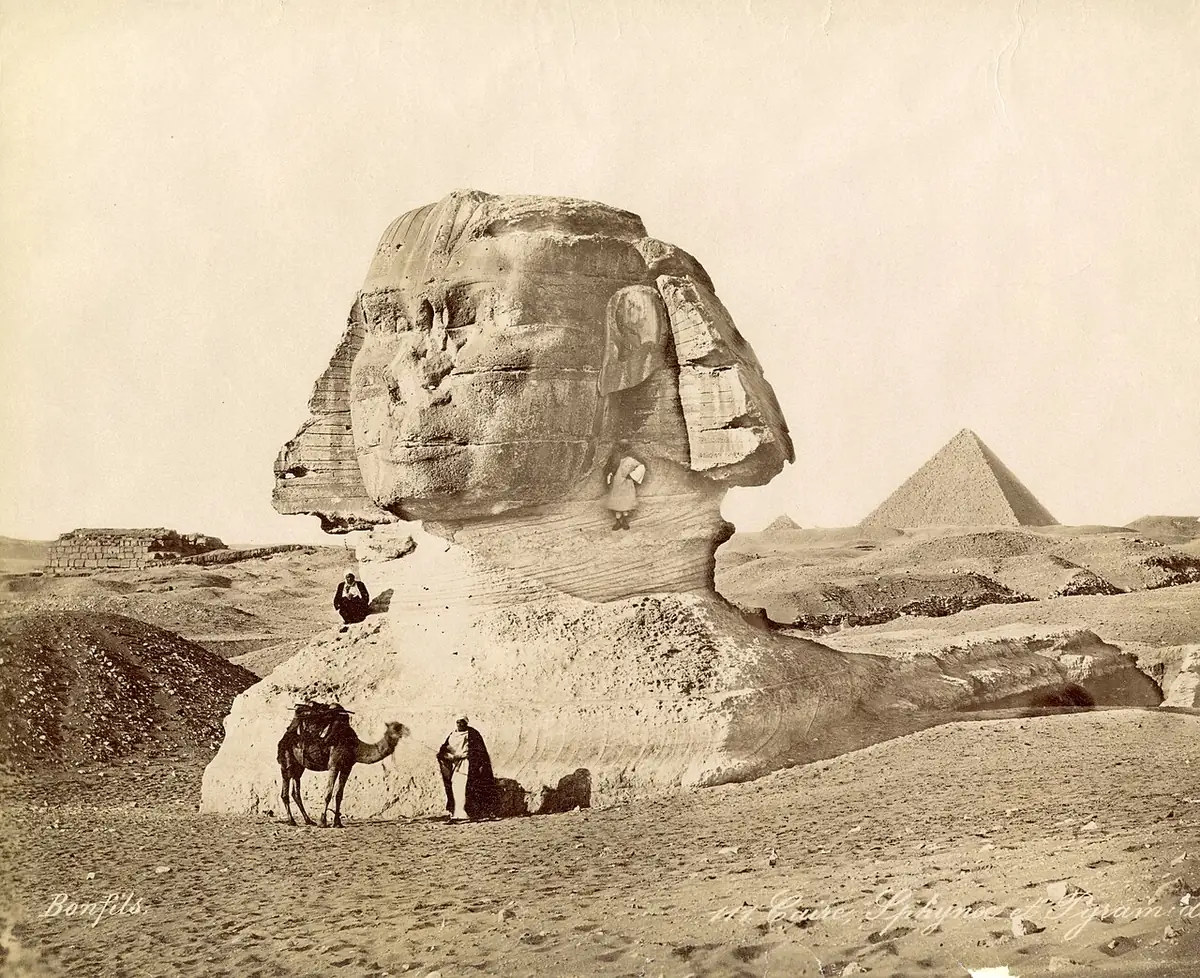
The Sphinx as David Roberts drew it in 1839. Image: David Roberts, Public domain, via Wikimedia Commons. Resized.The Sphinx in a 19th-century Bonfils photograph. Image: Félix Bonfils, CC0, via Wikimedia Commons. Resized.
✓ What Has Been Physically Measured
Dates, physical measurements, and excavated findings kept separate from interpretation.
30-meter hidden Big Void: Muon imaging found a void at least 30 m long above the Grand Gallery (2017) and a corridor about 9 m long behind the north-face chevrons (2023), the latter confirmed with an endoscope. [1][2]
Key finding: Dobecki and Schoch's seismic survey 'defined' a series of cavities on each side of the Sphinx and between its paws. These were inferred from seismic data, not entered or imaged. [3]
Known openings in the Sphinx: A passage at the north-west corner of the rump, reopened by Zahi Hawass and Mark Lehner in 1980, which ends about 4.5 m below floor level at the water table. Modern debris was found in it. A worker who had seen it during the 1926 clearance remembered its position. [6]
Other remote-sensing surveys: SRI International (1977–78) drilled three anomalies around the Sphinx and its temple, and the most promising proved to be natural cavities. A 1987 Waseda University survey reported possible cavities. A 1992 Egyptian seismic survey reported no cavities. [6]
Key finding: The Osiris Shaft under Khafre's causeway has three vertical shafts (9.6, 13.3 and 7.5 m), about 30 m in total, leading to three levels with granite and basalt sarcophagi. Finds date its main use to the 26th Dynasty and the Late Period, with some pottery of Old Kingdom style. Excavation in 1999 was hampered by groundwater. [7][8]
Key finding: The 2025 announcement described eight shafts and cube-shaped chambers far below Khafre. Reports gave depths from several hundred m to about 2 km, and a team-suggested age of about 38,000 years. It was not published in a peer-reviewed journal. [9][10]
2026 radar paper retraction: The team's 2022 Remote Sensing paper using the same radar method on the Great Pyramid was retracted on 10 August 2026 for serious method flaws and statistical errors. The authors disagreed. [11]
🧭 Proponents' Case & Cited Evidence
Key finding: Cayce's reading 378-16 (1933) placed a sealed chamber of records between the Sphinx and the Nile, reached through passages from the Sphinx's right forepaw. [5]
Key finding: Schoch's own account describes evidence of a cavity or chamber under the left paw, and possibly a tunnel-like feature along the body. [4][3]
The Khafre team says: its method uses micro-vibrations in satellite radar data, so ordinary radar depth limits do not apply, and that repeated scans were consistent. [10][9]
🏛️ Mainstream Archaeological View & Evidence
Hawass and Lehner point: out that remote sensing produces anomalies, not rooms. Natural fissures and karst cavities run through the Sphinx's limestone, and a large fissure lies where one tunnel was reported. [6]
Radar depth limit: Radar specialists say mainstream SAR sees only a couple of m into dry ground. The Khafre method has not been separately verified. [9]
Key finding: The Osiris Shaft, long rumoured to connect to the Sphinx and the Great Pyramid, was dug and mapped. Its excavator found a Late Period burial complex, not a connecting tunnel. [7]
🔬 What Future Tests Would Settle It
A modern ground-penetrating radar or seismic tomography survey of the Sphinx enclosure, tested first on the known rump passage, would show whether the paw anomalies are voids or fissures. A camera inserted into the Big Void, and release of the raw Khafre radar data with a blind test on known chambers, would settle the other two questions.
The Giza dig leaders share 30 years of finds, from the workers' town and stone quarries to Old Kingdom carbon dates.
▸ Why this book matters to both sides
The Giza dig teams' own large-format overview of decades of fieldwork on the plateau. It records the Heit el-Ghurab workers' town, limestone quarries, ramp remnants, and Old Kingdom carbon dates.
Role in the debate: Provides the primary archaeological and soil-layer baseline at Giza against which older-Sphinx, legacy-foundation, and precision-machining proposals are tested. (ISBN 9780226425696)
Atlantis and the Cycles of Time: Prophecies, Traditions, and Occult Revelations
Joscelyn Godwin
Traces two centuries of books and debates about Atlantis, pole shifts, Edgar Cayce, and repeating world ages.
▸ Why this book matters to both sides
Colgate University intellectual historian Joscelyn Godwin traces two centuries of geological, rationalist, and esoteric theories about Atlantis, Edgar Cayce, Bimini, pole shifts, and world-age cycles.
Role in the debate: Maps out exactly where modern ideas about lost continents, Hall of Records traditions, and cyclical disasters originated in 19th- and 20th-century thought. (ISBN 9781594772627)
The Message of the Sphinx: A Quest for the Hidden Legacy of Mankind
Graham Hancock & Robert Bauval
Joins the Sphinx rain-erosion case with sky maps to argue Giza was laid out to mark the spring sky of 10,500 BCE.
▸ Why this book matters to both sides
Joins the Great Sphinx rainfall-erosion argument with sky-cycle sky rebuilds. It argues the Sphinx, Khafre causeway, and Giza pyramids form a unified building horizon marker for 10,500 BCE.
Role in the debate: The primary text for the Sphinx–Leo 10,500 BCE equinox claim and the Hall of Records debate, paired on our pages with our own Vondrák 2011 sky wobble re-checks and Lehner & Hawass's excavation data. (ISBN 9780517888520)
Forgotten Civilization: New Discoveries on the Solar-Induced Dark Age (Revised ed.)
Robert M. Schoch with Catherine Ulissey
Geologist Robert Schoch sets out his rain-erosion case for an older Sphinx and his theory of a giant solar blast in 9700 BCE.
▸ Why this book matters to both sides
Boston University geologist Robert Schoch details his geological and seismic-refraction case for an older Great Sphinx alongside his idea that extreme solar proton outbursts ended the last Ice Age around 9700 BCE.
Role in the debate: Presents the geological case for precipitation-induced weathering on the Sphinx enclosure walls and the solar-disaster alternative to the Younger Dryas comet idea. (ISBN 9781644112922)
FTC affiliate disclosure: Book links go to Bookshop.org (ID 130218, Search for the Truth). Each sale helps local bookstores and pays us a 10% fee at no extra cost to you. All partner links use rel="sponsored nofollow noopener". Fees never change our verdicts. Affiliate disclosure.
Visiting & base stays: Great Sphinx of Giza & Giza Plateau (Cairo / Giza base)
FTC affiliate disclosure: Tour links go to GetYourGuide and Viator. Hotel links use Stay22 (aid=solarevidence) for Booking.com and Expedia. If you book a trip, we may earn a small fee at no extra cost to you. All partner links use rel="sponsored nofollow noopener". Check travel alerts before you go. Partner fees never change our ratings. All 64 site field visits · Affiliate disclosure.
Primary Academic Sources
▸ View All Cited Primary Sources & DOIs (11 papers)
Morishima, K. et al. (2017). Discovery of a big void in Khufu's Pyramid by observation of cosmic-ray muons. Nature 552. doi:10.1038/nature24647data
Procureur, S. et al. (2023). Precise characterization of a corridor-shaped structure in Khufu's Pyramid by observation of cosmic-ray muons. Nature Communications 14. doi:10.1038/s41467-023-36351-0data
Dobecki, T. L. & Schoch, R. M. (1992). Seismic investigations in the vicinity of the Great Sphinx of Giza, Egypt. Geoarchaeology 7(6). doi:10.1002/gea.3340070603data
Schoch, R. M. The Great Sphinx (author's own summary of his water-erosion dating, with links to his 1992 KMT paper). https://www.robertschoch.com/sphinx.htmlproponent
Hawass, Z. (2007). The discovery of the Osiris Shaft at Giza. In Hawass & Richards (eds.), The Archaeology and Art of Ancient Egypt: Essays in Honor of David B. O’Connor, vol. I, pp. 379–397 (Digital Giza record). https://giza.fas.harvard.edu/pubdocs/476/full/data
Whiting, N. E. (2021). The lost histories of the Shetayet of Sokar: contextualizing the Osiris Shaft at Rosetau (Giza). MA thesis, University of Montana. https://scholarworks.umt.edu/etd/11693background
Sources checked against Crossref and publisher pages on 2026-10-23. This entry presents a debated idea neutrally: the proponents' case first, then the mainstream position, in plain English. "Open question" is not a judgment that the idea is true or false. Labels describe the claim, not the people who hold it. Methodology.
_by_David_Roberts,_RA.jpg)
