Claims › Megalithic construction › Sacsayhuamán & Ollantaytambo vs. Giza & Baalbek: polygonal vs. ashlar megalithic engineering compared
Sacsayhuamán & Ollantaytambo vs. Giza & Baalbek: polygonal vs. ashlar megalithic engineering compared
Status: Contested
Verdict: Measured in part: Andean builders used mortarless interlocking polygonal andesite/rhyolite/limestone (~50–140 t) suited to a major seismic zone, whereas Giza (up to ~50–80 t granite) and Baalbek (~750–860 t limestone) used rectilinear coursed masonry; blocks above 40 t at all four sites exceed modern experimental replications
30-SECOND TAKEAWAY
In Plain English — The 30-Second Takeaway
What It Is: This comparison contrasts the jigsaw walls of Peru and Bolivia with the rectangular megablocks of Giza and Baalbek.
What Everyone Agrees On (Measured Facts): Andean crews fitted 140-ton jigsaw stones to survive earthquakes. Giza moved 80-ton granite beams, and Baalbek set 800-ton blocks.
🏛️ Mainstream Archaeology View: Engineers explain jigsaw walls as an Inca answer to earthquakes and rectangular blocks as an Egyptian and Roman quarry method.
🧭 Leading Edge View: Both ways moved stones far heavier than the 40-ton modern test limit and share sloped doors and multi-cornered blocks.
Overview & Context
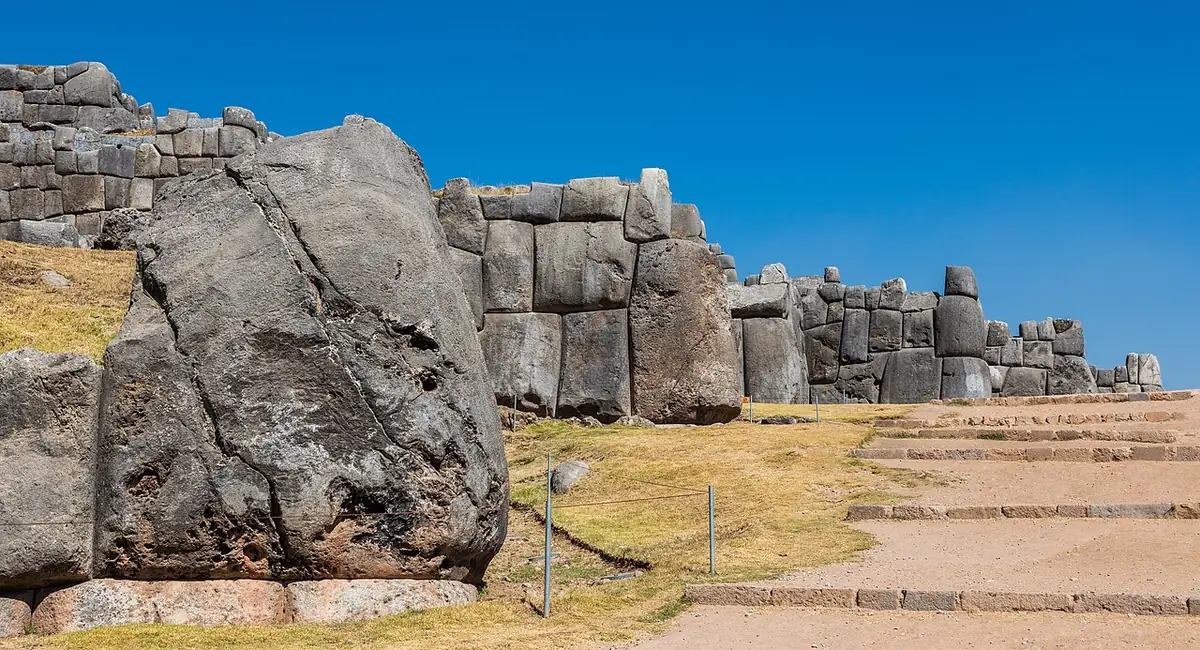
Why do the bastion walls of Sacsayhuamán and Cusco use multi-angled jigsaw blocks. Meanwhile, the Giza Pyramids, the Osireion and the Baalbek podium use massive rectangular courses, and Pumapunku uses modular H-blocks held by cast copper-arsenic-nickel cramps?
▸ Read Technical Background, Full Claim Wording & Academic Literature History
Formal claim tested: The megalithic stonework of the Andes (Sacsayhuamán, Ollantaytambo and Pumapunku) and the Mediterranean/Near East (Giza and Baalbek) represent distinct building solutions to quarry extraction, overland transport and seismic stability. Meanwhile, sharing an unresolved scale gap above 40 tons.
Where the evidence stands: Field checks by Petrie, Protzen, Nair, Lehner and the German Archaeological Institute document the exact geometry, stone mineralogy, quarry distances, and tool marks at each site. The comparison shows two distinct structural philosophies—Andean mortarless polygonal interlocking and Tiwanaku cramped modular stone vs. Egyptian and Roman-Levantine coursed ashlar—yet both traditions moved blocks between 60 t and 860 t (1.5× to 21.5× the 40 t modern ancient-tool test ceiling).
Comparing their measured block masses, stone hardness (Mohs 3.5 to 7.0), joint tolerances, quarry transport profiles, and earthquake behaviour separates what has been replicated by test archaeologists from what remains undemonstrated. See also the megalith transport review and the precision stonework tolerances review.
✓ What Has Been Physically Measured
Dates, physical measurements, and excavated findings kept separate from interpretation.
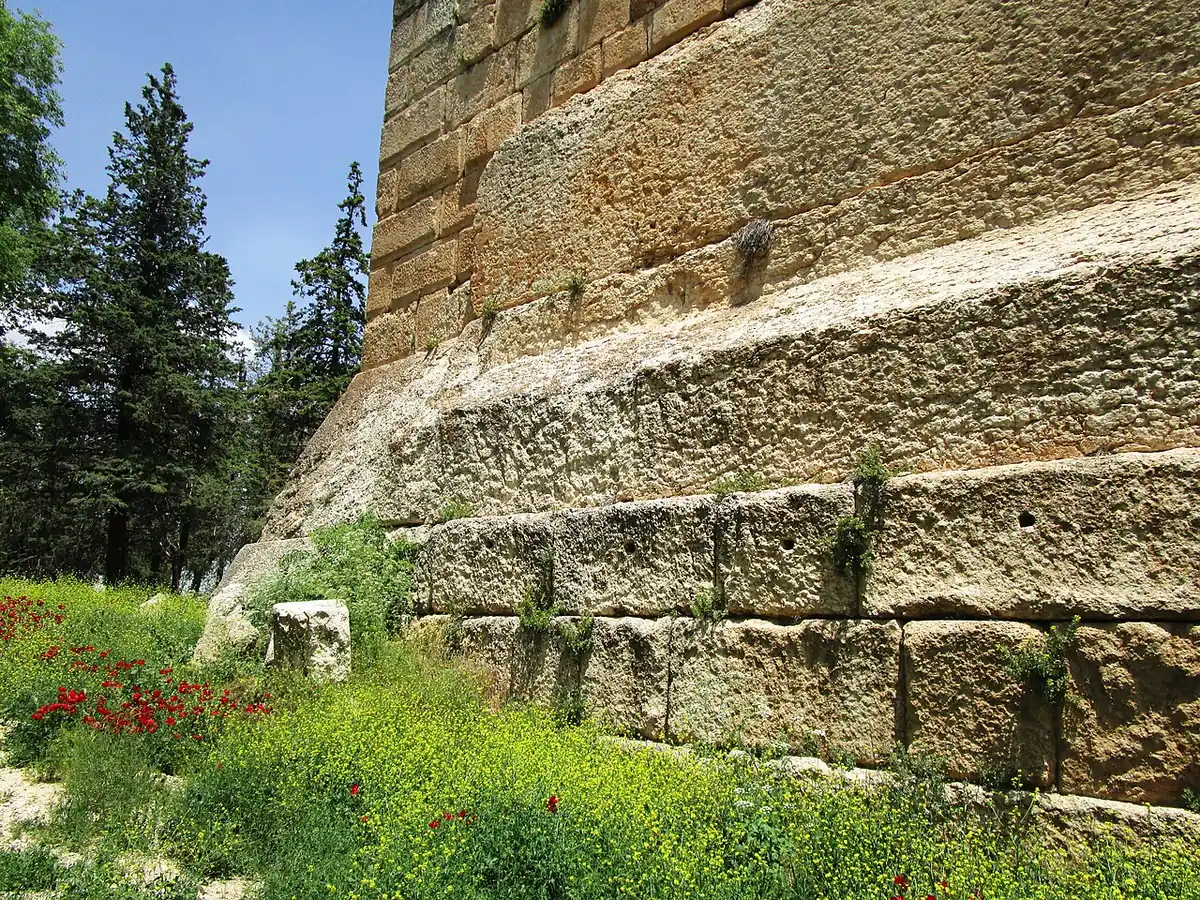
- 800-ton Trilithon wall blocks: Maximum moved block masses vs. the 40 t baseline: Baalbek’s three podium trilithon blocks weigh ~750–860 t each (~19–21.5× the 40 t test ceiling), with 1,000–1,650 t monoliths left in the quarry. Ollantaytambo’s rhyolite blocks reach ~140 t (3.5×). Pumapunku’s red sandstone platform slabs reach ~131 t (3.3×). Sacsayhuamán’s largest Yucay limestone bastion block is estimated at ~120–128 t (3.0–3.2×). And the Great Pyramid’s King’s Chamber Aswan granite beams weigh ~50–80 t (1.25–2.0×). [1][2][6][8][9][10]
- Quarry distance and elevation profile: Baalbek’s quarry sits ~800–900 m slightly uphill from the Jupiter podium, allowing a gentle downgrade haul. At Ollantaytambo, pink rhyolite was quarried at Kachiqhata across the Urubamba Valley (~4–6 km away), lowered down steep talus chutes, taken across the river, and dragged up an 8 m-wide ramp to the Temple Hill. At Giza, core limestone was quarried locally (300–800 m), fine Tura casing came ~15 km across the Nile, and King’s Chamber granite came ~800 km down the Nile from Aswan. [3][4][6][11][12]
- Stone hardness & dressing tools: Giza’s King’s Chamber beams and Valley Temple pillars are coarse Aswan rose granite (Mohs 6.0–7.0), worked with dolerite pounders and copper saws/tubular drills fed with abrasive sand. Cusco and Ollantaytambo walls include Yucay limestone (Mohs 3.5–4.0), green Sacsayhuamán diorite (Mohs 6.0), and Kachiqhata rhyolite/Rumiqolqa andesite (Mohs 6.0–6.5), dressed by hammerstone pecking and polished margins. Pumapunku combines red sandstone slabs with grey hypersthene andesite (Mohs 6.0–6.5) finished to ±1 mm flatness with sharp interior right angles. [13][14][5][7]
- Joint geometry & seismic response: Cusco and Sacsayhuamán use mortarless polygonal masonry with sunken ("pillow") faces, battered inward walls (~3°–5°), and three-dimensional interlocking bedding planes that dissipate seismic shear waves during major Andean earthquakes (such as the 1650 and 1950 Cusco earthquakes). Giza’s casing stones used planar oblique/vertical joints averaging ~0.5 mm wide set with a thin gypsum-lime mortar film. Pumapunku locked rectilinear blocks together with T-, I- and L-shaped cramps cast in place from a ternary copper-arsenic-nickel bronze alloy. [5][13][7]
🧭 Proponents' Case & Cited Evidence
- Earthquake-proof jigsaw joints: Leading Edge researchers highlight building parallels—such as multi-cornered jigsaw blocks in Giza’s Valley Temple and the Osireion alongside Cusco’s polygonal walls, trapezoidal doorways, and metal cramp sockets across the Old and New Worlds—as potential signs of shared or inherited pre-disaster stoneworking principles. [15][16][17]
- 40-ton modern haul test limit: At every one of these complexes, the heaviest stones moved (60 t to 860 t) exceed the largest modern ancient-tool test haul (40 t by Richards & Whitby 1997), and Protzen & Nair (1997) explicitly concluded that the tools used to cut Pumapunku’s sharp interior angles remain unidentified. [18][7][8]
🏛️ Mainstream Archaeological View & Evidence
- Granite drill cores and saws: Detailed tool-mark and rock-mineral studies show distinct local techniques: Inca masons pecked bedding sockets with cobble hammerstones and left handling bosses. Tiwanaku cast unique ternary Cu-As-Ni cramps. Egyptians used flat copper saws, tubular drills with quartz/emery sand, and gypsum mortar. And Baalbek’s podium blocks carry Roman-era Lewis holes and wedge splitting marks. [5][7][14][4][3]
- Earthquake-proof jigsaw joints: Polygonal masonry and trapezoidal openings are convergent structural adaptations to high seismic hazard (in the Andes) or core-and-veneer granite economizing (in the Giza Valley Temple), rather than proof of a single global builder. [5][19]
🔬 What Future Tests Would Settle It
Full-scale test hauls of 100+ t blocks up an 8 m ramp (testing Protzen’s Ollantaytambo problem) and lifting/setting tests for 500–800 t blocks (testing Adam’s Baalbek capstan model), together with published 3D laser-metrology scans of Giza, Serapeum, Cusco and Pumapunku surfaces, would test both the mainstream workforce rebuilds and Leading Edge precision claims.
▸ Reference Data Table: Engineering comparison: Sacsayhuamán & Ollantaytambo vs. Pumapunku vs. Giza vs. Baalbek
Block masses, Mohs hardness, quarry transport and joinery compared against the 40 t modern pre-industrial experimental ceiling.
| Site / Monument | Max moved block (× 40 t baseline) | Stone type & Mohs hardness | Quarry distance & route | Joinery & tolerances |
|---|
| Sacsayhuamán & Cusco (Peru) | ~120–128 t (3.0–3.2×) | Yucay limestone (3.5–4), green diorite & andesite (6.0–6.5) | ~3–15 km (Chincana / Rumiqolqa overland) | Mortarless 3D polygonal interlocking; knife-blade joints; battered seismic walls |
| Ollantaytambo Temple Hill (Peru) | ~140 t (3.5×) | Kachiqhata pink rhyolite granite (6.0) | ~4–6 km down mountain chute, across Urubamba River, up 8 m ramp | Six monolithic slabs (~50 t each) shimmed with narrow rhyolite fillets; "tired stones" left on ramp |
| Pumapunku / Tiwanaku (Bolivia) | ~131 t slab (3.3×) | Red sandstone (4–5) & grey andesite (6.0–6.5) | ~10 km (sandstone) to ~40–90 km across Lake Titicaca (andesite) | Modular prefab H-blocks; ±1 mm flatness; crisp 90° interior angles; cast Cu-As-Ni cramps |
| Giza Great Pyramid & Valley Temple (Egypt) | ~50–80 t granite (1.25–2.0×); ~200 t limestone | Nummulitic & Tura limestone (3.5); Aswan granite (6.5–7) | 0.5 km (core), 15 km (Tura), ~800 km Nile barge (Aswan granite) | ~0.5 mm casing joints with thin gypsum mortar; multi-angled granite core casing in Valley Temple |
| Baalbek Jupiter Podium (Lebanon) | ~750–860 t trilithon (19–21.5×); 1,000–1,650 t in quarry | Dense Miocene crystalline limestone (4.0) | ~800–900 m slight downgrade from Sheikh Abdallah quarry | Rectilinear megalithic ashlar courses set ~6–7 m above ground without mortar |
Ancient Sites Involved
Sacsayhuamán and Ollantaytambo · Pumapunku (Tiwanaku) · Giza pyramids · Baalbek megaliths · Chankillo Solar Observatory and Chavín de Huántar · Great Zimbabwe and Nabta Playa · Ishibutai Kofun and the Asuka Megaliths (Masuda-no-Iwafune & Sakafuneishi)
Related Tested Claims
📚 Further Reading: Both Sides of the Argument
Top books from both sides of the debate on this topic. Browse all 34 books on Books & Further Reading or visit our Search for the Truth Bookshop.org storefront.
Mainstream Baseline
2017
★ 4.7/5
Giza and the Pyramids: The Definitive History
Mark Lehner & Zahi Hawass
The Giza dig leaders share 30 years of finds, from the workers' town and stone quarries to Old Kingdom carbon dates.
▸ Why this book matters to both sides
The Giza dig teams' own large-format overview of decades of fieldwork on the plateau. It records the Heit el-Ghurab workers' town, limestone quarries, ramp remnants, and Old Kingdom carbon dates.
Role in the debate: Provides the primary archaeological and soil-layer baseline at Giza against which older-Sphinx, legacy-foundation, and precision-machining proposals are tested. (ISBN 9780226425696)
Mainstream Baseline
2014
★ 4.6/5
The Incas (2nd ed.)
Terence N. D'Altroy
A clear guide to how the Inca built Cusco, Sacsayhuamán, and Ollantaytambo using stone hammers, quarries, and road crews.
▸ Why this book matters to both sides
Columbia University archaeologist Terence D'Altroy's leading survey of Inca origins, Cuzco royal estates, mit'a labor group, Rumiqolqa and Cachiccata quarries, and Andean stone building.
Role in the debate: Presents the mainstream ethnohistoric, carbon, and quarry evidence for fifteenth-century Inca building at Sacsayhuamán and Ollantaytambo alongside the open questions of polygonal fitting. (ISBN 9781444331158)
Leading Edge
2010
★ 4.7/5
Lost Technologies of Ancient Egypt: Advanced Engineering in the Temples of the Pharaohs
Christopher Dunn
An engineer measures Egyptian granite boxes, statues, and drill cores with precision gauges to argue for advanced ancient tools.
▸ Why this book matters to both sides
Manufacturing engineer Christopher Dunn applies straightedges, radius gauges, and optical comparators to the Serapeum granite sarcophagi, Luxor Ramses statues, and Petrie's drill cores. It argues for high-speed mechanical tooling.
Role in the debate: Provides the primary Leading Edge metrology claims on Egyptian granite symmetry and flatness, contrasted on our precision pages with test copper-saw, tubular-drill, and pounder replications. (ISBN 9781591431022)
Leading Edge
2015
★ 4.7/5
Magicians of the Gods: The Forgotten Wisdom of Earth's Lost Civilization
Graham Hancock
Links Göbekli Tepe, Baalbek, and the Younger Dryas comet debate to argue a cosmic impact erased an Ice Age world.
▸ Why this book matters to both sides
Integrates Göbekli Tepe, Baalbek, Gunung Padang. The Younger Dryas comet-impact idea. It argues Taurid meteor-stream impacts between 12,800 and 11,600 years ago erased an advanced culture.
Role in the debate: Sets out the strongest popular overview linking Göbekli Tepe's enclosures and Pillar 43 to the Younger Dryas impact debate. (ISBN 9781250118400)
FTC affiliate disclosure: Book links go to Bookshop.org (ID 130218, Search for the Truth). Each sale helps local bookstores and pays us a 10% fee at no extra cost to you. All partner links use rel="sponsored nofollow noopener". Fees never change our verdicts. Affiliate disclosure.
Visiting & base stays: Sacsayhuamán, Cusco & Ollantaytambo (Sacred Valley, Peru)
FTC affiliate disclosure: Tour links go to GetYourGuide and Viator. Hotel links use Stay22 (aid=solarevidence) for Booking.com and Expedia. If you book a trip, we may earn a small fee at no extra cost to you. All partner links use rel="sponsored nofollow noopener". Check travel alerts before you go. Partner fees never change our ratings. All 64 site field visits · Affiliate disclosure.
Primary Academic Sources
▸ View All Cited Primary Sources & DOIs (19 papers)
- Truth in Stone (2026). Baalbek block-mass recomputation: Python script, released under CC0 1.0. /static/downloads/baalbek-block-masses.py data
- German Archaeological Institute press release via idw (21 Nov 2014). Lebanese–German team finds the largest known ancient stone block in Baalbek (in German): 19.60 × 6 × at least 5.5 m, about 1,650 t. https://idw-online.de/en/news614672 data
- Adam, J.-P. (1977). À propos du trilithon de Baalbek: le transport et la mise en œuvre des mégalithes. Syria 54 (in French). doi:10.3406/syria.1977.6623 background
- Lohmann, D. (2010). Giant strides towards monumentality – the architecture of the Jupiter sanctuary in Baalbek/Heliopolis. Bollettino di Archeologia on line, special volume (PDF). https://bollettinodiarcheologiaonline.beniculturali.it/wp-content/upl… data
- Protzen, J.-P. (1985). Inca quarrying and stonecutting. Journal of the Society of Architectural Historians 44(2). doi:10.2307/990027 data
- Protzen, J.-P. (1986). Inca stonemasonry. Scientific American 254(2): 94–105. doi:10.1038/scientificamerican0286-94 data
- Protzen, J.-P. & Nair, S. (1997). Who taught the Inca stonemasons their skills? A comparison of Tiahuanaco and Inca cut-stone masonry. Journal of the Society of Architectural Historians 56(2): 146–167. doi:10.2307/991281 data
- Truth in Stone (2026). Scale-gap block-mass recomputations (Pumapunku slabs, Aswan unfinished obelisk): Python script, released under CC0 1.0. /static/downloads/scale-gap-block-masses.py data
- MINCETUR, Peru. Inventario de recursos turísticos: Parque Arqueológico de Saqsaywaman (gives a block of more than 120 t, about 8.5 × 5 m). https://consultasenlinea.mincetur.gob.pe/fichaInventario/index.aspx?c… background
- Scheuring, S. (2025). Construction of the Great Pyramid with pulley-like systems using counter-weights on sliding-ramps. npj Heritage Science 13 (gives King's Chamber granite blocks of up to about 60 t). doi:10.1038/s40494-025-02018-w background
- Ghoneim, E. et al. (2024). The Egyptian pyramid chain was built along the now abandoned Ahramat Nile Branch. Communications Earth & Environment 5. doi:10.1038/s43247-024-01379-7 data
- Tallet, P. (2017). Les papyrus de la mer Rouge I: le 'journal de Merer' (MIFAO 136). IFAO, Cairo (publisher's summary). https://www.ifao.egnet.net/uploads/publications/divers/MIFAO136_ann_01.pdf data
- Petrie, W. M. F. (1883). The Pyramids and Temples of Gizeh. London: Field & Tuer (casing-joint measurements, §26; tubular drilling and core No. 7, §§130–133; Internet Archive scan). https://archive.org/details/cu31924012038927 data
- Stocks, D. A. (2001). Testing ancient Egyptian granite-working methods in Aswan, Upper Egypt. Antiquity 75. doi:10.1017/s0003598x00052777 data
- Hancock, G. (1995). Fingerprints of the Gods. Heinemann / Crown. Chapter 49. https://openlibrary.org/search?q=fingerprints+of+the+gods+hancock proponent
- Hancock, G. (2015). Magicians of the Gods. Coronet / Thomas Dunne Books. https://openlibrary.org/search?q=magicians+of+the+gods+hancock proponent
- Dunn, C. (2001/2003). The amazing boxes of the Serapeum (engineer's field checks with straightedge, square and radius gauges; self-published, not peer reviewed). https://gizapower.com/gizeh/articles/the-precision-of-the-ancient-egy… proponent
- Richards, J. & Whitby, M. (1997). The engineering of Stonehenge. In Cunliffe, B. & Renfrew, C. (eds), Science and Stonehenge. Proceedings of the British Academy 92: 231–256 (PDF). https://www.thebritishacademy.ac.uk/documents/3921/92p231.pdf data
- Lehner, M. (1997). The Complete Pyramids. Thames & Hudson. https://openlibrary.org/search?q=the+complete+pyramids+lehner critique
More in this section: Megalithic construction.
Sources checked against Crossref and publisher pages on 2026-10-24. This entry presents a debated idea neutrally: the proponents' case first, then the mainstream position, in plain English. "Open question" is not a judgment that the idea is true or false. Labels describe the claim, not the people who hold it. Methodology.