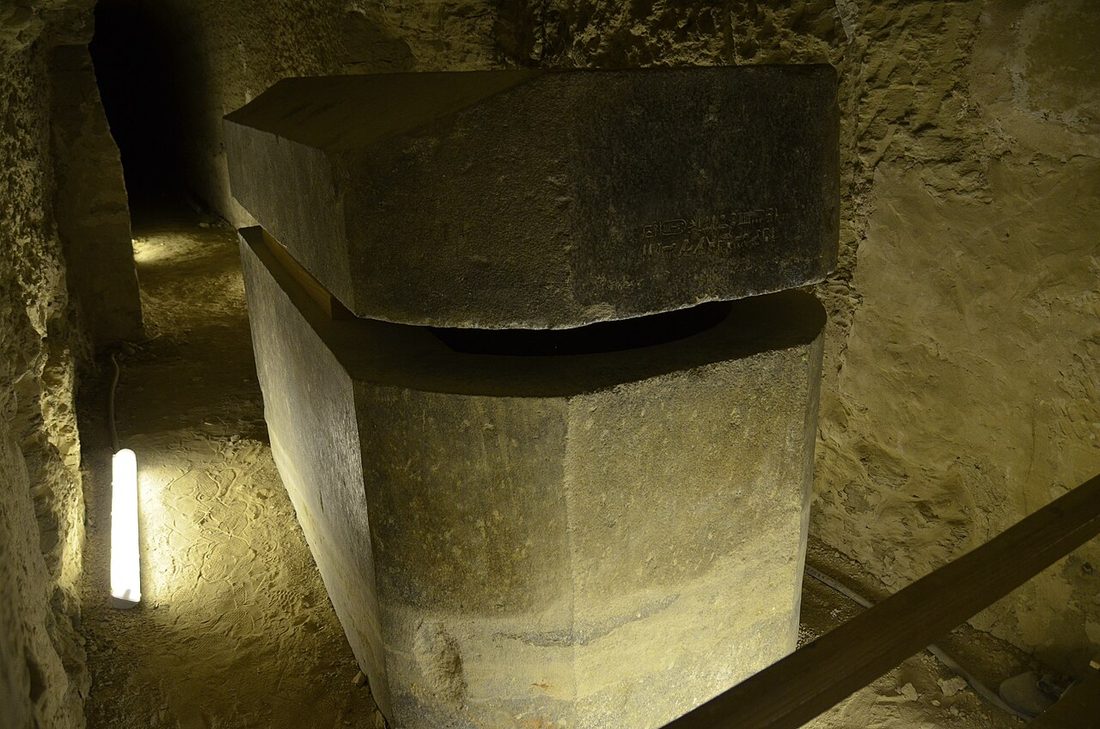
🧭 Leading Edge / Open AngleFlat polished granite interiors vs. rough scratched glyphs & 100-ton riggingDebated or newly revised
🪨 Heaviest Stone & Quarry65–70 ton boxes + 25–30 ton lids (~90–100 tons; Aswan granite, 500 mi)2.5× the 40-ton test limit · Compare all 64 sites →
30-SECOND TAKEAWAY
In Plain English — The 30-Second Takeaway
What It Is:
The Serapeum of Saqqara is a subterranean network of rock-cut tunnels near the Step Pyramid holding 24 giant single-block granite and basalt chests.
What Everyone Agrees On (Measured Facts):
Cut from hard stone quarried 500 miles away at Aswan, the boxes weigh up to 70 tons with 30-ton lids (100 tons total). They sit inside tunnels 10 feet wide.
🏛️ Mainstream Archaeology View:
Egyptologists date the burial vaults to 612–30 BCE from over 500 dated wall stelae, built as royal tombs for the sacred Apis bulls of Memphis.
🧭 Leading Edge View:
Engineers point out the sharp contrast between the flat, square granite interiors and the rough writing scratched outside. Moving 100 tons underground remains a puzzle.
Site Story & Overview
Cut deep into the limestone bedrock northwest of Djoser's Step Pyramid at Saqqara, the Serapeum was rediscovered by French archaeologist Auguste Mariette in 1851 after he followed a sand-buried avenue of sphinxes. Inside the Greater Vaults—an underground corridor roughly 200 m (656 feet) long and 3 m (10 feet) wide—stand 24 giant single-block stone chests carved from Aswan rose granite, black granodiorite, and basalt (Mohs hardness 6.5–7.0).
▸ Read Full Archaeological & Engineering Context
The largest boxes weigh 65 to 70 metric tons with 25-to-30-ton lids (90 to 100 metric tons combined, more than double the 40-ton ancient-tool haul test limit). Egypt scholars date the Greater Vaults to c. 612–30 BCE using hundreds of dated Apis bull stelae found in the walls. Meanwhile, builders and Leading Edge writers point to the polished flat interior granite walls, the rough scratched hieroglyphs on Amasis II's and Khabbash's boxes, and the tight underground clearance as one of antiquity's greatest stone-building puzzles. In October 2026, Czech and Egyptian archaeological teams at Saqqara also relocated the long-lost 5th Dynasty mastaba tombs of Sabu (54 × 28 m, with a newly uncovered chapel of his wife Ikhetneferet) and his son Ptahshepses (>900 m², containing his mummified remains inside a looted limestone sarcophagus, with full peer-reviewed osteological and carbon studies still ahead)—originally partly cleared by Mariette in 1858–1860.
✓ What Is Physically Measured on Site
Dated samples, laser scans, stone weights, and dug finds kept separate from opinion.
24 giant monolithic stone boxes: The Greater Vaults contain 24 single-block sarcophagi carved from Aswan rose granite, black granodiorite, diorite, and basalt (Mohs hardness 6.0 to 7.0), quarried 500 miles (800 km) south at Aswan or in the Eastern Desert. [1][2][4]
65-to-100-ton combined masses: The largest hollow granite boxes measure up to 3.85 m long, 2.3 m wide, and 2.4 m high, weighing 65 to 70 metric tons (72 to 77 US tons) for the box alone and 25 to 30 metric tons for the lid—totaling 90 to 100 metric tons (~2.25–2.5× the 40-ton test limit). [1][2][4]
Narrow 3-meter underground tunnels: All 24 boxes sit in sunken crypt niches flanking a rock-cut limestone main gallery ~200 m (656 feet) long and only ~3 m (10 feet) wide, leaving no room for hundreds of rope haulers side by side. [1][2]
Hundreds of dated Apis stelae: Auguste Mariette opened the sealed tunnels in November 1851. He found over 500 dated wall stones recording Apis bull burials from 612 to 30 BCE. Three stone chests also bear the names of Kings Amasis II, Cambyses II, and Khabbash. [1][2][3]
Engineer straightedge checks: Engineer Christopher Dunn checked the inside walls of two granite boxes with a 6-inch straightedge and a square. He reported flat walls with no light gap and sharp 90-degree corners. [5]
Oct 2026 Saqqara tomb rediscovery: On 27 October 2026, Czech Institute of Egyptology archaeologists (Charles University, led by Prof. Miroslav Bárta) and the Egyptian Ministry of Tourism and Antiquities announced the relocation of two 5th Dynasty Old Kingdom mastaba tombs at Saqqara first partly cleared by Auguste Mariette in 1858–1860 and lost under sand for ~160 years: Sabu's tomb (54 × 28 m, ~5 m original height, with a newly found offering chapel for his wife Ikhetneferet and false door naming sons Ptahshepses and Ranefer) and Ptahshepses's tomb (>900 m², holding his mummified remains—aged >60 years at death—inside a limestone sarcophagus looted in antiquity). Full peer-reviewed osteological and carbon reports are still ahead. [9][1]
New Find: The Tomb of Weni (Oct 2026)
Egypt announced this Saqqara find on October 26, 2026. The tomb sits in the burial grounds of King Merenre at Saqqara. It is a new Old Kingdom tomb. It is not the long-known tomb of Weni the Elder at Abydos. The reports do not link the two men.
Mainstream — MeasuredAn inscribed tomb for Weni: Egypt's Supreme Council of Antiquities says its team found an inscribed mud-brick tomb of a man named Weni. It is part of the funerary complex of King Merenre, an Old Kingdom ruler of the Sixth Dynasty. [10]
Mainstream — MeasuredA 6-meter shaft with bright paint: The tomb has a shaft about 6 m (20 feet) deep. Its painted scenes still keep their colors. Officials credit Saqqara's dry soil for that. [10]
Mainstream — MeasuredTwo wooden statues: The team found two wooden statues in a rare pose of worship, set on a small seat. Egypt's Ministry of Tourism and Antiquities says they sat in a vaulted room just above Weni's burial room. [10][11]
Mainstream — MeasuredA set of bronze tools: The team also found a group of bronze tools. The ministry says they lay in Weni's burial shaft. [10][11]
Mainstream — MeasuredTitles, per the ministry: Egypt's Ministry of Tourism and Antiquities says the burial room's writing names Weni's titles. They include mayor, sem priest, treasurer of the house of the north, sole companion, and lord of el-Kab. The ministry also reports a false door for a woman named Sekhet-Nebty, a priestess of Hathor. [11]
Open questionWhat were the tools for? Officials say the tools were probably used for medicine. They look like tools shown at the Temple of Kom Ombo. But the ministry says no writing in the tomb calls Weni a doctor. So why the tools were buried with him is still being studied. [10][11]
Open questionEarly bone studies: Per the ministry, first studies of Weni's bones suggest he died after age 50. They also point to advanced disease of the teeth and surrounding tissue, and bone signs consistent with repeated physical strain. These are early results, not a full published report. [11]
🏛️ Mainstream Archaeological View
Accepted timeline: Underground rock-cut burial galleries of the sacred Apis bulls of Memphis, begun in the 18th Dynasty (Amenhotep III / Prince Khaemwaset) and expanded with the Greater Vaults from Year 52 of Psamtik I (26th Dynasty, c. 612 BCE) through the Ptolemaic period.
Stone & hardness: Aswan rose granite, black granodiorite, diorite & basalt — Mohs hardness 6.5–7.0 (Aswan granite / granodiorite)(on the 1–10 Mohs scale where a steel knife is ~5.5 and diamond is 10).
Quarry distance & alignment: Stone source ~800 km / 500 miles down the Nile from Aswan & Eastern Desert. Orientation: East–West subterranean gallery (~200 m long × 3 m wide) with N/S sunken crypts.
🧭 Leading Edge Proposal & Open Questions
Christopher Dunn (Lost Technologies of Ancient Egypt, 2010) & engineering researchers:Precision granite machining & rigging: Highlight the stark contrast between the flat, square interior granite surfaces (Mohs hardness 6.5–7) and the crude hieroglyphs scratched onto three boxes—plus the unsolved rigging challenge of hauling and lowering 90-to-100-ton stone assemblies inside narrow 3-meter-wide underground tunnels. [5][6][12]
Tested Claims About The Serapeum of Saqqara (Egypt)
Can wooden sledges, ropes, wet sand, and dirt ramps explain how ancient crews moved stones weighing 80 to 860 tons?
Contested
Measured in part: sledges, wetted or timber tracks, ramps and boats are documented, and finished monuments show ancient moves of about 750–860 t; no test of ancient methods we found goes above about 40 t, and the 1,000 t-plus Baalbek blocks never left the quarry
Did tight stone joints, flat granite boxes, drill cores, and stone vases require advanced machine tools?
Leading Edge
Measured in part: tolerances of about 0.25–0.5 mm (Giza casing) and ±1–2 mm survey precision (Tiwanaku) are documented; copper-and-sand and hammerstone methods are replicated at small scale; how the sharpest interior angles, Petrie's spiral-grooved core and the finest vessels were finished is an open question
How did ancient crews cut and move 100-ton granite boxes inside the narrow underground tunnels of Saqqara?
Contested
Measured: 24 monolithic granite/diorite boxes (up to ~65–70 t box + ~25–30 t lid = ~90–100 t) sit in 3 m-wide underground tunnels dated by 500+ Apis stelae to c. 612–30 BCE; full peer-reviewed 3D laser flatness maps of the interior walls have not yet been published
Richards, J. & Whitby, M. (1997). The engineering of Stonehenge. In Cunliffe, B. & Renfrew, C. (eds), Science and Stonehenge. Proceedings of the British Academy 92: 231–256 (PDF). https://www.thebritishacademy.ac.uk/documents/3921/92p231.pdfdata
NOVA (PBS airdate 8 Feb 2000). Secrets of Lost Empires: Pharaoh's Obelisk, transcript: a 25-ton block dragged on a timber roadbed and a 25-ton (perhaps 30-ton) obelisk raised from a sand pit. https://www.pbs.org/wgbh/nova/transcripts/27poobelisk.htmldata
Li, J. & Chen, Z. (2016). Lubrication for transporting heavy objects in the history. Tribology Online 11(2): 242–249 (includes the Japanese shura sledge experiments). doi:10.2474/trol.11.242background
Harris, B. (2018). Moving megaliths: time to park the rollers. British Archaeology 163: 30–35 (author's accepted manuscript, UCL Discovery). https://discovery.ucl.ac.uk/id/eprint/10114174/background
Dodson, A. (2005). Bull Cults (Apis burials and the Serapeum of Saqqara). In Ikram, S. (ed.), Divine Creatures: Animal Mummies in Ancient Egypt, American University in Cairo Press, pp. 72–105. doi:10.5743/cairo/9789774248580.003.0004data
Petrie, W. M. F. (1883). The Pyramids and Temples of Gizeh. London: Field & Tuer (casing-joint measurements, §26; tubular drilling and core No. 7, §§130–133; Internet Archive scan). https://archive.org/details/cu31924012038927data
Stocks, D. A. (2001). Testing ancient Egyptian granite-working methods in Aswan, Upper Egypt. Antiquity 75. doi:10.1017/s0003598x00052777data
Science Frontiers no. 137 (Sep–Oct 2001). Granite-working in ancient Egypt (summary of Stocks 2001: a 3 cm × 95 cm saw slot in 14 hours; the blade lost 7.5 mm). https://www.science-frontiers.com/sf137/sf137p01.htmbackground
Stocks, D. A. (2003). Experiments in Egyptian Archaeology: Stoneworking Technology in Ancient Egypt. London: Routledge. doi:10.4324/9780203430231data
FTC affiliate disclosure: Tour links go to GetYourGuide and Viator. Hotel links use Stay22 (aid=solarevidence) for Booking.com and Expedia. If you book a trip, we may earn a small fee at no extra cost to you. All partner links use rel="sponsored nofollow noopener". Check travel alerts before you go. Partner fees never change our ratings. All 64 site field visits · Affiliate disclosure.
The Giza dig leaders share 30 years of finds, from the workers' town and stone quarries to Old Kingdom carbon dates.
▸ Why this book matters to both sides
The Giza dig teams' own large-format overview of decades of fieldwork on the plateau. It records the Heit el-Ghurab workers' town, limestone quarries, ramp remnants, and Old Kingdom carbon dates.
Role in the debate: Provides the primary archaeological and soil-layer baseline at Giza against which older-Sphinx, legacy-foundation, and precision-machining proposals are tested. (ISBN 9780226425696)
The Red Sea Scrolls: How Ancient Papyri Reveal the Secrets of the Pyramids
Pierre Tallet & Mark Lehner
Tells how 4,500-year-old papyrus logs found at a Red Sea cave record crews hauling fine limestone to the Great Pyramid for King Khufu.
▸ Why this book matters to both sides
Tells how the oldest known inscribed papyri—discovered in Fourth Dynasty boat caves at Wadi al-Jarf—record Inspector Merer's team hauling Tura casing limestone to the Great Pyramid under Khufu.
Role in the debate: Presents the contemporary written logbook evidence for Fourth Dynasty casing transport at Khufu's horizon, directly addressing whether the Great Pyramid was built or restored in the Old Kingdom. (ISBN 9780500052112)
Lost Technologies of Ancient Egypt: Advanced Engineering in the Temples of the Pharaohs
Christopher Dunn
An engineer measures Egyptian granite boxes, statues, and drill cores with precision gauges to argue for advanced ancient tools.
▸ Why this book matters to both sides
Manufacturing engineer Christopher Dunn applies straightedges, radius gauges, and optical comparators to the Serapeum granite sarcophagi, Luxor Ramses statues, and Petrie's drill cores. It argues for high-speed mechanical tooling.
Role in the debate: Provides the primary Leading Edge metrology claims on Egyptian granite symmetry and flatness, contrasted on our precision pages with test copper-saw, tubular-drill, and pounder replications. (ISBN 9781591431022)
Fingerprints of the Gods: The Evidence of Earth's Lost Civilization
Graham Hancock
Graham Hancock's bestseller arguing that Giza, Pumapunku, and ancient maps preserve traces of a lost Ice Age culture.
▸ Why this book matters to both sides
Hancock's worldwide bestseller examining Tiwanaku, Pumapunku, Teotihuacan, Giza, the Piri Reis map, and Hapgood's crustal-shift model. It argues for an Ice Age culture lost in a global cataclysm.
Role in the debate: The book that brought the lost-Ice-Age-culture idea to millions of readers and framed the modern debate over Giza, Pumapunku, and ancient sky sightlines. (ISBN 9780517887295)
FTC affiliate disclosure: Book links go to Bookshop.org (ID 130218, Search for the Truth). Each sale helps local bookstores and pays us a 10% fee at no extra cost to you. All partner links use rel="sponsored nofollow noopener". Fees never change our verdicts. Affiliate disclosure.
Primary Academic Sources
▸ View All Cited Primary Sources & DOIs (12 papers)
Dodson, A. (2005). Bull Cults (Apis burials and the Serapeum of Saqqara). In Ikram, S. (ed.), Divine Creatures: Animal Mummies in Ancient Egypt, American University in Cairo Press, pp. 72–105. doi:10.5743/cairo/9789774248580.003.0004data
Smith, H. S. (1973). Excavations East of the Serapeum at Saqqara (and chronology of the Apis bull burials). Journal of Egyptian Archaeology 59. doi:10.2307/3856105data
Petrie, W. M. F. (1883). The Pyramids and Temples of Gizeh. London: Field & Tuer (casing-joint measurements, §26; tubular drilling and core No. 7, §§130–133; Internet Archive scan). https://archive.org/details/cu31924012038927data
Stocks, D. A. (2001). Testing ancient Egyptian granite-working methods in Aswan, Upper Egypt. Antiquity 75. doi:10.1017/s0003598x00052777data
Stocks, D. A. (2003). Experiments in Egyptian Archaeology: Stoneworking Technology in Ancient Egypt. London: Routledge. doi:10.4324/9780203430231data
Czech Institute of Egyptology (Charles University, Prof. Miroslav Bárta) & Egyptian Ministry of Tourism and Antiquities (27 Oct 2026). Czech Archaeologists Rediscover the Tombs of Sabu and Ptahshepses at Saqqara. https://cegu.ff.cuni.cz/en/czech-archaeologists-rediscover-the-tombs-…data
Al-Gomhuria Online (26 Oct 2026, in Arabic). Full text of the Egyptian Ministry of Tourism and Antiquities statement on the inscribed Old Kingdom tomb of Weni at Saqqara. https://www.gomhuriaonline.com/5031378data