△ TruthInStone

Sites › North America › Tenochtitlan and the Templo Mayor (plus Coatlinchan Monolith)

Tenochtitlan and the Templo Mayor (plus Coatlinchan Monolith)

Tenochtitlan and the Templo Mayor (plus Coatlinchan Monolith)
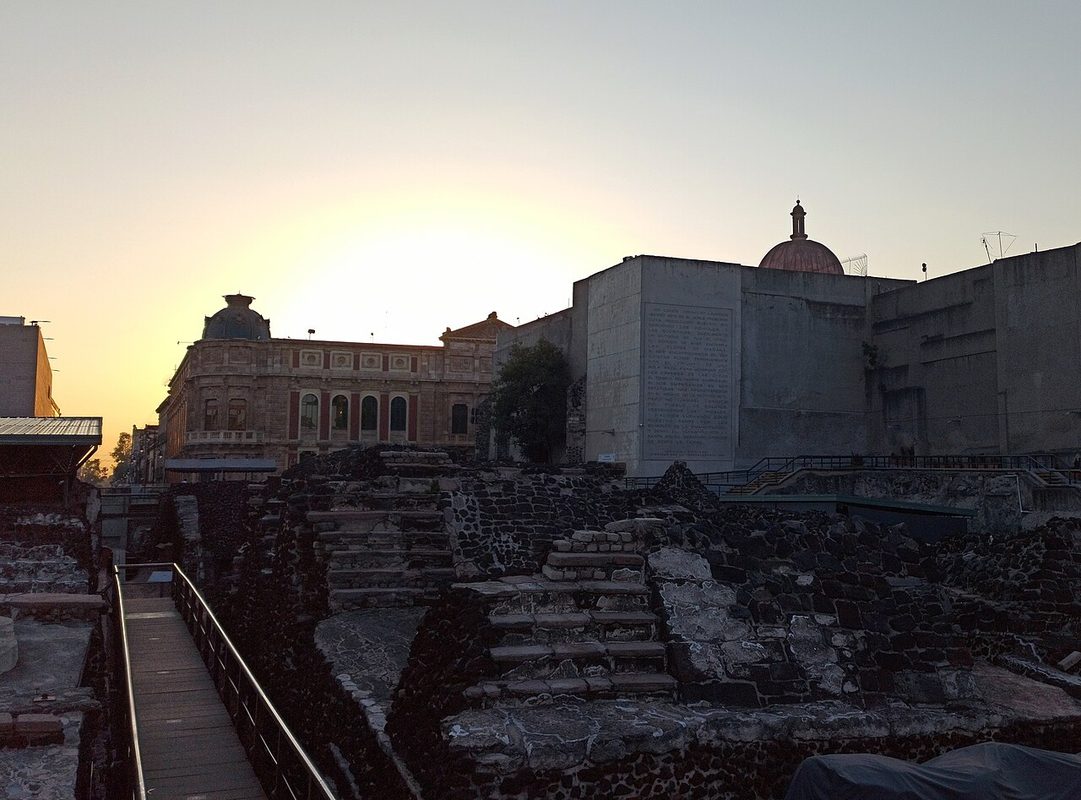
Image: Juan Carlos Fonseca Mata, Wikimedia Commons, CC BY-SA 4.0. Resized; not otherwise altered. All credits.
📍 Where It Is Historic Center of Mexico City & Coatlinchan, Mexico 19.4346°, -99.1319°
🏛️ Mainstream Date c. 1325–1521 CE (Mexica / Aztec Empire capital) Excavated baseline
🧭 Leading Edge / Open Angle 168-ton Coatlinchan monolith is 4.2× heavier than modern ancient-tool tests Debated or newly revised
🪨 Heaviest Stone & Quarry 24.5 tons moved 22 km (Sun Stone) · 168 tons in quarry (Coatlinchan) 0.6× the 40-ton test limit · Compare all 64 sites →
30-SECOND TAKEAWAY

In Plain English — The 30-Second Takeaway

What It Is:

Tenochtitlan was the island capital of the Aztec Empire in Lake Texcoco, centered on the twin-stairway Templo Mayor pyramid.

What Everyone Agrees On (Measured Facts):

Builders hauled the 24.5-ton basalt Sun Stone 22 km across lake causeways without wheels or draft animals. Carved a 168-ton andesite monolith at nearby Coatlinchan.

🏛️ Mainstream Archaeology View:

Mexican dig teams have uncovered seven complete pyramid layers built between 1375 and 1519 CE over wooden lake pilings, aligned to calendar sunrises.

🧭 Leading Edge View:

Moving the 168-ton Coatlinchan monolith to Mexico City's museum in 1964 required a 192-wheel steel trailer. Also, two bulldozers. Spotlighting the scale of Aztec stone carving.

Site Story & Overview

Tenochtitlan grew in less than two centuries into an island metropolis of 150,000–200,000 inhabitants connected to the mainland by three engineered causeways, a 16 km flood-control dike (Albarradón de Nezahualcóyotl), and twin terracotta aqueducts from Chapultepec. At its ritual heart stood the twin-shrine Templo Mayor (Dedicated to Huitzilopochtli and Tlaloc).

▸ Read Full Archaeological & Engineering Context

There, INAH's Proyecto Templo Mayor has recorded more than 200 ritual caches containing marine shells, coral, sawfish rostra, and greenstone imported from both coasts. From an building view, the Mexica transported multi-ton andesite and basalt sculptures across causeways and canoes without draft animals or wheeled carts, culminating in the 24.5 t Sun Stone, the 12 t Tlaltecuhtli slab, and the 168 t Coatlinchan monolith.

✓ What Is Physically Measured on Site

Dated samples, laser scans, stone weights, and dug finds kept separate from opinion.

🏛️ Mainstream Archaeological View

  • Accepted timeline: Mexica (Aztec) capital founded c. 1325 CE. The Templo Mayor was rebuilt in seven full building layers between c. 1375 and 1519 CE before its destruction in 1521.
  • Stone & hardness: Olivine basalt, Tenayuca pink lamprophyric andesite & tezontle volcanic scoria — Mohs hardness 6.0 (Andesite / Basalt) (on the 1–10 Mohs scale where a steel knife is ~5.5 and diamond is 10).
  • Quarry distance & alignment: Stone source 12 km (Tenayuca andesite) / 22 km (San Ángel/Xochimilco basalt) / 45 km (Coatlinchan). Orientation: 95.6° / 275.6° azimuth (5.6° S of E; sunrise 4 Mar / 9 Oct, 260-day calendar interval).

🧭 Leading Edge Proposal & Open Questions

  • Leading Edge researchers: Highlight the 168-ton unfinished Tlaloc/Chalchiuhtlicue monolith from nearby Coatlinchan and the 24.5-ton basalt Sun Stone as evidence of highland Mesoamerican heavy-stone transport well above the 40-ton test baseline [3][1]

Tested Claims About Tenochtitlan and the Templo Mayor (plus Coatlinchan Monolith)

ClaimStatusVerdict
Pyramids around the world point to a common lost source
Did pyramids in Egypt, Peru, Mexico, Sudan. Also, China come from one shared ancient parent culture?
Leading EdgeOpen question
How the world's megaliths were moved: what is shown, what is inferred, and where the gaps are
Can wooden sledges, ropes, wet sand, and dirt ramps explain how ancient crews moved stones weighing 80 to 860 tons?
ContestedMeasured in part: sledges, wetted or timber tracks, ramps and boats are documented, and finished monuments show ancient moves of about 750–860 t; no test of ancient methods we found goes above about 40 t, and the 1,000 t-plus Baalbek blocks never left the quarry
Solar alignments & eclipse monuments: solstice, equinox and the August 2, 2027 total eclipse over Luxor & Karnak
This review covers ancient sites proven to track the Sun's solstices and equinoxes, plus the 2027 total eclipse over Egypt.
MainstreamMeasured: solar horizon alignments (solstice and equinox azimuths) at Chankillo, Stonehenge, Newgrange, Karnak and Serpent Mound are physically verified and independent of axial precession; on 2 August 2027, the longest land total solar eclipse of the century (6m 22s) will pass directly over Karnak, Luxor, Abydos and Dendera
▸ View Engineering Callout Sources (7 lettered references)
  1. Richards, J. & Whitby, M. (1997). The engineering of Stonehenge. In Cunliffe, B. & Renfrew, C. (eds), Science and Stonehenge. Proceedings of the British Academy 92: 231–256 (PDF). https://www.thebritishacademy.ac.uk/documents/3921/92p231.pdf data
  2. NOVA (PBS airdate 12 Feb 1997). Secrets of Lost Empires: Obelisk, transcript: a forty-ton obelisk (US tons, about 36 t) dragged on a sledge at Aswan; it was not raised. https://www.pbs.org/wgbh/nova/transcripts/2405obelisk.html data
  3. NOVA (PBS airdate 8 Feb 2000). Secrets of Lost Empires: Pharaoh's Obelisk, transcript: a 25-ton block dragged on a timber roadbed and a 25-ton (perhaps 30-ton) obelisk raised from a sand pit. https://www.pbs.org/wgbh/nova/transcripts/27poobelisk.html data
  4. Li, J. & Chen, Z. (2016). Lubrication for transporting heavy objects in the history. Tribology Online 11(2): 242–249 (includes the Japanese shura sledge experiments). doi:10.2474/trol.11.242 background
  5. Harris, B. (2018). Moving megaliths: time to park the rollers. British Archaeology 163: 30–35 (author's accepted manuscript, UCL Discovery). https://discovery.ucl.ac.uk/id/eprint/10114174/ background
  6. López Luján, L. (2010). Tlaltecuhtli. Mexico City: INAH / Sexto Piso (monograph on the 12-tonne andesite monolith). https://www.mesoweb.com/es/articulos/sub/Tlaltecuhtli.pdf data
  7. Matos Moctezuma, E. (1988). The Great Temple of the Aztecs: Treasures of Tenochtitlan. London: Thames & Hudson (Open Library record). https://openlibrary.org/works/OL2697387W data

Visiting & base stays: Tenochtitlan & Templo Mayor Museum (Centro Histórico, Mexico City)

FTC affiliate disclosure: Tour links go to GetYourGuide and Viator. Hotel links use Stay22 (aid=solarevidence) for Booking.com and Expedia. If you book a trip, we may earn a small fee at no extra cost to you. All partner links use rel="sponsored nofollow noopener". Check travel alerts before you go. Partner fees never change our ratings. All 64 site field visits · Affiliate disclosure.

📚 Further Reading: Both Sides of the Argument

Top books from both sides of the debate on this topic. Browse all 34 books on Books & Further Reading or visit our Search for the Truth Bookshop.org storefront.

Mainstream Baseline 2005 ★ 4.6/5

1491: New Revelations of the Americas Before Columbus (2nd ed.)

Charles C. Mann

Shows how new digs and laser maps proved the ancient Americas held big cities, roads, and farms long before Columbus.

▸ Why this book matters to both sides

Surveys the archaeological, botanical, and demographic discoveries showing that the pre-Columbian Americas—from Caral-Supe and the Amazon basin to Cahokia—were older, more populous, and more engineered than once taught.

Role in the debate: Documents how mainstream field evidence overturned the 20th-century 'pristine wilderness' model in the Amazon and pushed giant buildings in Peru back to the third millennium BCE. (ISBN 9781400032051)

Mainstream Baseline 2022 ★ 4.7/5

The Maya (10th ed.)

Michael D. Coe & Stephen Houston

The classic guide to the Maya world, updated with new jungle laser maps, the 1000 BCE Aguada Fénix platform, and calendar science.

▸ Why this book matters to both sides

The tenth edition of the standard academic overview of Maya culture, updated with airborne LiDAR surveys across the Petén and Campeche, the 1000 BCE Aguada Fénix plateau, and Long Count astronomy.

Role in the debate: Pairs the latest LiDAR town densities and epigraphic readings with Mesoamerican calendrical and sky debates. (ISBN 9780500295144)

Leading Edge 1995 ★ 4.7/5

Fingerprints of the Gods: The Evidence of Earth's Lost Civilization

Graham Hancock

Graham Hancock's bestseller arguing that Giza, Pumapunku, and ancient maps preserve traces of a lost Ice Age culture.

▸ Why this book matters to both sides

Hancock's worldwide bestseller examining Tiwanaku, Pumapunku, Teotihuacan, Giza, the Piri Reis map, and Hapgood's crustal-shift model. It argues for an Ice Age culture lost in a global cataclysm.

Role in the debate: The book that brought the lost-Ice-Age-culture idea to millions of readers and framed the modern debate over Giza, Pumapunku, and ancient sky sightlines. (ISBN 9780517887295)

Bridge / Debate History 1969 ★ 4.6/5

Hamlet's Mill: An Essay Investigating the Origins of Human Knowledge and Its Transmissions Through Myth

Giorgio de Santillana & Hertha von Dechend

Two science historians argue that ancient stories worldwide preserve real observations of the 26,000-year wobble of the stars.

▸ Why this book matters to both sides

Written by historians of science at MIT and Frankfurt University. The author argues ancient stories worldwide encode technical findings of the 26,000-year sky wobble of the equinoxes and shifting world ages.

Role in the debate: The scholarly bridge between academic history of astronomy and modern sky-sightline claims about sky-cycle coding at Giza, Angkor, and Göbekli Tepe. (ISBN 9780879232153)

FTC affiliate disclosure: Book links go to Bookshop.org (ID 130218, Search for the Truth). Each sale helps local bookstores and pays us a 10% fee at no extra cost to you. All partner links use rel="sponsored nofollow noopener". Fees never change our verdicts. Affiliate disclosure.

Primary Academic Sources

▸ View All Cited Primary Sources & DOIs (5 papers)
  1. Matos Moctezuma, E. (1988). The Great Temple of the Aztecs: Treasures of Tenochtitlan. London: Thames & Hudson (Open Library record). https://openlibrary.org/works/OL2697387W data
  2. López Luján, L. (2006). La Casa de las Águilas: un ejemplo de la arquitectura religiosa de Tenochtitlan. Mexico City: INAH / FCE / Harvard University (project record). https://www.mesoweb.com/about/leonardo.html data
  3. López Luján, L. (2010). Tlaltecuhtli. Mexico City: INAH / Sexto Piso (monograph on the 12-tonne andesite monolith). https://www.mesoweb.com/es/articulos/sub/Tlaltecuhtli.pdf data
  4. Šprajc, I. (2000). Astronomical alignments at the Templo Mayor of Tenochtitlan, Mexico. Archaeoastronomy (Supplement to Journal for the History of Astronomy) 25: S11–S40. doi:10.1177/002182860003102502 data
  5. UNESCO World Heritage Centre: Historic Centre of Mexico City and Xochimilco (inscribed 1987). https://whc.unesco.org/en/list/412/ background

Dates and stone checks are summed up in plain English from the papers above. Measured facts stay separate from opinion. Methodology.