△ TruthInStone

Sites › Asia › Bada, Besoa and Napu Valley Megaliths (Lore Lindu)

Bada, Besoa and Napu Valley Megaliths (Lore Lindu)

Bada, Besoa and Napu Valley Megaliths (Lore Lindu)
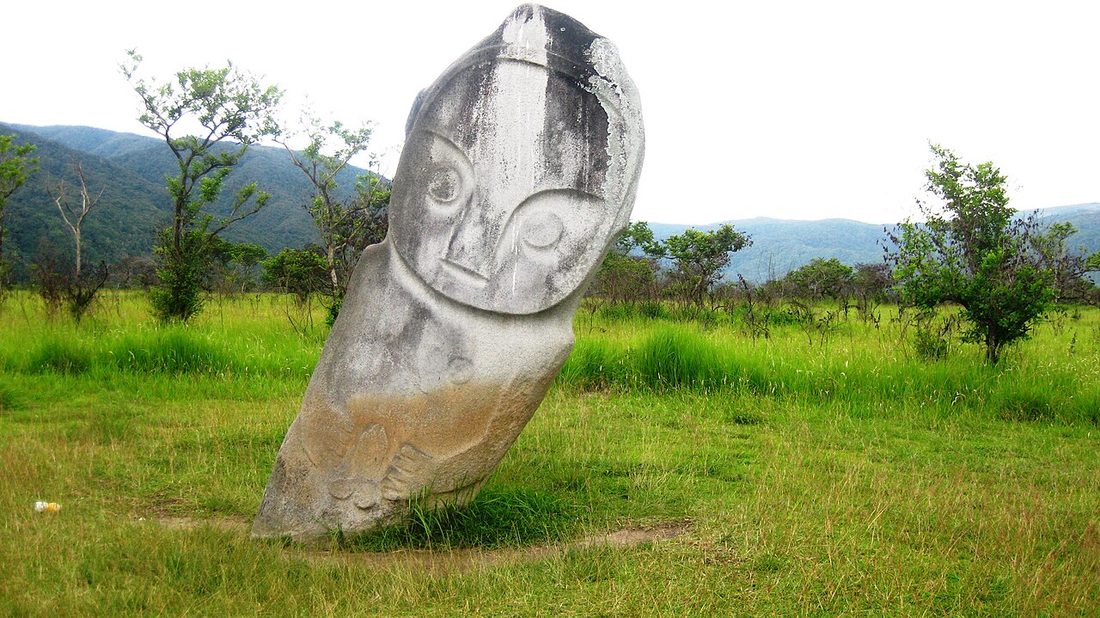
Image: Lo2asinamura, Wikimedia Commons, CC BY-SA 4.0. Resized; not otherwise altered. All credits.
📍 Where It Is Lore Lindu National Park, Central Sulawesi, Indonesia -1.7667°, 120.2500°
🏛️ Mainstream Date Broadly c. 1000 BCE to 1300 CE (valley settlement dates; statues undated) Excavated baseline
🧭 Leading Edge / Open Angle Striking parallel to Laos's Plain of Jars with no local record of who carved them Debated or newly revised
🪨 Heaviest Stone & Quarry 10–15 tons (4.5-m Palindo granite statue & 2.5-m hollowed stone vats, 3–8 km) 0.4× the 40-ton test limit · Compare all 64 sites →
30-SECOND TAKEAWAY

In Plain English — The 30-Second Takeaway

What It Is:

The Bada, Besoa. Napu valleys in the mountains of Sulawesi, Indonesia, hold hundreds of mysterious granite human statues and giant circular stone vats.

What Everyone Agrees On (Measured Facts):

Carved from hard river granite hauled 3 to 8 km, the largest statue. (Palindo) stands 4.5 meters tall. (~10–15 tons) alongside hollowed stone tanks. (kalamba) over 2 meters wide.

🏛️ Mainstream Archaeology View:

Soil and pollen cores show people farmed these valleys by 1000 BCE. Scholars group the stones with Austronesian megalithic ways.

🧭 Leading Edge View:

Because the granite itself has never been directly dated by base-soil luminescence and local villagers say the stones were already there before their ancestors arrived, their true age is wide open.

Site Story & Overview

Isolated in high tectonic valleys 750–1,100 m above sea level in the heart of Central Sulawesi, the Lore Lindu megaliths (Bada, Besoa, and Napu valleys) comprise hundreds of carved granite human figures and giant cylindrical stone vats (kalamba) resting across open rice paddies and grassy ridges. Because the stone itself cannot be carbon dated and very few statues have been dug down to their base sockets with OSL sampling, their exact age—whether Early Metal Age (c.

▸ Read Full Archaeological & Engineering Context

500 BCE–500 CE) or older—remains one of Southeast Asia's widest open dating questions. The pairing of multi-ton hollowed granite vats and disc lids offers a direct technological parallel to the sandstone Plain of Jars in Laos.

✓ What Is Physically Measured on Site

Dated samples, laser scans, stone weights, and dug finds kept separate from opinion.

🏛️ Mainstream Archaeological View

  • Accepted timeline: Austronesian highland megalithic tradition of Central Sulawesi. Carbon and palynological work in the Besoa and Napu valleys places human landscape clearance and associated town contexts between c. 1000 BCE and 1300 CE. Still, direct dates on the stone statues themselves remain scarce.
  • Stone & hardness: Porphyritic biotite granite & metamorphic gneiss — Mohs hardness 6.5 (Granite) (on the 1–10 Mohs scale where a steel knife is ~5.5 and diamond is 10).
  • Quarry distance & alignment: Stone source 3–8 km from Lariang River and mountain gorge granite boulders. Orientation: Valley-floor and river-terrace sightlines facing surrounding mountain peaks.

🧭 Leading Edge Proposal & Open Questions

  • Leading Edge & comparative megalith researchers: Point out that the Bada Valley's cylindrical stone vats (kalamba, up to 2–3 m across) closely parallel the Plain of Jars in Laos. Meanwhile, the minimalist round-eyed anthropomorphic monoliths (such as Palindo, 4.5 m tall) have no local written history or oral memory explaining who carved them [2][1]

Tested Claims About Bada, Besoa and Napu Valley Megaliths (Lore Lindu)

ClaimStatusVerdict
How the world's megaliths were moved: what is shown, what is inferred, and where the gaps are
Can wooden sledges, ropes, wet sand, and dirt ramps explain how ancient crews moved stones weighing 80 to 860 tons?
ContestedMeasured in part: sledges, wetted or timber tracks, ramps and boats are documented, and finished monuments show ancient moves of about 750–860 t; no test of ancient methods we found goes above about 40 t, and the 1,000 t-plus Baalbek blocks never left the quarry

Visiting & base stays: Bada, Besoa & Napu Valley Megaliths (Lore Lindu National Park via Palu, Central Sulawesi, Indonesia)

FTC affiliate disclosure: Tour links go to GetYourGuide and Viator. Hotel links use Stay22 (aid=solarevidence) for Booking.com and Expedia. If you book a trip, we may earn a small fee at no extra cost to you. All partner links use rel="sponsored nofollow noopener". Check travel alerts before you go. Partner fees never change our ratings. All 64 site field visits · Affiliate disclosure.

📚 Further Reading: Both Sides of the Argument

Top books from both sides of the debate on this topic. Browse all 34 books on Books & Further Reading or visit our Search for the Truth Bookshop.org storefront.

Mainstream Baseline 2003 ★ 4.5/5

After the Ice: A Global Human History, 20,000–5000 BC

Steven Mithen

Follows human life across every continent from the peak of the Ice Age (20,000 BCE) to early farming towns (5000 BCE).

▸ Why this book matters to both sides

A continent-by-continent narrative of human life from the Last Glacial Maximum to 5000 BCE, built directly from excavation reports across the Near East (including Göbekli Tepe), Europe, Asia, and the Americas.

Role in the debate: Provides the archaeological baseline for what human populations were building, hunting, and cultivating before, during, and right after the Younger Dryas. (ISBN 9780674019997)

Mainstream Baseline 2021 ★ 4.5/5

The Dawn of Everything: A New History of Humanity

David Graeber & David Wengrow

Examines how hunter-gatherers built giant stone sites like Göbekli Tepe and Poverty Point without kings or farming.

▸ Why this book matters to both sides

An culture scholar and an archaeologist examine Göbekli Tepe, Karahan Tepe, Poverty Point, Watson Brake, and Teotihuacan. It challenges the textbook step-by-step ladder from small hunter-gatherer bands to states.

Role in the debate: Shows how mainstream archaeology accounts for giant buildings built by hunter-gatherers (Göbekli Tepe, Poverty Point) without invoking a single global parent culture. (ISBN 9781250858801)

Leading Edge 2015 ★ 4.7/5

Magicians of the Gods: The Forgotten Wisdom of Earth's Lost Civilization

Graham Hancock

Links Göbekli Tepe, Baalbek, and the Younger Dryas comet debate to argue a cosmic impact erased an Ice Age world.

▸ Why this book matters to both sides

Integrates Göbekli Tepe, Baalbek, Gunung Padang. The Younger Dryas comet-impact idea. It argues Taurid meteor-stream impacts between 12,800 and 11,600 years ago erased an advanced culture.

Role in the debate: Sets out the strongest popular overview linking Göbekli Tepe's enclosures and Pillar 43 to the Younger Dryas impact debate. (ISBN 9781250118400)

Leading Edge 2012 ★ 4.7/5

Forgotten Civilization: New Discoveries on the Solar-Induced Dark Age (Revised ed.)

Robert M. Schoch with Catherine Ulissey

Geologist Robert Schoch sets out his rain-erosion case for an older Sphinx and his theory of a giant solar blast in 9700 BCE.

▸ Why this book matters to both sides

Boston University geologist Robert Schoch details his geological and seismic-refraction case for an older Great Sphinx alongside his idea that extreme solar proton outbursts ended the last Ice Age around 9700 BCE.

Role in the debate: Presents the geological case for precipitation-induced weathering on the Sphinx enclosure walls and the solar-disaster alternative to the Younger Dryas comet idea. (ISBN 9781644112922)

FTC affiliate disclosure: Book links go to Bookshop.org (ID 130218, Search for the Truth). Each sale helps local bookstores and pays us a 10% fee at no extra cost to you. All partner links use rel="sponsored nofollow noopener". Fees never change our verdicts. Affiliate disclosure.

Primary Academic Sources

▸ View All Cited Primary Sources & DOIs (2 papers)
  1. Kirleis, W., Pillar, H. & Behling, H. (2011). Human–environment interactions in the tropical rainforest of Central Sulawesi, Indonesia, since the first millennium BC (Lore Lindu project). Vegetation History and Archaeobotany 20: 165–179. doi:10.1007/s00334-011-0286-2 data
  2. Steimer-Herbet, T. (2018). Indonesian Megaliths: A Forgotten Cultural Heritage. Oxford: Archaeopress. doi:10.2307/j.ctv1nzfvx7 data

Dates and stone checks are summed up in plain English from the papers above. Measured facts stay separate from opinion. Methodology.