△ TruthInStone

Sites › North America › Bimini Road (North Bimini, Bahamas)

Bimini Road (North Bimini, Bahamas)

Bimini Road (North Bimini, Bahamas)
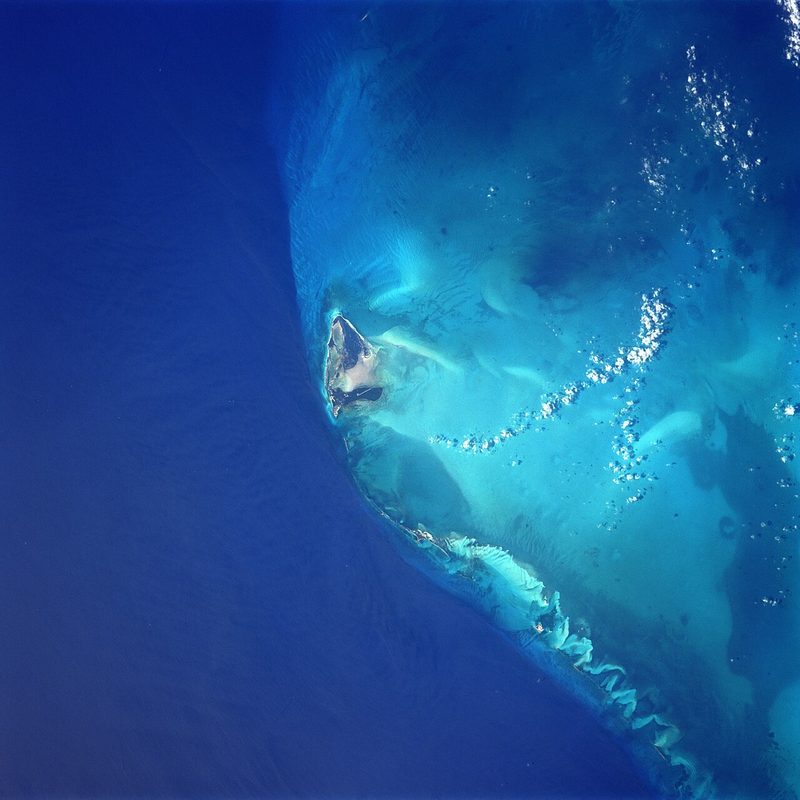
Image: NASA (Space Shuttle STS-91 crew photograph), Wikimedia Commons, Public domain. Resized; not otherwise altered. All credits.
📍 Where It Is Off Paradise Point, North Bimini, Bahamas (Americas) 25.7660°, -79.2800°
🏛️ Mainstream Date c. 2,200–3,500 BP natural fractured Holocene beachrock Excavated baseline
🧭 Leading Edge / Open Angle Proposed submerged megalithic road or harbor breakwater Debated or newly revised
🪨 Heaviest Stone & Quarry 1–15 tons (tabular beachrock limestone blocks, 1–4 m wide) 0.4× the 40-ton test limit · Compare all 64 sites →
30-SECOND TAKEAWAY

In Plain English — The 30-Second Takeaway

What It Is:

The Bimini Road is a half-mile-long submerged pavement of flat limestone blocks lying under 18 feet of clear water off North Bimini.

What Everyone Agrees On (Measured Facts):

Flat limestone blocks up to 13 feet wide form an 800-meter line. Seventeen drill cores date the rock to 2,200–3,500 years ago, with matching sand layers across blocks.

🏛️ Mainstream Archaeology View:

Geologists show it is natural Holocene beachrock that cemented on an old shoreline and fractured into rectangular blocks as waves eroded the sand below.

🧭 Leading Edge View:

Divers since 1968 argue the straight lines and flat corners look built. They point to smaller prop stones underneath as signs of a sunken harbor breakwater.

Site Story & Overview

Located in 5.5 m (18 feet) of clear water off Paradise Point on North Bimini, the Bimini Road consists of a main 800-meter-long (half-mile) line and two shorter parallel lines of flat, rectangular limestone blocks. Diver Joseph Manson Valentine, Jacques Mayol, and Robert Angove spotted the pavement in September 1968.

▸ Read Full Archaeological & Engineering Context

Because American mystic Edgar Cayce had predicted in 1940 that part of Atlantis would rise near Bimini in 1968 or 1969, the site quickly drew explorers, geologists, and film crews. Core drilling by the U.S. Geological Survey and the University of Miami found the blocks as peloidal biocalcarenite ('beachrock', Mohs hardness ~3.0–3.5) cemented between 2,200 and 3,500 years ago. Meanwhile, supporters such as David Zink and Greg Little point to small flat slabs underneath the main blocks that they interpret as leveling props.

✓ What Is Physically Measured on Site

Dated samples, laser scans, stone weights, and dug finds kept separate from opinion.

How carbon dates work, and their limits: How we date sites.

🏛️ Mainstream Archaeological View

  • Accepted timeline: Natural Holocene beachrock pavement (~2,200 to 3,500 carbon years old) that cemented in the intertidal zone and cracked along straight orthogonal joints into pillow-shaped rectangular blocks as underlying sand washed out.
  • Stone & hardness: Holocene peloidal biocalcarenite (beachrock limestone) — Mohs hardness 3.0–3.5 (Biocalcarenite beachrock) (on the 1–10 Mohs scale where a steel knife is ~5.5 and diamond is 10).
  • Quarry distance & alignment: Stone source In situ intertidal beachrock cementation (0 km; or local shoreline quarry per proponents). Orientation: Northeast–Southwest J-shaped line parallel to the North Bimini shoreline.

🧭 Leading Edge Proposal & Open Questions

  • J. Manson Valentine (1969), David Zink (1978) & Greg Little (2005–2006): Submerged megalithic harbor wall: Interpret the J-shaped line of tabular blocks (1–4 m / 3–13 ft wide, up to ~10–15 tons) and underlying smaller stones as a man-made roadway or breakwater built when Bahamian sea levels stood lower. [14][16][15][13]

Tested Claims About Bimini Road (North Bimini, Bahamas)

ClaimStatusVerdict
An advanced civilisation existed during the last Ice Age and was lost in a catastrophe
Did an advanced seafaring culture exist during the Ice Age before floods and impacts destroyed it 12,000 years ago?
Leading EdgeOpen question
The Bimini Road is a man-made structure, possibly linked to Atlantis
Is the half-mile line of blocky stones underwater off Bimini in the Bahamas a sunken road or natural beach rock?
Leading EdgeOpen question on origin; measured: cores and radiocarbon ages of about 2,200–3,500 years point to natural beachrock, and our sea-level check shows the site was dry land 10,000–12,000 years ago, 12–49 m or more above the sea

Visiting & base stays: Bimini Road Submerged Limestone Formation (North Bimini, Bahamas)

FTC affiliate disclosure: Tour links go to GetYourGuide and Viator. Hotel links use Stay22 (aid=solarevidence) for Booking.com and Expedia. If you book a trip, we may earn a small fee at no extra cost to you. All partner links use rel="sponsored nofollow noopener". Check travel alerts before you go. Partner fees never change our ratings. All 64 site field visits · Affiliate disclosure.

📚 Further Reading: Both Sides of the Argument

Top books from both sides of the debate on this topic. Browse all 34 books on Books & Further Reading or visit our Search for the Truth Bookshop.org storefront.

Mainstream Baseline 1998 ★ 4.4/5

Noah's Flood: The New Scientific Discoveries About the Event That Changed History

William Ryan & Walter Pitman

Two ocean geologists share seabed cores showing the Black Sea flooded rapidly around 5600 BCE.

▸ Why this book matters to both sides

Two Columbia University marine geologists present seabed cores, drowned shorelines, and sonar profiles for a rapid flooding of the freshwater Black Sea basin around 5600 BCE.

Role in the debate: Demonstrates how marine geologists test whether ancient Near Eastern deluge traditions preserve a real Holocene coastal inundation. (ISBN 9780684859200)

Bridge / Debate History 2010 ★ 4.5/5

Atlantis and the Cycles of Time: Prophecies, Traditions, and Occult Revelations

Joscelyn Godwin

Traces two centuries of books and debates about Atlantis, pole shifts, Edgar Cayce, and repeating world ages.

▸ Why this book matters to both sides

Colgate University intellectual historian Joscelyn Godwin traces two centuries of geological, rationalist, and esoteric theories about Atlantis, Edgar Cayce, Bimini, pole shifts, and world-age cycles.

Role in the debate: Maps out exactly where modern ideas about lost continents, Hall of Records traditions, and cyclical disasters originated in 19th- and 20th-century thought. (ISBN 9781594772627)

Leading Edge 2002 ★ 4.6/5

Underworld: The Mysterious Origins of Civilization

Graham Hancock

Combines Ice Age sea-level flood maps with scuba dives at submerged ruins off India, Japan, Malta, and Bimini.

▸ Why this book matters to both sides

Combines Glenn Milne's post-glacial sea-level inundation maps with scuba studies at India's Gulf of Khambhat and Dwarka, Japan's Yonaguni terraces, Malta, and Bimini.

Role in the debate: Frames the submerged-shelf debate over whether features at Yonaguni, Dwarka, and Bimini are human-modified monuments drowned by Meltwater pulses or natural coastal geology. (ISBN 9781400049516)

Leading Edge 1966 ★ 4.6/5

Maps of the Ancient Sea Kings: Evidence of Advanced Civilization in the Ice Age

Charles H. Hapgood

Studies the 1513 Piri Reis map and old sea charts to argue they copy surveys made by Ice Age mariners.

▸ Why this book matters to both sides

Analyzes the 1513 Piri Reis map, the 1531 Oronteus Finaeus map, and medieval portolans with U.S. Air Force cartographers. It argues they preserve spherical trigonometrical surveys from an Ice Age seafaring culture.

Role in the debate: A foundational source for the lost-Ice-Age-culture and Antarctica cartography arguments cited by Hancock, Flem-Ath, and Schoch. (ISBN 9780932813428)

FTC affiliate disclosure: Book links go to Bookshop.org (ID 130218, Search for the Truth). Each sale helps local bookstores and pays us a 10% fee at no extra cost to you. All partner links use rel="sponsored nofollow noopener". Fees never change our verdicts. Affiliate disclosure.

Primary Academic Sources

▸ View All Cited Primary Sources & DOIs (16 papers)
  1. Wikipedia. Bimini Road (secondary summary, including the 1968 discovery and Gifford and Ball's 1980 observations, which are not online). https://en.wikipedia.org/wiki/Bimini_Road background
  2. Rebikoff, D. (1972). Precision underwater photomosaic techniques for archaeological mapping: interim experiment on the Bimini "Cyclopean" complex. International Journal of Nautical Archaeology 1. doi:10.1111/j.1095-9270.1972.tb00696.x data
  3. Harrison, W. (1971). Atlantis undiscovered: Bimini, Bahamas. Nature 230: 287–289. doi:10.1038/230287a0 critique
  4. Calvert, P. M., Introne, D. S. & Stipp, J. J. (1979). University of Miami radiocarbon dates XIV. Radiocarbon 21 (Bimini Road core dates). doi:10.1017/s0033822200004239 data
  5. McKusick, M. & Shinn, E. A. (1980). Bahamian Atlantis reconsidered. Nature 287: 11–12. doi:10.1038/287011a0 data
  6. Shinn, E. A. (2004). A geologist's adventures with Bimini beachrock and Atlantis true believers. Skeptical Inquirer 28(1) (PDF). https://cdn.centerforinquiry.org/wp-content/uploads/sites/29/2004/01/… critique
  7. Shinn, E. A. (2009). The mystique of beachrock. In Swart, P. K. et al. (eds), Perspectives in Carbonate Geology. IAS Special Publication 41: 19–28. doi:10.1002/9781444312065.ch2 data
  8. Strasser, A. & Davaud, E. (1986). Formation of Holocene limestone sequences by progradation, cementation, and erosion: two examples from the Bahamas. Journal of Sedimentary Research 56. doi:10.1306/212f8936-2b24-11d7-8648000102c1865d data
  9. Truth in Stone (2026). Bimini Road sea-level check from the Barbados coral record: Python script, released under CC0 1.0. /static/downloads/bimini-sea-level.py data
  10. NOAA NCEI Paleoclimatology. Barbados 2006 coral sea-level data (Peltier & Fairbanks 2006), data file. https://www.ncei.noaa.gov/pub/data/paleo/coral/atlantic/barbados2006-… data
  11. Peltier, W. R. & Fairbanks, R. G. (2006). Global glacial ice volume and Last Glacial Maximum duration from an extended Barbados sea level record. Quaternary Science Reviews 25. doi:10.1016/j.quascirev.2006.04.010 data
  12. Lambeck, K. et al. (2014). Sea level and global ice volumes from the Last Glacial Maximum to the Holocene. PNAS 111. doi:10.1073/pnas.1411762111 data
  13. Edgar Cayce reading 958-3 (28 June 1940), transcript ("Poseidia will be among the first portions of Atlantis to rise again. Expect it in sixty-eight and sixty-nine"). https://archive.edgarcayce.ch/Reading%200958-0003.html proponent
  14. Zink, D. (1978). The Stones of Atlantis. Prentice-Hall (Open Library record). https://openlibrary.org/works/OL4464884W proponent
  15. Little, G. (2006). New underwater Bimini find: report on the June 2006 Bimini expedition (wedge stones, slabs under the blocks, stone anchors; self-published). https://www.mysterious-america.com/newunderwaterbim.html proponent
  16. Little, G. (2005). Bimini and Andros 2005 expedition report (stacked blocks, claimed tool marks; self-published). https://www.mysterious-america.com/biminiandros2005.html proponent

Dates and stone checks are summed up in plain English from the papers above. Measured facts stay separate from opinion. Methodology.