△ TruthInStone

Sites › North America › San Lorenzo and La Venta (Olmec Colossal Heads & Basalt Transport)

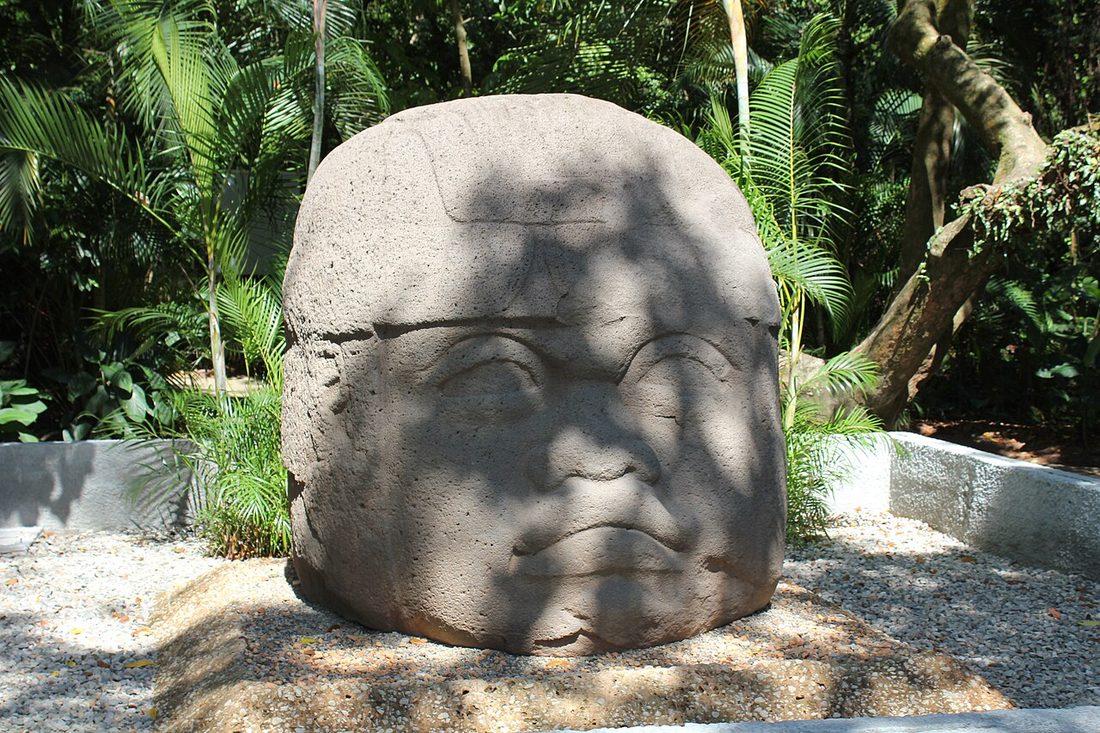
San Lorenzo and La Venta (Olmec Colossal Heads & Basalt Transport)

San Lorenzo and La Venta (Olmec Colossal Heads & Basalt Transport)
Image: Arian Zwegers from Brussels, Belgium, Wikimedia Commons, CC BY 2.0. Resized; not otherwise altered. All credits.
📍 Where It Is Veracruz & Tabasco Gulf Coast, Mexico 18.1031°, -94.0400°
🏛️ Mainstream Date c. 1400–400 BCE (Early & Middle Formative Olmec civilization) Excavated baseline
🧭 Leading Edge / Open Angle 65-ton basalt boulders hauled 60–100 km without wheels or metal Debated or newly revised
🪨 Heaviest Stone & Quarry 24–65 tons (colossal basalt heads & thrones, hauled 60–100 km) 1.2× the 40-ton test limit · Compare all 64 sites →
30-SECOND TAKEAWAY

In Plain English — The 30-Second Takeaway

What It Is:

San Lorenzo and La Venta on Mexico's Gulf Coast are the oldest giant stone cities in Mesoamerica, built by the Olmec culture.

What Everyone Agrees On (Measured Facts):

Seventeen colossal basalt heads and massive stone thrones weigh 20 to 65 tons each. It also were hauled 60 to 100 km from the volcanic Tuxtla Mountains across rivers and swamps.

🏛️ Mainstream Archaeology View:

Carbon dates place San Lorenzo between 1400 and 900 BCE and La Venta between 900 and 400 BCE. It has the heads representing local Olmec rulers.

🧭 Leading Edge View:

Moving 40-to-65-ton volcanic boulders up to 100 km through tropical wetlands without wheels, metal tools, or draft animals exceeds every modern ancient-tool test.

Site Story & Overview

San Lorenzo and La Venta stand at the base of Mesoamerican giant stoneworking. Located in alluvial river floodplains and coastal marshes completely devoid of volcanic rock, Early and Middle Formative Olmec builders organized expeditions to the volcanic Tuxtla Mountains 60 to 100 km away, extracted basalt boulders weighing 20 to 65 tons without metal tools, wheeled vehicles, or draft animals, and moved them across ridges, rivers, and swamps to carve colossal ruler portraits and single-stone altars.

▸ Read Full Archaeological & Engineering Context

Equally striking is La Venta's practice of 'buried giant buildings'. There, thousand-ton serpentine pavements were laid in deep pits and right sealed beneath layered colored clays.

✓ What Is Physically Measured on Site

Dated samples, laser scans, stone weights, and dug finds kept separate from opinion.

How carbon dates work, and their limits: How we date sites.

🏛️ Mainstream Archaeological View

  • Accepted timeline: Early and Middle Formative Olmec centres: San Lorenzo flourished c. 1400–900 BCE. La Venta flourished c. 900–400 BCE.
  • Stone & hardness: Olivine-augite basalt boulders, green serpentine blocks & compacted clay — Mohs hardness 6.0 (Basalt) (on the 1–10 Mohs scale where a steel knife is ~5.5 and diamond is 10).
  • Quarry distance & alignment: Stone source 60–80 km (Cerro Cintepec to San Lorenzo) / 90–100 km by river & raft to La Venta. Orientation: 8° west of true North centerline axis (La Venta Complex A & C).

🧭 Leading Edge Proposal & Open Questions

  • Leading Edge & trans-oceanic contact authors: Propose Old World or pre-Formative affinities based on the facial features of the colossal heads and the buried serpentine mosaic pavements at La Venta. Mainstream Mesoamericanists attribute the heads to portraits of local Olmec rulers and the buried pavements to ritual cosmological offerings [4][1]

Tested Claims About San Lorenzo and La Venta (Olmec Colossal Heads & Basalt Transport)

ClaimStatusVerdict
Pyramids around the world point to a common lost source
Did pyramids in Egypt, Peru, Mexico, Sudan. Also, China come from one shared ancient parent culture?
Leading EdgeOpen question
How the world's megaliths were moved: what is shown, what is inferred, and where the gaps are
Can wooden sledges, ropes, wet sand, and dirt ramps explain how ancient crews moved stones weighing 80 to 860 tons?
ContestedMeasured in part: sledges, wetted or timber tracks, ramps and boats are documented, and finished monuments show ancient moves of about 750–860 t; no test of ancient methods we found goes above about 40 t, and the 1,000 t-plus Baalbek blocks never left the quarry
▸ View Engineering Callout Sources (8 lettered references)
  1. Richards, J. & Whitby, M. (1997). The engineering of Stonehenge. In Cunliffe, B. & Renfrew, C. (eds), Science and Stonehenge. Proceedings of the British Academy 92: 231–256 (PDF). https://www.thebritishacademy.ac.uk/documents/3921/92p231.pdf data
  2. NOVA (PBS airdate 12 Feb 1997). Secrets of Lost Empires: Obelisk, transcript: a forty-ton obelisk (US tons, about 36 t) dragged on a sledge at Aswan; it was not raised. https://www.pbs.org/wgbh/nova/transcripts/2405obelisk.html data
  3. NOVA (PBS airdate 8 Feb 2000). Secrets of Lost Empires: Pharaoh's Obelisk, transcript: a 25-ton block dragged on a timber roadbed and a 25-ton (perhaps 30-ton) obelisk raised from a sand pit. https://www.pbs.org/wgbh/nova/transcripts/27poobelisk.html data
  4. Li, J. & Chen, Z. (2016). Lubrication for transporting heavy objects in the history. Tribology Online 11(2): 242–249 (includes the Japanese shura sledge experiments). doi:10.2474/trol.11.242 background
  5. Harris, B. (2018). Moving megaliths: time to park the rollers. British Archaeology 163: 30–35 (author's accepted manuscript, UCL Discovery). https://discovery.ucl.ac.uk/id/eprint/10114174/ background
  6. Williams, H. & Heizer, R. F. (1965). Sources of rocks used in Olmec monuments. Contributions of the University of California Archaeological Research Facility 1: 1–39. https://escholarship.org/uc/item/59c6x86w data
  7. Cyphers, A. (2012). Las viejasใหมेश de San Lorenzo: cronología y escultura monumental olmeca. Mexico City: UNAM Instituto de Investigaciones Antropológicas. https://www.iia.unam.mx/ data
  8. Pool, C. A. (2007). Olmec Archaeology and Early Mesoamerica. Cambridge: Cambridge University Press. doi:10.1017/CBO9781139167147 data

Visiting & base stays: La Venta Park-Museum & San Lorenzo Olmec Heartland (Villahermosa / Coatzacoalcos base)

FTC affiliate disclosure: Tour links go to GetYourGuide and Viator. Hotel links use Stay22 (aid=solarevidence) for Booking.com and Expedia. If you book a trip, we may earn a small fee at no extra cost to you. All partner links use rel="sponsored nofollow noopener". Check travel alerts before you go. Partner fees never change our ratings. All 64 site field visits · Affiliate disclosure.

📚 Further Reading: Both Sides of the Argument

Top books from both sides of the debate on this topic. Browse all 34 books on Books & Further Reading or visit our Search for the Truth Bookshop.org storefront.

Mainstream Baseline 2005 ★ 4.6/5

1491: New Revelations of the Americas Before Columbus (2nd ed.)

Charles C. Mann

Shows how new digs and laser maps proved the ancient Americas held big cities, roads, and farms long before Columbus.

▸ Why this book matters to both sides

Surveys the archaeological, botanical, and demographic discoveries showing that the pre-Columbian Americas—from Caral-Supe and the Amazon basin to Cahokia—were older, more populous, and more engineered than once taught.

Role in the debate: Documents how mainstream field evidence overturned the 20th-century 'pristine wilderness' model in the Amazon and pushed giant buildings in Peru back to the third millennium BCE. (ISBN 9781400032051)

Mainstream Baseline 2022 ★ 4.7/5

The Maya (10th ed.)

Michael D. Coe & Stephen Houston

The classic guide to the Maya world, updated with new jungle laser maps, the 1000 BCE Aguada Fénix platform, and calendar science.

▸ Why this book matters to both sides

The tenth edition of the standard academic overview of Maya culture, updated with airborne LiDAR surveys across the Petén and Campeche, the 1000 BCE Aguada Fénix plateau, and Long Count astronomy.

Role in the debate: Pairs the latest LiDAR town densities and epigraphic readings with Mesoamerican calendrical and sky debates. (ISBN 9780500295144)

Leading Edge 1995 ★ 4.7/5

Fingerprints of the Gods: The Evidence of Earth's Lost Civilization

Graham Hancock

Graham Hancock's bestseller arguing that Giza, Pumapunku, and ancient maps preserve traces of a lost Ice Age culture.

▸ Why this book matters to both sides

Hancock's worldwide bestseller examining Tiwanaku, Pumapunku, Teotihuacan, Giza, the Piri Reis map, and Hapgood's crustal-shift model. It argues for an Ice Age culture lost in a global cataclysm.

Role in the debate: The book that brought the lost-Ice-Age-culture idea to millions of readers and framed the modern debate over Giza, Pumapunku, and ancient sky sightlines. (ISBN 9780517887295)

Leading Edge 2019 ★ 4.7/5

America Before: The Key to Earth's Lost Civilization

Graham Hancock

Explores Amazon earthworks, Serpent Mound, ancient DNA, and early American sites to argue for an Ice Age culture in the Americas.

▸ Why this book matters to both sides

Tests pre-Clovis archaeological sites, Ancient North Eurasian DNA signals, Amazonian earthworks, Serpent Mound, and Poverty Point. It argues the Americas were central to an Ice Age cultural network.

Role in the debate: Contrasts directly with Charles Mann's *1491* and mainstream Americanist archaeology on early peopling, Amazon geoglyphs, and North American earthen mounds. (ISBN 9781250756954)

FTC affiliate disclosure: Book links go to Bookshop.org (ID 130218, Search for the Truth). Each sale helps local bookstores and pays us a 10% fee at no extra cost to you. All partner links use rel="sponsored nofollow noopener". Fees never change our verdicts. Affiliate disclosure.

Primary Academic Sources

▸ View All Cited Primary Sources & DOIs (4 papers)
  1. Cyphers, A. (2012). Las viejasใหมेश de San Lorenzo: cronología y escultura monumental olmeca. Mexico City: UNAM Instituto de Investigaciones Antropológicas. https://www.iia.unam.mx/ data
  2. Williams, H. & Heizer, R. F. (1965). Sources of rocks used in Olmec monuments. Contributions of the University of California Archaeological Research Facility 1: 1–39. https://escholarship.org/uc/item/59c6x86w data
  3. Heizer, R. F., Graham, J. A. & Napton, L. K. (1968). Archaeological investigations at La Venta, Tabasco, 1967–1968. Contributions of the University of California Archaeological Research Facility 5. https://escholarship.org/uc/item/53k0v43t data
  4. Pool, C. A. (2007). Olmec Archaeology and Early Mesoamerica. Cambridge: Cambridge University Press. doi:10.1017/CBO9781139167147 data

Dates and stone checks are summed up in plain English from the papers above. Measured facts stay separate from opinion. Methodology.