△ TruthInStone

Sites › Asia › Yangshan Quarry Megaliths (Nanjing)

Yangshan Quarry Megaliths (Nanjing)

Yangshan Quarry Megaliths (Nanjing)
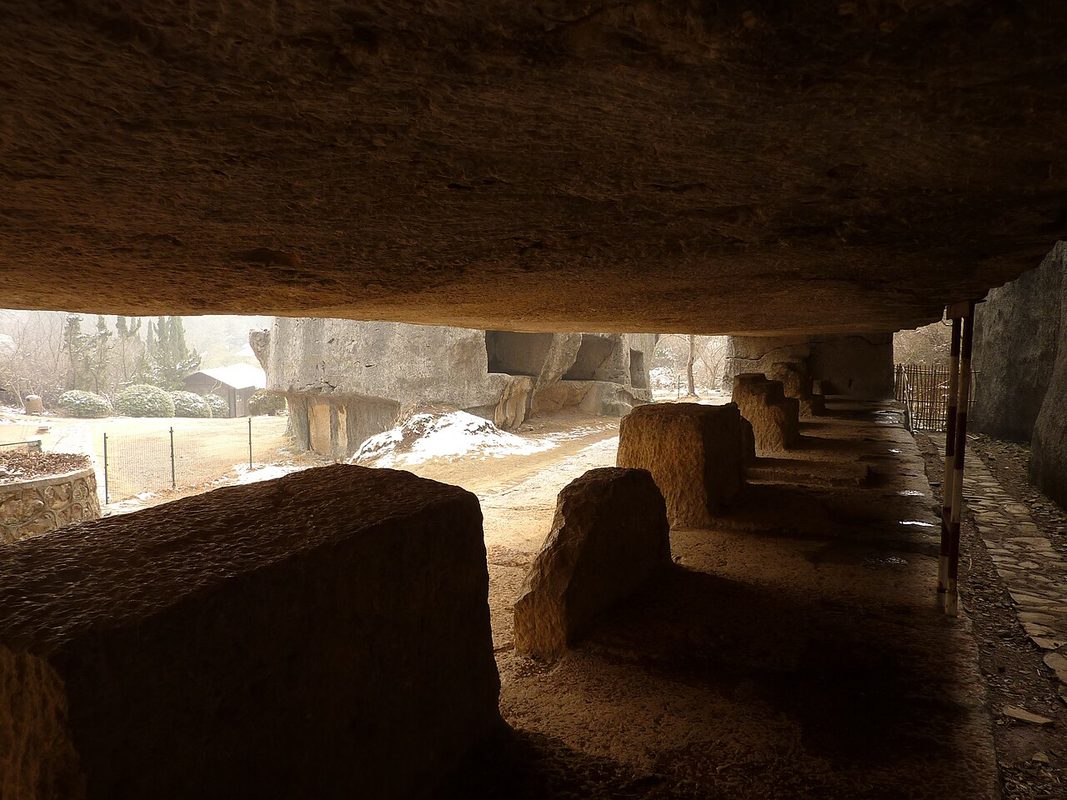
Image: User:Vmenkov, Wikimedia Commons, CC BY-SA 3.0. Resized; not otherwise altered. All credits.
📍 Where It Is Tangshan, 20 km east of Nanjing, Jiangsu Province, China 32.0658°, 119.0011°
🏛️ Mainstream Date Autumn 1405 CE (Ming Dynasty, commissioned by the Yongle Emperor) Excavated baseline
🧭 Leading Edge / Open Angle 16,250-ton block (406× the 40-ton test limit) shows where ancient hauling hit its wall Debated or newly revised
🪨 Heaviest Stone & Quarry 16,250 t base + 8,799 t shaft + 6,118 t head (left in quarry; ~100 t moved 18 km) 2.5× the 40-ton test limit · Compare all 64 sites →
30-SECOND TAKEAWAY

In Plain English — The 30-Second Takeaway

What It Is:

Yangshan Quarry near Nanjing holds the three heaviest human-shaped stone blocks anywhere on Earth, cut from a limestone mountainside in 1405 CE.

What Everyone Agrees On (Measured Facts):

Ordered by the Ming Yongle Emperor for a giant site, the three blocks weigh 16,250 tons. (base), 8,799 tons. Shaft. 6,118 tons. Head. Over 31,000 tons in total.

🏛️ Mainstream Archaeology View:

Historical records show thousands of quarry workers separated all three blocks from the cliff, realized they were impossible to drag 18 km to Nanjing. Erected a smaller 100-ton stele instead.

🧭 Leading Edge View:

At 10 times the weight of Baalbek's largest stone, Yangshan shows both how ancient-tool masons could cut multi-thousand-ton blocks. Also, the exact physical limit where hauling failed.

Site Story & Overview

Yangshan Quarry outside Nanjing contains the heaviest human-shaped monoliths on Earth—surpassing Baalbek's 1,650-ton quarry block and Aswan's 1,187-ton Unfinished Obelisk by an order of magnitude. In 1405 the Yongle Emperor ordered a three-part limestone stele for the Ming Xiaoling Mausoleum totaling over 31,000 tons.

▸ Read Full Archaeological & Engineering Context

Quarry crews successfully trenched around all three blocks and undercut their bases until they rested on rows of stone pillars ready to be knocked out, but neither the 16,250-ton base nor the 8,799-ton shaft nor the 6,118-ton head was ever moved a single metre. For our scale-gap review, Yangshan provides a recorded historical laboratory showing both how ancient-tool masons isolated multi-thousand-ton blocks from bedrock and why moving them overland proved impossible.

✓ What Is Physically Measured on Site

Dated samples, laser scans, stone weights, and dug finds kept separate from opinion.

🏛️ Mainstream Archaeological View

  • Accepted timeline: Early Ming Dynasty, autumn 1405 CE: commissioned by the Yongle Emperor (Zhu Di, r. 1402–1424) as a colossal commemorative stele for his father, the Hongwu Emperor, at the Ming Xiaoling Mausoleum before being abandoned in the quarry. The smaller completed ShenDaogongde Stele at Xiaoling (erected 1413) stands 8.78 m tall.
  • Stone & hardness: Carboniferous-Permiancrystalline bioclastic limestone — Mohs hardness 3.5–4.0 (Limestone) (on the 1–10 Mohs scale where a steel knife is ~5.5 and diamond is 10).
  • Quarry distance & alignment: Stone source 0 km (3 blocks left in quarry) / 18 km to Ming Xiaoling (~100 t erected stele). Orientation: East–west quarry trench following limestone bedding strike.

🧭 Leading Edge Proposal & Open Questions

  • Megalithic scale-gap analysts & Leading Edge researchers: Observe that the three unfinished Yangshan blocks (16,250 t base, 8,799 t body, and 6,118 t head—totalling >31,000 tons) are roughly 10× heavier than Baalbek's largest quarry block and 406× the 40-ton modern test sledge ceiling, demonstrating the physical upper boundary where ancient-tool stone transport broke down [1][2]

Tested Claims About Yangshan Quarry Megaliths (Nanjing)

ClaimStatusVerdict
How the world's megaliths were moved: what is shown, what is inferred, and where the gaps are
Can wooden sledges, ropes, wet sand, and dirt ramps explain how ancient crews moved stones weighing 80 to 860 tons?
ContestedMeasured in part: sledges, wetted or timber tracks, ramps and boats are documented, and finished monuments show ancient moves of about 750–860 t; no test of ancient methods we found goes above about 40 t, and the 1,000 t-plus Baalbek blocks never left the quarry
▸ View Engineering Callout Sources (7 lettered references)
  1. Richards, J. & Whitby, M. (1997). The engineering of Stonehenge. In Cunliffe, B. & Renfrew, C. (eds), Science and Stonehenge. Proceedings of the British Academy 92: 231–256 (PDF). https://www.thebritishacademy.ac.uk/documents/3921/92p231.pdf data
  2. NOVA (PBS airdate 12 Feb 1997). Secrets of Lost Empires: Obelisk, transcript: a forty-ton obelisk (US tons, about 36 t) dragged on a sledge at Aswan; it was not raised. https://www.pbs.org/wgbh/nova/transcripts/2405obelisk.html data
  3. NOVA (PBS airdate 8 Feb 2000). Secrets of Lost Empires: Pharaoh's Obelisk, transcript: a 25-ton block dragged on a timber roadbed and a 25-ton (perhaps 30-ton) obelisk raised from a sand pit. https://www.pbs.org/wgbh/nova/transcripts/27poobelisk.html data
  4. Li, J. & Chen, Z. (2016). Lubrication for transporting heavy objects in the history. Tribology Online 11(2): 242–249 (includes the Japanese shura sledge experiments). doi:10.2474/trol.11.242 background
  5. Harris, B. (2018). Moving megaliths: time to park the rollers. British Archaeology 163: 30–35 (author's accepted manuscript, UCL Discovery). https://discovery.ucl.ac.uk/id/eprint/10114174/ background
  6. Paludan, A. (1991). The Chinese Spirit Road: The Classical Tradition of Stone Tomb Statuary. New Haven: Yale University Press (documents the 1405 Yongle Yangshan stele project and Xiaoling). https://openlibrary.org/works/OL1893640W data
  7. UNESCO World Heritage Centre: Imperial Tombs of the Ming and Qing Dynasties — Ming Xiaoling Mausoleum, Nanjing (inscribed 2000/2003). https://whc.unesco.org/en/list/1004/ background

Visiting & base stays: Yangshan Quarry 16,250-Tonne Stele Megaliths & Ming Xiaoling (Nanjing, Jiangsu, China)

FTC affiliate disclosure: Tour links go to GetYourGuide and Viator. Hotel links use Stay22 (aid=solarevidence) for Booking.com and Expedia. If you book a trip, we may earn a small fee at no extra cost to you. All partner links use rel="sponsored nofollow noopener". Check travel alerts before you go. Partner fees never change our ratings. All 64 site field visits · Affiliate disclosure.

📚 Further Reading: Both Sides of the Argument

Top books from both sides of the debate on this topic. Browse all 34 books on Books & Further Reading or visit our Search for the Truth Bookshop.org storefront.

Mainstream Baseline 2017 ★ 4.7/5

Giza and the Pyramids: The Definitive History

Mark Lehner & Zahi Hawass

The Giza dig leaders share 30 years of finds, from the workers' town and stone quarries to Old Kingdom carbon dates.

▸ Why this book matters to both sides

The Giza dig teams' own large-format overview of decades of fieldwork on the plateau. It records the Heit el-Ghurab workers' town, limestone quarries, ramp remnants, and Old Kingdom carbon dates.

Role in the debate: Provides the primary archaeological and soil-layer baseline at Giza against which older-Sphinx, legacy-foundation, and precision-machining proposals are tested. (ISBN 9780226425696)

Mainstream Baseline 2014 ★ 4.6/5

The Incas (2nd ed.)

Terence N. D'Altroy

A clear guide to how the Inca built Cusco, Sacsayhuamán, and Ollantaytambo using stone hammers, quarries, and road crews.

▸ Why this book matters to both sides

Columbia University archaeologist Terence D'Altroy's leading survey of Inca origins, Cuzco royal estates, mit'a labor group, Rumiqolqa and Cachiccata quarries, and Andean stone building.

Role in the debate: Presents the mainstream ethnohistoric, carbon, and quarry evidence for fifteenth-century Inca building at Sacsayhuamán and Ollantaytambo alongside the open questions of polygonal fitting. (ISBN 9781444331158)

Leading Edge 2010 ★ 4.7/5

Lost Technologies of Ancient Egypt: Advanced Engineering in the Temples of the Pharaohs

Christopher Dunn

An engineer measures Egyptian granite boxes, statues, and drill cores with precision gauges to argue for advanced ancient tools.

▸ Why this book matters to both sides

Manufacturing engineer Christopher Dunn applies straightedges, radius gauges, and optical comparators to the Serapeum granite sarcophagi, Luxor Ramses statues, and Petrie's drill cores. It argues for high-speed mechanical tooling.

Role in the debate: Provides the primary Leading Edge metrology claims on Egyptian granite symmetry and flatness, contrasted on our precision pages with test copper-saw, tubular-drill, and pounder replications. (ISBN 9781591431022)

Leading Edge 2015 ★ 4.7/5

Magicians of the Gods: The Forgotten Wisdom of Earth's Lost Civilization

Graham Hancock

Links Göbekli Tepe, Baalbek, and the Younger Dryas comet debate to argue a cosmic impact erased an Ice Age world.

▸ Why this book matters to both sides

Integrates Göbekli Tepe, Baalbek, Gunung Padang. The Younger Dryas comet-impact idea. It argues Taurid meteor-stream impacts between 12,800 and 11,600 years ago erased an advanced culture.

Role in the debate: Sets out the strongest popular overview linking Göbekli Tepe's enclosures and Pillar 43 to the Younger Dryas impact debate. (ISBN 9781250118400)

FTC affiliate disclosure: Book links go to Bookshop.org (ID 130218, Search for the Truth). Each sale helps local bookstores and pays us a 10% fee at no extra cost to you. All partner links use rel="sponsored nofollow noopener". Fees never change our verdicts. Affiliate disclosure.

Primary Academic Sources

▸ View All Cited Primary Sources & DOIs (2 papers)
  1. Paludan, A. (1991). The Chinese Spirit Road: The Classical Tradition of Stone Tomb Statuary. New Haven: Yale University Press (documents the 1405 Yongle Yangshan stele project and Xiaoling). https://openlibrary.org/works/OL1893640W data
  2. UNESCO World Heritage Centre: Imperial Tombs of the Ming and Qing Dynasties — Ming Xiaoling Mausoleum, Nanjing (inscribed 2000/2003). https://whc.unesco.org/en/list/1004/ background

Dates and stone checks are summed up in plain English from the papers above. Measured facts stay separate from opinion. Methodology.