The Easter Island moai 'walked' to their platforms (and have hidden bodies)
Status: ContestedVerdict: Mostly measured: road moai have features suited to upright 'walking', and a replica walked; critics still favour horizontal transport. The 'buried bodies' are real and were buried by quarry soil
30-SECOND TAKEAWAY
In Plain English — The 30-Second Takeaway
What It Is:
Were Easter Island's stone statues rocked upright with ropes so they 'walked' down the roads. Also, why are some buried?
What Everyone Agrees On (Measured Facts):
In 2012, 18 people walked a 4.35-ton replica statue 100 meters in 40 minutes. Quarry statues have full bodies buried by 5 meters of hill dirt.
🏛️ Mainstream Archaeology View:
Some scholars favour the upright 'walking' method matching island way. Meanwhile, others think 80-ton statues needed wooden sledges.
🧭 Leading Edge View:
Both sides note the 4.35-ton walking test is still 18 times lighter than Paro, the 82-ton statue raised on the island.
Overview & Context
Almost all moai were carved from volcanic tuff at the Rano Raraku crater and moved up to about 20 km to ceremonial platforms (ahu). About 1,000 statues are known.
▸ Read Technical Background, Full Claim Wording & Academic Literature History
Formal claim tested: The moai of Rapa Nui were moved upright, rocked from side to side with ropes so they 'walked', as islanders' oral tradition says. Separately, the famous 'heads' on the slopes of the Rano Raraku quarry are full statues with bodies buried below ground.
Where the evidence stands: The buried bodies are measured: digs by the Easter Island Statue Project exposed statues standing in pits, buried up to the shoulders by soil washed down the quarry slope. Walking upright is supported by statue shape, road form, statues fallen along the roads, and a working experiment. A 2025 paper answers the critics. Some archaeologists still prefer horizontal transport on sledges or rails. No experiment has moved a full-size statue over a long distance. So the mechanism remains contested, though walking is better supported.
Those abandoned along the ancient roads ('road moai') differ in shape from those set up on platforms. For the wider debate about what happened to Rapanui society, see the collapse claim and the Rapa Nui site page.
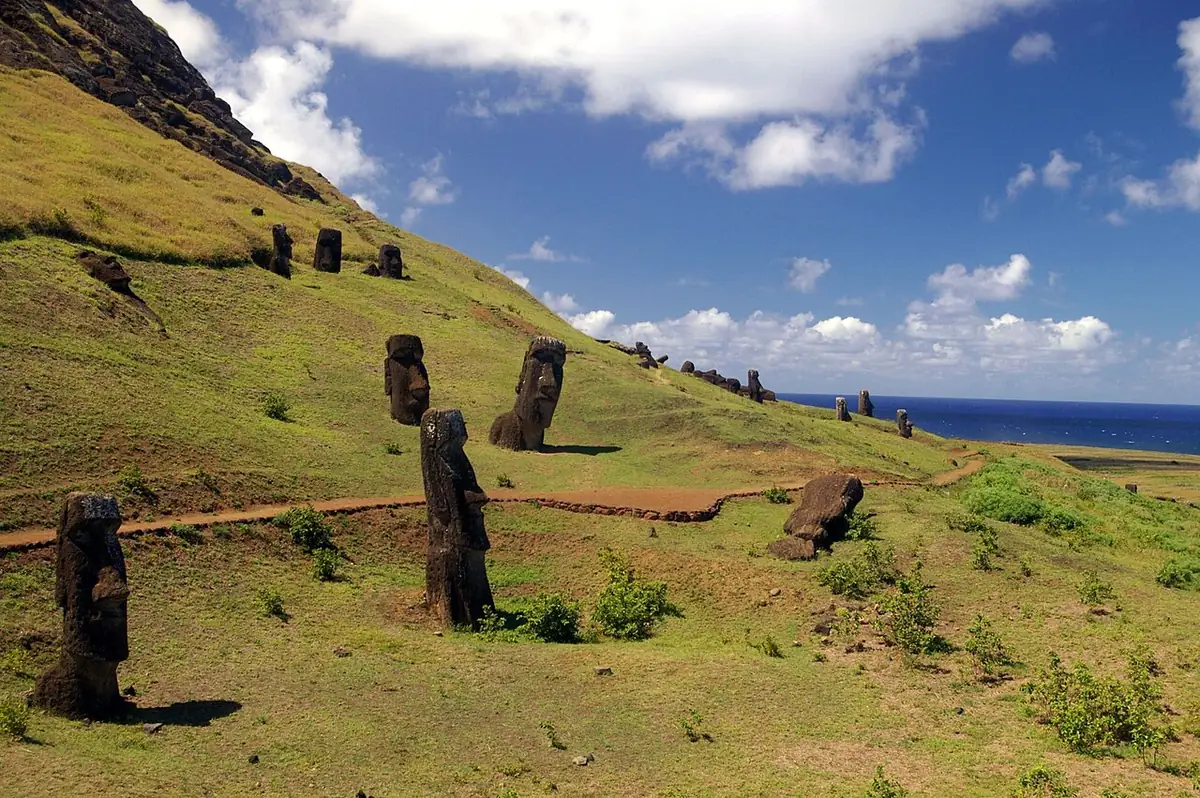
Moai on the slopes of Rano Raraku, the quarry where nearly all moai were carved and from which they were moved. Image: Rivi, CC BY-SA 3.0, via Wikimedia Commons. Resized.
✓ What Has Been Physically Measured
Dates, physical measurements, and excavated findings kept separate from interpretation.
Walking statue field test: Lipo and Hunt (2025) analysed 962 moai, including 62 road moai. Road moai have wider D-shaped bases and lean forward by about 6–15°, which keeps the centre of mass over the front edge, and they lack eye sockets, which were carved only on the platform. [2]
Walking statue field test: The roads are about 4.5 m wide with a concave cross-section, a shape that helps steady an upright statue. About half the road moai (51.6%) lie within 2 km of the quarry. About 37% of road moai show breaks consistent with falling from upright, 70% show chipping on the side edges of the base where rocking would load it, and fallen statues lie face-down on downhill slopes and on their backs uphill more often than chance (p < 0.02). [2][1]
Experiment: A 4.35-ton replica of a road moai was walked 100 m in 40 minutes by 18 people with three ropes. [2][1]
Excavation at Rano Raraku: The EISP team dug about 5 m down beside statue RR-001-156 and found its full body standing in a pit. The pit held carbon-dated deposits and basalt tools from island quarries, dated to around the 1400s CE. [3]
Statues 156 and 157 were: partly buried by colluvium (soil slumping down the slope) while upright. Rock art on the dug statues is dated to about the 16th–17th centuries. [4]
The EISP inventory holds: about 1,000 moai and about 1,300 single-stone sculptural objects in all, including those in the quarry. [6]
Walking statue field test: Lipo and Hunt argue that only upright transport explains the combination of road moai shape, concave roads and fall patterns, and that walking needs far fewer people and less timber than horizontal methods. [2]
Rapanui oral tradition says: the moai walked from the quarry. [2][1]
Richards and colleagues argue: that standing statues at the quarry were set up deliberately, and that the quarry was a ritual place where the moai were 'brought to life'. [5]
🏛️ Mainstream Archaeological View & Evidence
Key finding: Jo Anne Van Tilburg, director of the EISP, called the 2012 walking demonstration a 'stunt' with an inaccurate model, and has long modelled horizontal transport on wooden frames. Bahn and Flenley called the walking experiments unnecessary (both as reported by Lipo and Hunt). [2]
Walking statue field test: The experiment used a 4.35-ton replica over 100 m. Statues over 10 m tall and weighing about 74 tons were moved more than 5 km, so walking at full scale over such distances is inferred from physics and evidence, not showed. [2]
🔬 What Future Tests Would Settle It
A full-size walking trial on a reconstructed road section, and wear studies of moai bases, would test the idea directly. Dating more road segments and fallen road moai would show when transport took place.
Richards, J. & Whitby, M. (1997). The engineering of Stonehenge. In Cunliffe, B. & Renfrew, C. (eds), Science and Stonehenge. Proceedings of the British Academy 92: 231–256 (PDF). https://www.thebritishacademy.ac.uk/documents/3921/92p231.pdfdata
NOVA (PBS airdate 8 Feb 2000). Secrets of Lost Empires: Pharaoh's Obelisk, transcript: a 25-ton block dragged on a timber roadbed and a 25-ton (perhaps 30-ton) obelisk raised from a sand pit. https://www.pbs.org/wgbh/nova/transcripts/27poobelisk.htmldata
Li, J. & Chen, Z. (2016). Lubrication for transporting heavy objects in the history. Tribology Online 11(2): 242–249 (includes the Japanese shura sledge experiments). doi:10.2474/trol.11.242background
Harris, B. (2018). Moving megaliths: time to park the rollers. British Archaeology 163: 30–35 (author's accepted manuscript, UCL Discovery). https://discovery.ucl.ac.uk/id/eprint/10114174/background
Easter Island Statue Project. Statue Paro (about 9.8 m, about 82 t). https://eisp.org/1954/background
Lipo, C. P. & Hunt, T. L. (2025). The walking moai hypothesis: archaeological evidence, experimental validation, and response to critics. Journal of Archaeological Science 183: 106383. doi:10.1016/j.jas.2025.106383data
1491: New Revelations of the Americas Before Columbus (2nd ed.)
Charles C. Mann
Shows how new digs and laser maps proved the ancient Americas held big cities, roads, and farms long before Columbus.
▸ Why this book matters to both sides
Surveys the archaeological, botanical, and demographic discoveries showing that the pre-Columbian Americas—from Caral-Supe and the Amazon basin to Cahokia—were older, more populous, and more engineered than once taught.
Role in the debate: Documents how mainstream field evidence overturned the 20th-century 'pristine wilderness' model in the Amazon and pushed giant buildings in Peru back to the third millennium BCE. (ISBN 9781400032051)
Examines how hunter-gatherers built giant stone sites like Göbekli Tepe and Poverty Point without kings or farming.
▸ Why this book matters to both sides
An culture scholar and an archaeologist examine Göbekli Tepe, Karahan Tepe, Poverty Point, Watson Brake, and Teotihuacan. It challenges the textbook step-by-step ladder from small hunter-gatherer bands to states.
Role in the debate: Shows how mainstream archaeology accounts for giant buildings built by hunter-gatherers (Göbekli Tepe, Poverty Point) without invoking a single global parent culture. (ISBN 9781250858801)
Forgotten Civilization: New Discoveries on the Solar-Induced Dark Age (Revised ed.)
Robert M. Schoch with Catherine Ulissey
Geologist Robert Schoch sets out his rain-erosion case for an older Sphinx and his theory of a giant solar blast in 9700 BCE.
▸ Why this book matters to both sides
Boston University geologist Robert Schoch details his geological and seismic-refraction case for an older Great Sphinx alongside his idea that extreme solar proton outbursts ended the last Ice Age around 9700 BCE.
Role in the debate: Presents the geological case for precipitation-induced weathering on the Sphinx enclosure walls and the solar-disaster alternative to the Younger Dryas comet idea. (ISBN 9781644112922)
Magicians of the Gods: The Forgotten Wisdom of Earth's Lost Civilization
Graham Hancock
Links Göbekli Tepe, Baalbek, and the Younger Dryas comet debate to argue a cosmic impact erased an Ice Age world.
▸ Why this book matters to both sides
Integrates Göbekli Tepe, Baalbek, Gunung Padang. The Younger Dryas comet-impact idea. It argues Taurid meteor-stream impacts between 12,800 and 11,600 years ago erased an advanced culture.
Role in the debate: Sets out the strongest popular overview linking Göbekli Tepe's enclosures and Pillar 43 to the Younger Dryas impact debate. (ISBN 9781250118400)
FTC affiliate disclosure: Book links go to Bookshop.org (ID 130218, Search for the Truth). Each sale helps local bookstores and pays us a 10% fee at no extra cost to you. All partner links use rel="sponsored nofollow noopener". Fees never change our verdicts. Affiliate disclosure.
Visiting & base stays: Rapa Nui (Easter Island): Rano Raraku Quarry, Ahu Tongariki & Orongo (Hanga Roa, Chile)
FTC affiliate disclosure: Tour links go to GetYourGuide and Viator. Hotel links use Stay22 (aid=solarevidence) for Booking.com and Expedia. If you book a trip, we may earn a small fee at no extra cost to you. All partner links use rel="sponsored nofollow noopener". Check travel alerts before you go. Partner fees never change our ratings. All 64 site field visits · Affiliate disclosure.
Primary Academic Sources
▸ View All Cited Primary Sources & DOIs (6 papers)
Lipo, C. P., Hunt, T. L. & Rapu Haoa, S. (2013). The ‘walking’ megalithic statues (moai) of Easter Island. Journal of Archaeological Science 40. doi:10.1016/j.jas.2012.09.029data
Lipo, C. P. & Hunt, T. L. (2025). The walking moai hypothesis: archaeological evidence, experimental validation, and response to critics. Journal of Archaeological Science 183: 106383. doi:10.1016/j.jas.2025.106383data
Simpson, D. J. Jr., Van Tilburg, J. A. & Dussubieux, L. (2018). Geochemical and radiometric analyses of archaeological remains from Easter Island’s moai (statue) quarry. Journal of Pacific Archaeology 9(2). doi:10.70460/jpa.v9i2.230data
Van Tilburg, J. A. et al. (2021). Rock art on excavated monolithic statues (moai), Rano Raraku statue quarry, Rapa Nui (Easter Island). Archaeology in Oceania 56. doi:10.1002/arco.5253data
Richards, C., Croucher, K., Paoa, T. et al. (2011). Road my body goes: re-creating ancestors from stone at the great moai quarry of Rano Raraku. World Archaeology 43(2). doi:10.1080/00438243.2011.579483data
Easter Island Statue Project (Van Tilburg, J. A., director): project site and statue inventory. https://www.eisp.org/background
Sources checked against Crossref and publisher pages on 2026-10-23. This entry presents a debated idea neutrally: the proponents' case first, then the mainstream position, in plain English. "Open question" is not a judgment that the idea is true or false. Labels describe the claim, not the people who hold it. Methodology.