Claims › Megalithic construction › Easter Island's people destroyed their environment and collapsed before Europeans arrived
Easter Island's people destroyed their environment and collapsed before Europeans arrived
Status: Contested
Verdict: Newest data contradict a pre-contact collapse: genomes show no 1600s population crash, gardens supported only a few thousand people, and ahu building continued past 1722; deforestation is real
30-SECOND TAKEAWAY
In Plain English — The 30-Second Takeaway
What It Is: Did Easter Islanders really cut down their trees, starve, and collapse in war before Europeans arrived in 1722?
What Everyone Agrees On (Measured Facts): A 2024 ancient DNA study found no 1600s population crash. Rock-garden maps show the island fed ~3,000–4,000 people past 1722.
🏛️ Mainstream Archaeology View: New genetic and dig data show islanders adapted well with rock gardens until 1800s slave raids and smallpox hit.
🧭 Leading Edge View: Older environmental models led by Jared Diamond still argue palm loss caused severe soil erosion before 1722.
Overview & Context
Jared Diamond's Collapse (2005) made Rapa Nui the best-known example of self-inflicted collapse. From the 2000s, Terry Hunt, Carl Lipo and colleagues argued instead for a small, resilient population hit hardest by contact-era disease and slavery.
▸ Read Technical Background, Full Claim Wording & Academic Literature History
Formal claim tested: The Rapanui cut down the island's forest to move moai, causing soil loss, famine and warfare, and their population crashed from perhaps 15,000 or more to a few thousand before Europeans arrived in 1722. This 'ecocide' is presented as a warning for the planet.
Where the evidence stands: The forest loss is real, but the pre-contact collapse is not supported by the newest primary data. Ancient genomes show no severe population bottleneck in the 1600s. Island-wide mapping shows the rock gardens were far smaller than assumed and could feed only about 4,000 people. Bayesian dating shows platform building continued after European contact. The major population decline is better explained by introduced disease and the 1860s slave raids. Collapse accounts are still held by some authors, so this is listed as contested, with the new findings weighted accordingly.
Two 2024 studies, one in Nature and one in Science Advances, added separate lines of evidence. Rapa Nui's statues and their transport are covered in the walking moai claim.
✓ What Has Been Physically Measured
Dates, physical measurements, and excavated findings kept separate from interpretation.
- Lake cores show: the palm-dominated forest was replaced by grassland. Newer, gap-free cores show this happened gradually and at different times in different places, with drought as well as people as causes. [2]
- 2024 finding: Whole genomes of 15 Rapanui individuals carbon-dated to 1670–1950 CE show no severe population bottleneck in the 1600s. They also show about 10% Native American ancestry from contact around 1250–1430 CE. [3]
- 2024 finding: Shortwave-infrared satellite imagery and machine learning mapped about 0.76 km² of rock gardens, far less than an earlier estimate of 4.3–21.1 km². This could have supported about 4,000 people, not the figures of up to about 17,000 proposed in some collapse accounts. [4][5]
- 2020 finding: Bayesian models of carbon dates from 11 ahu show building began within a few centuries of town (1150–1280 CE), was fastest about 1350–1450, and continued at a steady rate past European contact in 1722. [6]
- An island-wide review of radiocarbon dates: found town and land use continuing up to European contact, without a sharp earlier collapse. [7]
How carbon dates work, and their limits: How we date sites.
🧭 Proponents' Case & Cited Evidence
- Key finding: Diamond argues that clearing the forest for farming, fuel and statue transport led to soil erosion, loss of canoe timber, food shortage and social breakdown before 1722. [1]
- The deforestation is: real and coincides with the centuries of human occupation, and many moai were found toppled by the 19th century. [2]
🏛️ Mainstream Archaeological View & Evidence
- Key finding: The genome study rejects a 1600s bottleneck in simulations, and reconstructs a population that kept growing until the 1860s. [3]
- Key finding: The garden mapping implies a population of a few thousand at most, so the large crash in many collapse accounts may never have been possible. [4]
- Key finding: Rull's review of paleoecology concludes that the Rapanui remained resilient to deforestation and healthy until European contact. [2]
- Key finding: Monument building continuing after 1722 does not fit a society that had already collapsed. [6]
🔬 What Future Tests Would Settle It
More dated skeletons from before 1600, and dated household sites across the island, would test population size and change directly. Studies of diet in dated remains would show whether there was a pre-contact food crisis.
Ancient Sites Involved
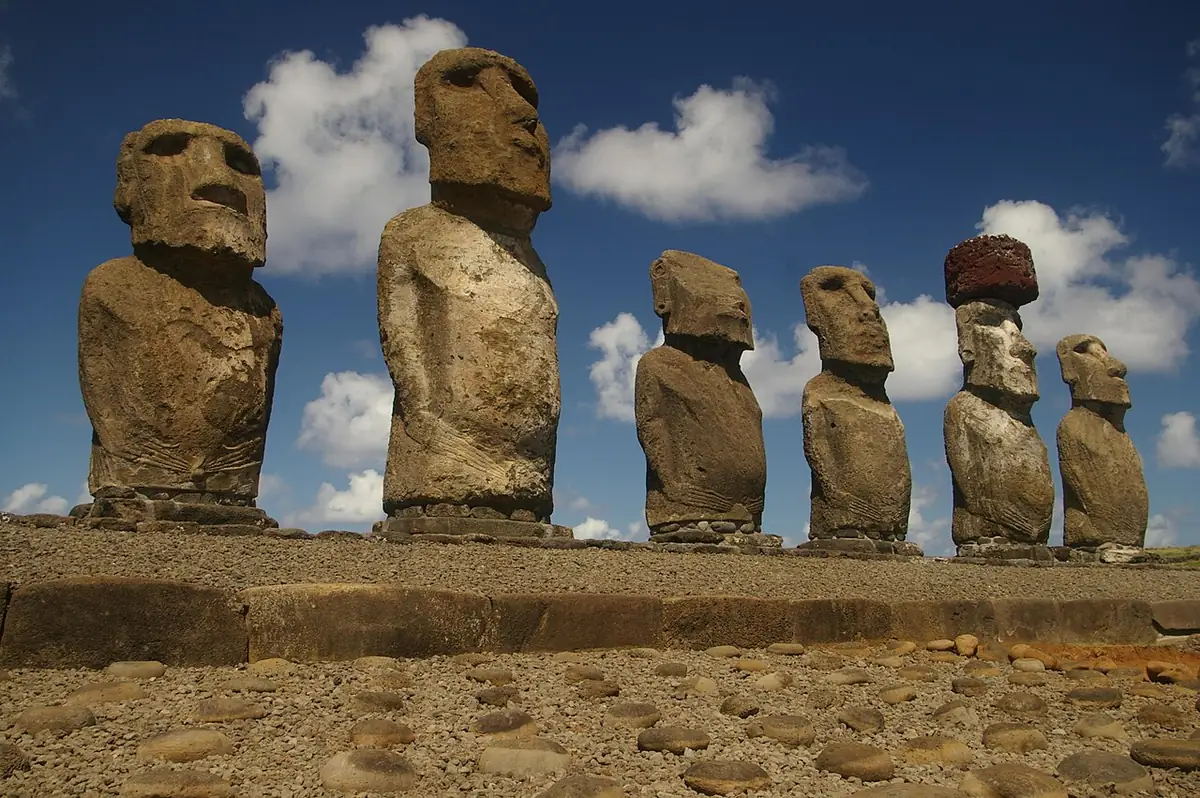
Rapa Nui (Easter Island) moai and Rano Raraku
Related Tested Claims
📚 Further Reading: Both Sides of the Argument
Top books from both sides of the debate on this topic. Browse all 34 books on Books & Further Reading or visit our Search for the Truth Bookshop.org storefront.
Mainstream Baseline
2005
★ 4.6/5
1491: New Revelations of the Americas Before Columbus (2nd ed.)
Charles C. Mann
Shows how new digs and laser maps proved the ancient Americas held big cities, roads, and farms long before Columbus.
▸ Why this book matters to both sides
Surveys the archaeological, botanical, and demographic discoveries showing that the pre-Columbian Americas—from Caral-Supe and the Amazon basin to Cahokia—were older, more populous, and more engineered than once taught.
Role in the debate: Documents how mainstream field evidence overturned the 20th-century 'pristine wilderness' model in the Amazon and pushed giant buildings in Peru back to the third millennium BCE. (ISBN 9781400032051)
Mainstream Baseline
2021
★ 4.5/5
The Dawn of Everything: A New History of Humanity
David Graeber & David Wengrow
Examines how hunter-gatherers built giant stone sites like Göbekli Tepe and Poverty Point without kings or farming.
▸ Why this book matters to both sides
An culture scholar and an archaeologist examine Göbekli Tepe, Karahan Tepe, Poverty Point, Watson Brake, and Teotihuacan. It challenges the textbook step-by-step ladder from small hunter-gatherer bands to states.
Role in the debate: Shows how mainstream archaeology accounts for giant buildings built by hunter-gatherers (Göbekli Tepe, Poverty Point) without invoking a single global parent culture. (ISBN 9781250858801)
Leading Edge
2012
★ 4.7/5
Forgotten Civilization: New Discoveries on the Solar-Induced Dark Age (Revised ed.)
Robert M. Schoch with Catherine Ulissey
Geologist Robert Schoch sets out his rain-erosion case for an older Sphinx and his theory of a giant solar blast in 9700 BCE.
▸ Why this book matters to both sides
Boston University geologist Robert Schoch details his geological and seismic-refraction case for an older Great Sphinx alongside his idea that extreme solar proton outbursts ended the last Ice Age around 9700 BCE.
Role in the debate: Presents the geological case for precipitation-induced weathering on the Sphinx enclosure walls and the solar-disaster alternative to the Younger Dryas comet idea. (ISBN 9781644112922)
Leading Edge
2015
★ 4.7/5
Magicians of the Gods: The Forgotten Wisdom of Earth's Lost Civilization
Graham Hancock
Links Göbekli Tepe, Baalbek, and the Younger Dryas comet debate to argue a cosmic impact erased an Ice Age world.
▸ Why this book matters to both sides
Integrates Göbekli Tepe, Baalbek, Gunung Padang. The Younger Dryas comet-impact idea. It argues Taurid meteor-stream impacts between 12,800 and 11,600 years ago erased an advanced culture.
Role in the debate: Sets out the strongest popular overview linking Göbekli Tepe's enclosures and Pillar 43 to the Younger Dryas impact debate. (ISBN 9781250118400)
FTC affiliate disclosure: Book links go to Bookshop.org (ID 130218, Search for the Truth). Each sale helps local bookstores and pays us a 10% fee at no extra cost to you. All partner links use rel="sponsored nofollow noopener". Fees never change our verdicts. Affiliate disclosure.
Visiting & base stays: Rapa Nui (Easter Island): Rano Raraku Quarry, Ahu Tongariki & Orongo (Hanga Roa, Chile)
FTC affiliate disclosure: Tour links go to GetYourGuide and Viator. Hotel links use Stay22 (aid=solarevidence) for Booking.com and Expedia. If you book a trip, we may earn a small fee at no extra cost to you. All partner links use rel="sponsored nofollow noopener". Check travel alerts before you go. Partner fees never change our ratings. All 64 site field visits · Affiliate disclosure.
Primary Academic Sources
▸ View All Cited Primary Sources & DOIs (7 papers)
- Diamond, J. (2005). Collapse: How Societies Choose to Fail or Succeed. Viking (catalogue record). https://openlibrary.org/search?q=collapse+jared+diamond proponent
- Rull, V. (2020). The deforestation of Easter Island. Biological Reviews 95 (online 2019). doi:10.1111/brv.12556 data
- Moreno-Mayar, J. V. et al. (2024). Ancient Rapanui genomes reveal resilience and pre-European contact with the Americas. Nature 633. doi:10.1038/s41586-024-07881-4 data
- Davis, D. S., DiNapoli, R. J., Pakarati, G. et al. (2024). Island-wide characterization of agricultural production challenges the demographic collapse hypothesis for Rapa Nui. Science Advances 10. doi:10.1126/sciadv.ado1459 data
- Ladefoged, T. N., Flaws, A. & Stevenson, C. M. (2013). The distribution of rock gardens on Rapa Nui as determined from satellite imagery. Journal of Archaeological Science 40. doi:10.1016/j.jas.2012.09.006 data
- DiNapoli, R. J., Rieth, T. M., Lipo, C. P. & Hunt, T. L. (2020). A model-based approach to the tempo of “collapse”: the case of Rapa Nui. Journal of Archaeological Science 116. doi:10.1016/j.jas.2020.105094 data
- Mulrooney, M. A. (2013). An island-wide assessment of the chronology of settlement and land use on Rapa Nui based on radiocarbon data. Journal of Archaeological Science 40. doi:10.1016/j.jas.2013.06.020 data
More in this section: Megalithic construction.
Sources checked against Crossref and publisher pages on 2026-10-23. This entry presents a debated idea neutrally: the proponents' case first, then the mainstream position, in plain English. "Open question" is not a judgment that the idea is true or false. Labels describe the claim, not the people who hold it. Methodology.