△ TruthInStone

Sites › Europe › Antikythera Shipwreck & Mechanism (Greece)

Antikythera Shipwreck & Mechanism (Greece)

Antikythera Shipwreck & Mechanism (Greece)
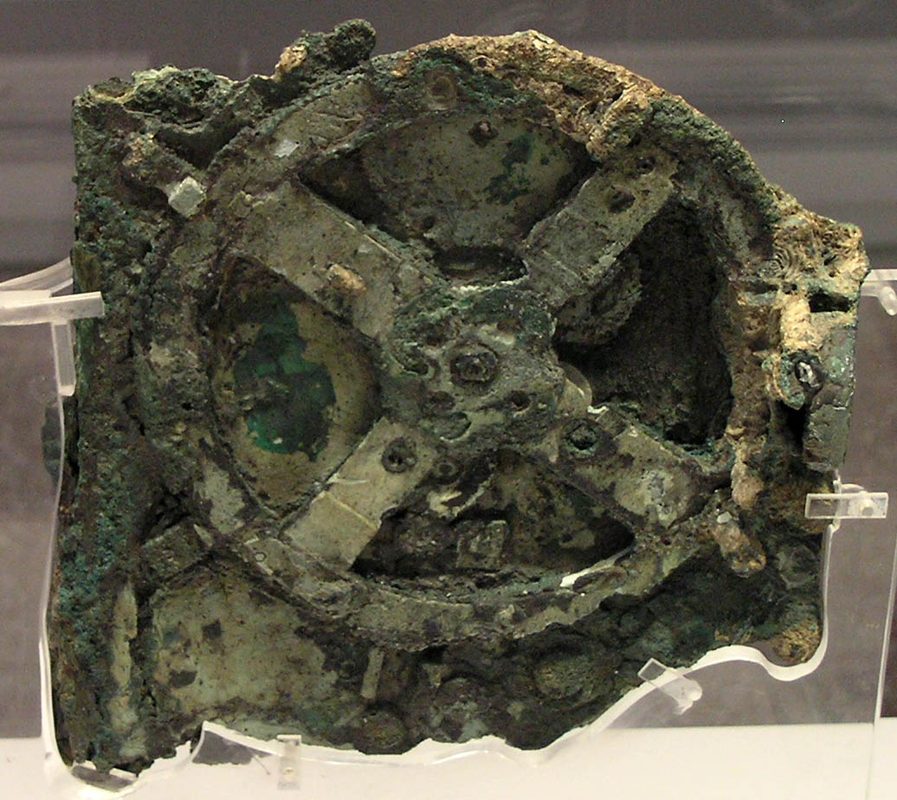
Image: Marsyas, Wikimedia Commons, CC BY 2.5. Resized; not otherwise altered. All credits.
📍 Where It Is Off Antikythera Island, Greece (Athens National Museum) 35.8890°, 23.3100°
🏛️ Mainstream Date c. 150–60 BCE Hellenistic Greek geared cosmos calculator Excavated baseline
🧭 Leading Edge / Open Angle Proves one shipwreck can overturn centuries of technology assumptions Debated or newly revised
🪨 Heaviest Stone & Quarry Precision bronze gear train (30+ gears, 1–2 mm teeth) + marble statues 0.1× the 40-ton test limit · Compare all 64 sites →
30-SECOND TAKEAWAY

In Plain English — The 30-Second Takeaway

What It Is:

The Antikythera Mechanism is a shoebox-sized bronze gear computer pulled in 1901 from a Roman-era shipwreck 150 feet deep off Greece.

What Everyone Agrees On (Measured Facts):

3D X-ray scans of the 82 corroded bronze pieces reveal at least 30 hand-cut gears with tiny 1.5-mm teeth, eclipse dials, and over 3,400 Greek letters.

🏛️ Mainstream Archaeology View:

Historians date the device to 150–60 BCE in the Greek school of Archimedes and Hipparchus. It tracked the Sun, Moon, planets, and Olympic games.

🧭 Leading Edge View:

Researchers highlight that this single lucky find overturned centuries of beliefs about ancient metalwork, showing how easily advanced tools vanish.

Site Story & Overview

In the spring of 1900, Greek sponge divers sheltering from a storm off the small island of Antikythera discovered a giant 1st-century BCE shipwreck 42 to 60 m (138 to 197 feet) below the surface. Among the marble horses, bronze statues, and luxury glassware raised in 1901 was a corroded, shoebox-sized lump of bronze and wood.

▸ Read Full Archaeological & Engineering Context

When it split open at the National Archaeological Museum in Athens in May 1902, archaeologist Valerios Stais spotted precision gear wheels and tiny Greek sky carved texts. Radiographic studies by Derek de Solla Price (1974) and 3D X-ray CT scans led by Tony Freeth and Alexander Jones (2006–2021) proved the device is a 30+ gear mechanical cosmos calculator built between 150 and 60 BCE. Both mainstream historians and Leading Edge writers point to it as a landmark warning against assuming ancient craftspeople lacked complex mechanical tools simply because metal rarely survives.

✓ What Is Physically Measured on Site

Dated samples, laser scans, stone weights, and dug finds kept separate from opinion.

🏛️ Mainstream Archaeological View

  • Accepted timeline: Hellenistic Greek geared sky calculator and planetarium built c. 150–60 BCE (within the school of Archimedes, Hipparchus, or Posidonius on Rhodes or Syracuse) and lost aboard a Roman-era cargo ship c. 70–60 BCE.
  • Stone & hardness: Low-lead tin bronze gearwork (34 × 18 × 9 cm case) & Parian marble cargo — Mohs hardness 4.0 (Bronze alloy / Marble cargo) (on the 1–10 Mohs scale where a steel knife is ~5.5 and diamond is 10).
  • Quarry distance & alignment: Stone source ~350–500 km by Aegean cargo ship from Rhodes / Pergamon / Paros. Orientation: 223-month Saros eclipse dial, 19-year Metonic solar/lunar calendar & 5-planet cosmos display.

🧭 Leading Edge Proposal & Open Questions

  • Leading Edge & history-of-technology researchers: Fragility of ancient high technology: Cite the Antikythera Mechanism as physical proof that a single surviving shipwreck overturned centuries of textbook assumptions about ancient precision building—showing how easily metal instruments vanish from the archaeological record. [1][2][4]

Tested Claims About Antikythera Shipwreck & Mechanism (Greece)

ClaimStatusVerdict
Precision and shaping in ancient stonework: what has been measured, what has been replicated
Did tight stone joints, flat granite boxes, drill cores, and stone vases require advanced machine tools?
Leading EdgeMeasured in part: tolerances of about 0.25–0.5 mm (Giza casing) and ±1–2 mm survey precision (Tiwanaku) are documented; copper-and-sand and hammerstone methods are replicated at small scale; how the sharpest interior angles, Petrie's spiral-grooved core and the finest vessels were finished is an open question
The Antikythera Mechanism proves ancient workshops built geared astronomical computers centuries ahead of medieval clocks
What does the 2,100-year-old Antikythera Mechanism prove about ancient Greek precision gear making?
MainstreamMeasured: micro-focus X-ray CT scans confirm at least 30 precision bronze gears (1–2 mm teeth), pin-and-slot epicyclic lunar gearing, and eclipse/calendar dials built c. 150–60 BCE

Visiting & base stays: Antikythera Mechanism Exhibition at the National Archaeological Museum (Athens, Greece)

FTC affiliate disclosure: Tour links go to GetYourGuide and Viator. Hotel links use Stay22 (aid=solarevidence) for Booking.com and Expedia. If you book a trip, we may earn a small fee at no extra cost to you. All partner links use rel="sponsored nofollow noopener". Check travel alerts before you go. Partner fees never change our ratings. All 64 site field visits · Affiliate disclosure.

📚 Further Reading: Both Sides of the Argument

Top books from both sides of the debate on this topic. Browse all 34 books on Books & Further Reading or visit our Search for the Truth Bookshop.org storefront.

Mainstream Baseline 2021 ★ 4.6/5

1177 B.C.: The Year Civilization Collapsed (Revised & Updated)

Eric H. Cline

Explains how Bronze Age kingdoms around the Mediterranean collapsed within decades from drought, quakes, and broken trade.

▸ Why this book matters to both sides

Tests how the globalized Bronze Age kingdoms of Egypt, Hatti, Mycenae, and Ugarit collapsed within a few decades through interlocking megadrought, earthquake storms, famine, and cut trade networks.

Role in the debate: Provides a benchmark case study of how archaeologists use pollen cores, ancient climate proxies, seismic horizons, and royal letters to reconstruct a rapid multi-civilizational collapse. (ISBN 9780691208015)

Mainstream Baseline 2017 ★ 4.7/5

Giza and the Pyramids: The Definitive History

Mark Lehner & Zahi Hawass

The Giza dig leaders share 30 years of finds, from the workers' town and stone quarries to Old Kingdom carbon dates.

▸ Why this book matters to both sides

The Giza dig teams' own large-format overview of decades of fieldwork on the plateau. It records the Heit el-Ghurab workers' town, limestone quarries, ramp remnants, and Old Kingdom carbon dates.

Role in the debate: Provides the primary archaeological and soil-layer baseline at Giza against which older-Sphinx, legacy-foundation, and precision-machining proposals are tested. (ISBN 9780226425696)

Bridge / Debate History 1969 ★ 4.6/5

Hamlet's Mill: An Essay Investigating the Origins of Human Knowledge and Its Transmissions Through Myth

Giorgio de Santillana & Hertha von Dechend

Two science historians argue that ancient stories worldwide preserve real observations of the 26,000-year wobble of the stars.

▸ Why this book matters to both sides

Written by historians of science at MIT and Frankfurt University. The author argues ancient stories worldwide encode technical findings of the 26,000-year sky wobble of the equinoxes and shifting world ages.

Role in the debate: The scholarly bridge between academic history of astronomy and modern sky-sightline claims about sky-cycle coding at Giza, Angkor, and Göbekli Tepe. (ISBN 9780879232153)

Leading Edge 2010 ★ 4.7/5

Lost Technologies of Ancient Egypt: Advanced Engineering in the Temples of the Pharaohs

Christopher Dunn

An engineer measures Egyptian granite boxes, statues, and drill cores with precision gauges to argue for advanced ancient tools.

▸ Why this book matters to both sides

Manufacturing engineer Christopher Dunn applies straightedges, radius gauges, and optical comparators to the Serapeum granite sarcophagi, Luxor Ramses statues, and Petrie's drill cores. It argues for high-speed mechanical tooling.

Role in the debate: Provides the primary Leading Edge metrology claims on Egyptian granite symmetry and flatness, contrasted on our precision pages with test copper-saw, tubular-drill, and pounder replications. (ISBN 9781591431022)

FTC affiliate disclosure: Book links go to Bookshop.org (ID 130218, Search for the Truth). Each sale helps local bookstores and pays us a 10% fee at no extra cost to you. All partner links use rel="sponsored nofollow noopener". Fees never change our verdicts. Affiliate disclosure.

Primary Academic Sources

▸ View All Cited Primary Sources & DOIs (5 papers)
  1. Price, D. de Solla (1974). Gears from the Greeks: The Antikythera Mechanism — A Calendar Computer from ca. 80 B.C. Transactions of the American Philosophical Society 64(7): 1–70. doi:10.2307/1006146 data
  2. Freeth, T., Bitsakis, Y., Moussas, X. et al. (2006). Decoding the ancient Greek astronomical calculator known as the Antikythera Mechanism. Nature 444: 587–591. doi:10.1038/nature05357 data
  3. Freeth, T., Jones, A., Steele, J. M. & Bitsakis, Y. (2008). Calendars with Olympiad display and eclipse prediction on the Antikythera Mechanism. Nature 454: 614–617. doi:10.1038/nature07130 data
  4. Freeth, T., Higgon, D., Dacanalis, A., MacDonald, L., Georgakopoulou, M. & Wojcik, A. (2021). A Model of the Cosmos in the ancient Greek Antikythera Mechanism. Scientific Reports 11: 5821. doi:10.1038/s41598-021-84310-w data
  5. Jones, A. (2017). A Portable Cosmos: Revealing the Antikythera Mechanism, Scientific Wonder of the Ancient World (review record in Almagest 8). Oxford University Press. doi:10.1484/j.almagest.5.113701 background

Dates and stone checks are summed up in plain English from the papers above. Measured facts stay separate from opinion. Methodology.