△ TruthInStone

Claims › Sky alignments & sacred landscapes › The Antikythera Mechanism proves ancient workshops built geared astronomical computers centuries ahead of medieval clocks

The Antikythera Mechanism proves ancient workshops built geared astronomical computers centuries ahead of medieval clocks

Status: Mainstream Verdict: Measured: micro-focus X-ray CT scans confirm at least 30 precision bronze gears (1–2 mm teeth), pin-and-slot epicyclic lunar gearing, and eclipse/calendar dials built c. 150–60 BCE
30-SECOND TAKEAWAY

In Plain English — The 30-Second Takeaway

What It Is:

What does the 2,100-year-old Antikythera Mechanism prove about ancient Greek precision gear making?

What Everyone Agrees On (Measured Facts):

Sponge divers pulled 82 corroded bronze fragments from a Greek shipwreck in 1901. X-ray scans reveal at least 30 hand-cut bronze gears with tiny 1.5-mm teeth inside a wooden frame.

🏛️ Mainstream Archaeology View:

Hellenistic Greek workshops built this geared sky calculator around 150–60 BCE. It tracked the Sun, Moon, eclipses, and Olympic games using gear math from Archimedes and Hipparchus.

🧭 Leading Edge View:

Researchers point out that this single surviving shipwreck overturned centuries of assumptions, proving high-precision metal instruments can vanish from the ground record.

Overview & Context

Sponge divers pulled 82 corroded bronze pieces from the Antikythera Shipwreck in 1901. Before this find, many scholars doubted Roman stories of geared sky spheres built by Archimedes.

▸ Read Technical Background, Full Claim Wording & Academic Literature History

Formal claim tested: Recovered from a 1st-century BCE Roman-era shipwreck off Greece, the Antikythera Mechanism is a 30+ gear bronze mechanical computer that calculated solar, lunar, planetary, and eclipse cycles with a complexity not seen again in surviving artifacts until 14th-century European sky clocks.

Why this label applies: Confirmed by peer-reviewed X-ray radiography (Price 1974) and high-resolution 3D X-ray computed tomography and surface imaging published in Nature (Freeth et al. 2006, 2008) and Scientific Reports (Freeth et al. 2021). Both mainstream historians of science and Leading Edge researchers agree that this single surviving shipwreck artifact overturned long-held assumptions about the ceiling of ancient precision metalworking.

Micro-focus X-ray CT scans in 2005–2021 revealed a shoebox-sized instrument containing at least 30 hand-cut bronze gears with 1–2 mm triangular teeth, epicyclic pin-and-slot gearing for the Moon's elliptical orbit, a 223-month Saros eclipse dial, and a 4-year Olympiad dial. See also the worldwide precision stonework review and solar and sky alignments.

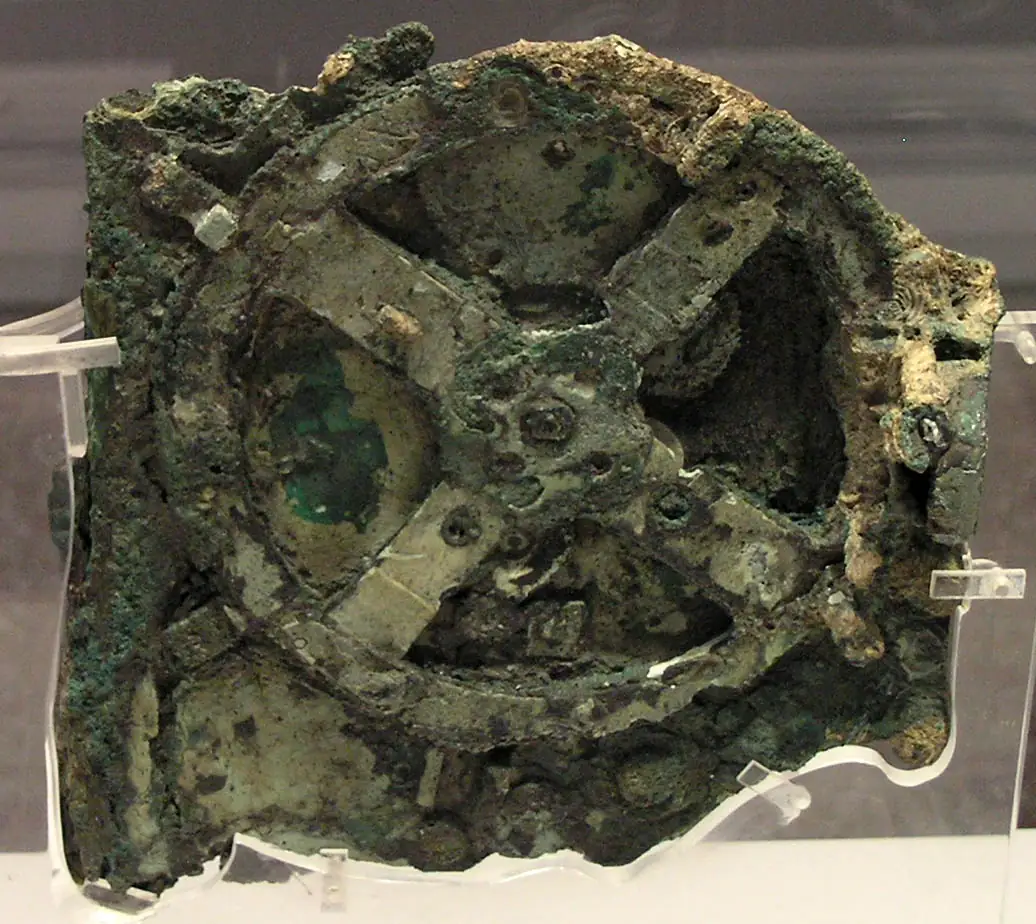
Fragment A of the Antikythera Mechanism showing corroded bronze gear wheels in the National Archaeological Museum, Athens
Fragment A of the Antikythera Mechanism, housing the main drive wheel and stacked bronze gear trains. Image: Marsyas, CC BY 2.5, via Wikimedia Commons. Resized.
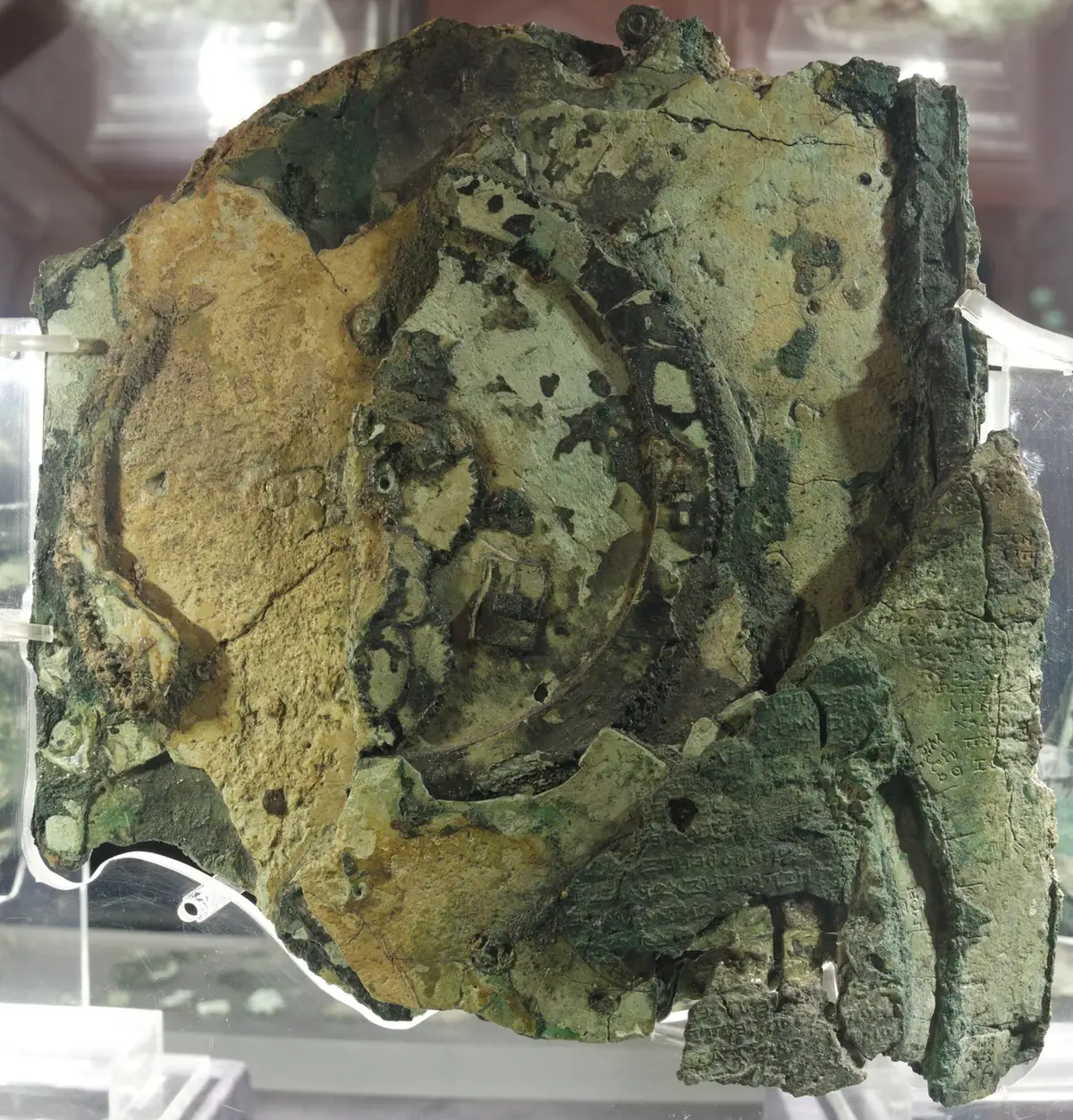
Back view of Fragment A of the Antikythera Mechanism showing concentric calendar and eclipse dial rings
Rear face of Fragment A, where the Metonic calendar and Saros eclipse prediction dials were mounted. Image: Logg Tandy, CC BY-SA 4.0, via Wikimedia Commons. Resized.

✓ What Has Been Physically Measured

Dates, physical measurements, and excavated findings kept separate from interpretation.

🧭 Evidence & Arguments For

  • Direct physical and CT verification: Unlike lost literary devices, the bronze gears, axles, pin-and-slot drive, and 3,400+ engraved Greek characters are physically preserved and imaged in 3D at the National Archaeological Museum in Athens. [2][3][4]
  • Confirms classical accounts of Archimedes: Cicero (De Republica 1.14.21–22, 1st century BCE) recorded that the Roman general Marcellus looted a mechanical bronze sphere built by Archimedes at Syracuse (212 BCE) that showed the motions of the Sun, Moon, and five planets, and that Posidonius built a similar device on Rhodes. [1][5]
  • Proof of survivorship bias in archaeology: Because bronze was routinely melted down and recycled in antiquity, only an accidental deep-sea shipwreck preserved this device—proving that a lack of surviving artifacts in museum cases does not mean a technology never existed. [1][4]

🏛️ Evidence & Arguments Against, or Limits

  • Fits Hellenistic Greek astronomy & script: Epigraphers date the Greek letterforms to c. 150–100 BCE, the Corinthian/Epirote month names and Halieia games of Rhodes place its workshop in the Greek Mediterranean, and its lunar theory matches Hipparchus of Rhodes (fl. 140–120 BCE) rather than a pre-classical culture. [3][5]
  • Hand-divided gear spacing errors: Metrological analysis of the gear tooth positions shows small angular division errors (~0.2°–0.5°) characteristic of skilled hand-dividing and triangular filing with bronze/iron hand tools rather than modern CNC machinery. [2][5]

🔬 Open Questions & What Would Change the Verdict

Ongoing underwater digs at the Antikythera wreck site (42–60 m depth) aim to recover the missing front planetary gear train fragments. Metallographic and lead-isotope rock source testing of the bronze alloy could also pinpoint where the copper and tin were smelted.

Ancient Sites Involved

Antikythera Shipwreck & Mechanism (Greece)

Related Tested Claims

📚 Further Reading: Both Sides of the Argument

Top books from both sides of the debate on this topic. Browse all 34 books on Books & Further Reading or visit our Search for the Truth Bookshop.org storefront.

Mainstream Baseline 2021 ★ 4.6/5

1177 B.C.: The Year Civilization Collapsed (Revised & Updated)

Eric H. Cline

Explains how Bronze Age kingdoms around the Mediterranean collapsed within decades from drought, quakes, and broken trade.

▸ Why this book matters to both sides

Tests how the globalized Bronze Age kingdoms of Egypt, Hatti, Mycenae, and Ugarit collapsed within a few decades through interlocking megadrought, earthquake storms, famine, and cut trade networks.

Role in the debate: Provides a benchmark case study of how archaeologists use pollen cores, ancient climate proxies, seismic horizons, and royal letters to reconstruct a rapid multi-civilizational collapse. (ISBN 9780691208015)

Mainstream Baseline 2017 ★ 4.7/5

Giza and the Pyramids: The Definitive History

Mark Lehner & Zahi Hawass

The Giza dig leaders share 30 years of finds, from the workers' town and stone quarries to Old Kingdom carbon dates.

▸ Why this book matters to both sides

The Giza dig teams' own large-format overview of decades of fieldwork on the plateau. It records the Heit el-Ghurab workers' town, limestone quarries, ramp remnants, and Old Kingdom carbon dates.

Role in the debate: Provides the primary archaeological and soil-layer baseline at Giza against which older-Sphinx, legacy-foundation, and precision-machining proposals are tested. (ISBN 9780226425696)

Bridge / Debate History 1969 ★ 4.6/5

Hamlet's Mill: An Essay Investigating the Origins of Human Knowledge and Its Transmissions Through Myth

Giorgio de Santillana & Hertha von Dechend

Two science historians argue that ancient stories worldwide preserve real observations of the 26,000-year wobble of the stars.

▸ Why this book matters to both sides

Written by historians of science at MIT and Frankfurt University. The author argues ancient stories worldwide encode technical findings of the 26,000-year sky wobble of the equinoxes and shifting world ages.

Role in the debate: The scholarly bridge between academic history of astronomy and modern sky-sightline claims about sky-cycle coding at Giza, Angkor, and Göbekli Tepe. (ISBN 9780879232153)

Leading Edge 2010 ★ 4.7/5

Lost Technologies of Ancient Egypt: Advanced Engineering in the Temples of the Pharaohs

Christopher Dunn

An engineer measures Egyptian granite boxes, statues, and drill cores with precision gauges to argue for advanced ancient tools.

▸ Why this book matters to both sides

Manufacturing engineer Christopher Dunn applies straightedges, radius gauges, and optical comparators to the Serapeum granite sarcophagi, Luxor Ramses statues, and Petrie's drill cores. It argues for high-speed mechanical tooling.

Role in the debate: Provides the primary Leading Edge metrology claims on Egyptian granite symmetry and flatness, contrasted on our precision pages with test copper-saw, tubular-drill, and pounder replications. (ISBN 9781591431022)

FTC affiliate disclosure: Book links go to Bookshop.org (ID 130218, Search for the Truth). Each sale helps local bookstores and pays us a 10% fee at no extra cost to you. All partner links use rel="sponsored nofollow noopener". Fees never change our verdicts. Affiliate disclosure.

Visiting & base stays: Antikythera Mechanism Exhibition at the National Archaeological Museum (Athens, Greece)

FTC affiliate disclosure: Tour links go to GetYourGuide and Viator. Hotel links use Stay22 (aid=solarevidence) for Booking.com and Expedia. If you book a trip, we may earn a small fee at no extra cost to you. All partner links use rel="sponsored nofollow noopener". Check travel alerts before you go. Partner fees never change our ratings. All 64 site field visits · Affiliate disclosure.

Primary Academic Sources

▸ View All Cited Primary Sources & DOIs (5 papers)
  1. Price, D. de Solla (1974). Gears from the Greeks: The Antikythera Mechanism — A Calendar Computer from ca. 80 B.C. Transactions of the American Philosophical Society 64(7): 1–70. doi:10.2307/1006146 data
  2. Freeth, T., Bitsakis, Y., Moussas, X. et al. (2006). Decoding the ancient Greek astronomical calculator known as the Antikythera Mechanism. Nature 444: 587–591. doi:10.1038/nature05357 data
  3. Freeth, T., Jones, A., Steele, J. M. & Bitsakis, Y. (2008). Calendars with Olympiad display and eclipse prediction on the Antikythera Mechanism. Nature 454: 614–617. doi:10.1038/nature07130 data
  4. Freeth, T., Higgon, D., Dacanalis, A., MacDonald, L., Georgakopoulou, M. & Wojcik, A. (2021). A Model of the Cosmos in the ancient Greek Antikythera Mechanism. Scientific Reports 11: 5821. doi:10.1038/s41598-021-84310-w data
  5. Jones, A. (2017). A Portable Cosmos: Revealing the Antikythera Mechanism, Scientific Wonder of the Ancient World (review record in Almagest 8). Oxford University Press. doi:10.1484/j.almagest.5.113701 background

More in this section: Sky alignments & sacred landscapes.

Sources checked against Crossref and publisher pages on 2026-10-27. Labels describe the claim, not the people who hold it. Methodology.