△ TruthInStone

Sites › Asia › Barabar and Nagarjuni Caves (Lomas Rishi, Sudama & Gopika)

Barabar and Nagarjuni Caves (Lomas Rishi, Sudama & Gopika)

Barabar and Nagarjuni Caves (Lomas Rishi, Sudama & Gopika)
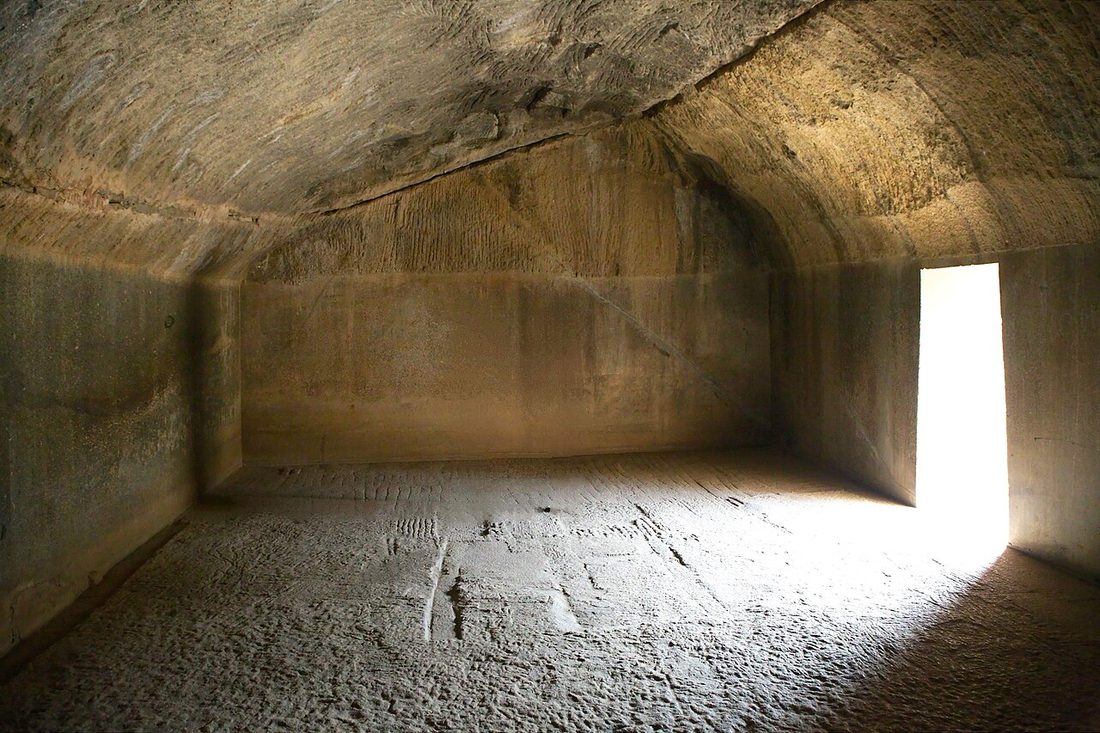
Image: Devajyoti Sarkar, Wikimedia Commons, CC BY-SA 2.0. Resized; not otherwise altered. All credits.
📍 Where It Is Jehanabad District, Bihar, India 25.0053°, 85.0631°
🏛️ Mainstream Date c. 257–232 BCE (Mauryan Emperor Ashoka & grandson Dasharatha) Excavated baseline
🧭 Leading Edge / Open Angle Mirror-smooth granite walls (Ra 0.1–0.3 µm) & ~2.5 mm 3D scan symmetry Debated or newly revised
🪨 Heaviest Stone & Quarry In-place hard gneissic granite chambers (Mohs 6.5–7.0, harder than steel) Compare all 64 sites →
30-SECOND TAKEAWAY

In Plain English — The 30-Second Takeaway

What It Is:

The Barabar and Nagarjuni Caves in Bihar are seven chambers hollowed directly inside giant boulders of hard granite. The oldest surviving rock-cut caves in India.

What Everyone Agrees On (Measured Facts):

Contact surface gauges measure a mirror finish of 0.1 to 0.3 microns. (smoother than optical glass) on the granite walls. 3D laser scans map the vaulted rooms within a 2.5-mm scan tolerance.

🏛️ Mainstream Archaeology View:

Inscriptions carved at the cave doors record that Emperor Ashoka. (c. 257–250 BCE). Also, his grandson Dasharatha gifted the rooms to ascetics. Lomas Rishi cave preserves unfinished iron chisel marks.

🧭 Leading Edge View:

The BAM survey team argues that achieving mirror-polished, even granite vaults inside rock harder than steel warrants full peer-reviewed building study.

Site Story & Overview

The Barabar and Nagarjuni Caves are the oldest surviving rock-cut chambers in India and the only ones carved directly into hard banded granite (Mohs 6.5–7) rather than the softer sandstones or Deccan basalts used at later Indian sites like Ajanta and Ellora. For stoneworking research, the contrast between Lomas Rishi and its twin cave Sudama next door is uniquely informative: Lomas Rishi features an intricately carved chaitya-arch facade imitating bent timber rafters over a trapezoidal doorway, yet its inner circular chamber was abandoned partway through dressing, preserving rows of iron point-chisel trenches side by side with the mirror-polished granite surfaces of the outer hall.

✓ What Is Physically Measured on Site

Dated samples, laser scans, stone weights, and dug finds kept separate from opinion.

🏛️ Mainstream Archaeological View

  • Accepted timeline: Mauryan Empire, 3rd century BCE: four caves in the Barabar Hills and three in the Nagarjuni Hills, dated by Brahmi dedicatory carved texts of Emperor Ashoka (regnal years 12 and 19, c. 257 and 250 BCE) and his grandson Dasharatha (c. 232 BCE) donating the chambers to the Ājīvika ascetics.
  • Stone & hardness: Proterozoic Chotanagpur quartzofeldspathic gneissic granite — Mohs hardness 6.5–7.0 (Gneissic granite) (on the 1–10 Mohs scale where a steel knife is ~5.5 and diamond is 10).
  • Quarry distance & alignment: Stone source Excavated in situ inside Barabar & Nagarjuni granite inselbergs (0 km). Orientation: South-facing trapezoidal rock-cut entrances parallel to granite ridge axis.

🧭 Leading Edge Proposal & Open Questions

  • BAM Investigators (Bâtisseurs de l'Ancien Monde, Patrice Pouillard et al., 2019–2023): Published room-scale 3D Earth laser scans (measuring chamber walls, vault curvature, and symmetry with a stated ~2.5 mm point-cloud uncertainty) alongside handheld contact surface surface gauge (recording Ra ~0.1–0.3 µm mirror polish on the granite walls) and acoustic testing (120–160 Hz resonant modes). They question whether 3rd-century BCE iron chisels and hand-grinding fully explain the geometry or whether the chambers predate the Mauryan Brahmi carved texts [3]

Tested Claims About Barabar and Nagarjuni Caves (Lomas Rishi, Sudama & Gopika)

ClaimStatusVerdict
Precision and shaping in ancient stonework: what has been measured, what has been replicated
Did tight stone joints, flat granite boxes, drill cores, and stone vases require advanced machine tools?
Leading EdgeMeasured in part: tolerances of about 0.25–0.5 mm (Giza casing) and ±1–2 mm survey precision (Tiwanaku) are documented; copper-and-sand and hammerstone methods are replicated at small scale; how the sharpest interior angles, Petrie's spiral-grooved core and the finest vessels were finished is an open question
▸ View Engineering Callout Sources (8 lettered references)
  1. Falk, H. (2006). Aśokan Sites and Artefacts: A Source-Book with Bibliography. Mainz: Philipp von Zabern (monograph on the Barabar and Nagarjuni inscriptions and cave dimensions). https://openlibrary.org/works/OL20341815W data
  2. Huntington, J. C. (1974). Lomās Ṛṣi: another look. Archives of Asian Art 28: 34–56. https://www.jstor.org/stable/20111071 data
  3. BAM (Bâtisseurs de l'Ancien Monde) Acoustic, Contact Profilometry & 3D Laser Metrology Reports on the Barabar and Nagarjuni Caves (2022–2023). Room-scale terrestrial 3D laser scanning (~2.5 mm point-cloud uncertainty), handheld contact surface profilometry (Ra ~0.1–0.3 µm), and acoustic testing (120–160 Hz) of Sudama, Lomas Rishi, Gopika and Vadathika granite chambers. https://bam-investigations.com/categorie-produit/rapports-sur-les-cha… proponent
  4. Dhavalikar, M. K. (1983). Masterpieces of Rashtrakuta Art: The Kailasa. Bombay: Taraporevala. https://openlibrary.org/works/OL15035163W data
  5. UNESCO World Heritage Centre: Ellora Caves (inscribed 1983). https://whc.unesco.org/en/list/243/ background
  6. Yang, Z. F., Yue, Z. Q., Li, L. H. et al. (2010). Design and construction of super-large-span caverns carved in weak pelitic siltstone at Longyou more than 2000 years ago: an engineering geological study. International Journal of Rock Mechanics and Mining Sciences 47. doi:10.1016/j.ijrmms.2005.04.011 data
  7. Li, L., Yang, Z., Yue, Z. & Zhang, L. (2009). Engineering geological characteristics, failure modes and long-term stability of the 2000-year-old underground rock caverns at Longyou, China. Tunnelling and Underground Space Technology 24(2): 190–204. doi:10.1016/j.tust.2008.08.003 data
  8. Spink, W. M. (2005). Ajanta: History and Development, Vol. 1. Leiden: Brill (comparative Deccan basalt rock-cut excavation rates). doi:10.1163/9789047416647 data

Visiting & base stays: Barabar & Nagarjuni Polished Granite Caves (Bodh Gaya / Patna base, Bihar, India)

FTC affiliate disclosure: Tour links go to GetYourGuide and Viator. Hotel links use Stay22 (aid=solarevidence) for Booking.com and Expedia. If you book a trip, we may earn a small fee at no extra cost to you. All partner links use rel="sponsored nofollow noopener". Check travel alerts before you go. Partner fees never change our ratings. All 64 site field visits · Affiliate disclosure.

📚 Further Reading: Both Sides of the Argument

Top books from both sides of the debate on this topic. Browse all 34 books on Books & Further Reading or visit our Search for the Truth Bookshop.org storefront.

Mainstream Baseline 2017 ★ 4.7/5

Giza and the Pyramids: The Definitive History

Mark Lehner & Zahi Hawass

The Giza dig leaders share 30 years of finds, from the workers' town and stone quarries to Old Kingdom carbon dates.

▸ Why this book matters to both sides

The Giza dig teams' own large-format overview of decades of fieldwork on the plateau. It records the Heit el-Ghurab workers' town, limestone quarries, ramp remnants, and Old Kingdom carbon dates.

Role in the debate: Provides the primary archaeological and soil-layer baseline at Giza against which older-Sphinx, legacy-foundation, and precision-machining proposals are tested. (ISBN 9780226425696)

Mainstream Baseline 2003 ★ 4.5/5

After the Ice: A Global Human History, 20,000–5000 BC

Steven Mithen

Follows human life across every continent from the peak of the Ice Age (20,000 BCE) to early farming towns (5000 BCE).

▸ Why this book matters to both sides

A continent-by-continent narrative of human life from the Last Glacial Maximum to 5000 BCE, built directly from excavation reports across the Near East (including Göbekli Tepe), Europe, Asia, and the Americas.

Role in the debate: Provides the archaeological baseline for what human populations were building, hunting, and cultivating before, during, and right after the Younger Dryas. (ISBN 9780674019997)

Leading Edge 2010 ★ 4.7/5

Lost Technologies of Ancient Egypt: Advanced Engineering in the Temples of the Pharaohs

Christopher Dunn

An engineer measures Egyptian granite boxes, statues, and drill cores with precision gauges to argue for advanced ancient tools.

▸ Why this book matters to both sides

Manufacturing engineer Christopher Dunn applies straightedges, radius gauges, and optical comparators to the Serapeum granite sarcophagi, Luxor Ramses statues, and Petrie's drill cores. It argues for high-speed mechanical tooling.

Role in the debate: Provides the primary Leading Edge metrology claims on Egyptian granite symmetry and flatness, contrasted on our precision pages with test copper-saw, tubular-drill, and pounder replications. (ISBN 9781591431022)

Leading Edge 2002 ★ 4.6/5

Underworld: The Mysterious Origins of Civilization

Graham Hancock

Combines Ice Age sea-level flood maps with scuba dives at submerged ruins off India, Japan, Malta, and Bimini.

▸ Why this book matters to both sides

Combines Glenn Milne's post-glacial sea-level inundation maps with scuba studies at India's Gulf of Khambhat and Dwarka, Japan's Yonaguni terraces, Malta, and Bimini.

Role in the debate: Frames the submerged-shelf debate over whether features at Yonaguni, Dwarka, and Bimini are human-modified monuments drowned by Meltwater pulses or natural coastal geology. (ISBN 9781400049516)

FTC affiliate disclosure: Book links go to Bookshop.org (ID 130218, Search for the Truth). Each sale helps local bookstores and pays us a 10% fee at no extra cost to you. All partner links use rel="sponsored nofollow noopener". Fees never change our verdicts. Affiliate disclosure.

Primary Academic Sources

▸ View All Cited Primary Sources & DOIs (3 papers)
  1. Falk, H. (2006). Aśokan Sites and Artefacts: A Source-Book with Bibliography. Mainz: Philipp von Zabern (monograph on the Barabar and Nagarjuni inscriptions and cave dimensions). https://openlibrary.org/works/OL20341815W data
  2. Huntington, J. C. (1974). Lomās Ṛṣi: another look. Archives of Asian Art 28: 34–56. https://www.jstor.org/stable/20111071 data
  3. BAM (Bâtisseurs de l'Ancien Monde) Acoustic, Contact Profilometry & 3D Laser Metrology Reports on the Barabar and Nagarjuni Caves (2022–2023). Room-scale terrestrial 3D laser scanning (~2.5 mm point-cloud uncertainty), handheld contact surface profilometry (Ra ~0.1–0.3 µm), and acoustic testing (120–160 Hz) of Sudama, Lomas Rishi, Gopika and Vadathika granite chambers. https://bam-investigations.com/categorie-produit/rapports-sur-les-cha… proponent

Dates and stone checks are summed up in plain English from the papers above. Measured facts stay separate from opinion. Methodology.