△ TruthInStone

Sites › Asia › Borobudur and Prambanan (Kedu Plain & Mount Merapi)

Borobudur and Prambanan (Kedu Plain & Mount Merapi)

Borobudur and Prambanan (Kedu Plain & Mount Merapi)
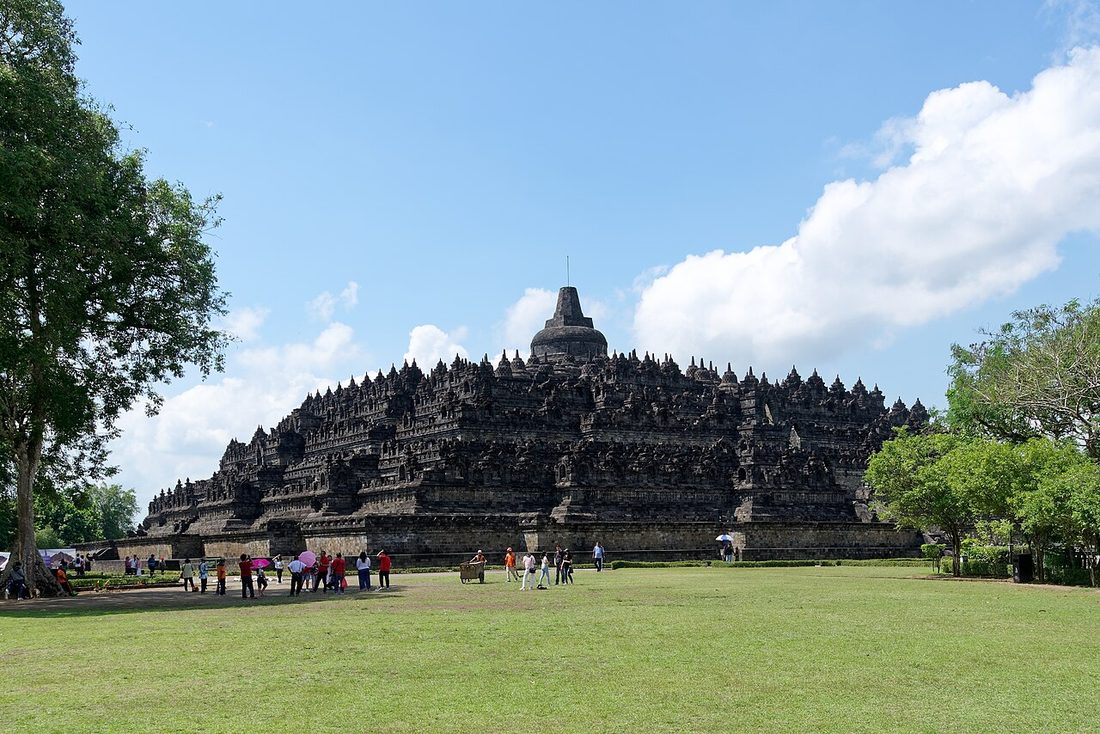
Image: Jakub Hałun, Wikimedia Commons, CC BY-SA 4.0. Resized; not otherwise altered. All credits.
📍 Where It Is Kedu Plain, near Yogyakarta, Central Java, Indonesia -7.6079°, 110.2038°
🏛️ Mainstream Date Borobudur c. 780–825 CE · Prambanan dedicated 856 CE (Mataram Kingdom) Excavated baseline
🧭 Leading Edge / Open Angle 2,000,000 mortarless dovetail blocks buried by Mount Merapi volcanic eruptions Debated or newly revised
🪨 Heaviest Stone & Quarry 1–4 tons per block (~2,000,000 interlocking andesite blocks / 130,000 tons total) 0.1× the 40-ton test limit · Compare all 64 sites →
30-SECOND TAKEAWAY

In Plain English — The 30-Second Takeaway

What It Is:

Borobudur and Prambanan in Central Java are two massive 9th-century volcanic-stone temple complexes built on the plains beside active Mount Merapi.

What Everyone Agrees On (Measured Facts):

Borobudur contains about 2 million hard basaltic-andesite blocks. (~130,000 tons) locked together without mortar using carved double-dovetail stone keys and internal rain drains.

🏛️ Mainstream Archaeology View:

Inscriptions and style date both complexes between 780 and 856 CE, before violent eruptions of Mount Merapi around 928–1006 CE buried the valley in volcanic ash.

🧭 Leading Edge View:

Experts point to Borobudur's straight 3-kilometer sightline with Mendut and Pawon temples. Also, its survival under volcanic ash as a model for how tropical disasters bury stone cities.

Site Story & Overview

Built within decades of each other on the fertile volcanic plains flanking Mount Merapi, Borobudur and Prambanan showcase Central Java's mastery of mortarless basaltic-andesite joinery. Rather than relying on mortar or metal cramps, 8th- and 9th-century Javanese masons cut over two million hard volcanic blocks with integral stone tenons, stepped rabbet edges, and double-dovetail stone keys.

▸ Read Full Archaeological & Engineering Context

It also covers internal stone drainage spouts (jaladwara) engineered to shed tropical monsoon downpours. Their preservation beneath centuries of Merapi volcanic ash and tropical vegetation—until rediscovery and anastylosis in the 19th and 20th centuries—makes them essential reference points for volcanic-ash burial in tropical archaeology.

✓ What Is Physically Measured on Site

Dated samples, laser scans, stone weights, and dug finds kept separate from opinion.

🏛️ Mainstream Archaeological View

  • Accepted timeline: Central Javanese Mataram Kingdom (Sailendra and Sanjaya dynasties): Borobudur built c. 780–825 CE. Prambanan (Loro Jonggrang complex) dedicated in 856 CE (Shivagrha carved text).
  • Stone & hardness: Merapi vesicular basaltic andesite — Mohs hardness 6.0 (Basaltic andesite) (on the 1–10 Mohs scale where a steel knife is ~5.5 and diamond is 10).
  • Quarry distance & alignment: Stone source 2–5 km (Progo, Elo & Opak volcanic boulder riverbeds). Orientation: Cardinal faces; Borobudur–Pawon–Mendut form a 3.0 km straight line (~7° N of E).

🧭 Leading Edge Proposal & Open Questions

  • Archaeoastronomical & geoarchaeological studies: Note that Borobudur, Mendut, and Pawon lie along a single straight 3.0 km east-northeast line (~7° north of east) and that explosive eruptions of nearby Mount Merapi (especially the 928–1006 CE cycle) buried Central Java's temples in volcanic ash and lahars, triggering the sudden eastward shift of Javanese power [2][1]

Tested Claims About Borobudur and Prambanan (Kedu Plain & Mount Merapi)

ClaimStatusVerdict
Pyramids around the world point to a common lost source
Did pyramids in Egypt, Peru, Mexico, Sudan. Also, China come from one shared ancient parent culture?
Leading EdgeOpen question
Precision and shaping in ancient stonework: what has been measured, what has been replicated
Did tight stone joints, flat granite boxes, drill cores, and stone vases require advanced machine tools?
Leading EdgeMeasured in part: tolerances of about 0.25–0.5 mm (Giza casing) and ±1–2 mm survey precision (Tiwanaku) are documented; copper-and-sand and hammerstone methods are replicated at small scale; how the sharpest interior angles, Petrie's spiral-grooved core and the finest vessels were finished is an open question
▸ View Engineering Callout Sources (6 lettered references)
  1. Robles García, N. M. (1994). Las canteras de Mitla, Oaxaca: tecnología para la arquitectura monumental. Vanderbilt University Publications in Anthropology No. 47. https://hdl.handle.net/1803/5789 data
  2. Argote, D. L., Tejero-Andrade, A., Cárdenas-Soto, M. et al. (2023). Joint geophysical survey (ERT, GPR and seismic noise) at the Church Group and Columns Group in Mitla, Oaxaca (Project Lyobaa). Journal of Archaeological Science: Reports 51. doi:10.1016/j.jasrep.2023.104156 data
  3. Miksic, J. N. (1990). Borobudur: Golden Tales of the Buddhas. Boston: Shambhala / Periplus. https://openlibrary.org/works/OL2152678W data
  4. UNESCO World Heritage Centre: Borobudur Temple Compounds (inscribed 1991). https://whc.unesco.org/en/list/592/ background
  5. Bisht, R. S. (2015). Excavations at Dholavira (1989–90 to 2004–2005). New Delhi: Archaeological Survey of India (916-page excavation report). https://asi.nic.in/ data
  6. UNESCO World Heritage Centre: Dholavira: a Harappan City (inscribed 2021). https://whc.unesco.org/en/list/1645/ background

Visiting & base stays: Borobudur Andesite Mandala & Prambanan Temple Compounds (Magelang / Yogyakarta, Java, Indonesia)

FTC affiliate disclosure: Tour links go to GetYourGuide and Viator. Hotel links use Stay22 (aid=solarevidence) for Booking.com and Expedia. If you book a trip, we may earn a small fee at no extra cost to you. All partner links use rel="sponsored nofollow noopener". Check travel alerts before you go. Partner fees never change our ratings. All 64 site field visits · Affiliate disclosure.

📚 Further Reading: Both Sides of the Argument

Top books from both sides of the debate on this topic. Browse all 34 books on Books & Further Reading or visit our Search for the Truth Bookshop.org storefront.

Mainstream Baseline 2003 ★ 4.5/5

After the Ice: A Global Human History, 20,000–5000 BC

Steven Mithen

Follows human life across every continent from the peak of the Ice Age (20,000 BCE) to early farming towns (5000 BCE).

▸ Why this book matters to both sides

A continent-by-continent narrative of human life from the Last Glacial Maximum to 5000 BCE, built directly from excavation reports across the Near East (including Göbekli Tepe), Europe, Asia, and the Americas.

Role in the debate: Provides the archaeological baseline for what human populations were building, hunting, and cultivating before, during, and right after the Younger Dryas. (ISBN 9780674019997)

Mainstream Baseline 2019 ★ 4.4/5 · AIA Holton Award

Archaeology from Space: How the Future Shapes Our Past

Sarah Parcak

Explains how satellites and airplane lasers spot buried cities, roads, and temples across Egypt and the Americas.

▸ Why this book matters to both sides

Remote-sensing archaeologist Sarah Parcak explains how multispectral satellite imagery and airborne LiDAR reveal buried towns, road networks, and giant foundations across Egypt, Europe, and the Americas.

Role in the debate: Explains the physics and ground-truthing requirements of remote sensing—essential context for comparing verified LiDAR cities against disputed subsurface radar claims. (ISBN 9781250231345)

Leading Edge 2015 ★ 4.7/5

Magicians of the Gods: The Forgotten Wisdom of Earth's Lost Civilization

Graham Hancock

Links Göbekli Tepe, Baalbek, and the Younger Dryas comet debate to argue a cosmic impact erased an Ice Age world.

▸ Why this book matters to both sides

Integrates Göbekli Tepe, Baalbek, Gunung Padang. The Younger Dryas comet-impact idea. It argues Taurid meteor-stream impacts between 12,800 and 11,600 years ago erased an advanced culture.

Role in the debate: Sets out the strongest popular overview linking Göbekli Tepe's enclosures and Pillar 43 to the Younger Dryas impact debate. (ISBN 9781250118400)

Bridge / Debate History 1969 ★ 4.6/5

Hamlet's Mill: An Essay Investigating the Origins of Human Knowledge and Its Transmissions Through Myth

Giorgio de Santillana & Hertha von Dechend

Two science historians argue that ancient stories worldwide preserve real observations of the 26,000-year wobble of the stars.

▸ Why this book matters to both sides

Written by historians of science at MIT and Frankfurt University. The author argues ancient stories worldwide encode technical findings of the 26,000-year sky wobble of the equinoxes and shifting world ages.

Role in the debate: The scholarly bridge between academic history of astronomy and modern sky-sightline claims about sky-cycle coding at Giza, Angkor, and Göbekli Tepe. (ISBN 9780879232153)

FTC affiliate disclosure: Book links go to Bookshop.org (ID 130218, Search for the Truth). Each sale helps local bookstores and pays us a 10% fee at no extra cost to you. All partner links use rel="sponsored nofollow noopener". Fees never change our verdicts. Affiliate disclosure.

Primary Academic Sources

▸ View All Cited Primary Sources & DOIs (4 papers)
  1. Miksic, J. N. (1990). Borobudur: Golden Tales of the Buddhas. Boston: Shambhala / Periplus. https://openlibrary.org/works/OL2152678W data
  2. Newhall, C. G. et al. (2000). 10,000 years of explosive eruptions of Merapi Volcano, Central Java: archaeological and modern implications. Journal of Volcanology and Geothermal Research 100: 9–50. doi:10.1016/S0377-0273(00)00132-3 data
  3. UNESCO World Heritage Centre: Borobudur Temple Compounds (inscribed 1991). https://whc.unesco.org/en/list/592/ background
  4. UNESCO World Heritage Centre: Prambanan Temple Compounds (inscribed 1991). https://whc.unesco.org/en/list/642/ background

Dates and stone checks are summed up in plain English from the papers above. Measured facts stay separate from opinion. Methodology.