△ TruthInStone

Sites › Asia › Brihadeeswarar Temple (Thanjavur) and Hampi (Vijayanagara)

Brihadeeswarar Temple (Thanjavur) and Hampi (Vijayanagara)

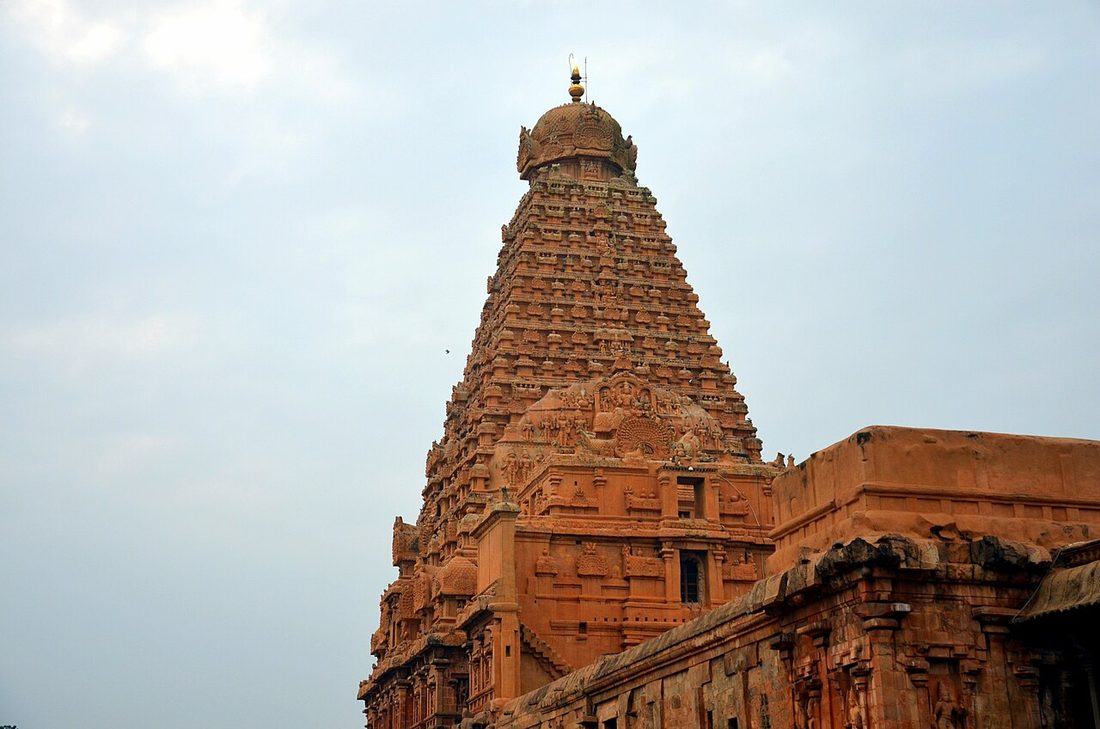
Brihadeeswarar Temple (Thanjavur) and Hampi (Vijayanagara)
Image: simianwolverine, Wikimedia Commons, CC BY 2.0. Resized; not otherwise altered. All credits.
📍 Where It Is Thanjavur (Tamil Nadu) & Hampi (Karnataka), southern India 10.7828°, 79.1318°
🏛️ Mainstream Date Thanjavur built 1003–1010 CE (Chola) · Hampi 1336–1565 CE (Vijayanagara) Excavated baseline
🧭 Leading Edge / Open Angle 80-ton granite block hauled 50 km & raised 66 m high without mortar Debated or newly revised
🪨 Heaviest Stone & Quarry 80-ton granite tower crown (raised 66 m, hauled 45–60 km) · 130,000 t total 2.0× the 40-ton test limit · Compare all 64 sites →
30-SECOND TAKEAWAY

In Plain English — The 30-Second Takeaway

What It Is:

Brihadeeswarar Temple at Thanjavur. Also, the stone capital of Hampi showcase southern India's mastery of giant interlocking granite architecture.

What Everyone Agrees On (Measured Facts):

Completed in 1010 CE, Thanjavur's 66-meter hollow tower holds 130,000 tons of mortarless granite. Hauled 45 to 60 km. Also, is topped by an 80-ton granite block at its peak.

🏛️ Mainstream Archaeology View:

Historians report that Chola engineers dragged the 80-ton crowning stone up a multi-kilometer earthen ramp using elephants and timber sledges.

🧭 Leading Edge View:

Hauling 130,000 tons of hard granite 50 km across river plains and lifting an 80-ton block 216 feet in the air in just seven years is double the 40-ton modern test limit.

Site Story & Overview

Southern India's granite buildings reaches its structural zenith at Thanjavur and Hampi. Completed in just seven years (1003–1010 CE) on an alluvial delta where no natural rock exists for 45+ km, the Brihadeeswarar Temple required hauling more than 130,000 tons of hard granite and raising an ~80-ton crowning assembly 66 m into the air atop a hollow corbelled tower that has survived six major earthquakes without mortar. At Hampi, Vijayanagara masons worked straight into a landscape of giant Closepet granite tors, splitting multi-ton blocks with lines of shallow wedge slots and turning single-stone granite piers into resonant acoustic columns.

✓ What Is Physically Measured on Site

Dated samples, laser scans, stone weights, and dug finds kept separate from opinion.

🏛️ Mainstream Archaeological View

  • Accepted timeline: Brihadeeswarar (Rajarajesvaram) Temple built 1003–1010 CE by Chola Emperor Rajaraja I. Hampi served as the capital of the Vijayanagara Empire from 1336 to 1565 CE, with earlier Neolithic/megalithic dolmen sites on the surrounding hills.
  • Stone & hardness: Archean biotite-hornblende gneissic granite & Closepet granite — Mohs hardness 6.5 (Granite / Gneiss) (on the 1–10 Mohs scale where a steel knife is ~5.5 and diamond is 10).
  • Quarry distance & alignment: Stone source 45–60 km (Narthamalai / Pudukkottai granite outcrops to Thanjavur; local tors at Hampi). Orientation: Strict cardinal East–West sanctuary axis facing sunrise.

🧭 Leading Edge Proposal & Open Questions

  • Engineering historians & Leading Edge authors: Focus on the unresolved scale gap of how Chola builders transported the ~80-ton granite vimana crowning block over 50 km of alluvial plains and raised it 66 m (216 ft) to the apex of a hollow pyramid without mortar, and on the acoustic tuning of Hampi's 56 'musical' granite pillars at the Vittala Temple [1][2]

Tested Claims About Brihadeeswarar Temple (Thanjavur) and Hampi (Vijayanagara)

ClaimStatusVerdict
How the world's megaliths were moved: what is shown, what is inferred, and where the gaps are
Can wooden sledges, ropes, wet sand, and dirt ramps explain how ancient crews moved stones weighing 80 to 860 tons?
ContestedMeasured in part: sledges, wetted or timber tracks, ramps and boats are documented, and finished monuments show ancient moves of about 750–860 t; no test of ancient methods we found goes above about 40 t, and the 1,000 t-plus Baalbek blocks never left the quarry
Precision and shaping in ancient stonework: what has been measured, what has been replicated
Did tight stone joints, flat granite boxes, drill cores, and stone vases require advanced machine tools?
Leading EdgeMeasured in part: tolerances of about 0.25–0.5 mm (Giza casing) and ±1–2 mm survey precision (Tiwanaku) are documented; copper-and-sand and hammerstone methods are replicated at small scale; how the sharpest interior angles, Petrie's spiral-grooved core and the finest vessels were finished is an open question
▸ View Engineering Callout Sources (8 lettered references)
  1. Richards, J. & Whitby, M. (1997). The engineering of Stonehenge. In Cunliffe, B. & Renfrew, C. (eds), Science and Stonehenge. Proceedings of the British Academy 92: 231–256 (PDF). https://www.thebritishacademy.ac.uk/documents/3921/92p231.pdf data
  2. NOVA (PBS airdate 12 Feb 1997). Secrets of Lost Empires: Obelisk, transcript: a forty-ton obelisk (US tons, about 36 t) dragged on a sledge at Aswan; it was not raised. https://www.pbs.org/wgbh/nova/transcripts/2405obelisk.html data
  3. NOVA (PBS airdate 8 Feb 2000). Secrets of Lost Empires: Pharaoh's Obelisk, transcript: a 25-ton block dragged on a timber roadbed and a 25-ton (perhaps 30-ton) obelisk raised from a sand pit. https://www.pbs.org/wgbh/nova/transcripts/27poobelisk.html data
  4. Li, J. & Chen, Z. (2016). Lubrication for transporting heavy objects in the history. Tribology Online 11(2): 242–249 (includes the Japanese shura sledge experiments). doi:10.2474/trol.11.242 background
  5. Harris, B. (2018). Moving megaliths: time to park the rollers. British Archaeology 163: 30–35 (author's accepted manuscript, UCL Discovery). https://discovery.ucl.ac.uk/id/eprint/10114174/ background
  6. Srinivasan, K. R. (1991). The Brihadisvara Temple at Tanjavur. Archaeological Survey of India monograph series. https://asi.nic.in/ data
  7. Michell, G. (1995). Architecture and Art of Southern India. The New Cambridge History of India I:6. Cambridge University Press. doi:10.1017/CHOL9780521441100 data
  8. UNESCO World Heritage Centre: Great Living Chola Temples (inscribed 1987, extended 2004). https://whc.unesco.org/en/list/250/ background

Visiting & base stays: Brihadeeswarar Temple (Thanjavur) & Hampi Monoliths (Tamil Nadu & Karnataka, India)

FTC affiliate disclosure: Tour links go to GetYourGuide and Viator. Hotel links use Stay22 (aid=solarevidence) for Booking.com and Expedia. If you book a trip, we may earn a small fee at no extra cost to you. All partner links use rel="sponsored nofollow noopener". Check travel alerts before you go. Partner fees never change our ratings. All 64 site field visits · Affiliate disclosure.

📚 Further Reading: Both Sides of the Argument

Top books from both sides of the debate on this topic. Browse all 34 books on Books & Further Reading or visit our Search for the Truth Bookshop.org storefront.

Mainstream Baseline 2017 ★ 4.7/5

Giza and the Pyramids: The Definitive History

Mark Lehner & Zahi Hawass

The Giza dig leaders share 30 years of finds, from the workers' town and stone quarries to Old Kingdom carbon dates.

▸ Why this book matters to both sides

The Giza dig teams' own large-format overview of decades of fieldwork on the plateau. It records the Heit el-Ghurab workers' town, limestone quarries, ramp remnants, and Old Kingdom carbon dates.

Role in the debate: Provides the primary archaeological and soil-layer baseline at Giza against which older-Sphinx, legacy-foundation, and precision-machining proposals are tested. (ISBN 9780226425696)

Mainstream Baseline 2003 ★ 4.5/5

After the Ice: A Global Human History, 20,000–5000 BC

Steven Mithen

Follows human life across every continent from the peak of the Ice Age (20,000 BCE) to early farming towns (5000 BCE).

▸ Why this book matters to both sides

A continent-by-continent narrative of human life from the Last Glacial Maximum to 5000 BCE, built directly from excavation reports across the Near East (including Göbekli Tepe), Europe, Asia, and the Americas.

Role in the debate: Provides the archaeological baseline for what human populations were building, hunting, and cultivating before, during, and right after the Younger Dryas. (ISBN 9780674019997)

Leading Edge 2010 ★ 4.7/5

Lost Technologies of Ancient Egypt: Advanced Engineering in the Temples of the Pharaohs

Christopher Dunn

An engineer measures Egyptian granite boxes, statues, and drill cores with precision gauges to argue for advanced ancient tools.

▸ Why this book matters to both sides

Manufacturing engineer Christopher Dunn applies straightedges, radius gauges, and optical comparators to the Serapeum granite sarcophagi, Luxor Ramses statues, and Petrie's drill cores. It argues for high-speed mechanical tooling.

Role in the debate: Provides the primary Leading Edge metrology claims on Egyptian granite symmetry and flatness, contrasted on our precision pages with test copper-saw, tubular-drill, and pounder replications. (ISBN 9781591431022)

Leading Edge 2002 ★ 4.6/5

Underworld: The Mysterious Origins of Civilization

Graham Hancock

Combines Ice Age sea-level flood maps with scuba dives at submerged ruins off India, Japan, Malta, and Bimini.

▸ Why this book matters to both sides

Combines Glenn Milne's post-glacial sea-level inundation maps with scuba studies at India's Gulf of Khambhat and Dwarka, Japan's Yonaguni terraces, Malta, and Bimini.

Role in the debate: Frames the submerged-shelf debate over whether features at Yonaguni, Dwarka, and Bimini are human-modified monuments drowned by Meltwater pulses or natural coastal geology. (ISBN 9781400049516)

FTC affiliate disclosure: Book links go to Bookshop.org (ID 130218, Search for the Truth). Each sale helps local bookstores and pays us a 10% fee at no extra cost to you. All partner links use rel="sponsored nofollow noopener". Fees never change our verdicts. Affiliate disclosure.

Primary Academic Sources

▸ View All Cited Primary Sources & DOIs (4 papers)
  1. Srinivasan, K. R. (1991). The Brihadisvara Temple at Tanjavur. Archaeological Survey of India monograph series. https://asi.nic.in/ data
  2. Michell, G. (1995). Architecture and Art of Southern India. The New Cambridge History of India I:6. Cambridge University Press. doi:10.1017/CHOL9780521441100 data
  3. UNESCO World Heritage Centre: Great Living Chola Temples (inscribed 1987, extended 2004). https://whc.unesco.org/en/list/250/ background
  4. UNESCO World Heritage Centre: Group of Monuments at Hampi (inscribed 1986). https://whc.unesco.org/en/list/241/ background

Dates and stone checks are summed up in plain English from the papers above. Measured facts stay separate from opinion. Methodology.