△ TruthInStone

Sites › Asia › Dholavira (Khadir Bet) and the Gulf of Khambhat / Dwaraka

Dholavira (Khadir Bet) and the Gulf of Khambhat / Dwaraka

Dholavira (Khadir Bet) and the Gulf of Khambhat / Dwaraka
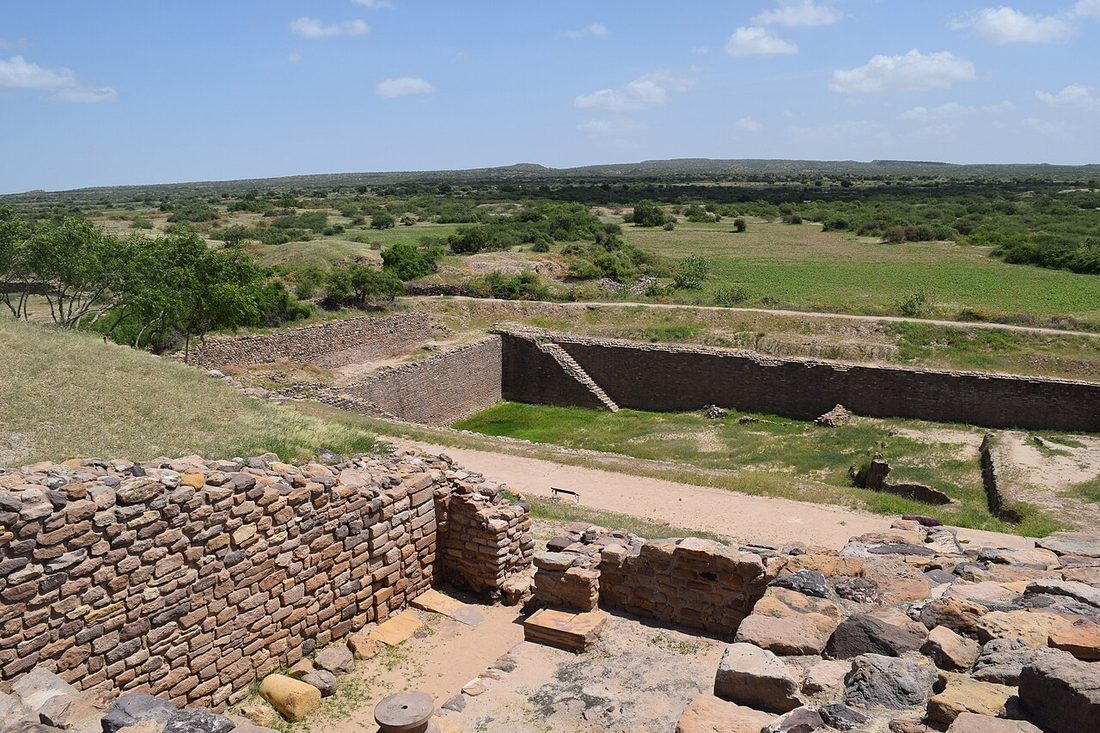
Image: Lalit Gajjer, Wikimedia Commons, CC BY-SA 4.0. Resized; not otherwise altered. All credits.
📍 Where It Is Khadir Bet (Rann of Kachchh) & Saurashtra Coast, Gujarat, India 23.8869°, 70.2136°
🏛️ Mainstream Date Dholavira c. 3000–1500 BCE · Dwarka anchors c. 1500 BCE–medieval Excavated baseline
🧭 Leading Edge / Open Angle Debated 30–40 m deep sonar targets in the Gulf of Khambhat (c. 7500 BCE claim) Debated or newly revised
🪨 Heaviest Stone & Quarry 1–3 tons (tubular-drilled polished limestone ring-stones & 16 rock-cut reservoirs) 0.1× the 40-ton test limit · Compare all 64 sites →
30-SECOND TAKEAWAY

In Plain English — The 30-Second Takeaway

What It Is:

Dholavira in Gujarat is the best-preserved stone city of the Bronze Age Indus Civilization. It has here with the underwater marine sites of Dwarka. Also, the Gulf of Khambhat.

What Everyone Agrees On (Measured Facts):

Dholavira is surrounded by 16 giant rock-cut water reservoirs, a 10-letter inlaid gypsum signboard. 1-to-3-ton polished stone pillar bases drilled with tubular copper drills.

🏛️ Mainstream Archaeology View:

Digs date Dholavira from 3000 to 1500 BCE. Then, a severe drought dried its rivers. Meanwhile, underwater stone anchors off Bet Dwarka date from 1500 BCE onward.

🧭 Leading Edge View:

Graham Hancock. Also, a 2001 sonar team proposed that 30-to-40-meter-deep sonar shapes in the Gulf of Khambhat are a drowned 7500 BCE Ice Age city. This geologists read as natural river gravel.

Site Story & Overview

Gujarat hosts both the best-preserved stone-built metropolis of the Indus Civilization—Dholavira on Khadir Bet Island—and the marine archaeological sites of Dwarka and the Gulf of Khambhat. While Mohenjo-daro relied on baked brick, Dholavira's builders quarried cream and pink sandstone to construct giant stepped reservoirs, storm drains, a 283 m ceremonial stadium, and lathe-turned/drilled limestone ring-stones whose precise axial holes and curved profiles remain a focal point of Harappan stoneworking studies. Offshore, the contrast between the dated Late Harappan/historic stone anchors at Bet Dwarka and the contested 30–40 m sonar anomalies in the high-velocity tidal channels of the Gulf of Khambhat illustrates the difference between stratified underwater excavation and unexcavated sonar targets.

✓ What Is Physically Measured on Site

Dated samples, laser scans, stone weights, and dug finds kept separate from opinion.

🏛️ Mainstream Archaeological View

  • Accepted timeline: Dholavira was occupied across seven Harappan cultural stages from c. 3000 to 1500 BCE (Mature Harappan urban peak c. 2600–1900 BCE). Coastal and submerged stone anchors and walls off Dwarka and Bet Dwarka date to the Late Harappan (c. 1500 BCE) through medieval periods.
  • Stone & hardness: Jurassic calcareous sandstone, crystalline limestone & mudbrick — Mohs hardness 4.0–4.5 (Calcareous sandstone / Limestone) (on the 1–10 Mohs scale where a steel knife is ~5.5 and diamond is 10).
  • Quarry distance & alignment: Stone source 2–4 km on Khadir Bet Island (Dholavira quarries showing wedge-slot marks). Orientation: Cardinal urban grid (~4° off true N–S) & 16 perimeter hydraulic reservoirs.

🧭 Leading Edge Proposal & Open Questions

  • Graham Hancock (Underworld, 2002) & NIOT marine sonar team (2001–2002): Proposed that side-scan sonar anomalies at 30–40 m depth in the Gulf of Khambhat (Cambay) represent a submerged Pleistocene urban complex dating to c. 7500 BCE before post-glacial sea-level rise. Geologists counter that the tidal-channel features are natural palaeochannel conglomerates and that wood/pottery dredged from 2–3 knot tidal currents is reworked [6][4][3]

Tested Claims About Dholavira (Khadir Bet) and the Gulf of Khambhat / Dwaraka

ClaimStatusVerdict
An advanced civilisation existed during the last Ice Age and was lost in a catastrophe
Did an advanced seafaring culture exist during the Ice Age before floods and impacts destroyed it 12,000 years ago?
Leading EdgeOpen question
Precision and shaping in ancient stonework: what has been measured, what has been replicated
Did tight stone joints, flat granite boxes, drill cores, and stone vases require advanced machine tools?
Leading EdgeMeasured in part: tolerances of about 0.25–0.5 mm (Giza casing) and ±1–2 mm survey precision (Tiwanaku) are documented; copper-and-sand and hammerstone methods are replicated at small scale; how the sharpest interior angles, Petrie's spiral-grooved core and the finest vessels were finished is an open question
▸ View Engineering Callout Sources (6 lettered references)
  1. Robles García, N. M. (1994). Las canteras de Mitla, Oaxaca: tecnología para la arquitectura monumental. Vanderbilt University Publications in Anthropology No. 47. https://hdl.handle.net/1803/5789 data
  2. Argote, D. L., Tejero-Andrade, A., Cárdenas-Soto, M. et al. (2023). Joint geophysical survey (ERT, GPR and seismic noise) at the Church Group and Columns Group in Mitla, Oaxaca (Project Lyobaa). Journal of Archaeological Science: Reports 51. doi:10.1016/j.jasrep.2023.104156 data
  3. Miksic, J. N. (1990). Borobudur: Golden Tales of the Buddhas. Boston: Shambhala / Periplus. https://openlibrary.org/works/OL2152678W data
  4. UNESCO World Heritage Centre: Borobudur Temple Compounds (inscribed 1991). https://whc.unesco.org/en/list/592/ background
  5. Bisht, R. S. (2015). Excavations at Dholavira (1989–90 to 2004–2005). New Delhi: Archaeological Survey of India (916-page excavation report). https://asi.nic.in/ data
  6. UNESCO World Heritage Centre: Dholavira: a Harappan City (inscribed 2021). https://whc.unesco.org/en/list/1645/ background

Visiting & base stays: Dholavira Harappan Stone City & Dwarka Coast (Bhuj / Khadir Bet & Dwarka, Gujarat, India)

FTC affiliate disclosure: Tour links go to GetYourGuide and Viator. Hotel links use Stay22 (aid=solarevidence) for Booking.com and Expedia. If you book a trip, we may earn a small fee at no extra cost to you. All partner links use rel="sponsored nofollow noopener". Check travel alerts before you go. Partner fees never change our ratings. All 64 site field visits · Affiliate disclosure.

📚 Further Reading: Both Sides of the Argument

Top books from both sides of the debate on this topic. Browse all 34 books on Books & Further Reading or visit our Search for the Truth Bookshop.org storefront.

Mainstream Baseline 1998 ★ 4.4/5

Noah's Flood: The New Scientific Discoveries About the Event That Changed History

William Ryan & Walter Pitman

Two ocean geologists share seabed cores showing the Black Sea flooded rapidly around 5600 BCE.

▸ Why this book matters to both sides

Two Columbia University marine geologists present seabed cores, drowned shorelines, and sonar profiles for a rapid flooding of the freshwater Black Sea basin around 5600 BCE.

Role in the debate: Demonstrates how marine geologists test whether ancient Near Eastern deluge traditions preserve a real Holocene coastal inundation. (ISBN 9780684859200)

Mainstream Baseline 2003 ★ 4.5/5

After the Ice: A Global Human History, 20,000–5000 BC

Steven Mithen

Follows human life across every continent from the peak of the Ice Age (20,000 BCE) to early farming towns (5000 BCE).

▸ Why this book matters to both sides

A continent-by-continent narrative of human life from the Last Glacial Maximum to 5000 BCE, built directly from excavation reports across the Near East (including Göbekli Tepe), Europe, Asia, and the Americas.

Role in the debate: Provides the archaeological baseline for what human populations were building, hunting, and cultivating before, during, and right after the Younger Dryas. (ISBN 9780674019997)

Leading Edge 2002 ★ 4.6/5

Underworld: The Mysterious Origins of Civilization

Graham Hancock

Combines Ice Age sea-level flood maps with scuba dives at submerged ruins off India, Japan, Malta, and Bimini.

▸ Why this book matters to both sides

Combines Glenn Milne's post-glacial sea-level inundation maps with scuba studies at India's Gulf of Khambhat and Dwarka, Japan's Yonaguni terraces, Malta, and Bimini.

Role in the debate: Frames the submerged-shelf debate over whether features at Yonaguni, Dwarka, and Bimini are human-modified monuments drowned by Meltwater pulses or natural coastal geology. (ISBN 9781400049516)

Leading Edge 2012 ★ 4.7/5

Forgotten Civilization: New Discoveries on the Solar-Induced Dark Age (Revised ed.)

Robert M. Schoch with Catherine Ulissey

Geologist Robert Schoch sets out his rain-erosion case for an older Sphinx and his theory of a giant solar blast in 9700 BCE.

▸ Why this book matters to both sides

Boston University geologist Robert Schoch details his geological and seismic-refraction case for an older Great Sphinx alongside his idea that extreme solar proton outbursts ended the last Ice Age around 9700 BCE.

Role in the debate: Presents the geological case for precipitation-induced weathering on the Sphinx enclosure walls and the solar-disaster alternative to the Younger Dryas comet idea. (ISBN 9781644112922)

FTC affiliate disclosure: Book links go to Bookshop.org (ID 130218, Search for the Truth). Each sale helps local bookstores and pays us a 10% fee at no extra cost to you. All partner links use rel="sponsored nofollow noopener". Fees never change our verdicts. Affiliate disclosure.

Primary Academic Sources

▸ View All Cited Primary Sources & DOIs (6 papers)
  1. Bisht, R. S. (2015). Excavations at Dholavira (1989–90 to 2004–2005). New Delhi: Archaeological Survey of India (916-page excavation report). https://asi.nic.in/ data
  2. Sengupta, T., Deshpande Mukherjee, A., Bhushan, R. et al. (2020). Did the Harappan settlement of Dholavira (India) collapse during the onset of Meghalayan stage drought? Journal of Quaternary Science 35(3): 382–395. doi:10.1002/jqs.3178 data
  3. Rao, S. R. (1999). The Lost City of Dvārakā. New Delhi: Aditya Prakashan (marine archaeology off Bet Dwarka and Dwarka). https://openlibrary.org/works/OL388732W proponent
  4. Vora, K. H., Gaur, A. S., Price, D. & Sundaresh (2002). Cultural sequence of Bet Dwarka island based on thermoluminescence dating. Current Science 82(11): 1351–1356. https://www.jstor.org/stable/24106008 data
  5. UNESCO World Heritage Centre: Dholavira: a Harappan City (inscribed 2021). https://whc.unesco.org/en/list/1645/ background
  6. Graham Hancock, official site (books including Fingerprints of the Gods, 1995, and America Before, 2019; proponent of a lost Ice Age civilisation). https://grahamhancock.com/ proponent

Dates and stone checks are summed up in plain English from the papers above. Measured facts stay separate from opinion. Methodology.