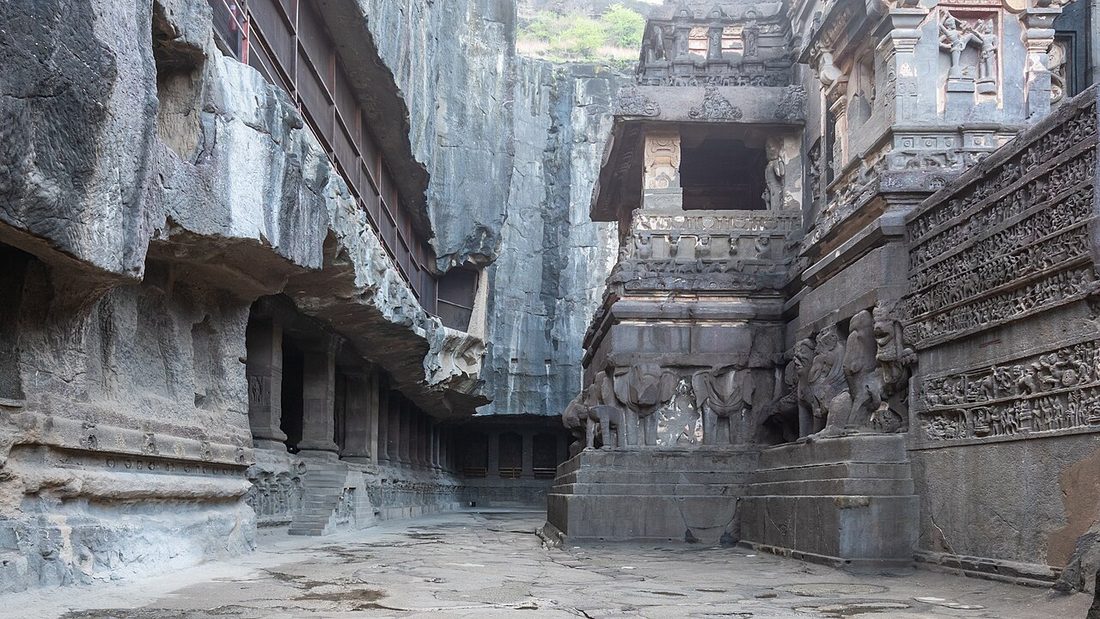
📍 Where It IsChhatrapati Sambhajinagar (Aurangabad) District, Maharashtra, India20.0238°, 75.1792°
🏛️ Mainstream Datec. 756–773 CE (Rashtrakuta King Krishna I, Cave 16 at Ellora)Excavated baseline
🧭 Leading Edge / Open Angle220,000–400,000 tons of solid basalt carved top-down with zero margin for errorDebated or newly revised
🪨 Heaviest Stone & QuarryIn-place monolithic cliff temple (220,000–400,000 tons of basalt removed)Compare all 64 sites →
30-SECOND TAKEAWAY
In Plain English — The 30-Second Takeaway
What It Is:
The Kailasa Temple. (Cave 16 at Ellora) is the largest single-stone rock-cut building on Earth. An entire multi-story temple carved from the top down out of a solid volcanic cliff.
What Everyone Agrees On (Measured Facts):
Masons trenched three deep U-shaped slots into the hillside and removed 220,000 to 400,000 tons of basalt rock to leave a freestanding 32.6-meter-tall temple, bridges. Obelisks.
🏛️ Mainstream Archaeology View:
An 812 CE copper-plate carved text credits the main temple to King Krishna I. (r. 756–773 CE). It has top-down grid-trenching with iron picks.
🧭 Leading Edge View:
Leading Edge writers ask how hand-chisel crews could remove up to 400,000 tons of hard volcanic rock in 18 years with zero room for a structural mistake.
Site Story & Overview
Unlike built temples assembled from quarried blocks, the Kailasa Temple (Cave 16 at Ellora) is a subtractive megastructure: an entire multi-storey Dravidian temple complex—complete with upper and lower halls, pillared verandas, overhanging cornices, flying stone bridges, and 15 m obelisks—carved top-down out of a single living Deccan basalt cliff. Because subtractive carving leaves zero room for error (a broken column cannot be replaced without recutting the surrounding bedrock), the architects had to lay out the three-dimensional elevations of the roof, halls, bridges, and courtyard drains before cutting the lower storeys.
✓ What Is Physically Measured on Site
Dated samples, laser scans, stone weights, and dug finds kept separate from opinion.
Cave 16 (Kailasa) is: the largest single single-stone rock-cut building in the world: workers cut three U-shaped trenches vertically down into the sloping Deccan basalt cliff (85 m deep into the hill × 46 m wide × up to 33 m high), isolating a freestanding central block that was sculpted top-down from the vimana roof finial to the plinth. [1][3]
Volume and mass of removed rock: Given the courtyard trench volume (~85 × 46 × 25 m average depth, minus the standing temple mass), roughly 85,000 to 150,000 m³—or ~220,000 to 400,000 tons—of Cretaceous-Paleogene Deccan trap basalt (density ~2.8–2.9 t/m³, Mohs ~5.5–6.0) was chiseled out of the cliff face. [1][3]
Key finding: The resulting single-stone shrine rises 32.6 m (107 ft) above the courtyard floor and includes a two-storey gateway (gopura), a freestanding Nandi pavilion connected by rock-cut stone bridges, two 15 m single-stone flagstaff pillars (dhvajastambhas), life-size freestanding basalt elephants around the base, and multi-storey base loop galleries carved with the Ramayana and Mahabharata. [1][3]
Key finding: Tool-mark and excavation-rate studies on Deccan basalt caves (Spink 2005; Dhavalikar 1983) show systematic grid-trenching with iron picks and point chisels: isolating small square blocks by cutting base loop grooves and snapping them off along natural horizontal lava flow contacts speeds bulk rock removal compared with pulverizing every cubic centimetre. [2][1]
🏛️ Mainstream Archaeological View
Accepted timeline: 34 rock-cut Buddhist, Hindu, and Jain cave temples dug c. 600–1000 CE. Cave 16 (Kailasa / Kailasanatha Temple) is credited by the Baroda copper-plate carved text (812 CE) primarily to Rashtrakuta ruler Krishna I (r. 756–773 CE), with subsidiary galleries added over the 8th–9th centuries.
Stone & hardness: Cretaceous-Paleogene Deccan Trap amygdaloidal & vesicular basalt — Mohs hardness 5.5–6.0 (Deccan basalt)(on the 1–10 Mohs scale where a steel knife is ~5.5 and diamond is 10).
Quarry distance & alignment: Stone source Carved top-down in situ from the Charanandri basalt cliff (0 km). Orientation: West-facing courtyard entrance along East–West sanctuary axis.
🧭 Leading Edge Proposal & Open Questions
Leading Edge commentators: Question how an estimated 200,000 to 400,000 tons of dense Deccan trap basalt were dug top-down in ~18 years using hand chisels without leaving spoil heaps nearby. Mainstream building historians note that vesicular/amygdaloidal basalt cuts faster than granite, that quarry spoil was reused in local roads/platforms or washed into seasonal streams, and that carving continued across multiple reigns [1][2]
Tested Claims About Ellora Caves and the Kailasa Monolithic Temple (Cave 16)
Did tight stone joints, flat granite boxes, drill cores, and stone vases require advanced machine tools?
Leading Edge
Measured in part: tolerances of about 0.25–0.5 mm (Giza casing) and ±1–2 mm survey precision (Tiwanaku) are documented; copper-and-sand and hammerstone methods are replicated at small scale; how the sharpest interior angles, Petrie's spiral-grooved core and the finest vessels were finished is an open question
Falk, H. (2006). Aśokan Sites and Artefacts: A Source-Book with Bibliography. Mainz: Philipp von Zabern (monograph on the Barabar and Nagarjuni inscriptions and cave dimensions). https://openlibrary.org/works/OL20341815Wdata
BAM (Bâtisseurs de l'Ancien Monde) Acoustic, Contact Profilometry & 3D Laser Metrology Reports on the Barabar and Nagarjuni Caves (2022–2023). Room-scale terrestrial 3D laser scanning (~2.5 mm point-cloud uncertainty), handheld contact surface profilometry (Ra ~0.1–0.3 µm), and acoustic testing (120–160 Hz) of Sudama, Lomas Rishi, Gopika and Vadathika granite chambers. https://bam-investigations.com/categorie-produit/rapports-sur-les-cha…proponent
Yang, Z. F., Yue, Z. Q., Li, L. H. et al. (2010). Design and construction of super-large-span caverns carved in weak pelitic siltstone at Longyou more than 2000 years ago: an engineering geological study. International Journal of Rock Mechanics and Mining Sciences 47. doi:10.1016/j.ijrmms.2005.04.011data
Li, L., Yang, Z., Yue, Z. & Zhang, L. (2009). Engineering geological characteristics, failure modes and long-term stability of the 2000-year-old underground rock caverns at Longyou, China. Tunnelling and Underground Space Technology 24(2): 190–204. doi:10.1016/j.tust.2008.08.003data
Spink, W. M. (2005). Ajanta: History and Development, Vol. 1. Leiden: Brill (comparative Deccan basalt rock-cut excavation rates). doi:10.1163/9789047416647data
FTC affiliate disclosure: Tour links go to GetYourGuide and Viator. Hotel links use Stay22 (aid=solarevidence) for Booking.com and Expedia. If you book a trip, we may earn a small fee at no extra cost to you. All partner links use rel="sponsored nofollow noopener". Check travel alerts before you go. Partner fees never change our ratings. All 64 site field visits · Affiliate disclosure.
The Giza dig leaders share 30 years of finds, from the workers' town and stone quarries to Old Kingdom carbon dates.
▸ Why this book matters to both sides
The Giza dig teams' own large-format overview of decades of fieldwork on the plateau. It records the Heit el-Ghurab workers' town, limestone quarries, ramp remnants, and Old Kingdom carbon dates.
Role in the debate: Provides the primary archaeological and soil-layer baseline at Giza against which older-Sphinx, legacy-foundation, and precision-machining proposals are tested. (ISBN 9780226425696)
After the Ice: A Global Human History, 20,000–5000 BC
Steven Mithen
Follows human life across every continent from the peak of the Ice Age (20,000 BCE) to early farming towns (5000 BCE).
▸ Why this book matters to both sides
A continent-by-continent narrative of human life from the Last Glacial Maximum to 5000 BCE, built directly from excavation reports across the Near East (including Göbekli Tepe), Europe, Asia, and the Americas.
Role in the debate: Provides the archaeological baseline for what human populations were building, hunting, and cultivating before, during, and right after the Younger Dryas. (ISBN 9780674019997)
Lost Technologies of Ancient Egypt: Advanced Engineering in the Temples of the Pharaohs
Christopher Dunn
An engineer measures Egyptian granite boxes, statues, and drill cores with precision gauges to argue for advanced ancient tools.
▸ Why this book matters to both sides
Manufacturing engineer Christopher Dunn applies straightedges, radius gauges, and optical comparators to the Serapeum granite sarcophagi, Luxor Ramses statues, and Petrie's drill cores. It argues for high-speed mechanical tooling.
Role in the debate: Provides the primary Leading Edge metrology claims on Egyptian granite symmetry and flatness, contrasted on our precision pages with test copper-saw, tubular-drill, and pounder replications. (ISBN 9781591431022)
Fingerprints of the Gods: The Evidence of Earth's Lost Civilization
Graham Hancock
Graham Hancock's bestseller arguing that Giza, Pumapunku, and ancient maps preserve traces of a lost Ice Age culture.
▸ Why this book matters to both sides
Hancock's worldwide bestseller examining Tiwanaku, Pumapunku, Teotihuacan, Giza, the Piri Reis map, and Hapgood's crustal-shift model. It argues for an Ice Age culture lost in a global cataclysm.
Role in the debate: The book that brought the lost-Ice-Age-culture idea to millions of readers and framed the modern debate over Giza, Pumapunku, and ancient sky sightlines. (ISBN 9780517887295)
FTC affiliate disclosure: Book links go to Bookshop.org (ID 130218, Search for the Truth). Each sale helps local bookstores and pays us a 10% fee at no extra cost to you. All partner links use rel="sponsored nofollow noopener". Fees never change our verdicts. Affiliate disclosure.
Primary Academic Sources
▸ View All Cited Primary Sources & DOIs (3 papers)
Spink, W. M. (2005). Ajanta: History and Development, Vol. 1. Leiden: Brill (comparative Deccan basalt rock-cut excavation rates). doi:10.1163/9789047416647data